Building a home is perhaps the most significant emotional and financial milestone for any Indian family. As an expert construction consultant and civil engineer with over 15 years of experience, I have seen the landscape of Indian construction change drastically. In 2026, the question I hear most often is whether it is still possible to build a house for ₹5 lakh. My professional answer is a qualified “Yes”—but it requires strategic engineering and meticulous planning.
The reality of construction today is that costs have risen significantly; cement that used to be ₹280 a bag is now hovering around ₹420, and steel has reached nearly ₹90/kg. Understanding the baseline house construction per sq ft rate in your local area is step one. For a ₹5 lakh budget, we are realistically looking at a “no-frills” functional home of approximately 350 to 500 square feet. This is ideal for 1BHK or studio-style layouts on plot sizes like 20×20, 20×30, or typical village plots. While you won’t get luxury finishes or large multi-bedroom villas, you can achieve a safe, permanent, and weather-proof structure that provides dignity for your family.
👉 Dreaming of a Home on a Budget? Get Expert Guidance for Affordable House Designs.
At Construction Estimator India, we believe everyone deserves a solid roof over their head, a philosophy echoed by national initiatives like the Pradhan Mantri Awas Yojana (PMAY). We offer specialized support for those working with tight budgets, including:
- Free construction cost estimation tailored for low-budget homes.
- Free basic house design consultation for small plots.
- Free initial site planning guidance specifically for 5 lakh budget projects.
If you are ready to start your journey, contact us.
WhatsApp/Call: +91 8630676890
Understanding the 5 Lakh Budget
Building under such a tight constraint is an exercise in discipline. You must account for every rupee before the first brick is laid. A ₹5 lakh budget in 2026 translates to a simple, durable home in rural or semi-urban areas where labor and local materials are more affordable.
Cost Breakdown of a Typical 5 Lakh House
To succeed, you must understand where the money goes. Approximately 56% (roughly ₹2.8 lakh) of your budget is reserved for the “skeleton” or structure of the house—foundation, walls, and roof slab. Understanding how to plan home construction in India prevents you from overspending here. Finishing, which includes flooring, paint, and basic fixtures, should take up about 29% (₹1.45 lakh). The remaining funds are split between utilities (7%) and a vital contingency fund (8%) for transport and tools.
Factors That Change the Budget (City vs Village)
Location is the biggest variable. In rural areas, “Mistry” rates are lower, and you might save on permits or water supply. In semi-urban towns, higher labor rates (₹700-₹900/day vs ₹350-₹500 in villages) and municipal approval costs can eat into your material budget. In a village, you might manage a 500 sq. ft. home, whereas in a town, you might only manage 350 sq. ft. for the same ₹5 lakh.
What Size House Is Realistic Under 5 Lakhs?
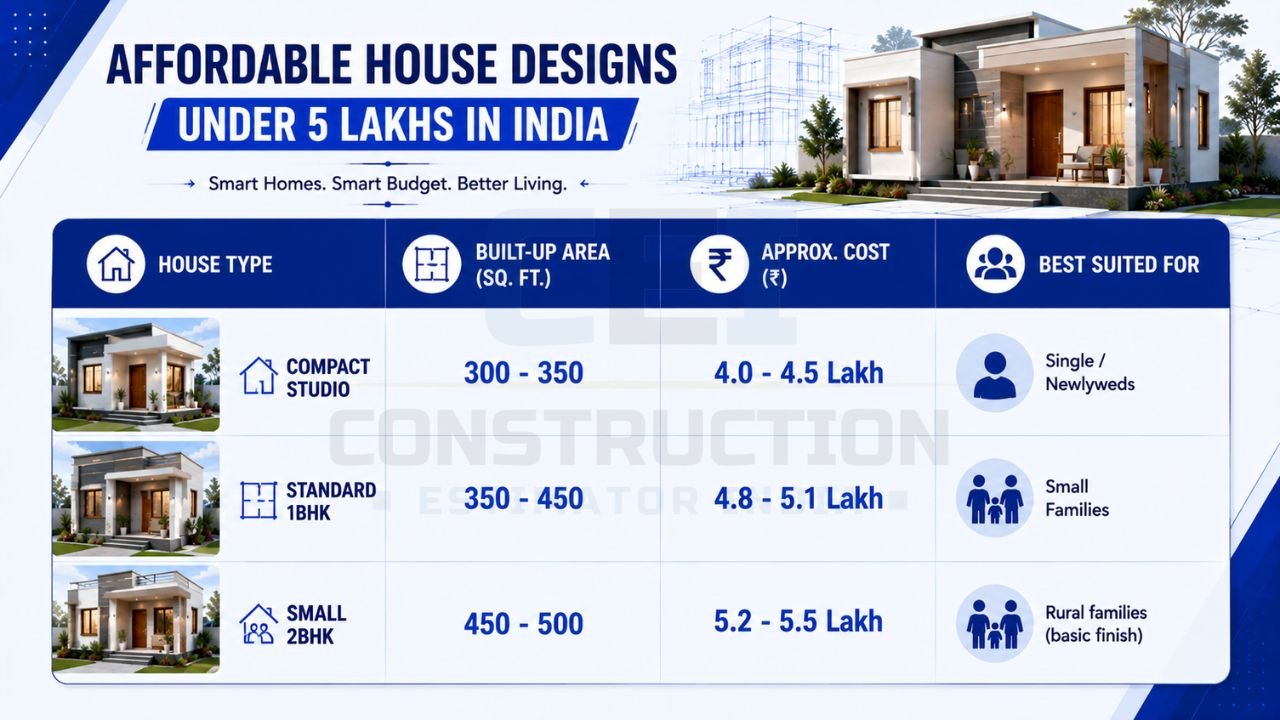
For this budget, aim for a built-up area of 350–450 sq. ft.. This typically allows for a comfortable living room, a kitchen, a bathroom, and one bedroom.
| House Type | Built-up Area (Sq. Ft.) | Approx. Cost (₹) | Best Suited For |
|---|---|---|---|
| Compact Studio | 300 – 350 | 4.0 – 4.5 Lakh | Single/Newlyweds |
| Standard 1BHK | 350 – 450 | 4.8 – 5.1 Lakh | Small Families |
| Small 2BHK | 450 – 500 | 5.2 – 5.5 Lakh | Rural families (basic finish) |
👉 Build a Functional and Beautiful Home Without Exceeding Your Budget.
Planning the Layout for a 5 Lakh House
The design phase is where you save the most money. Construction Estimator India can help you prepare low-cost layout options as per your plot size. WhatsApp/Call: +91 8630676890.
Choose Compact Layout: 1BHK / 2-Room Plan
An efficient layout minimizes the amount of internal wall construction, which saves on bricks, cement, and labor. A 1BHK plan typically includes a 10′ x 10′ bedroom, an 8′ x 10′ kitchen, and a 10′ x 12′ hall. By keeping rooms functional rather than large, you ensure the structure remains within your financial reach.
Use Simple Rectangular Shape
A perfect square or rectangular design is the “Gold Standard” for affordability. It minimizes the length of the external walls—the most expensive part of masonry—and simplifies the roofing process. Avoid complex projections, L-shapes, or decorative balconies, as every corner adds significantly to labor and shuttering costs.
Combine Toilet and Bath to Save Cost
Instead of building separate rooms for bathing and the toilet, combine them into one functional 5′ x 8′ or 4′ x 7′ space. This reduces the number of walls, doors, and plumbing lines required, saving approximately ₹15,000–₹20,000 in material and labor.
Keep Staircase Outside
If you plan to add a first floor in the future, keep the staircase on the outside of the main structure. This keeps the current carpet area focused on living space and prevents the need for a large internal hole in your roof slab, which can be structurally complex and expensive to finish initially.
Foundation & Structure Choices for Low Budget
The foundation is the most critical part of your home; never cut costs here in a way that compromises safety. Following guidelines from the Bureau of Indian Standards (BIS) ensures your core remains strong.
Use Shallow Foundation Where Soil Is Good
For a single-story house on hard soil, a 3-foot deep trench for the foundation is often sufficient. In rural settings, examining different foundation types for house construction in India, like Random Rubble Masonry (RR Masonry) using local stones, reveals they are significantly cheaper than RCC footings while providing excellent stability for small loads. Approximate Cost: ₹75,000 for foundation and plinth.
Avoid Over-Designing Columns & Beams
While learning what is RCC construction is vital, many small houses are over-engineered. For a 400 sq. ft. home, focus on a “Load Bearing Structure” where walls support the roof. This drastically reduces the need for heavy steel and high-grade cement, though you must still include a proper lintel beam over doors and windows for safety.
Use Load Bearing Walls
In villages or for low-rise structures, load-bearing walls (9-inch thick outer walls) are your best friend. Understanding the difference between RCC and brick construction highlights how load-bearing bricks eliminate the cost of multiple columns while providing enough strength for a standard RCC slab. Timeline: 2–3 weeks for foundation and wall structure up to lintel level.
Plan for Future Expansion
Design your foundation today to support a first floor later. This “Future-Expansion” approach allows you to build a high-quality 300–400 sq. ft. core now and grow as your savings increase. It is a much smarter strategy than building a large, half-finished shell.
Low-Cost Wall Materials and Techniques
Walls account for about 20% of your total construction cost.
Burnt Brick vs Fly Ash Brick vs Concrete Blocks
Standard red bricks are common, but I highly recommend Fly Ash Bricks or AAC (Autoclaved Aerated Concrete) blocks. They are larger, more uniform, and require less mortar for joining, which saves on cement. AAC blocks also provide better thermal insulation, keeping your home cooler in summer.
Cost Range: ₹5–₹8 per brick/block depending on local availability.
Use 4.5″ Internal Walls Where Possible
Use 9-inch thick walls for your exterior for safety and insulation, but use 4.5-inch partition walls for the interior. This saves space—vital in a 400 sq. ft. home—and reduces material usage by 50% for those specific walls.
Reduce Unnecessary Internal Walls
Embrace the “Great Room” concept where the hall and kitchen are integrated into one open space. This eliminates an entire wall, saving on bricks, plaster, and paint while making the small house feel much more spacious.
Use Proper Curing and Jointing
Saving money isn’t just about the purchase price; it’s about avoiding repairs. Proper curing of walls (sprinkling water for at least 7–10 days) prevents future cracks. Knowing which grade cement is best for plastering in India ensures a cleaner finish and less cement wastage.
Affordable Roofing Options Under 5 Lakhs
The roof is often the single most expensive component after the foundation.
RCC Slab for Long-Term Durability
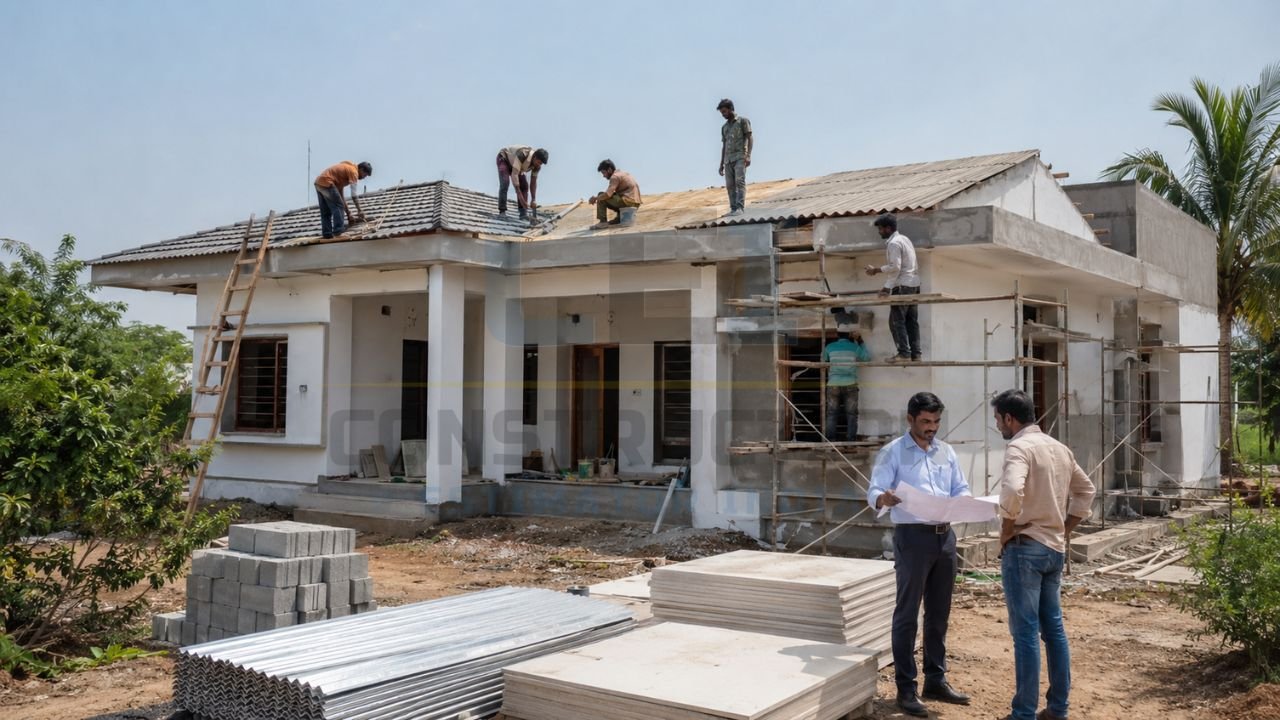
An RCC slab (typically 4.5 inches thick) is the gold standard for Indian weather. It is durable and allows for future expansion. Utilizing brands like UltraTech Cement can guarantee longevity. Approximate Cost: ₹75,000 to ₹95,000 for a 400–450 sq. ft. house.
Cost-Saving Options: Mangalore Tiles or GI Sheets
If the budget is extremely tight, consider high-quality GI (Galvanized Iron) or ACC sheets. While these are much cheaper (₹40–₹60 per sq. ft.), they can be hot and noisy. Adding a simple false ceiling for insulation can help, though it may impact long-term resale value.
Hybrid Approach
Use an RCC slab for the main living area and kitchen to ensure safety and durability, but use a cheaper Mangalore tile or sheet roof for the verandah or utility area. This balances cost and quality.
Provide Basic Waterproofing
Never skip waterproofing. Applying a simple waterproofing compound to your roof slab costs very little during construction but saves thousands in repair costs from leaks later. Implementing techniques like learning how to use white cement for waterproofing in India can be a highly cost-effective barrier. Cost: ~₹2,000–₹5,000 for basic additives.
👉 Turn Your Dream of Homeownership into Reality with Cost-Effective Design Solutions.
Budget-Friendly Flooring, Doors & Windows
Finishing is where most people lose control of their budget.
Low-Cost Flooring Options
Standard 2×2 ceramic tiles are affordable and durable. However, for maximum savings, a smooth IPS (Indian Patent Stone) floor or red oxide finish is excellent, costing as little as ₹35 per sq. ft. compared to ₹80+ for tiles.
Material Option: Kota stone is another durable, low-cost local option in many parts of India.
Simple, Strong Doors
Avoid expensive teak or designer doors. Use basic flush doors with local hardwood frames for the interior. A standard PVC door is perfect for the bathroom as it is water-resistant and very cheap.
Approximate Cost: ₹3,500 per door unit.
Use Fewer, Well-Planned Windows
Windows are expensive because of the frames and glass. Instead of many small windows, use fewer, larger ones (standard 4′ x 4′) placed strategically to maximize cross-ventilation and natural light. This keeps the house bright without the high cost of multiple frames.
Reuse / Refurbish Old Materials
If you are planning an update via house renovation or have access to a second-hand market, refurbishing old wooden doors or window frames can save you 50% on these items. Just ensure the wood is treated for termites before installation.
Smart Finishes: Paint, Plaster & Interiors on a Budget
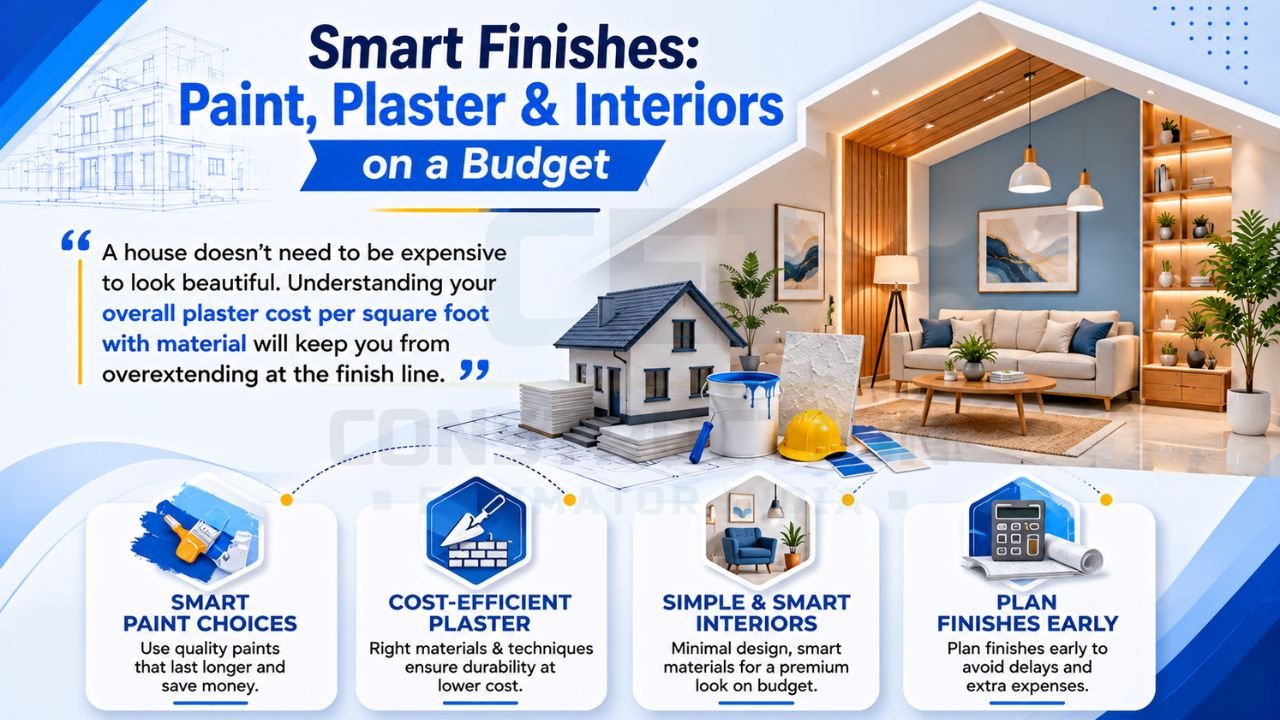
A house doesn’t need to be expensive to look beautiful. Understanding your overall plaster cost per square foot with material will keep you from overextending at the finish line.
Basic Cement Plaster with Putty
Apply a single coat of plaster on the outside and a smooth finish inside. You only need putty in the main living room and bedroom to give a smooth look; other areas can be finished with a simple white-wash to save costs initially.
Use Economical Exterior Paint
Invest in a decent exterior paint for the front elevation to give the house curb appeal. For the sides and back, use basic cement-based paint which is much more economical and still protects the structure.
Minimal False Ceiling
In a small house with an RCC roof, a false ceiling is often unnecessary unless you are trying to hide electrical conduits. Skipping this can save you ₹15,000–₹25,000.
Basic Kitchen Platform
Instead of an expensive modular kitchen, build a simple concrete platform topped with polished Kota stone or a basic granite slab. Use open shelving initially; you can add wooden or laminate shutters later as your budget allows.
👉 Get Professional Advice on Affordable House Planning and Construction.
Cost-Saving Tips Without Compromising Safety
Smart planning is more important than a big budget. Construction Estimator India can prepare a detailed material list for your project. WhatsApp/Call: +91 8630676890.
Save in Finishes, NOT in Structure
You can change your paint or tiles five years from now, but you cannot easily fix a weak foundation or a leaking roof. Never compromise on the grade of cement for the slab or the quantity of steel in the lintels.
Buy Materials in Bulk
Negotiate with a single dealer for all your cement (approx. 180–220 bags) and steel (1.2–1.5 tons). Buying in bulk can often save you 5–10% on the total material cost.
Use Local Material and Labour
Transporting “fancy” materials from the city will kill your budget. Use local bricks, sand (or M-Sand), and stones. Hiring a local “Mistry” who understands the local climate and soil is often better than hiring an outside contractor.
Plan Work in Continuous Phases
Avoid long gaps in construction. Once you start the foundation, try to reach the slab level without stopping. Idle time often leads to material theft, weather damage, and rising labor costs.
Sample 5 Lakh Budget House Scenarios
Example 1: 400 sq. ft. Village House
This is the most realistic high-quality option.
- Layout: 1 Bedroom (10’x10′), Hall (10’x12′), Kitchen (8’x10′), and Bathroom.
- Structure: Load-bearing walls with RR Masonry foundation.
- Finishes: IPS flooring, white-wash walls, PVC bathroom door.
- Estimated Cost: ₹4.5 to ₹4.8 Lakhs.
Example 2: 450 sq. ft. Semi-Urban 1BHK
- Layout: Similar to above but with slightly larger rooms or a small verandah.
- Structure: RCC frame (limited columns) for better durability in crowded areas.
- Finishes: Basic ceramic tiles, single coat of interior putty.
- Estimated Cost: ₹4.9 to ₹5.2 Lakhs.
When to Contact Construction Estimator India
If you have a plot and a ₹4–5 lakh budget, don’t start without a plan. 60% of homeowners fail because they start without a clear budget, running out of money at the roof level. We are here to ensure you finish your home.
Contact us if you need:
- A detailed BOQ (Bill of Quantities) to know exactly how much cement and steel to buy.
- 2–3 low-budget layout options tailored to your specific plot.
- Verification of your local material rates.
Free construction cost estimation | Free basic house design discussion
WhatsApp/Call: +91 8630676890
FAQs: 5 Lakh Budget House in India
Can I build a full 2BHK house under 5 lakhs?
It is possible but very challenging. You would have to use very small room sizes (roughly 9’x9′) and extremely basic finishes. It is usually better to build a high-quality 1BHK that is comfortable rather than a cramped 2BHK.
How many square feet can I build in 5 lakhs?
Realistically, you can build between 350 and 500 square feet. The upper limit of 500 sq. ft. is usually only achievable in rural areas with self-supervision and local materials.
Is an RCC roof possible in a 5 lakh budget?
Yes, it is included in our standard breakdown. An RCC slab for a 400 sq. ft. house typically costs around ₹75,000–₹95,000.
What is the cheapest flooring for a small house?
The most affordable options are IPS (cement) flooring or red oxide finish. These are durable and look traditional. Ceramic tiles are the next most affordable option.
How can I reduce construction cost without reducing quality?
Self-supervision is the best way. By managing the labor and buying materials yourself, you can save the 15–20% “contractor profit”. Also, avoid any decorative elements that don’t add to the strength of the house.
How do I contact Construction Estimator India for a plan?
You can reach us directly for a free initial consultation.
WhatsApp/Call: +91 8630676890
Conclusion: Make the Most of Your 5 Lakh Budget
Building a home with ₹5 lakhs in India is a challenge of discipline and smart engineering. It requires you to prioritize structural integrity over flashy trends. By choosing a compact layout, a simple rectangular shape, and local materials, you can provide your family with a safe, dignified home without falling into debt.
Remember, a well-built small house that is finished is infinitely better than a large, half-finished structure that you cannot live in. Plan carefully, supervise the work, and stick to your budget.
If you are planning an affordable house design under 5 lakhs in India, Construction Estimator India is here to help with free cost estimation and design guidance.
WhatsApp/Call: +91 8630676890.