
Choosing the right sand is one of the most important decisions in any construction project. Sand directly affects concrete strength, plaster quality, brickwork durability, and overall structural performance. Homeowners, builders, contractors, civil engineers, property developers, and anyone planning house construction or renovation in India often face the question: River Sand vs M Sand — Which Is Better for Construction? River sand is naturally sourced from riverbeds, while M Sand (manufactured sand) is produced by crushing rocks in controlled factory conditions. Both have advantages and limitations, but environmental concerns, government regulations, and consistent quality are driving a major shift toward M Sand across India.
👉 Confused Between River Sand & M Sand? – 📲 Contact Our Experts Today
This detailed comparison guide examines River Sand vs M Sand across quality, strength, cost, environmental impact, suitability for different applications (concrete, plaster, brickwork, flooring), government regulations, and which sand is better for specific tasks. Whether you are building a home, villa, commercial project, or renovation, understanding these differences will help you make an informed, cost-effective, and sustainable choice.
What Is River Sand?
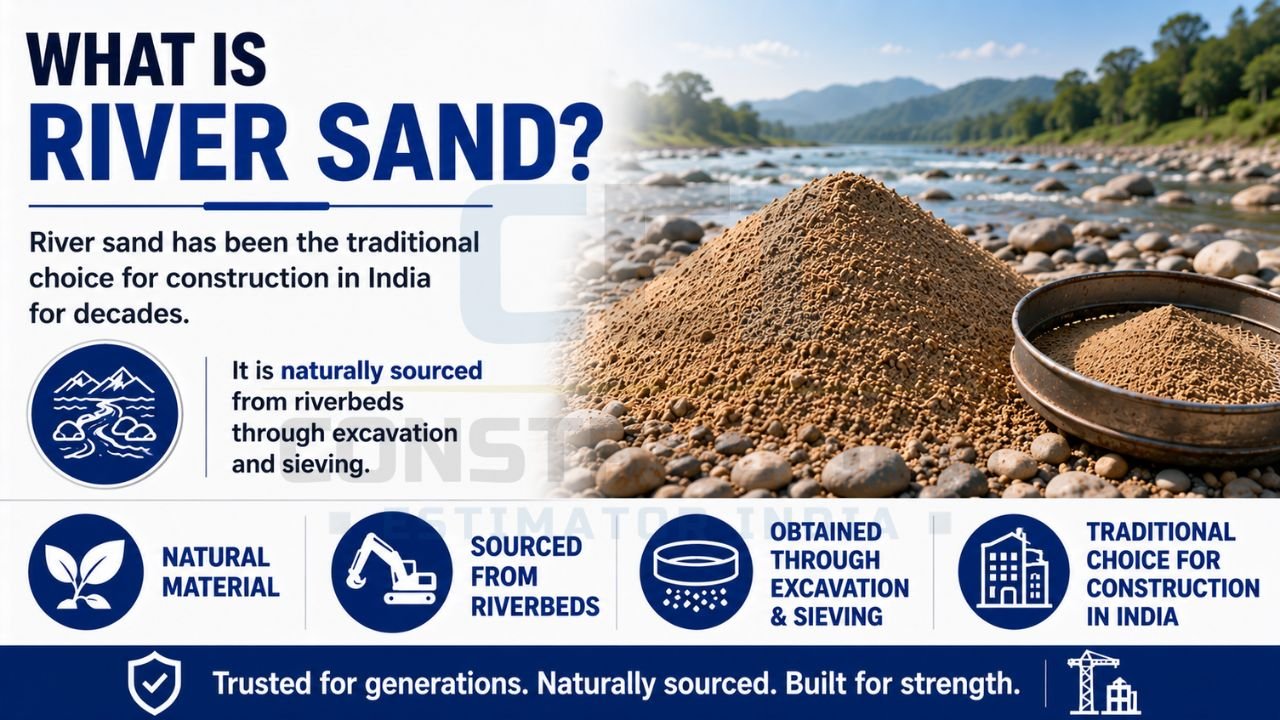
River sand has been the traditional choice for construction in India for decades. It is naturally sourced from riverbeds through excavation and sieving.
👉 Confused Between River Sand & M Sand? – 📲 Contact Our Experts Today
How River Sand Is Sourced?
River sand is collected from riverbeds, where continuous water flow naturally rounds and smooths the particles. It is available in different grades — fine, medium, and coarse — making it versatile for various applications. However, excessive mining has led to severe environmental damage, river erosion, groundwater depletion, and ecological imbalance. Many states in India, including Tamil Nadu, Kerala, Karnataka, Andhra Pradesh, and Telangana, have imposed bans or strict restrictions on river sand mining. This scarcity has driven up prices and made river sand less reliable and more expensive in many regions.
What Is M Sand (Manufactured Sand)?
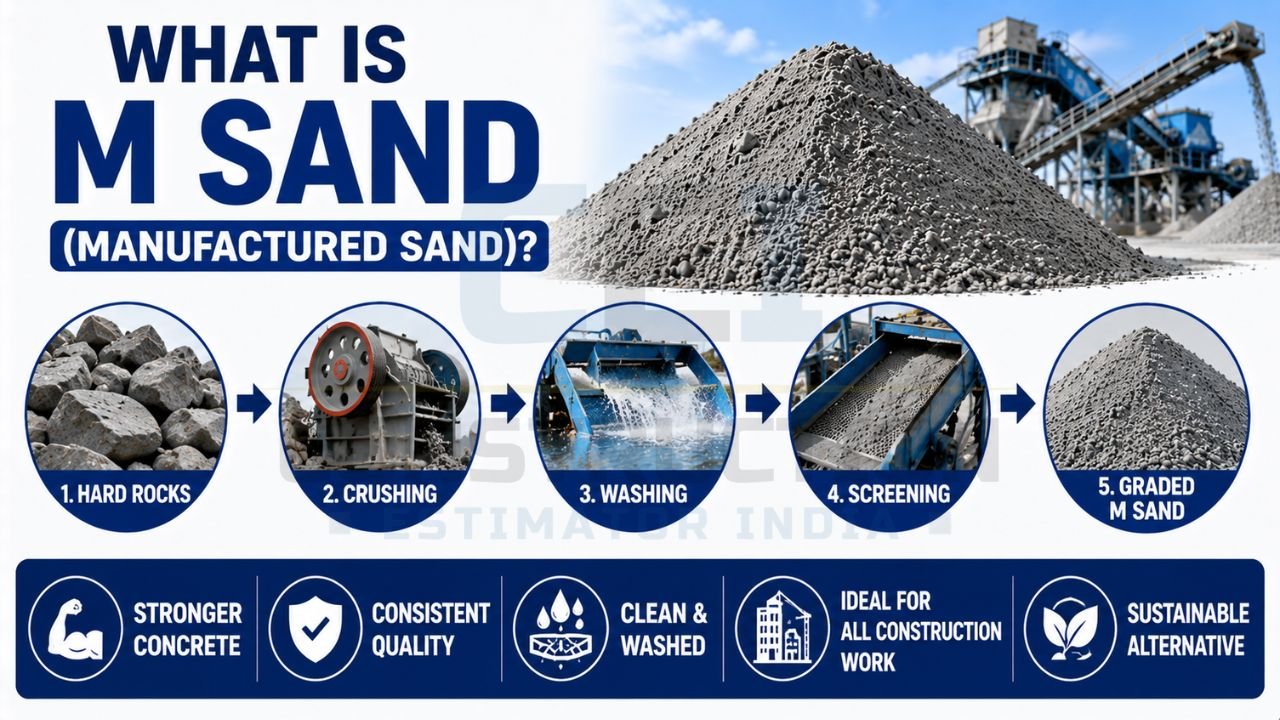
M Sand, also known as manufactured sand or crushed sand, is produced by crushing hard rocks (granite, basalt, or other stones) in stone crushing plants. It is then washed, screened, and graded to meet construction standards.
👉 Choose the Right Sand for Stronger & Safer Construction – 📲 WhatsApp Now
How M Sand Is Produced?
The production process involves crushing rocks into smaller particles, removing dust and impurities through washing and screening, and grading the sand to achieve consistent particle size. Modern M Sand plants use Vertical Shaft Impactors (VSI) to create cubical and angular particles that provide better bonding with cement compared to rounded river sand particles. Quality M Sand is tested for silt content, specific gravity, and fineness modulus to ensure it meets IS 383 standards for construction sand.
River Sand vs M Sand — Key Differences
Here is a clear comparison table for quick understanding:
| Feature | River Sand | M Sand (Manufactured Sand) |
| Source | Natural riverbeds | Crushed rock in factories |
| Particle Shape | Smooth, rounded | Angular, cubical, rough |
| Grain Size & Consistency | Variable, often inconsistent | Consistent and controlled |
| Impurities | Clay, silt, organic matter | Minimal, well-washed |
| Compressive Strength | Good | Better due to angular shape |
| Cost (per brass) | Higher (₹4,000–₹7,000) | Lower (₹2,500–₹4,500) |
| Environmental Impact | High (river erosion, bans) | Low (uses quarry waste) |
| Availability | Limited due to bans | Abundant and consistent |
| Suitability for Plaster | Excellent (smooth finish) | Good (with proper grading) |
| Suitability for Concrete | Good | Excellent (better bonding) |
Strength and Durability: River Sand vs M Sand
M Sand generally provides better compressive strength in concrete due to its angular particles, which create stronger mechanical interlocking and better bonding with cement. River sand’s rounded particles can lead to weaker bonding and higher cement consumption for the same strength. In long-term construction, M Sand’s consistent quality reduces voids, improves density, and enhances durability against weathering, cracking, and water seepage. For RCC work, slabs, beams, and columns in India, M Sand is increasingly preferred by structural engineers for its superior performance.
👉 Need Expert Material Selection & Cost Planning? – 📲 Start Chat Today
Cost Comparison: River Sand vs M Sand
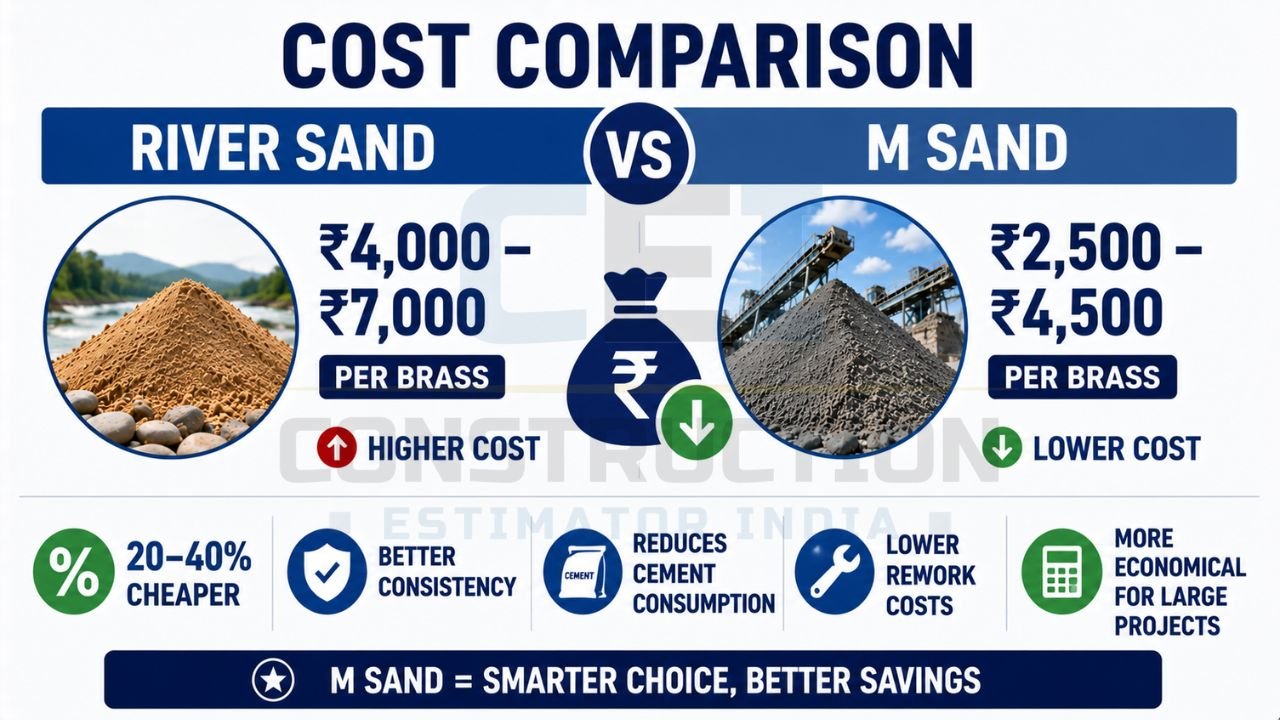
River sand has become significantly more expensive due to scarcity, transportation costs, and environmental bans. In many parts of India, it costs ₹4,000–₹7,000 per brass, while quality M Sand is available for ₹2,500–₹4,500 per brass. M Sand is often 20–40% cheaper and offers better consistency, reducing overall cement consumption and rework costs. When you consider material estimation and quantity takeoff, M Sand proves more economical for large projects.
👉 Get Professional Guidance on River Sand vs M Sand – 📲 Message Us Now
For accurate cost planning: What is Estimation in Construction.
Environmental Impact: River Sand vs M Sand
River sand mining causes severe environmental damage — river erosion, damage to aquatic life, groundwater depletion, and flooding risks. Many states have banned or heavily regulated river sand extraction. M Sand is a sustainable alternative that uses quarry waste and crushed rock, reducing environmental impact and supporting circular economy principles. Government policies across India are actively promoting M Sand as the future of construction sand.
Suitability for Different Construction Tasks
Concrete and RCC Work
M Sand is better for concrete and RCC work due to higher compressive strength, better bonding, and reduced voids. It is the preferred choice for slabs, beams, columns, and foundations in modern construction.
Plaster Work
River sand has traditionally been preferred for smooth plaster finishes due to its rounded particles. However, fine-grade M Sand with proper mixing and admixtures works equally well and is widely used today.
For plaster guidance: Which Cement is Best for Plaster Work.
Brickwork and Masonry
Both sands work well for brickwork. M Sand offers better consistency and strength in mortar.
Flooring and Tiling
Fine M Sand is suitable for flooring mortar and tiling work due to its uniform grading.
👉 Better Materials Mean Better Construction Results – 📲 Contact Us Now
Roof Slab Construction
M Sand is preferred for roof slab concrete due to higher strength and durability.
For roof slab guidance: Best Cement for Roof Slab in India.
Quality and Consistency: River Sand vs M Sand
River sand quality varies significantly depending on the source, often containing clay, silt, and organic impurities that weaken concrete. M Sand offers consistent grading, controlled particle size, and minimal impurities, making it more reliable for modern construction estimation and quantity takeoff.
For quantity takeoff guidance: What is Quantity Takeoff in Construction.
Government Regulations and Bans on River Sand
Many states in India have banned or restricted river sand mining due to environmental concerns. Tamil Nadu, Kerala, Karnataka, Andhra Pradesh, and Telangana have strict regulations. The Government of India and state governments are actively promoting M Sand as the sustainable alternative. Building codes and local authorities increasingly accept M Sand for all construction applications, including concrete, plaster, and brickwork.
Which Sand Is Best for Construction in India?
For most applications in India, M Sand is the better choice. It offers superior strength, consistent quality, lower cost, and environmental sustainability. River sand may still be preferred for smooth plaster work in some traditional projects, but fine-grade M Sand with proper admixtures works equally well. For concrete, RCC, and structural work, M Sand is clearly superior.
For a complete sand selection guide: Which Sand is Best for Construction.
👉 Better Materials Mean Better Construction Results – 📲 Contact Us Now
Cement Compatibility: River Sand vs M Sand
M Sand’s angular particles bond better with cement, improving compressive strength and reducing cement consumption. This compatibility makes M Sand more efficient when paired with quality cement.
For cement selection: Which Cement is Best for House Construction in India.
Common Mistakes When Choosing Sand for Construction
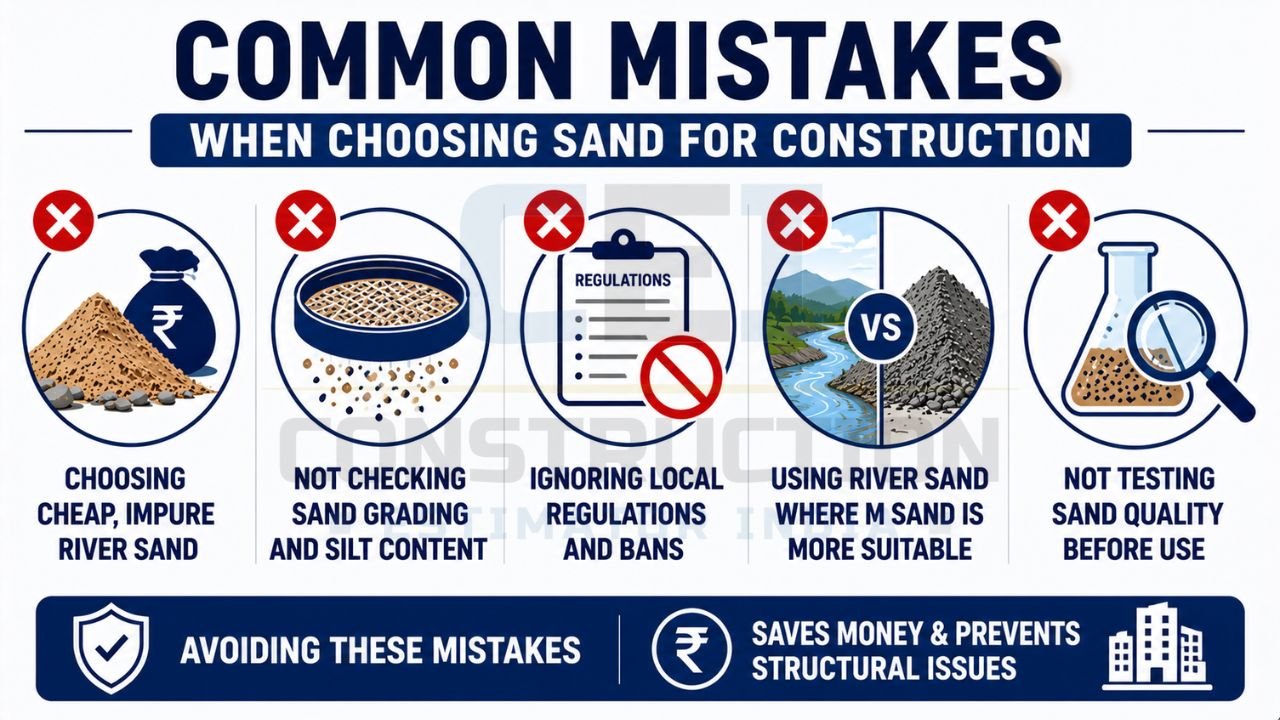
Homeowners often make these mistakes:
👉 Get Accurate BOQ, Quantity Takeoff & Material Estimates – 📲 Chat With Us Now
- Choosing cheap, impure river sand.
- Not checking sand grading and silt content.
- Ignoring local regulations and bans.
- Using river sand where M Sand is more suitable.
- Not testing sand quality before use.
Avoiding these mistakes saves money and prevents structural issues.
For common expensive mistakes: 7 Common Expensive Mistakes in House Construction in India.
Why Construction Projects Fail: Sand Quality Matters?
Poor sand selection contributes to project failure through weak concrete, cracks in plaster, structural durability issues, and increased rework costs. Proper sand choice, combined with quality cement and professional estimation, ensures durable and cost-effective construction.
For reasons why projects fail: 5 Reasons Why Construction Projects Fail in India.
Why Construction Estimator India?
Construction Estimator India is a trusted advisor for construction material selection and cost planning. We provide expert guidance on sand selection, transparent cost estimates, material quality verification, professional estimation and quantity takeoff, and end-to-end construction support to help you build stronger, more economical, and sustainable projects in India.
Conclusion
River Sand vs M Sand — Which Is Better for Construction ultimately depends on your specific application, but M Sand is increasingly the better choice for most construction tasks in India. It offers superior strength, consistent quality, lower cost, and environmental sustainability while river sand faces scarcity and regulatory restrictions. Proper sand selection, combined with quality cement and professional estimation, ensures durable, cost-effective, and safe construction projects across India.
Are you unsure whether to use River Sand or M Sand for your house construction, renovation, or commercial project in India? As a trusted construction cost planning and material selection partner, Construction Estimator India helps homeowners and builders choose the right sand, cement, and materials for strength, durability, and cost efficiency. From material guidance to detailed estimation and quantity takeoff, we provide end-to-end solutions to protect your investment.
Contact us today for a free consultation and detailed construction material & cost plan!
📞 Call / WhatsApp: +91 8630676890
🌐 Visit Us: Construction Estimator India
📍 Serving: Across India – Dehradun, Roorkee, Haridwar, Rishikesh, Delhi, Mumbai, Bangalore, and more
FAQ Section
Is M Sand better than River Sand for concrete?
Yes. M Sand provides better compressive strength, better bonding with cement, and consistent quality for concrete and RCC work.
Can M Sand be used for plaster work?
Yes. Fine-grade M Sand works very well for plaster with proper mixing and admixtures. Many builders now prefer it over river sand.
Why is River Sand being banned in many states?
Excessive river sand mining causes river erosion, damage to aquatic life, groundwater depletion, and flooding risks. Many states have banned or restricted it to protect the environment.
Which sand is more cost-effective: River Sand or M Sand?
M Sand is generally 20–40% cheaper and offers better consistency, making it more cost-effective for most construction applications.
Does M Sand affect cement performance?
M Sand’s angular particles bond better with cement, often improving strength and reducing cement consumption compared to rounded river sand.
Is River Sand still available in India?
Availability is limited due to bans and restrictions in many states. Where available, it is significantly more expensive and often of inconsistent quality.
What grading of M Sand is best for plaster?
Fine-grade M Sand (Zone II or Zone III) with low silt content is ideal for plaster work. Proper grading ensures smooth finish and good bonding.