Everywhere in North India you hear the same complaints after 1–2 years of painting: hairline cracks in plaster, hollow “phus-phus” sound when you tap the wall, damp patches, and paint peeling in bubbles. In most cases, the main culprit is not sand or painter – it is the wrong cement grade used for plaster and poor mix/curing.
Why Cement Grade Matters So Much for Plaster Quality & Durability?
Plaster is a thin protective skin on your brick/block or concrete wall, so it must bond strongly, shrink less, and resist water and weather for 15–20 years. The cement type and grade directly control heat of hydration, shrinkage, workability, and long-term durability of that thin layer.
Key reasons cement choice is critical for plaster:
- Heat & shrinkage: High-heat cements (like OPC 53) shrink more while setting, creating hairline cracks and map cracking under paint.
- Workability: Finer, blended cements like PPC/PSC give a creamy mix that spreads easily, fills pores, and reduces voids and hollowness.
- Bonding: Pozzolana/slag in PPC/PSC/Composite reacts with free lime and improves bonding with brick, AAC block, and old concrete.
- Water resistance: Dense microstructure of PSC and special water-repellent PPC variants cuts seepage and dampness in exterior walls.
- Paint finish: Smooth, low-shrinkage plaster supports putty and paint without micro-cracks or flaking.
Simple rule: For plaster, we prefer cooler, slower, low-shrinkage cements (PPC/PSC/Composite), not “very fast/very hot” OPC 53 meant for high-early-strength RCC.
Which Cement Grade Is Best for Plastering in India?
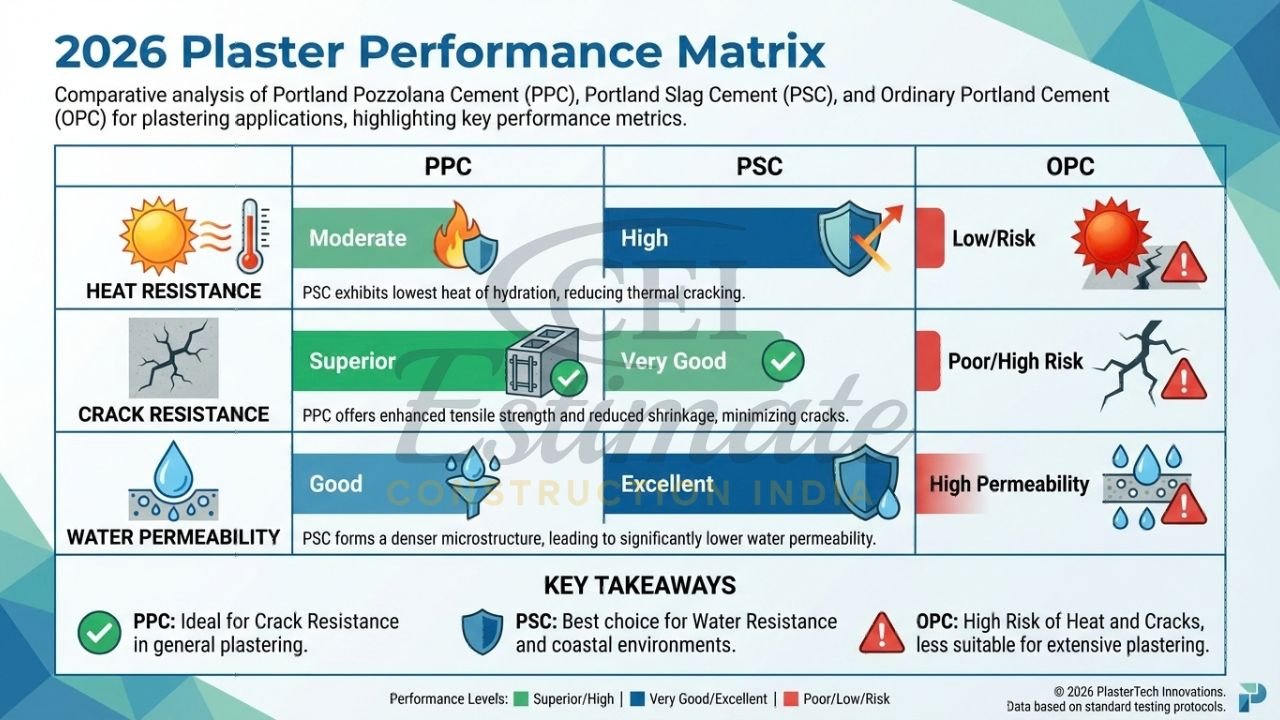
For 2026, most experts and site experience clearly favour PPC and PSC over OPC for plaster work in Indian climatic conditions. Let’s break it down grade-wise.
OPC 43 Grade – Acceptable but Not Ideal
- Characteristics: Moderate heat of hydration, reasonable strength gain, widely available.
- For plaster:
- Pros: Easily available, familiar to local masons, okay for basic interior plaster in non-critical rooms.
- Cons: Higher shrinkage and heat than PPC/PSC → more risk of hairline cracks, especially in hot/dry climates and thick coats.
Use OPC 43 only when PPC/PSC is not available, and ensure very good curing.
OPC 53 Grade – Generally NOT Recommended for Plaster
- Characteristics: High early strength, very high heat of hydration, fast setting.
- For plaster:
- Sets quickly, so masons get less time to level and finish, leading to uneven surface and cold joints.
- High heat and shrinkage create micro cracking and crazing visible after putty and paint.
OPC 53 should be avoided for plaster in most houses; it is better suited to RCC where fast strength is needed and curing can be strictly controlled.
PPC (Portland Pozzolana Cement) – No. 1 Choice for Plaster
- What it is: OPC clinker blended with fly ash (pozzolana) for improved durability and lower heat.
- Why it’s best for plaster:
- Very good workability – finer particles give a creamy, cohesive mix that finishes smooth.
- Lowest shrinkage among common cements, so fewer hairline cracks.
- Excellent bonding with brick/block and old concrete surfaces.
- Better long-term durability and resistance to moisture than plain OPC.
For 80–90% of interior and moderate exterior plaster in India, PPC is the first choice.
PSC (Portland Slag Cement) – Best for Exterior & Coastal/High-Humidity Zones
- What it is: OPC clinker blended with granulated blast furnace slag.
- Why it shines in exterior plaster:
- Very low permeability and dense microstructure – less water seepage and dampness.
- Superior sulfate and chloride resistance – ideal for coastal, high-salinity groundwater, and sulfate soils.
- Low heat & shrinkage – excellent crack resistance in sun-exposed external walls.
For exterior walls in coastal, high-rainfall, or aggressive soil conditions, PSC is often the safest long-term option.
Composite Cement (IS 16415) – Strong Emerging All-Rounder
- What it is: Blended cement with a combination of fly ash and slag along with clinker as per IS 16415.
- Benefits:
- Balanced properties of PPC and PSC – good workability, low heat, and better durability than plain OPC.
- Often priced competitively, making it attractive in semi-urban/rural markets.
Where good quality PPC/PSC is not easily available, Composite cement (IS 16415) is a solid, plaster-friendly alternative.
Simple Cement Grade Comparison for Plaster
Table: Cement Grades vs Plaster Performance (India 2026)
| Grade / Type | Best For Plaster | Shrinkage / Crack Risk | Workability | Sulfate / Chloride Resistance | Approx Price 2026 (50 kg) | Recommended Use |
| OPC 43 | Basic interior plaster, non-critical areas | Medium – more than PPC/PSC | Medium – workable but not creamy | Low–medium | ₹380–₹430 in most markets | Use only if PPC/PSC not available; ensure good curing |
| OPC 53 | Generally avoid for plaster | High – fast set and high heat | Fair – stiff, short finishing time | Medium | ₹400–₹450 | Reserve for RCC only; not for wall plaster |
| PPC | Interior & most exterior plaster | Low – best crack resistance | Excellent – smooth, creamy mix | Medium–high, better than OPC | ₹390–₹460 for branded PPC | First choice for all interior and moderate exterior walls |
| PSC | Exterior, coastal, humid, sulfate soil areas | Very low – very stable plaster | Very good – slightly slower set | Very high – best sulfate/chloride resistance | ₹390–₹480 depending on region | Best for external walls, coastal belts, high groundwater and aggressive soils |
| Composite (IS 16415) | General all-round plaster use | Low–medium – better than OPC | Good to very good | Medium–high | ₹380–₹450 | Good alternative when PPC/PSC not available or cost-sensitive |
Clear recommendations:
- Interior plaster → PPC in almost all cases.
- Exterior plaster → PSC or water-repellent PPC (premium hydrophobic variants).
- Very high exposure / coastal / sulfate soil → PSC only for plaster.
- Avoid OPC 53 for plaster unless there is a very specific fast-track requirement and curing is perfectly controlled.
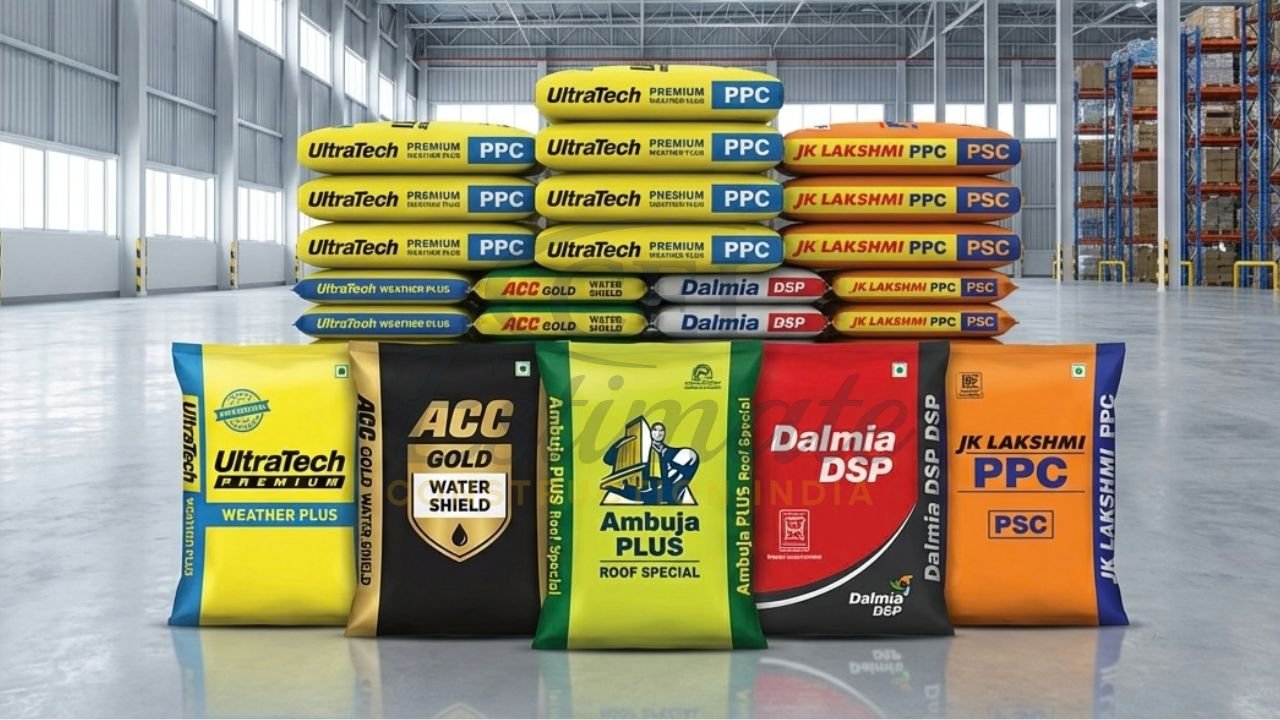
Top 10 Best Cement Brands / Variants for Plaster Work in India 2026
Prices vary by state, distance from plant and dealer margin, but 2026 branded cement for plaster generally falls between ₹380–₹520 per 50 kg bag in North and Central India.
1. UltraTech PPC / UltraTech Premium (water-repellent)
- Type & best use:
- UltraTech PPC – standard PPC for interior and exterior plaster in most climates.
- UltraTech Premium / Weather Plus – hydrophobic, water-repellent grade ideal for exterior walls and terraces.
- Price band (2026): Typically ₹420–₹500 per bag depending on variant and city.
- Regional strength: Very strong presence in Delhi NCR, UP, Rajasthan, MP, Bihar through dealer networks.
- Mason feedback:
- PPC variant gives very smooth plaster, easy trowelling, and fewer cracks when cured properly.
- Premium hydrophobic variant shows less dampness and paint blistering on exterior walls.
2. ACC Gold Water Shield / ACC PPC
- Type & best use:
- ACC PPC – reliable PPC for interior and general exterior plaster.
- ACC Gold Water Shield – premium water-repellent cement for exterior walls and roofs.
- Price band: Around ₹410–₹500 per bag depending on state and dealer.
- Regional strength: Strong in UP, Uttarakhand, Bihar, Punjab, Haryana and parts of MP.
- Mason feedback:
- Good workability and consistent quality, plaster feels dense and less “powdery”.
- Water Shield variant is appreciated where seepage and damp patches were earlier a problem.
3. Ambuja Plus Roof Special / Ambuja PPC
- Type & best use:
- Ambuja PPC – standard PPC for smooth internal plaster.
- Ambuja Plus Roof Special – premium, water-resistant cement for exterior and roof areas.
- Price band: Usually ₹410–₹500 per bag for PPC and premium product.
- Regional strength: Strong in Delhi NCR, Rajasthan, Punjab, Haryana, parts of UP.
- Mason feedback:
- Fine particle size gives a very neat finish with less effort.
- Exterior performance is good in high rainfall areas with reduced paint peeling.
4. JK Lakshmi PPC / JK Super PSC
- Type & best use:
- JK Lakshmi PPC – ideal for interior plaster and moderate exterior.
- JK Super PSC – PSC cement best suited for exterior, coastal, and sulfate-prone areas.
- Price band: Roughly ₹390–₹470 per bag.
- Regional strength: Good presence in Rajasthan, Gujarat, Delhi NCR, Western UP.
- Mason feedback:
- PPC version spreads easily and sticks well to brick and block.
- PSC version is preferred in exterior plasters exposed to aggressive weather.
5. Dalmia DSP Cement / Dalmia PSC
- Type & best use:
- Dalmia DSP (PPC / Composite) – positioned as durable, crack-resistant, suitable for fine plaster.
- Dalmia PSC – strong option for coastal and high-humidity zones.
- Price band: Around ₹390–₹480 per bag depending on region.
- Regional strength: Stronger in Eastern UP, Bihar, Jharkhand, East India; expanding in North India.
- Mason feedback:
- Plaster feels dense and less prone to hairline cracking when curing is done properly.
- PSC variant is respected near coastal and riverine belts with aggressive water.
6. Wonder PPC / Wonder PSC
- Type & best use:
- Wonder PPC – popular in Rajasthan and nearby regions for interior plaster.
- Wonder PSC – better for exterior and damp-prone areas.
- Price band: Typically ₹380–₹450 per bag, often slightly more economical than top 3 national brands.
- Regional strength: Strong in Rajasthan, Gujarat, parts of MP.
- Mason feedback:
- Good value-for-money plaster finish, easy availability.
- PSC used where owners worry about dampness and sulfate-rich soil.
7. Shree / Bangur PPC / PSC
- Type & best use:
- Shree / Bangur PPC – interior and general exterior plaster.
- Shree / Bangur PSC – suitable for exterior walls and aggressive exposure.
- Price band: About ₹380–₹460 per bag depending on sub-brand and location.
- Regional strength: Good distribution in Rajasthan, Haryana, Punjab, Delhi NCR, UP.
- Mason feedback:
- Stable quality, plaster shows less shrinkage when proper curing is done.
8. HeidelbergCement – Mycem PSC, Penna PSC
- Type & best use:
- Mycem PSC / Penna PSC – PSC cements meant for long life and high durability, very suitable for exterior walls, basements and humid zones.
- Price band: Around ₹400–₹480 per bag in most accessible markets.
- Regional strength: Presence in Central India (MP), parts of UP, Bihar, and South/Coastal belts (Penna).
- Mason feedback:
- Exterior plaster feels solid and less damp; good for long-term performance in aggressive environments.
9. Birla Corporation / MP Birla Perfect Plus (PSC)
- Type & best use:
- MP Birla Perfect Plus (PSC / Composite range) – marketed as durable and damp-resistant, suitable for exterior plaster as well as structural work.
- Price band: Typically ₹390–₹470 per bag.
- Regional strength: Strong in MP, UP, Bihar and parts of Rajasthan.
- Mason feedback:
- Exterior walls show fewer moisture issues when the right mix and curing is used.
10. Coromandel King / India Cements PSC
- Type & best use:
- Coromandel / India Cements PSC – especially popular in South and coastal belts, good for exterior plaster, marine and sulfate-prone environments.
- Price band: Around ₹390–₹480 per bag depending on state.
- Regional strength: Strong in South India and coastal regions, but also available in parts of Central/East India.
- Mason feedback:
- Considered trustworthy for damp-prone and coastal sites; plaster remains sound over many monsoons.
How Much Cement Do You Need for Plastering Walls?
As a thumb rule, for 12–15 mm thick plaster, you will consume about 0.15–0.20 bags of cement per square metre of wall area with typical 1:4–1:6 mixes.
Simple Plaster Cement Consumption (Approx.)
| Wall Area (sq m) | Plaster Thickness | Approx Cement per sq m | Approx Total Cement Bags (50 kg) |
| 10 sq m | 12–15 mm | 0.15–0.20 bags | 1.5–2.0 bags |
| 50 sq m | 12–15 mm | 0.15–0.20 bags | 7.5–10 bags |
| 100 sq m | 12–15 mm | 0.15–0.20 bags | 15–20 bags |
| 200 sq m | 12–15 mm | 0.15–0.20 bags | 30–40 bags |
These are only planning numbers; actual consumption varies with surface roughness, thickness control, wastage and mix ratio.
Want accurate detailed plaster material takeoff and cost estimate? WhatsApp +91 8630676890 – our professional service starts from just ₹10,000 INR.
Practical Tips for Smooth, Crack-Free Plaster Using the Best Cement
Even the best PPC/PSC will crack if mixing and curing are wrong. Follow these site-friendly tips:
- Use the right cement type
- Interior walls: choose a good PPC from the brands above.
- Exterior/high-exposure walls: pick PSC or premium water-repellent PPC.
- Maintain proper cement:sand ratio
- For general plaster: 1:4 to 1:6 (cement:sand) by volume depending on location and specification.
- Overly rich mixes (like 1:3) can increase shrinkage and cracks.
- Use clean, well-graded river sand
- Avoid very fine or dusty sand; wash if needed.
- Proper sand reduces shrinkage and improves workability.
- Control water–cement ratio
- Target w/c ratio around 0.45–0.55 – enough for workable mix but not soupy.
- Too much water = more shrinkage and weaker plaster.
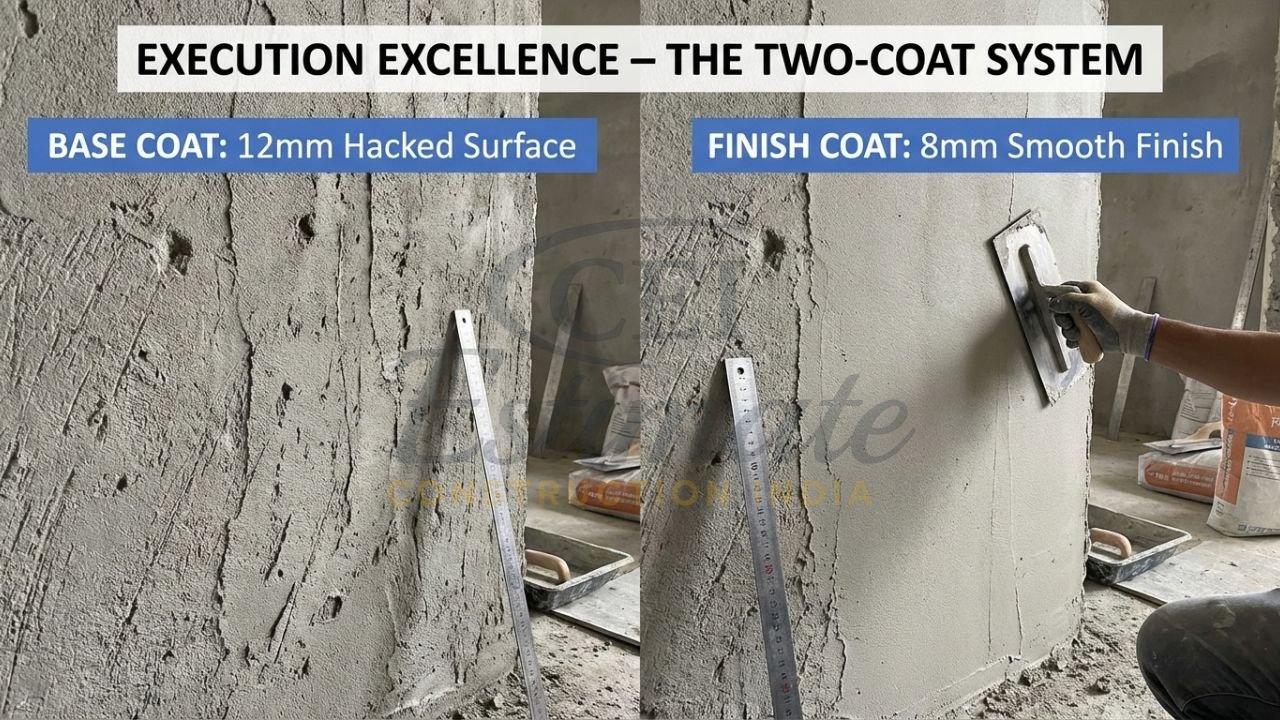
- Two-coat system for best results
- First coat (undercoat): 12–15 mm, roughened slightly.
- Second coat (finish): 8–10 mm, applied after the first has set but is still green (or as per engineer’s instructions).
- Proper surface preparation
- Remove dust, loose particles, curing compounds, and oily materials.
- Wet the masonry/concrete background well before plastering to avoid sudden suction.
- Add plasticizer/waterproofing compound for exterior
- Use an approved plasticizer or waterproofing admixture in exterior plaster and wet/seepage-prone walls as per manufacturer dosage.
- Mix thoroughly and use within time
- Machine mixing is better than hand mixing for uniform mortar.
- Do not retemper (add water again) and reuse stiffened mortar.
- Control thickness and joints
- Keep total plaster thickness reasonable and uniform; very thick patches shrink more.
- Plan working joints logically and avoid random day-work joints in the middle of walls.
- Curing is non-negotiable
- Start curing as soon as plaster has set enough not to be damaged.
- Cure for 7–10 days minimum for PPC/PSC plaster, more in hot and windy weather.
- Protect fresh plaster from sun and wind
- Direct hot wind or harsh sun on fresh plaster accelerates drying and cracking.
- Use temporary shading or polythene where needed.
- Coordinate with painter
- Allow adequate drying time before applying putty/primer/paint to avoid blistering and peeling.
If you want site-specific plaster mix design and curing schedule for your city and soil/groundwater condition, WhatsApp +91 8630676890 for our professional cost estimating service starting from ₹10,000 INR.
Need Accurate Plaster Material Estimate & Full House Budget?
Get professional detailed cost estimates and material takeoffs from experts – no guesswork.
Simple Step-by-Step Process
- WhatsApp +91 8630676890
Send your name, city (for example: Agra, Meerut, Dehradun, Patna) and basic project type (G+1 house, boundary wall, renovation, etc.). - Share drawings or room sizes
- If you have architectural drawings, share PDF/Photos.
- Or simply send room-by-room wall dimensions and floor–floor height.
- We prepare detailed cost estimate & takeoff
- We work out plaster area (inner + outer), thickness, select best cement grade (PPC/PSC) for your region.
- You receive professional BOQ & cost report
- Cement bags, sand quantity, labour estimate, total cost per sq ft for plaster.
- Option for complete full house construction budget (foundation to finishing) – service starts from ₹10,000 INR only.
- Save time and money with accurate planning
- Use the professional estimate to negotiate better rates and avoid costly material errors.
WhatsApp +91 8630676890 today for:
- Detailed plaster material takeoff & cost estimate (from ₹10,000 INR)
- Accurate BOQ with quantities and rates
- Full house construction cost budget
Prominent CTA Box
Need crack-free, long-lasting plaster with accurate costing?
WhatsApp +91 8630676890 now for professional detailed plaster material takeoff, BOQ and full house construction cost estimate – service starts from just ₹10,000 INR for your city and site conditions.
FAQ – Common Questions About Cement for Plaster (India 2026)
- Which cement is best for interior wall plaster in India?
For most homes, a good quality PPC cement from a trusted brand (UltraTech, ACC, Ambuja, JK, etc.) gives the best combination of workability, smooth finish and low cracking for interior plaster. - Which cement is best for exterior plaster in coastal or high-rainfall areas?
For coastal belts, high groundwater, or sulfate-rich soils, PSC cement is preferred for exterior walls because of its superior sulfate and chloride resistance and low permeability. - Can I use OPC 53 Grade cement for plastering?
Technically you can, but it is not recommended because OPC 53 generates high heat, sets fast, and shows more shrinkage cracks in plaster; it is better reserved for RCC where early strength is needed. - Is PPC cement strong enough for my house plaster and structure?
Yes, PPC develops excellent long-term strength and durability while reducing cracking; many builders now use PPC for most residential work including brickwork and plaster. - What is Composite Cement (IS 16415) and is it good for plaster?
Composite cement combines clinker with both fly ash and slag as per IS 16415, giving balanced workability, low heat and good durability, making it a plaster-friendly option when PPC/PSC availability or cost is a concern. - Does water-repellent (hydrophobic) cement really help in exterior plaster?
Premium hydrophobic variants like weatherproof PPC improve surface water repellence and reduce damp patches and efflorescence when combined with good detailing and curing, though they do not replace full waterproofing systems where needed. - How long should I cure plaster made with PPC or PSC cement?
Generally, 7–10 days of regular curing is recommended for PPC and PSC plaster, and longer in very hot, windy or dry conditions to avoid shrinkage cracks and ensure strength. - What mix ratio is best for plaster – 1:4, 1:5 or 1:6?
Most residential plaster uses 1:4 to 1:6 cement:sand depending on location and specification; richer mixes increase cost and shrinkage, while too lean mixes can become weak or dusty. - How do I know how many cement bags I need for my house plaster?
Roughly, 12–15 mm plaster consumes 0.15–0.20 bags per sq m wall area, but for accurate detailed takeoff get professional service. WhatsApp +91 8630676890 for estimate starting from ₹10,000 INR. - Which brands give the best value for plaster in Tier-2/3 cities?
Brands like UltraTech, ACC, Ambuja, JK, Wonder, Shree/Bangur, Dalmia, MP Birla offer PPC/PSC and Composite cements with good availability and competitive pricing in Tier-2/3 and semi-urban markets.
Conclusion – Choose the Right Cement Today and Avoid Cracks Tomorrow
For plaster, the smartest move in 2026 is not the highest grade number, but the right cement type: PPC for almost all interiors, PSC or water-repellent PPC for exteriors, and PSC only for very harsh coastal/sulfate conditions. When you combine the right cement with correct mix, thickness and curing, your walls stay smooth, solid and crack-free for years.
If you want help deciding the best brand and exact quantities for your house in Delhi NCR, UP, Uttarakhand, Rajasthan, MP, Bihar, Punjab or Haryana, simply WhatsApp +91 8630676890 for our professional detailed plaster material takeoff, BOQ and full house construction cost estimate – service starts from just ₹10,000 INR. Build confidently and avoid costly mistakes!
WhatsApp +91 8630676890 now for accurate plaster quantity calculation, detailed BOQ and complete house construction budget estimate – starting from ₹10,000 INR only!