
Choosing the right cement is one of the most important decisions in any construction project. Cement directly affects concrete strength, plaster quality, durability, and overall structural performance. Homeowners, builders, contractors, civil engineers, property developers, and anyone planning house construction in India often face the question: PPC vs OPC Cement Which Is Better in India? OPC (Ordinary Portland Cement) is pure cement clinker, while PPC (Portland Pozzolana Cement) is OPC blended with pozzolanic materials like fly ash. Both have distinct advantages, and the best choice depends on the specific application — from RCC work and roof slabs to plastering and brickwork.
👉 Confused Between PPC & OPC Cement? – 📲 Contact Our Experts Today
This detailed comparison guide examines PPC vs OPC across strength, cost, durability, setting time, heat of hydration, workability, and suitability for different construction tasks in India. It will help you make an informed decision while highlighting that neither is universally “better” — the right cement depends on your project needs, budget, and environmental considerations.
What Is OPC Cement?
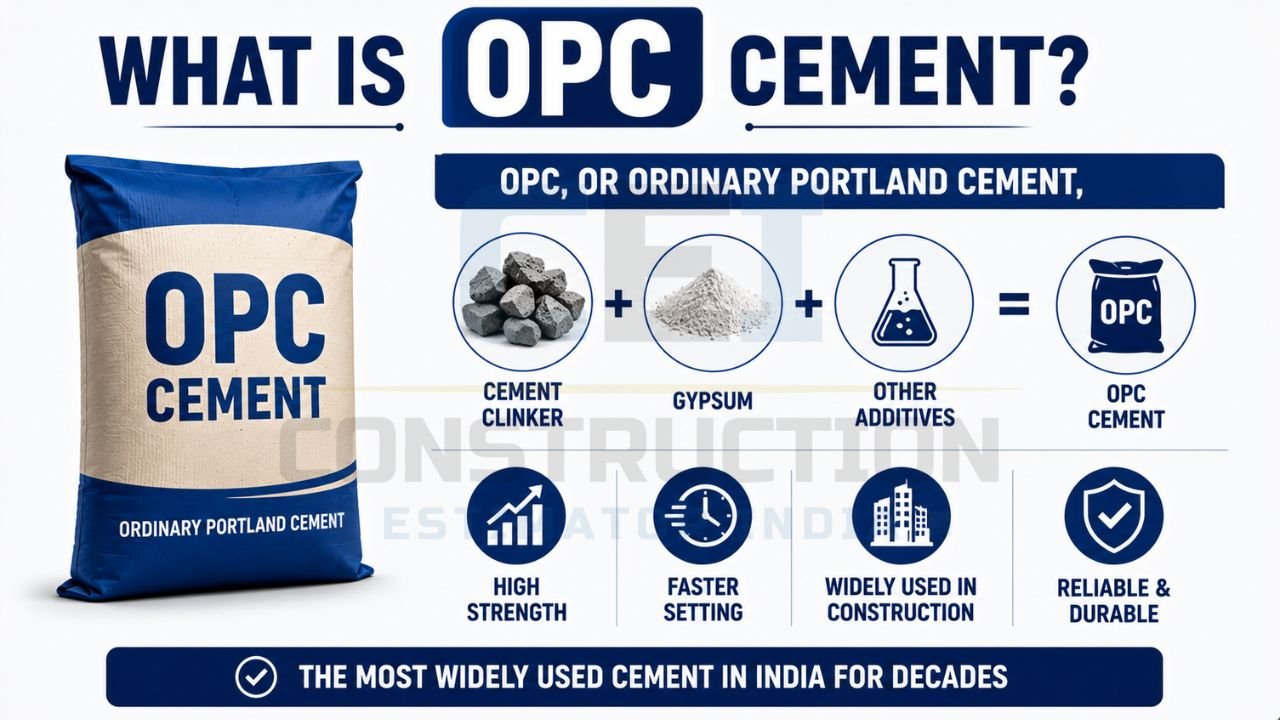
OPC, or Ordinary Portland Cement, is the most widely used cement in India for decades. It is manufactured from cement clinker, gypsum, and other additives without significant blending materials.
👉 Choose the Right Cement for Stronger & Safer Construction – 📲 WhatsApp Now
OPC Cement Grades in India
OPC is available in three main grades based on 28-day compressive strength:
- OPC 33 Grade: Lower strength, suitable for general non-structural work, plastering, and low-load applications.
- OPC 43 Grade: Medium strength, widely used for brickwork, plastering, and general construction.
- OPC 53 Grade: High early strength, preferred for RCC work, columns, beams, slabs, and structures requiring fast setting and high load-bearing capacity.
For detailed grade comparison: 33, 43, 53 Grade Cement Difference in India.
What Is PPC Cement?
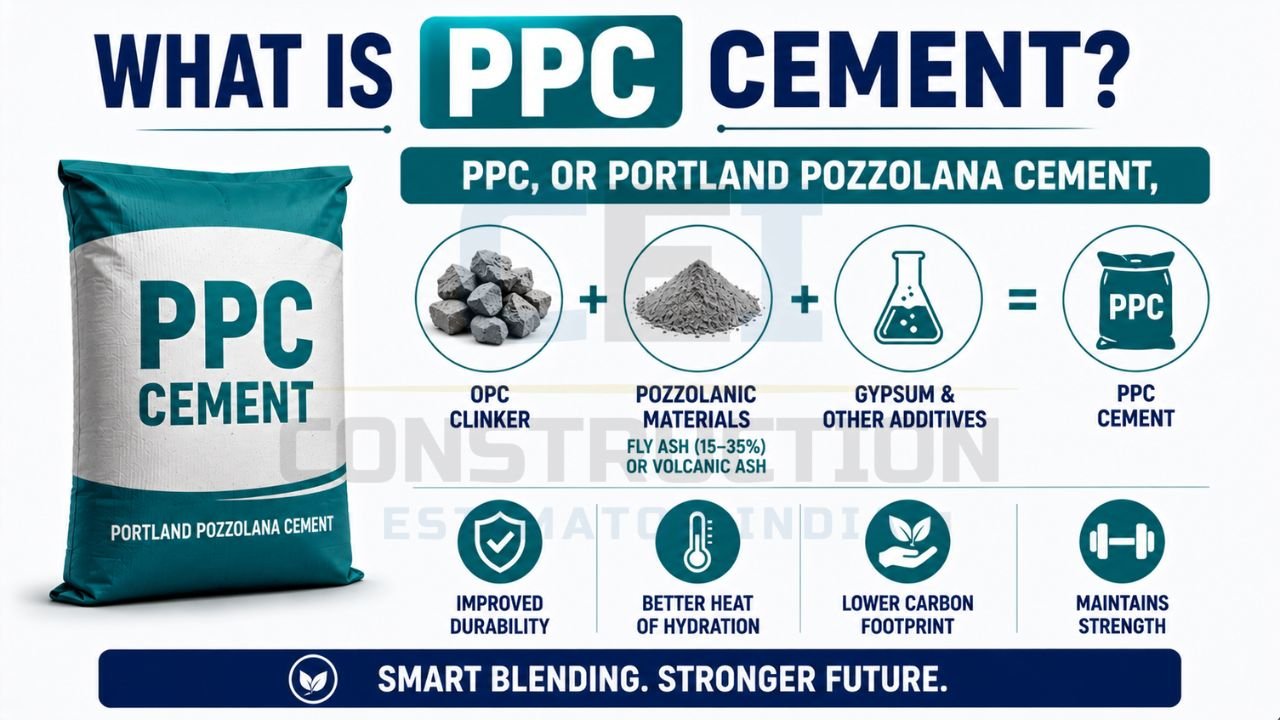
PPC, or Portland Pozzolana Cement, is manufactured by blending OPC clinker with pozzolanic materials such as fly ash (15–35%) or volcanic ash. This blending improves certain properties while maintaining strength.
👉 Need Expert Guidance on Cement Selection? – 📲 Start Chat Today
How PPC Is Manufactured?
PPC is produced by grinding OPC clinker with gypsum and pozzolanic materials. The addition of fly ash (a byproduct of thermal power plants) makes PPC more economical and environmentally friendly. It develops strength more slowly but achieves comparable or higher long-term strength than OPC.
PPC vs OPC Cement — Key Differences
Here is a clear comparison table for quick understanding:
| Feature | OPC Cement | PPC Cement |
| Composition | Pure cement clinker + gypsum | OPC + fly ash (15–35%) |
| Grades | 33, 43, 53 | Single grade (equivalent to 43/53) |
| Strength Development | Fast (7–14 days) | Slower, catches up at 28–90 days |
| Heat of Hydration | Higher | Lower (better for mass concrete) |
| Workability | Good | Better, smoother finish |
| Durability | Good | Better chemical/sulphate resistance |
| Cost | Higher | 5–10% cheaper |
| Best For | RCC, columns, beams, slabs | Plastering, brickwork, flooring |
| Setting Time | Faster initial setting | Slower initial setting |
| Environmental Impact | Higher carbon footprint | Lower (uses industrial waste) |
Strength and Durability: PPC vs OPC
OPC gains strength faster, making it ideal for projects requiring early formwork removal and high early load-bearing capacity. PPC develops strength more slowly but often surpasses OPC at 90 days and beyond due to the pozzolanic reaction. For long-term durability, PPC offers better resistance to sulphate attacks, chemical corrosion, and chloride penetration, making it more suitable for marine, underground, and humid environments common in many parts of India.
👉 Get Professional Advice for RCC, Plastering & Brickwork – 📲 Message Us Now
Cost Comparison: PPC vs OPC
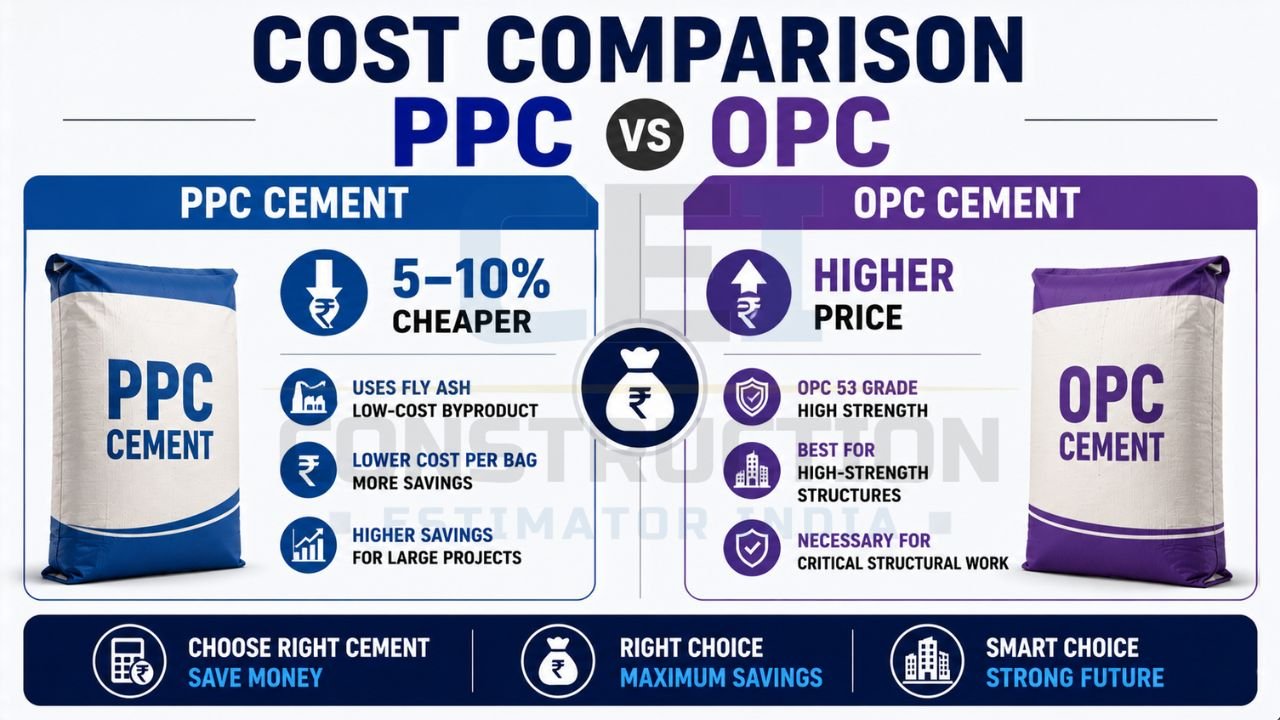
PPC is generally 5–10% cheaper per bag than OPC due to the use of fly ash, a low-cost industrial byproduct. For large projects, this cost difference becomes significant. OPC 53 grade is more expensive but necessary for high-strength structural work. When planning your project budget, choosing the right cement for each application can save substantial money without compromising quality.
👉 Build Smarter with the Right Cement for Every Application – 📲 Talk to Our Team Today
For accurate cost planning: What is Estimation in Construction.
Which Cement Is Better for Specific Construction Tasks?
Plastering Work
PPC is generally better for plastering due to its smoother finish, better workability, and lower heat of hydration, which reduces cracking. It provides an excellent surface for painting.
For plaster guidance: Which Cement is Best for Plastering and Top 10 Cement for Plastering in India.
Roof Construction and Slabs
OPC 53 grade is preferred for roof slabs and RCC work due to its high early strength, which allows faster formwork removal and supports heavy loads.
For roof slab guidance: Best Cement for Roof Construction in India and Best Cement for Roof Dhalai.
Column Casting
OPC 53 grade is best for column casting due to its high compressive strength and faster setting time, which is critical for vertical load-bearing elements.
For column guidance: Best Cement for Column Casting in India.
Brickwork and Masonry
PPC is suitable for brickwork due to better workability and long-term durability.
Flooring and Tiling
PPC is preferred for flooring and tiling due to its smooth finish and lower shrinkage.
Heat of Hydration: PPC vs OPC
OPC generates higher heat during hydration, which can cause thermal cracking in mass concrete pours. PPC generates lower heat, making it better for large foundations, dams, and thick slabs. This property reduces the risk of cracking in Indian summer conditions.
👉 Strong Foundations Begin with the Right Cement Choice – 📲 Contact Us Now
Workability and Finish: PPC vs OPC
PPC offers better workability and a smoother finish, making it easier for plastering and finishing work. OPC is good for structural concrete but can be harsher to work with for non-structural applications.
Environmental Impact: PPC vs OPC
PPC is more environmentally friendly because it uses fly ash, an industrial waste product, reducing the carbon footprint and conserving natural resources. OPC has a higher carbon footprint due to pure clinker production. Many government projects now prefer PPC for sustainability reasons.
Which Cement Is Better in India: PPC or OPC?
The right choice depends on the application:
👉 Strong Foundations Begin with the Right Cement Choice – 📲 Contact Us Now
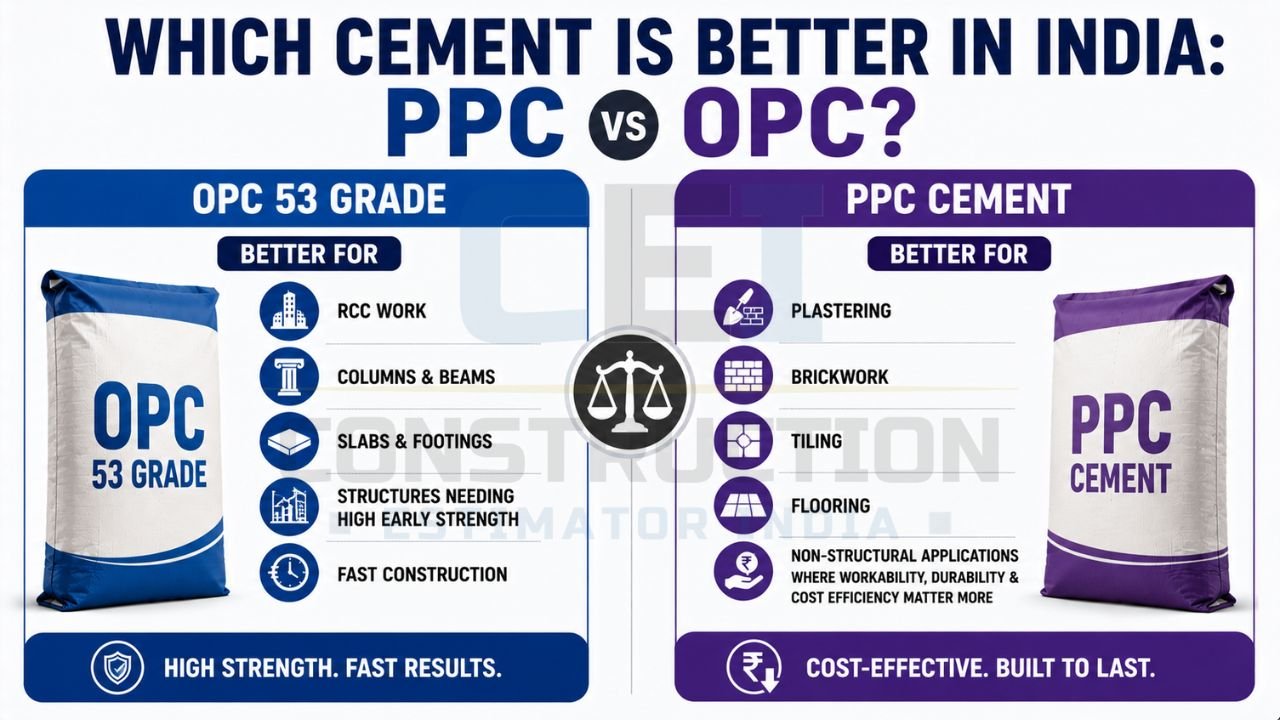
- OPC 53 Grade is better for: RCC work, columns, beams, slabs, footings, and structures needing high early strength and fast construction.
- PPC is better for: Plastering, brickwork, tiling, flooring, and non-structural applications where workability, durability, and cost efficiency matter more.
For most home construction in India, you need both: OPC for structural work and PPC for non-structural work. This combination gives the best balance of strength, finish, and cost.
Common Mistakes When Choosing Cement
Homeowners often make these mistakes:
- Using PPC for RCC work (weakens structure).
- Using OPC for plastering (causes cracks and poor finish).
- Not checking cement grade or manufacturing date.
- Buying without ISI mark.
- Ignoring project-specific requirements.
Avoiding these mistakes saves money and prevents structural issues.
For common expensive mistakes: 7 Common Expensive Mistakes in House Construction in India.
Why Construction Projects Fail: Cement Quality Matters?
Poor cement selection contributes to project failure through weak concrete, cracks in plaster, structural durability issues, and increased rework costs. Proper cement choice, combined with quality sand and professional estimation, ensures durable and cost-effective construction.
For reasons why projects fail: 5 Reasons Why Construction Projects Fail in India.
Why Construction Estimator India?
Construction Estimator India is a trusted advisor for construction material selection and cost planning. We provide expert guidance on cement selection (PPC vs OPC), transparent cost estimates, material quality verification, professional estimation and quantity takeoff, and end-to-end construction support to help you build stronger, more economical, and sustainable projects in India.
Conclusion
PPC vs OPC Cement Which Is Better in India depends on your construction task. OPC 53 grade is superior for structural RCC work, while PPC is better for plastering, brickwork, and finishing. For most home construction, using the right cement for each application — combined with quality materials and professional estimation — ensures durable, cost-effective, and safe buildings across India.
Are you unsure whether to use PPC or OPC cement for your house construction, renovation, or commercial project in India? As a trusted construction cost planning and material selection partner, Construction Estimator India helps homeowners and builders choose the right cement grade (33, 43, 53) for strength, durability, and cost efficiency. From material guidance to detailed estimation and quantity takeoff, we provide end-to-end solutions to protect your investment.
Contact us today for a free consultation and detailed construction material & cost plan!
📞 Call / WhatsApp: +91 8630676890
🌐 Visit Us: Construction Estimator India
📍 Serving: Across India – Dehradun, Roorkee, Haridwar, Rishikesh, Delhi, Mumbai, Bangalore, and more
FAQ Section
Is PPC better than OPC for house construction?
It depends on the application. OPC is better for structural RCC work, while PPC is better for plastering and non-structural work. Many projects use both.
Which cement is best for plastering: PPC or OPC?
PPC is generally better for plastering due to smoother finish, better workability, and reduced cracking.
Which cement grade is best for roof slab?
OPC 53 grade is preferred for roof slabs due to high early strength and load-bearing capacity.
Can I use PPC for RCC work?
PPC can be used for RCC work, but OPC 53 grade is often preferred for faster strength gain in structural elements.
Is OPC 53 grade better than PPC for columns?
Yes, OPC 53 grade is better for columns due to higher early compressive strength and better performance under load.
Why is PPC cheaper than OPC?
PPC uses fly ash, a low-cost industrial byproduct, reducing production cost while maintaining long-term strength.
Which cement has better durability: PPC or OPC?
PPC generally offers better long-term durability due to lower heat of hydration and higher resistance to chemical and sulphate attacks.