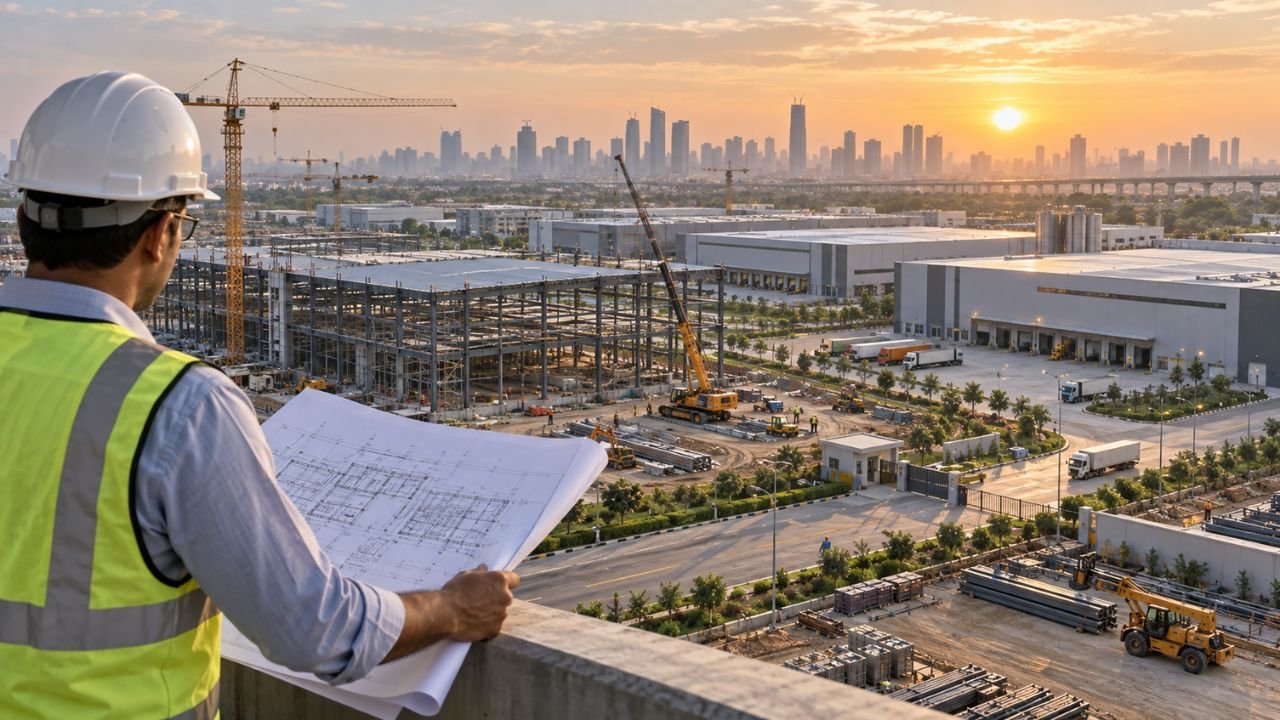
Let me tell you a story that I’ve seen play out far too many times in my twenty years as a civil engineer. Meet Ramesh. Ramesh is a hardworking IT professional from Pune who spent a decade saving every rupee to build a retirement home for his parents. He found a contractor named Vinay through a local Facebook group. Vinay’s profile was filled with stunning photos of modern bungalows, and his WhatsApp DP showed him standing proudly in front of a half-finished luxury villa. He promised Ramesh the world: premium Italian marble, high-end teak wood, and a completion date in just eight months, all at a price that seemed like a steal.
Vinay was charismatic and spoke with such confidence that Ramesh didn’t feel the need to do much checking. When Vinay asked for a 60% advance to “lock in material prices before they rise,” Ramesh didn’t hesitate. He transferred ₹7 lakh immediately. For the first two weeks, everything seemed fine. A few workers showed up, some basic excavation for the foundation types for house construction in India happened, and Ramesh felt his dream was taking shape. Then, the excuses started. First, it was a labor shortage because of a festival. Then, it was a delay in cement delivery. Finally, Vinay’s phone went dead. When Ramesh visited the office address on Vinay’s visiting card, he found a small tailoring shop that had been there for five years. The tailor had never even heard of Vinay.
👉 Hiring a Contractor? Verify Their Credentials Before You Commit.
Ramesh lost his hard-earned ₹7 lakh and was left with a hole in the ground and a heap of legal bills. He eventually had to hire a new contractor to fix the mess, costing him even more than his original budget. This nightmare wasn’t a result of bad luck; it was a result of skipped steps. This could have been avoided with simple verification. Most homeowners in India don’t verify because they feel it’s too “rude” to ask for papers or because they are in a hurry to start. But remember, you are trusting someone with your life savings. If you’re feeling overwhelmed, remember that Construction Estimator India offers free contractor verification help at +91 8630676890 to ensure you never end up like Ramesh.
Why Most Homeowners Get Scammed by Contractors?
The psychology of a construction scam is fascinating and tragic. Most homeowners are driven by a mix of urgency and misplaced trust. We often rely on a “friend’s recommendation” without realizing that the friend might not have actually verified the contractor either. Take Sunita from Delhi, for example. She hired a contractor because her neighbor, Mrs. Sharma, said he was “a very nice boy.” What Mrs. Sharma didn’t mention was that the contractor had only done a small kitchen renovation for her, not a full house construction. Sunita’s project stalled for six months because the contractor didn’t have the technical expertise or the financial stability to handle a multi-story building.
Common mistakes include hiring based on WhatsApp photos alone without visiting sites or paying massive advances before any work starts. Understanding how to plan home construction in India means realizing that asking for a GST registration or a trade license does not make you look suspicious; it makes you an informed client. The reality is that the construction industry in India is rapidly growing, but it is also filled with unregistered and unreliable players. Verification is about protecting your ₹50 lakh to ₹2 crore investment. A professional contractor will actually appreciate your diligence because it shows you understand the value of quality work.
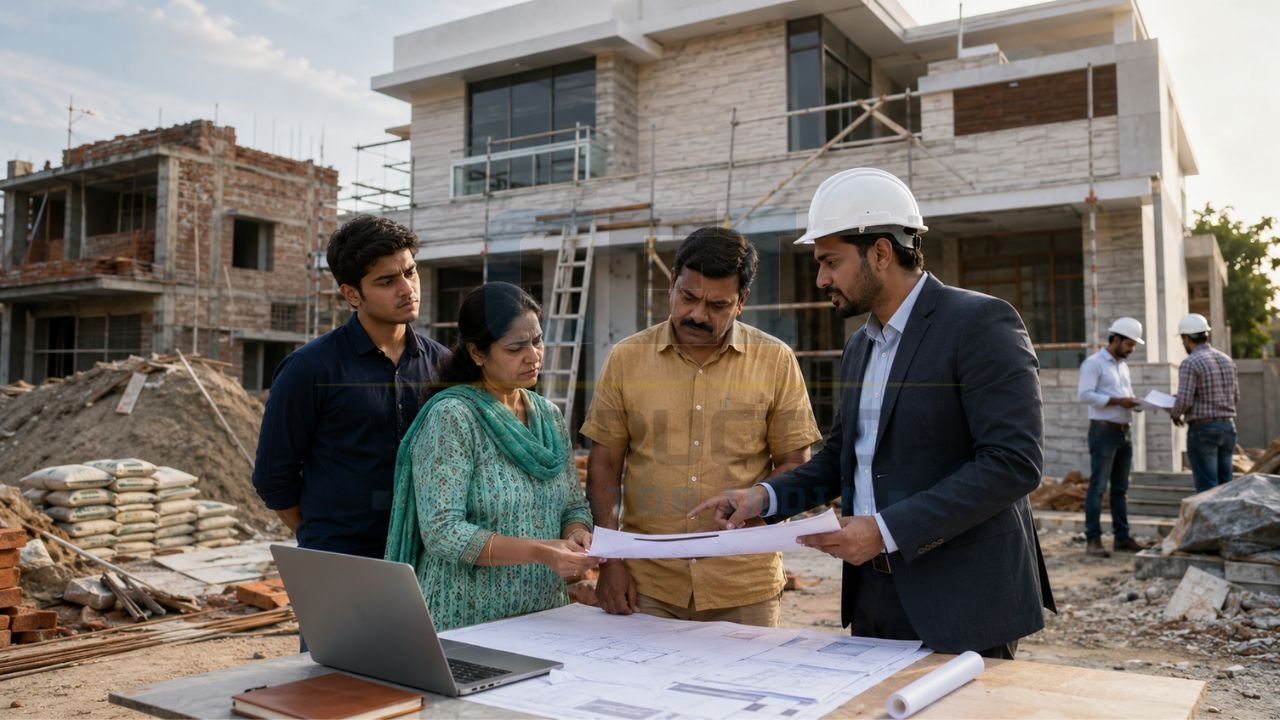
👉 Protect Your Construction Investment with Expert Contractor Verification Guidance.
The 3 Documents You MUST Check Before Hiring
GST Registration (The First Filter)
The first thing I always tell homeowners is to check for a GST registration. In 2026, any legitimate contractor handling projects with over ₹20 lakh in annual revenue must be registered for GST. If a contractor tells you “GST is not needed for small work,” they are likely lying to avoid taxes or hiding their business volume. To verify this, ask for their GSTIN and head over to the official GST Portal. Use the “Search Taxpayer” tool to see if their status is “Active.”
The business name on the portal must match the contractor’s name or company name exactly as it appears on your agreement. Ramesh’s contractor, Vinay, actually gave him a fake GST number that didn’t even exist on the portal. Had Ramesh spent two minutes checking that number, he would have known immediately that he was dealing with a fraud. Construction Estimator India provides a free contractor legitimacy check to help you verify these details quickly.
Trade License (The Local Authority Approval)
A trade license is essentially the permission given by a municipal corporation to carry out a specific business in a specific area. For construction, this is crucial. It proves the contractor is recognized by local authorities like the BMC in Mumbai or the BBMP in Bangalore. You should ask for a copy of the license and check the valid date and the category of work listed.
A red flag to watch for is a contractor claiming that a trade license is “too expensive” or “not needed for residential homes.” This usually means they are operating illegally. I once saw a case in Bangalore where a house was partially demolished by the municipal order because the contractor didn’t have the proper licenses or permissions to build in that zone. Don’t risk your home’s legal standing; verify the trade license or call +91 8630676890 to have the team at Construction Estimator India assist you.
Insurance Policy (Protection for You)
This is the document most homeowners skip, and it’s the one that can bankrupt you. Construction is dangerous work. If a worker gets injured or dies on your site, you are legally liable for compensation if the contractor doesn’t have Workmen’s Compensation Insurance as regulated by the IRDAI.
Ask for the insurance policy copy and call the insurance company directly to confirm it is active and covers your specific project type. Never believe a contractor who says “insurance is not needed for small projects.” That is a dangerous lie. Protecting your project means protecting the people working on it, and Construction Estimator India can help you review these policies to ensure they are sufficient for your needs.
The 3 Questions That Reveal a Bad Contractor
Question 1: “Can I visit one of your ongoing projects?”
A good contractor will be proud of their work and will say, “Yes, absolutely—here’s the address, visit anytime.” A bad contractor will give you excuses like “the site is private” or “I’ll show you later when it’s more finished.” This is your biggest warning sign. In my experience, “Photos can be fake”—they are often downloaded from the internet or taken from another contractor’s site.
When you visit a site, don’t just look at the walls. Check if the materials conform to the standards set by the Bureau of Indian Standards (BIS). Ask yourself: Are they using proper structural techniques, and do they know which grade cement is best for plastering in India? Talk to the workers to gauge the contractor’s reliability.
Question 2: “Can I call your past clients?”
You need to hear from real people, not just see testimonials on a website. “Make sure to call every one of these references to inquire about their experience, the project timeline, communication, and overall satisfaction”. A professional should be able to provide 3–5 references of completed projects similar to yours.
When calling, ask technical questions to verify the reference is real. Ask them about the difference between RCC and brick construction in India that the builder employed, or how the contractor handled waterproofing. If the reference sounds clueless, they might just be a friend or relative of the contractor.
Question 3: “Can we sign a detailed written contract?”
“Legitimate contractors never refuse a proper written contract with scope and milestones”. If a contractor tells you “a contract is too formal” or “we are like friends, trust me,” you should walk away immediately. Trust is built on clarity, and clarity comes from a written agreement.
A proper contract must include a detailed scope of work, a clear timeline with start and end dates, payment milestones, a specific materials list including brands, and warranty terms. Ramesh’s biggest mistake was falling for the “no contract needed” trap. When his work stalled for three months, he had no legal proof of the timeline or the payments he’d made. If you need help, Construction Estimator India offers free contract preparation assistance to ensure all your interests are protected.
The Payment Red Flag That Cost Homeowners Millions
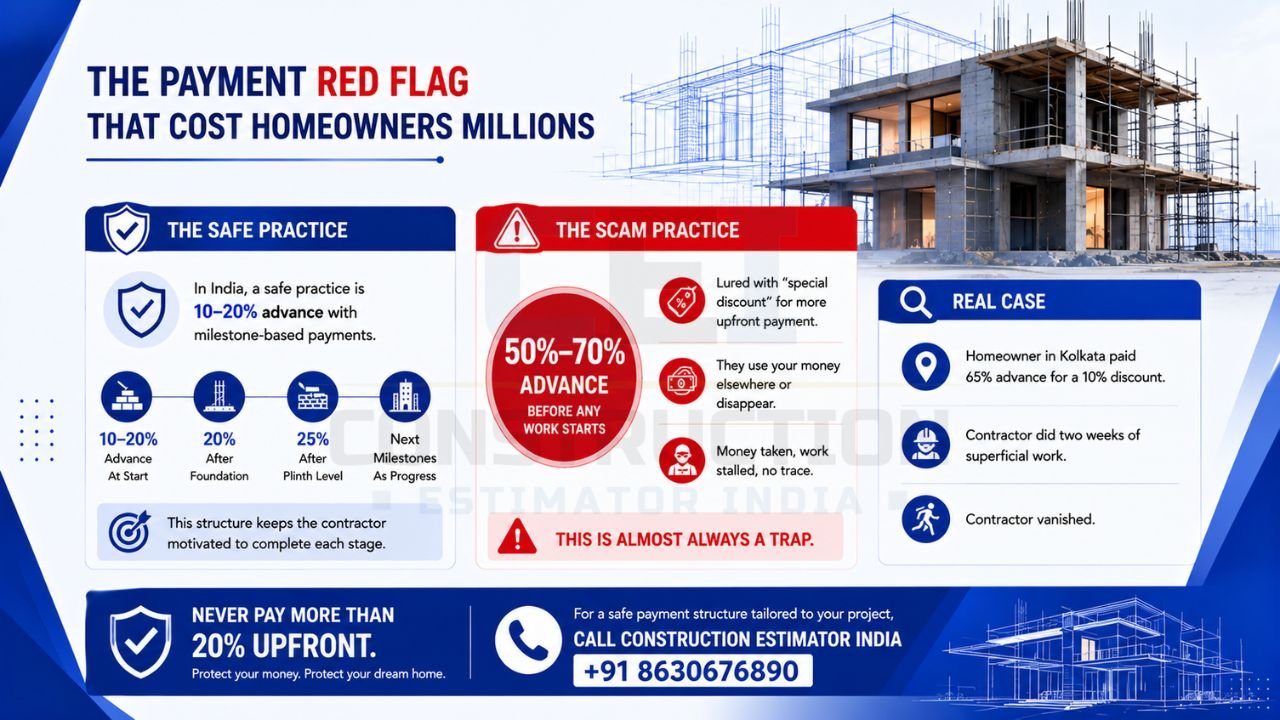
Let’s talk about money. The most common scam involves the advance payment. A safe, professional practice in India is usually a 10–20% advance, followed by milestone-based payments—for example, 20% after the foundation, 25% after the plinth level, and so on. This keeps the contractor motivated to finish each stage to get the next check.
The scam practice is demanding 50% to 70% advance before any significant work starts. They often lure you in with a “special discount” if you pay more upfront. This is almost always a trap. Once they have your money, they often use it to finish another project or simply disappear. A homeowner in Kolkata once paid a 65% advance because the contractor promised a 10% discount on the total bill. The contractor took the money, did two weeks of superficial work, and was never seen again. Never pay more than 20% upfront. For a safe payment structure tailored to your project, call Construction Estimator India at +91 8630676890.
How to Verify a Contractor’s Office Address (Don’t Skip This)
In the digital age, it’s easy to create a fake business presence. I’ve seen dozens of contractors who operate solely out of their cars or temporary sheds but claim to have fancy offices. You must verify their physical address. Start by asking for the address clearly and checking it on Google Maps. Does the building actually exist?
If possible, visit the office once. Is it a real office with staff and equipment, or is it just a rented desk in a co-working space that they’ve occupied for a week? Check their business registration documents while you are there. A contractor in Pune had a professional-looking address on his visiting card and Google Maps, but when the homeowner actually went there, it was a vacant, weed-covered plot. He caught the scam just before handing over the first check.
👉 Choose the Right Contractor with Confidence and Peace of Mind.
Bank Account: Business or Personal? This Matters
Always ensure that the bank account you are transferring money to is a business account in the name of the company, not a personal account of the contractor. A business account requires GST registration and other legal proofs to open, making it a sign of a legitimate operation. A personal account offers you almost no legal recourse under the Department of Consumer Affairs if the money is misused.
When to Hire (and When to Walk Away Immediately)
You should feel confident to hire if the contractor has an active GST registration, a valid trade license, and insurance that you’ve personally verified. They should have at least three positive references you’ve actually spoken to and be willing to let you visit an ongoing site. If you see high-quality execution, like a proper understanding of what is RCC construction and solid safety protocols, you are in good hands.
On the other hand, you must walk away immediately if they refuse a site visit, have no GST or trade license, or pressure you to pay a large advance quickly. If they say “the offer expires today,” that’s a sales tactic used by scammers to stop you from thinking clearly. I remember a homeowner in Mumbai who walked away from a contractor demanding 60% advance without a contract. He felt bad at the time, but he later found out that contractor had scammed three other families in the same suburb. He saved himself ₹8 lakh by just saying “no.” Verification takes 2-3 days, but it saves you years of stress.
Where to Find Legitimate Contractors in India
The most reliable source is often friends or family who have recently completed a house—but only if you go and see the finished product yourself. Check if the contractor knows the fine details, such as how to use white cement for waterproofing in India.
You can also talk to material suppliers like cement and steel shop owners. They know which contractors are legitimate because they’ve dealt with them for years. Avoid random WhatsApp contacts or social media ads with “too cheap” quotes. Understanding the accurate plaster cost per square foot with material in India will quickly reveal if a quote is realistically priced or a trap.
When Construction Estimator India Can Help You
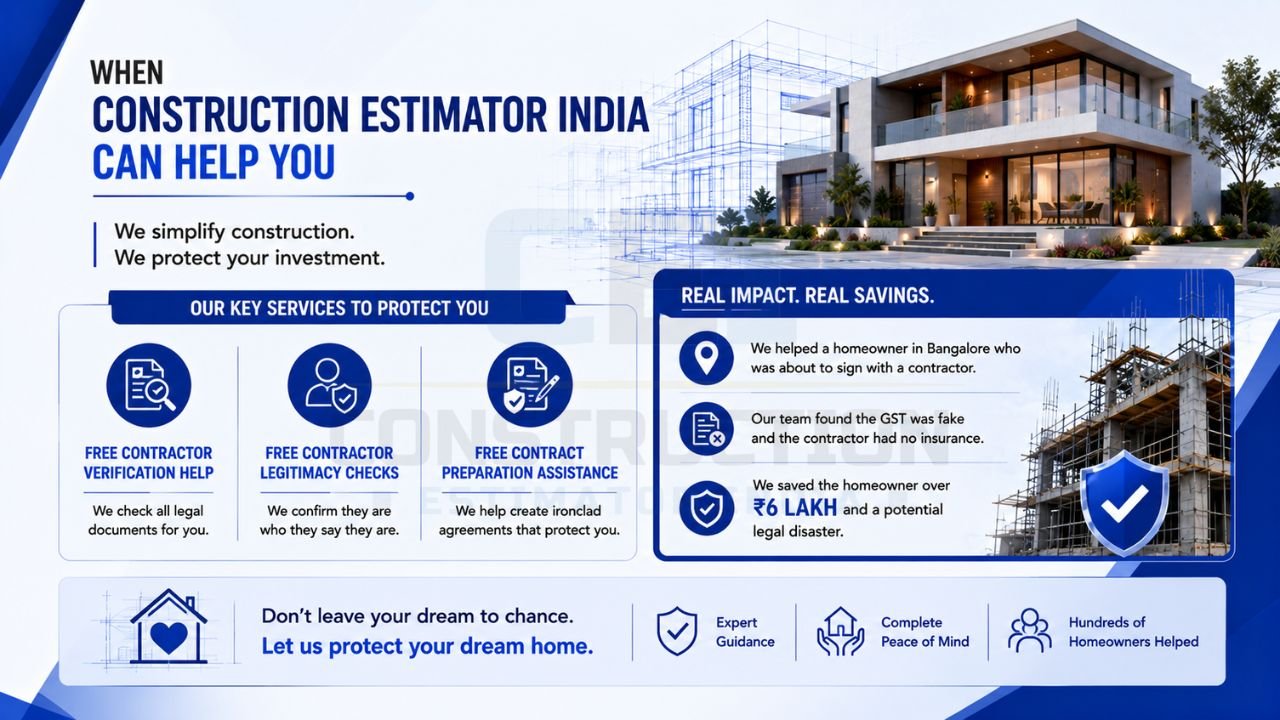
Building a home is stressful enough without having to play detective. If you are worried about verifying credentials, or if you don’t know how to read a GST portal or an insurance policy, we are here for you. Construction Estimator India has helped hundreds of homeowners navigate the complex world of Indian construction.
We offer several key services to protect you:
- Free contractor verification help to check all legal documents.
- Free contractor legitimacy checks to ensure they are who they say they are.
- Free contract preparation assistance to make sure your agreement is ironclad.
We recently helped a homeowner in Bangalore who was about to sign with a contractor who seemed perfect. Our team did a quick check and found the GST was fake and the contractor had no insurance. We saved that homeowner over ₹6 lakh and a potential legal disaster. Don’t leave your dream to chance. Call or WhatsApp us at +91 8630676890.
👉 Get Expert Advice Before Hiring a Contractor for Your Project.
Your Next Step: Don’t Hire Without Verification
Before you sign anything or pay a single rupee, take a deep breath. Remember that “Before hiring anyone for your home remodeling project, it’s crucial to verify their professional credentials”. Do not be swayed by pretty photos or charming talk. “Before hiring any contractor in India, verify their GST registration number (free on GST portal), ask for past client references and call them, check their work photos on-site (not just WhatsApp screenshots), and ensure they have a registered business address”.
The three critical documents—GST, Trade License, and Insurance—are your shield. The three questions—Site visit, References, and Contract—are your sword. And the payment rule—never more than 20% advance—is your safety net. This process might take a few extra days, but it protects your ₹50 lakh to ₹2 crore investment. Don’t let Ramesh’s mistake happen to you. Verify thoroughly, stay informed, and remember that Construction Estimator India is always just a phone call away at +91 8630676890 for free contractor verification help.