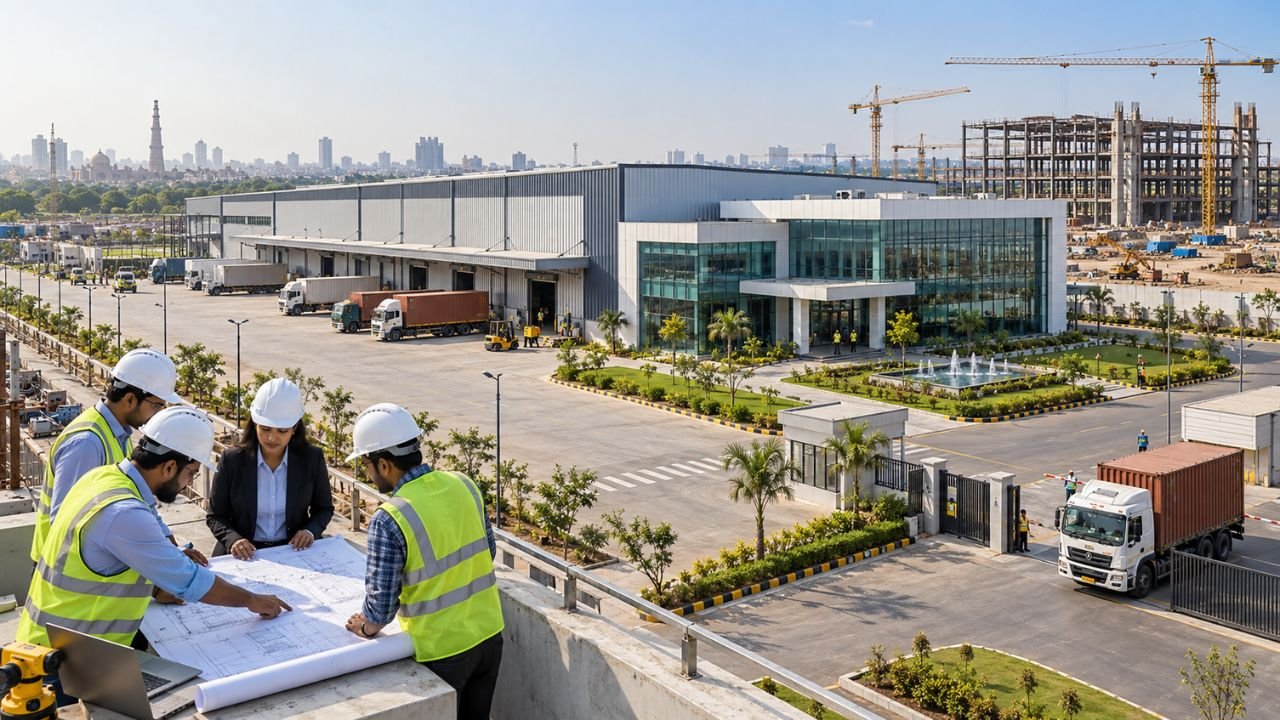
Imagine a thriving textile manufacturing unit in the industrial heart of Kanpur, Uttar Pradesh. In early 2026, amidst a surge in export orders, a massive electrical short circuit triggers a flash fire in the warehouse. Within an hour, raw silk stocks worth crores are reduced to ash, and the specialized German-made weaving looms suffer irreparable heat damage. Because the owners overlooked specific types of insurance for manufacturing companies, specifically failing to secure adequate stock-in-process coverage and business interruption insurance, the factory is forced to halt production indefinitely. The financial burden of unfulfilled contracts, worker layoffs, and high-interest debt leads to a total business collapse.
In the 2026 industrial landscape, the manufacturing sector faces a unique and escalating risk profile. High-value automated machinery, volatile chemical processes, complex supply chain interdependencies, and a rising frequency of climate-induced events like urban flooding or seismic tremors in the Delhi-NCR region make financial protection non-negotiable. Whether you are an MSME operator or a large-scale plant manager, a single product defect or a boiler explosion can lead to catastrophic legal and repair costs. You need a layered, strategic insurance portfolio to safeguard your physical assets, your operational continuity, and your most valuable resource—your workforce.
Proper manufacturing company insurance India is no longer just a regulatory checkbox; it is a strategic tool for securing bank financing from institutions like SBI or SIDBI and ensuring long-term resilience. By adhering to IRDAI guidelines for manufacturing insurance, you can transfer these operational risks to professional insurers, allowing you to focus on innovation and growth. This guide explores the essential insurance types, their 2026 coverage nuances, and how to accurately factor these premiums into your factory budgeting and project estimates.
Why Manufacturing Companies in India Need Multiple Insurance Covers?
In 2026, the complexity of manufacturing operations means that no single policy can offer total protection. The inherent risks are multi-dimensional. First, the physical risk to high-value assets is immense. A fire or explosion doesn’t just damage property; it destroys the core of your production capacity. Second, the legal landscape in India, governed by the Factories Act, the Employees’ Compensation Act, and the Public Liability Act, mandates specific protections for your labor force and the general public.
Furthermore, supply chain vulnerabilities have reached a peak. If your supplier in Noida faces a shutdown due to an insured peril, your own production might grind to a halt. This downtime results in a double blow: the loss of daily revenue and the persistence of fixed costs like rent, salaries, and interest. Lender mandates also play a critical role; banks almost always require comprehensive coverage before releasing capital for plant expansion or machinery leasing. Finally, in regions like North India, natural calamities such as seismic activity (Zone IV/V) and unseasonal monsoons can derail a business if not backed by a robust insurance safety net.
For insights into similar risk management in large-scale operations, read our guide on commercial construction insurance requirements in India.
Major Types of Insurance for Manufacturing Companies in India
Navigating the various insurance products available in 2026 requires an understanding of what each specific policy shields. For an Indian manufacturer, the goal is to build a “fortress” around your balance sheet.
| Insurance Type | Primary Purpose | Key Beneficiary |
|---|---|---|
| Fire & Property | Protects factory building, stocks, and furniture. | Factory Owner / Lender |
| Machinery Breakdown | Covers sudden mechanical or electrical failures. | Maintenance/Operations Team |
| Business Interruption | Replaces lost income during a forced shutdown. | Finance Department / Stakeholders |
| Product Liability | Covers legal costs for defects causing injury. | Legal Team / General Public |
| Workmen Compensation | Mandatory cover for worker injury or death. | The Entire Workforce |
| Marine/Inland Transit | Protects goods while being shipped or received. | Logistics / Supply Chain |
1. Fire and Property Insurance (Standard Fire & Special Perils Policy)
Foundational to any industrial unit is the Standard Fire and Special Perils (SFSP) policy. In 2026, many Indian MSMEs utilize the fire insurance for factory under the “Bharat Laghu Udyam Suraksha” scheme, specifically designed for enterprises with an insurable value up to ₹50 crores. This policy is your primary defense against fire, lightning, explosions, and natural catastrophes like floods, storms, and earthquakes.
It covers your factory building, plant, machinery, furniture, and crucially, your stocks—whether they are raw materials, work-in-progress, or finished goods. When setting the sum insured, you must use the reinstatement value (the cost to replace with new equipment at current 2026 rates) rather than the market value. Failing to account for the rising cost of steel and construction materials in your project estimates can lead to “under-insurance,” where the insurer only pays a fraction of the actual loss.
2. Machinery Breakdown Insurance & Boiler and Pressure Plant Insurance
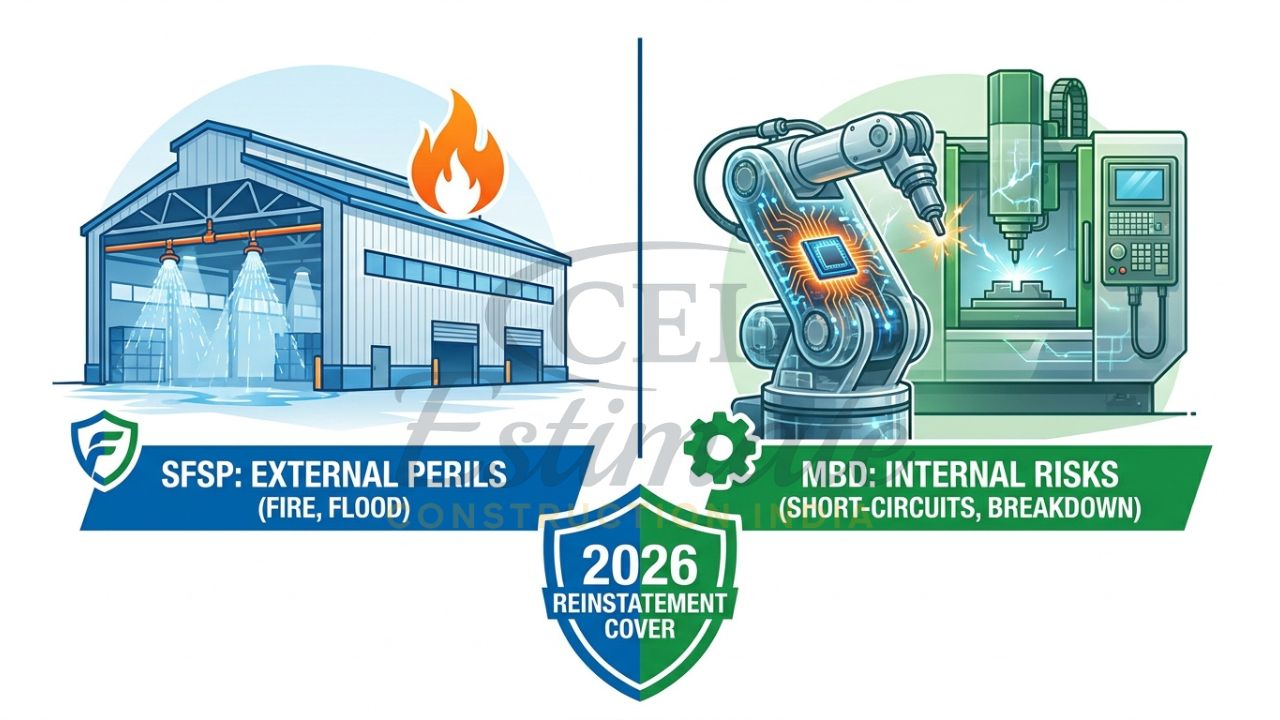
While fire insurance covers “external” perils, machinery breakdown insurance is designed for the “internal” risks. Modern manufacturing lines, especially those involving CNC machines, automated robotics, or high-speed packaging, are prone to sudden mechanical or electrical failures. This policy covers the repair or replacement costs arising from short circuits, structural stress, or operational errors.
For units utilizing boilers, steam turbines, or high-pressure vessels, boiler and pressure plant insurance is a separate, vital necessity. An explosion in a boiler can cause devastating damage not only to the equipment itself but to the surrounding property and nearby personnel. These policies often include an “Add-on” for surrounding property damage and third-party liability, ensuring that a single mechanical failure doesn’t result in a multi-front financial crisis.
3. Business Interruption / Machinery Loss of Profit Insurance
A common mistake manufacturers make is insuring the “asset” but forgetting the “income.” If a fire shuts down your plant in Ghaziabad for three months, your fire policy will pay for the building and machines, but who pays for the lost profit and the ongoing salaries? This is where business interruption insurance (also known as Consequential Loss insurance) becomes critical.
In 2026, sophisticated manufacturers opt for Machinery Loss of Profit (MLOP) cover. If a critical machine breaks down and halts the entire production line, the policy covers the loss of gross profit and the increased cost of working (such as outsourcing production to a competitor to fulfill orders). This ensures that your cash flow remains stable even when your chimneys are not smoking.
For small and growing manufacturing setups, explore tailored solutions in our article on best insurance for small construction business in India, which shares many overlapping needs.
4. Liability Insurance Covers
As your manufacturing business scales, so does your exposure to third parties. Public liability insurance is mandatory for many industries under the Public Liability Insurance Act 1991, especially those handling hazardous substances. It protects you against legal claims if your factory operations cause bodily injury or property damage to neighbors or visitors.
Product liability insurance is perhaps the most critical for exporters and retail manufacturers. If a consumer in Delhi or an importer in Europe claims that your product was defective and caused them harm, you could face massive legal battles and compensation claims. Furthermore, Commercial General Liability (CGL) provides a broader umbrella, covering public liability, product liability, and even advertising injury, while Professional Indemnity is essential if you provide specialized design or specification services to other industrial clients.
5. Employee and Workmen Insurance
Your workforce is the engine of your factory. In India, workmen compensation for manufacturing is a statutory requirement under the Employees’ Compensation Act. As the employer, you are legally liable to provide compensation for any injury, disability, or death occurring “during and in the course of employment.”
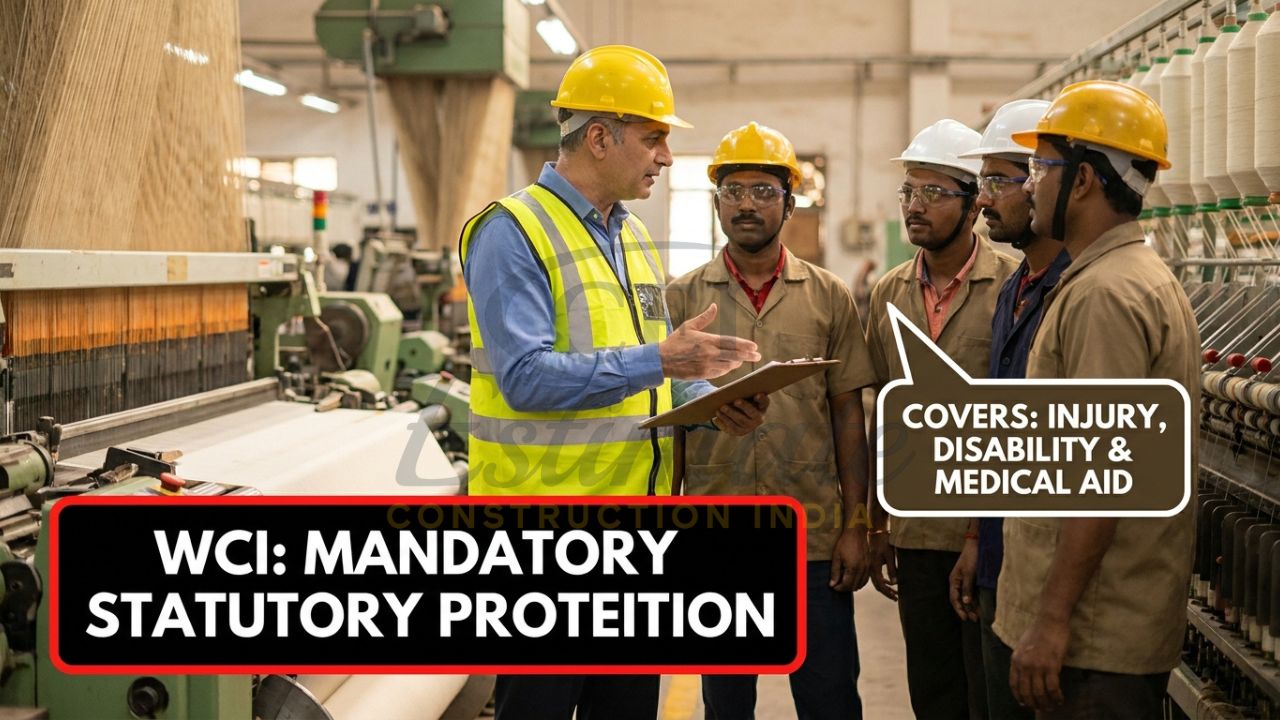
A WCI policy covers these legal liabilities, including medical expenses and structured payouts. In 2026, leading factories also provide Group Health Insurance and Group Personal Accident covers as part of their employee retention strategy. These policies often align with factory-specific requirements and the BOCW Act (for units involving construction-related activities), ensuring that your workers feel secure and your business remains compliant with labor laws.
To understand statutory worker protection requirements, refer to our detailed guide on workers comp requirements for construction businesses in India.
6. Other Important Types
In the hyper-connected world of 2026, manufacturing companies must look beyond the factory gate. Marine/Inland Transit Insurance is essential for protecting your raw materials as they travel from suppliers and your finished goods as they are dispatched to dealers across India. Contractors All Risk (CAR) or Erection All Risk (EAR) policies are necessary whenever you are undertaking plant expansions or installing new, complex production lines.
Furthermore, as “Industry 4.0” integrates IoT and cloud-based management into your shop floor, Cyber Insurance is becoming a new necessity to protect against data breaches or system hacking that can halt production. Finally, Directors & Officers (D&O) Liability insurance protects the personal assets of your leadership team from legal claims related to corporate governance or site safety failures, ensuring that management decisions are not paralyzed by the fear of personal litigation.
For accurate project costing and risk budgeting, see our analysis on how much does builders risk insurance cost in India.
Comparison of Key Types of Insurance for Manufacturing Companies
To help you prioritize your risk management spend, review this detailed comparison based on 2026 Indian market standards.
| Policy Type | Primary Coverage | Sum Insured Basis | Typical 2026 Premium Range | Best For | Key Exclusions |
|---|---|---|---|---|---|
| Fire & Property | Fire, Flood, Natural Perils | Reinstatement Value | 0.05% – 0.15% of Asset | All Factory Owners | Wear and tear, War |
| Machinery Breakdown | Internal Mechanical Failure | Current Replacement Cost | 0.5% – 1.5% of Machine | Engineering/Automated Units | Wilful Negligence |
| Business Interruption | Lost Profits/Fixed Costs | Annual Gross Profit | Linked to Fire Premium | Units with High Overheads | Shutdowns < 48 hours |
| Product Liability | Legal Defense/Claims | Limit of Indemnity | Case-by-case (Risk-based) | Exporters & Consumer Goods | Intentional Malpractice |
| WCI Insurance | Worker Injury/Death | Total Annual Wage Bill | 0.4% – 1.0% of Wages | All Labor-intensive units | Alcohol/Drug influence |
How to Choose and Manage Insurance for Your Manufacturing Unit?
Choosing the right types of insurance for manufacturing companies is a strategic exercise that begins with a deep dive into your operations. A chemical plant in Kanpur has a vastly different risk profile than a garments factory in Noida. Factors such as the nature of your raw materials (flammable vs. inert), the age of your machinery, your factory’s location relative to flood zones, and your claims history will dictate your coverage needs.
Best practices for 2026 include conducting an annual insurance audit. As you add new machinery or expand your warehouse, your sum insured must be updated immediately. Baling policies with a single insurer like ICICI Lombard, HDFC Ergo, or New India Assurance can often lead to “loyalty discounts” and more streamlined claim settlements. Working with specialized industrial brokers who understand the manufacturing sector in North India is highly recommended to ensure no “gaps” exist in your liability covers.
When scaling operations or working with external partners, proper coverage coordination is key. Learn more in our guide on how to get insurance for subcontractors in India.
Cost Considerations and Impact on Business Estimates
In 2026, insurance should never be an “unforeseen” expense; it must be a precise line item in your business estimates and project costing. Fire insurance premiums are generally affordable, but they vary based on the “risk occupancy” (e.g., a plastic factory pays more than a metal shop). Machinery breakdown costs are higher, reflecting the higher probability of localized equipment failure.
For an estimator, including insurance premiums in the factory budget ensures that your product pricing is accurate and your profit margins are protected. For example, allocating approximately 1.5% to 3% of your total operational budget to a comprehensive insurance portfolio is a standard benchmark in 2026. This “fixed soft cost” prevents a single accident from draining your working capital or forcing you to liquidate assets to pay for repairs or legal settlements.
Step-by-Step Guide to Buying Insurance for Manufacturing Companies
- Risk Assessment: List all your critical assets—buildings, machines, stocks—and identify the biggest threats (fire, theft, downtime).
- Calculate Sum Insured: Use 2026 reinstatement values for property and machinery; use gross profit for business interruption.
- Compare Quotes: Obtain quotes from at least three major insurers, focusing on the “Claim Settlement Ratio” and industrial expertise.
- Customize Add-ons: Ensure you include specific clauses like “Removal of Debris,” “Architect’s Fees,” and “Escalation” (to cover inflation).
- Review Annually: Update your policy every time you hire more staff, buy new equipment, or expand your factory footprint.
Conclusion
Mastering the various types of insurance for manufacturing companies is the hallmark of a resilient industrial leader in 2026. From protecting your physical plant with fire insurance to fulfilling your legal duties via workmen compensation, these policies are the invisible foundation of your growth. In an era of unpredictable climate shifts and rapid technological change, risk management is your ultimate competitive advantage.
Don’t let an unforeseen event derail your manufacturing vision. Build with the confidence that your assets and operations are fully protected from the first shift to the final dispatch. At Construction Estimator India, we specialize in providing professional cost estimation and industrial project costing services that accurately incorporate these essential insurance premiums.
Ready to secure your manufacturing unit? Contact us for a professional BOQ or project estimate today.
FAQ Section
What are the main types of insurance for manufacturing companies in India?
The core types include Standard Fire & Special Perils (Fire Insurance), Machinery Breakdown (MBD), Business Interruption, Product Liability, and Workmen Compensation (WCI).
Is fire insurance mandatory for factories?
While not always a legal mandate like WCI, it is practically mandatory for any factory seeking bank loans, as lenders require it to protect their collateral.
What does machinery breakdown insurance cover?
It covers sudden and unforeseen mechanical or electrical failures, including short circuits and structural damage during operation, which standard fire policies exclude.
How much does insurance cost for manufacturing companies?
In 2026, premiums range from 0.05% of asset value for fire to 1.5% for machinery breakdown, generally totaling 1.5%–3% of total operational costs.
What is product liability insurance and who needs it?
It covers legal costs and compensation if your product is defective and causes injury or damage to a consumer. It is essential for exporters and FMCG manufacturers.
Does business interruption insurance cover machinery breakdown?
Yes, if you opt for the “Machinery Loss of Profit” (MLOP) add-on, it covers lost income resulting specifically from a machine failure.
Is Workmen Compensation mandatory for manufacturing units?
Yes, under the Employees’ Compensation Act, it is a legal requirement for any employer to cover site-related injuries or deaths of workers.
What is the difference between fire insurance and machinery breakdown insurance?
Fire insurance covers external perils like fire and floods, whereas MBD covers internal perils like mechanical failure or electrical short-circuits.
How to include insurance costs in manufacturing project estimates?
It should be listed as a “Preliminary” or “Fixed Overhead” line item in your budget, calculated as a percentage of your total asset value and wage bill.
Which insurers are best for manufacturing companies in India?
Top-rated providers in 2026 include New India Assurance, ICICI Lombard, HDFC Ergo, and Bajaj Allianz, known for their industrial claim expertise.
Related Guide Suggestions: