Imagine a mid-sized construction company headquartered in Meerut, securing a prestigious ₹150 crore residential project in the heart of Delhi-NCR. Six months into construction, a severe unseasonal monsoon event—now a recurring phenomenon in 2026—causes a structural collapse of the basement shoring. Simultaneously, a tragic accident on-site leads to two worker fatalities, while falling debris damages a fleet of luxury cars in an adjacent property. Without a tailored portfolio of the right types of insurance for construction companies, this firm faces more than just repair costs; it faces total insolvency, legal debarment, and personal liability for its directors. In the high-stakes Indian infrastructure landscape of 2026, such scenarios are not just “worst-case”—they are statistically probable risks that every large-scale builder must mitigate.
The risks you face as a construction company are layered and complex. You are managing large-scale projects with high capital exposure, coordinating multiple stakeholders, and navigating stringent regulatory compliance under the BOCW Act and RERA. Furthermore, climate risks in regions like Uttar Pradesh and Delhi-NCR have escalated, making financial safeguards non-negotiable. Construction companies today require a comprehensive insurance portfolio that extends far beyond a simple site policy; it must cover your projects, your employees, your heavy machinery, your professional liabilities, and even the personal financial safety of your directors. Proper insurance is no longer a mere line-item expense; it is a strategic tool essential for tender eligibility, securing bank financing from lenders like SBI or HDFC, and ensuring business continuity. This guide provides a detailed breakdown of the essential types of insurance for construction companies, explaining their coverage, 2026 costs, and how to integrate them into your company’s risk management and Bill of Quantities (BOQ).
Why Construction Companies Need a Robust Insurance Portfolio?
In the 2026 infrastructure boom, characterized by rapid expansion in smart cities, high-speed rail, and massive housing projects, your company’s risk profile is higher than ever. You have legal obligations under the BOCW Act (Building and Other Construction Workers Act) and the Employees’ Compensation Act to protect your labor force. Furthermore, the Companies Act 2013 has heightened the accountability of your directors and officers regarding corporate governance and site safety.
Lender requirements have also evolved. Banks almost always mandate a comprehensive contractors all risk policy before releasing project finance. Beyond legalities, you must account for the increasing frequency of natural disasters in North India, such as seismic tremors in Delhi-NCR (Zone IV/V) or flash floods in Uttar Pradesh. Emerging threats like cyberattacks on automated building systems and global supply chain disruptions further necessitate a sophisticated approach to enterprise risk management. The consequences of under-insurance are catastrophic: crippled cash flow, loss of future government contracts, and the potential for directors to be held personally liable for company debts or legal penalties.
For a complete overview of all available protections, read our detailed guide on types of construction insurance in India.
Major Types of Insurance for Construction Companies in India
Navigating the various policies available in the Indian market requires an understanding of what each specifically protects. Below is an overview of the core construction company insurance India portfolio.
| Insurance Type | Primary Purpose | Who it Protects |
|---|---|---|
| CAR Insurance | Comprehensive project protection for civil works. | Company, Owners, & Partners |
| EAR Insurance | Protection for machinery installation and testing. | EPC Contractors & Industrial Builders |
| WCI / EL | Statutory cover for worker injury or death. | The Entire Labor Force |
| CPM Insurance | Fleet protection for heavy machinery and cranes. | Equipment Departments & Owners |
| CGL Insurance | Broad liability for third-party damage or injury. | The Construction Company Entity |
| PI Insurance | Protection against design and supervision errors. | Architects & Structural Engineers |
| D&O Insurance | Protects directors from personal financial loss. | Directors, CEOs, & Officers |
1. Contractors’ All Risk (CAR) Insurance
For many firms, CAR insurance for construction companies is the cornerstone of their project-specific risk strategy. This policy is recognized as the “gold standard” for civil engineering projects, from residential villas in Meerut to large-scale flyovers in Noida. It provides a dual shield: covering physical loss or damage to the construction works (including materials on-site) and offering a primary layer of third-party liability.
Crucially, CAR insurance for construction companies covers perils such as fire, earthquake, flood, and theft of high-value materials like steel and cement. The sum insured must be based on the total contract value plus a percentage for price escalation—vital in 2026 as material rates continue to fluctuate. Most policies include a “maintenance period” to cover defects that might arise shortly after handover. For your company, this ensures that a single site catastrophe doesn’t drain the reserves of the entire organization.
For accurate project costing, explore our analysis on how much is insurance for construction in India.
2. Erection All Risk (EAR) Insurance
While CAR is designed for civil works, you need contractors all risk policy for companies specifically tailored for mechanical and electrical risks if you are involved in industrial plants, power projects, or telecommunications. This is known as Erection All Risk (EAR) insurance.
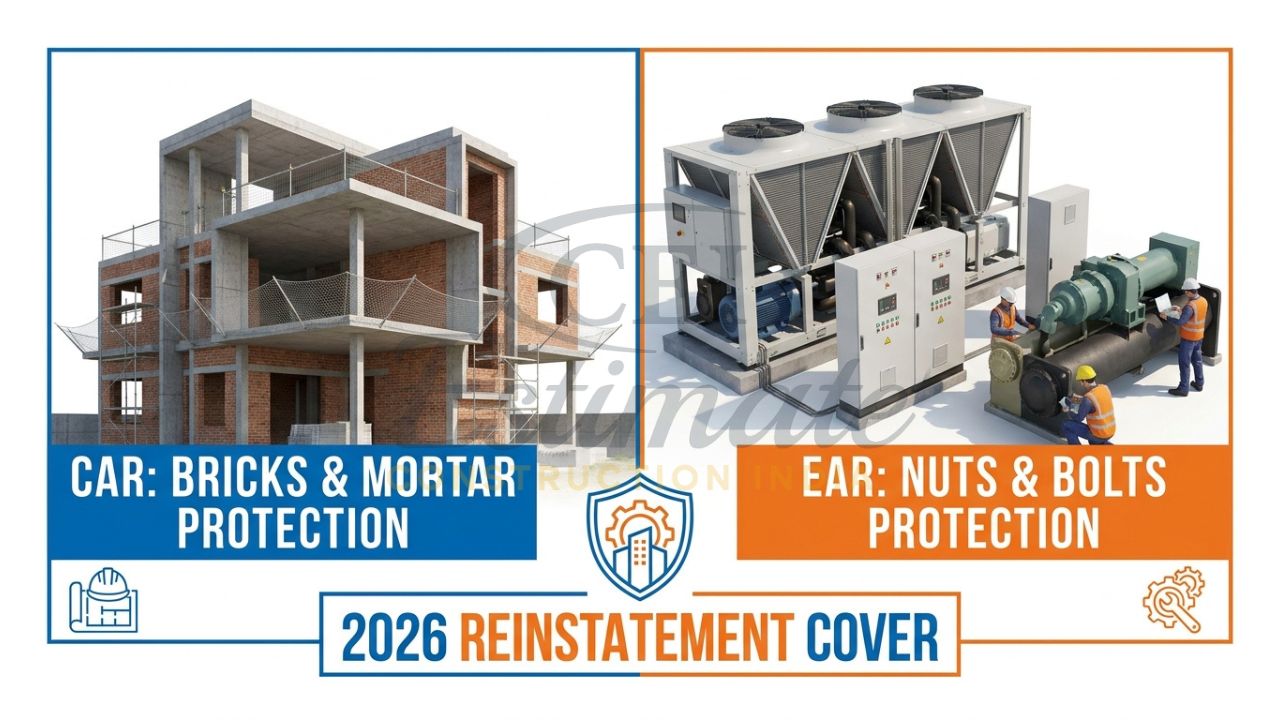
The key difference lies in the focus on “nuts and bolts” rather than “bricks and mortar.” EAR insurance covers the machinery from the moment it is unloaded at the site, through storage and assembly, until final testing and commissioning are complete. In 2026, as many companies in North India pivot toward renewable energy and automated manufacturing units, EAR is essential because a calibration error during a trial run can result in millions in losses that a standard building policy would exclude.
3. Workmen Compensation Insurance & Group Accident Covers
In India, workmen compensation for construction companies is not just a benefit; it is a statutory mandate. Under the Employees’ Compensation Act 1923 and the BOCW Act, your company is legally liable to compensate any worker who suffers an injury, disability, or death while on your site.
A robust WCI policy covers these legal liabilities, including medical expenses and legal defense costs. In 2026, many leading construction firms are integrating WCI with group personal accident covers and government schemes like PMSBY to provide a more comprehensive safety net. Failing to maintain this insurance can lead to project shutdowns by authorities and heavy fines that can jeopardize your company’s license to operate.
To understand worker-specific protections in depth, refer to our guide on insurance for construction workers in India.
4. Contractors Plant & Machinery (CPM) / Equipment Insurance
Your fleet of tower cranes, excavators, and JCBs represents a massive capital investment. Contractors Plant & Machinery (CPM) insurance provides specific protection for these assets. While some CAR policies allow machinery to be added as an “add-on,” large construction companies typically prefer a standalone CPM fleet policy.
This policy protects your assets against accidental damage, mechanical breakdown (while working or at rest), and theft. For a company moving equipment across various sites in the Delhi-NCR region, CPM insurance is often a requirement from financing companies to ensure the asset’s value is protected regardless of its current location. It covers the equipment during transit, ensuring your fleet is always “on the grid” and protected.
5. Liability and Professional Insurance for Construction Companies
As your company grows, your liability exposure increases. Beyond site damage, you must protect your corporate entity and its leadership:
- Commercial General Liability (CGL): This is a broader umbrella than the liability section of a CAR policy. It covers public liability across all your business operations, protecting you if a visitor is injured at your head office or if your activities damage a neighbor’s property on a project you completed years ago.
- Professional Indemnity (PI) Insurance for Construction Firms: Essential for companies offering “Design and Build” services. It protects against claims of professional negligence, design errors, or faulty supervision that lead to financial loss for the client.
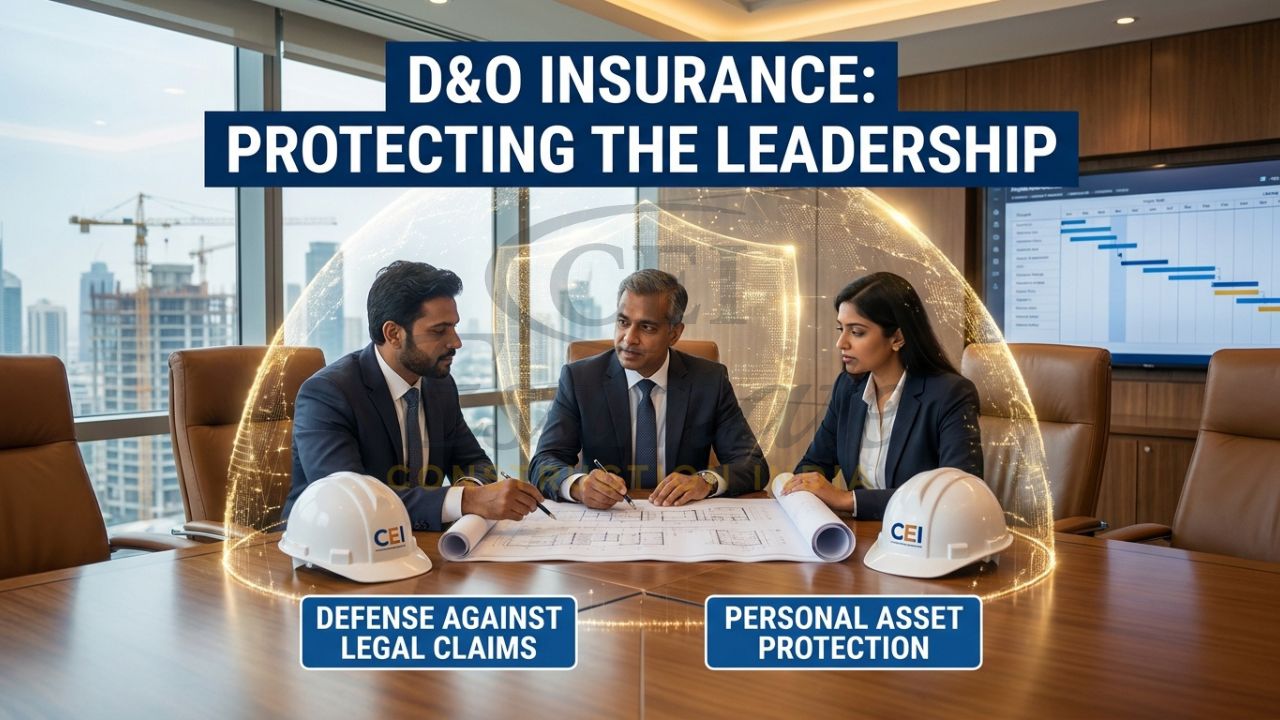
- Directors and Officers (D&O) Liability Insurance: In 2026, this is critical for company directors. It protects your personal assets from being seized to pay for legal defense or settlements if you are sued for “wrongful acts” in your capacity as a director, such as mismanagement of company funds or failure to implement safety protocols.
- Employers Liability: This covers you for claims made by employees that fall outside the strict scope of the Workmen Compensation Act.
For companies focused on commercial and large-scale work, specific compliance is essential. Read our guide on commercial construction insurance requirements in India.
6. Other Essential Types of Insurance for Construction Companies
Modern construction companies in 2026 are also adopting specialized covers to address niche risks:
- Marine Cargo / Inland Transit: Protects your materials (like imported marble or high-grade steel) while they are being transported from suppliers to your various sites.
- Advance Loss of Profits (ALOP): Also known as Delay in Start-up (DSU), this covers the loss of revenue if a project’s completion is delayed due to an insured event like a fire or flood.
- Cyber Insurance: As sites become “smarter” with IoT and automated project management software, this protects against data breaches and system hacking.
- Group Health / Mediclaim: Enhances your employee retention by providing health benefits to your permanent staff and engineers.
- Key Man Insurance: Protects the company financially if a critical leader or specialist (the “Key Man”) suffers a disability or death.
Smaller or growing firms should check best insurance for small construction business in India for tailored and affordable packages.
Comparison Table of Types of Insurance for Construction Companies
To help you structure your company’s insurance strategy, review this detailed comparison based on 2026 market standards in India.
| Policy Name | Sum Insured Basis | Typical 2026 Premium | Key Exclusion |
|---|---|---|---|
| CAR Insurance | Total Contract Value | 0.50% – 1.5% | Normal wear and tear |
| EAR Insurance | Machine + Erection Cost | 0.60% – 2.0% | Faulty design/workmanship |
| WCI Insurance | Annual Wage Bill | Based on Risk Class | Willful negligence of worker |
| CPM Insurance | Market Value of Asset | 1.0% – 2.5% | Breakdown from overloading |
| D&O Insurance | Limit of Indemnity | Variable | Fraudulent acts / criminal intent |
| CGL Insurance | Limit per Accident | 0.1% – 0.5% | Contractual liabilities |
How Construction Companies Should Choose and Manage Insurance?
Choosing the right types of insurance for construction companies is a strategic decision that should involve your CFO and a specialized insurance broker. You must consider your project portfolio—residential projects in Meerut have different risk profiles than high-tech industrial plants in Noida. Your risk appetite and the specific “Insurable Interest” of your stakeholders also play a role.
Best practices for 2026 include conducting an annual insurance audit to ensure no “gaps” exist between project-specific policies and company-wide liability covers. For large firms, negotiating “Master Policies” or group covers can lead to significant cost efficiencies compared to buying individual policies for every small contract.
Cost of Insurance for Construction Companies in India 2026 & Impact on Estimates
In 2026, construction company insurance India costs remain manageable if planned correctly. CAR premiums generally range from 0.5% to 1.5% of the total project value. However, for a professional construction estimator, insurance should never be a “lump sum” guess.
How to include insurance costs in construction company BOQ: You must list insurance as a distinct line item in your Bill of Quantities (BOQ). By categorizing it under “Preliminaries” or “Project Overheads,” you ensure your bid is both competitive and protected. Including the premium for the entire construction period, plus the maintenance period, prevents your profit margins from being eroded by “soft costs”.
Step-by-Step Guide to Procuring Insurance for Construction Companies
- Risk Assessment: Evaluate your current projects and fleet to identify gaps in coverage.
- Define Reinstatement Values: Use 2026 rates to ensure your sum insured reflects the actual cost to rebuild.
- Obtain Multiple Quotes: Compare offerings from insurers like ICICI Lombard, HDFC Ergo, or New India Assurance.
- Review IRDAI Guidelines: Ensure your policy aligns with the latest IRDAI guidelines for construction companies to ensure faster claim settlements.
- Finalize Add-ons: Always include “Escalation” clauses to account for rising material costs during the project duration.
When working with multiple parties, proper documentation is key. Learn how to obtain a certificate of insurance for contractors in India.
Conclusion
Mastering the various types of insurance for construction companies is what separates a stable, long-term industry leader from a firm that is one accident away from bankruptcy. From protecting your massive civil projects with CAR insurance to safeguarding your leadership with D&O liability, these policies are the invisible foundation of your company’s growth. In the competitive Indian landscape of 2026, comprehensive risk management is your ultimate competitive advantage.
Don’t let an unforeseen event derail your corporate vision. At Construction Estimator India, we specialize in providing professional BOQs and cost estimation services that accurately factor in all necessary insurance costs. Build with confidence by ensuring your company is fully protected.
- Need a Professional BOQ for your next project? Person
- Contact us for a Company Risk Audit: Person
- Read our guide on How to Include Insurance in Construction Cost Estimation for more expert tips.
FAQ Section
What are the main types of insurance for construction companies in India?
The core types include Contractors’ All Risk (CAR), Erection All Risk (EAR), Workmen Compensation Insurance (WCI), Contractors Plant and Machinery (CPM), and Commercial General Liability (CGL).
What does CAR insurance cover for construction companies?
It covers physical damage to the works (due to fire, flood, etc.) and third-party liability for bodily injury or property damage during construction and maintenance.
Is Directors and Officers (D&O) insurance necessary for construction firms?
Yes, it protects the personal assets of directors and officers from legal claims arising from their management decisions or corporate governance failures.
How much do different types of insurance cost for construction companies in 2026?
CAR premiums are usually 0.5%–1.5% of the project value, while CPM insurance costs 1.0%–2.5% of the asset’s market value.
What is the difference between CAR and EAR insurance for contractors?
CAR is for civil construction (buildings, bridges), while EAR is for the installation and testing of mechanical/electrical machinery and industrial plants.
How to include insurance costs in BOQ for construction company projects?
Include them as a “Fixed Soft Cost” or “Preliminary” line item. Calculate it as a percentage of the total project value based on current market quotes.
Is Workmen Compensation mandatory for construction companies?
Yes, it is legally mandatory under the Employees’ Compensation Act 1923 and the BOCW Act for any company hiring construction labor in India.
What is Professional Indemnity insurance for construction companies?
It protects the company against claims of negligence or errors in design, engineering, or supervision services.
Can small construction companies afford comprehensive insurance?
Yes, insurance is highly affordable relative to the risks it covers. Many insurers offer “package policies” tailored for smaller firms at lower premiums.
Which insurers are best for construction companies in India?
Top-rated insurers include ICICI Lombard, HDFC Ergo, Bajaj Allianz, and government entities like New India Assurance.