Designing a north facing house plan is a top priority for many Indian homeowners due to the unique blend of natural light, ventilation, and traditional beliefs associated with prosperity and financial growth. In simple terms, a north-facing home is one where the main entrance faces the north direction, or the access road is on the northern side of the plot. This orientation is highly sought after in the Indian climate because it allows for a consistent, soft light throughout the day without the intense heat gain associated with west or south-facing walls. Smart planning of your home construction in India ensures that your layout maximizes these natural advantages while maintaining privacy and keeping construction costs under control.
If you are planning a north facing house and want to know how much it could cost on your plot, you can contact Construction Estimator India on WhatsApp / Call +91 8630676890.
Understand North Facing Plots and Orientation
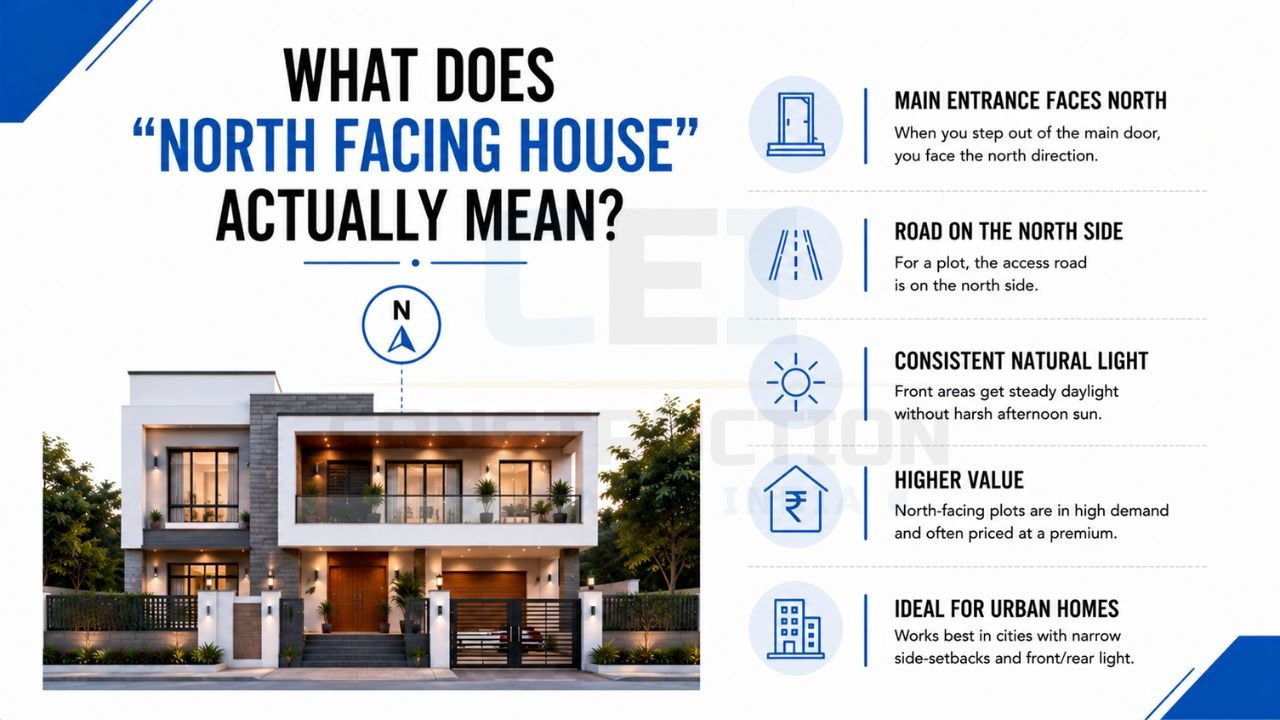
What Does “North Facing House” Actually Mean?
A house is considered north-facing when you stand at the main entrance door and face the north direction as you exit the house. For a vacant plot, it means the road that provides access to the property is located to the north. In India, north-facing plots are often priced at a premium because they allow the front of the house—where the living room and balconies usually sit—to receive constant daylight without the scorching afternoon sun. This orientation is particularly beneficial for urban homes where side-setbacks are narrow and light mainly enters from the front and rear.
Sunlight, Climate, and Comfort in North Facing Homes
The north direction provides what architects call “indirect light.” Unlike the east, which gets bright morning rays, or the west, which gets harsh evening heat, the north side remains relatively cool and bright. Integrating sustainable design principles recommended by the Indian Green Building Council (IGBC) can further optimize this thermal comfort.
- Cooler Interiors: Rooms on the north side generally stay cooler during the peak summer months.
- Consistent Lighting: Ideal for home offices, studies, or art studios where you need steady light without glare.
- Energy Efficiency: By placing large windows on the north, you can illuminate your living spaces naturally, reducing the need for artificial lighting during the day.
👉 Planning a North-Facing House? Get Expert Guidance for Design, Vastu, and Construction.
North Facing House in Simple Vastu Terms (Non‑technical)
In the context of Indian home design, north is often called the direction of wealth and success. This is because, in traditional Vastu Shastra, the north is associated with the deity of wealth. Practically speaking, this translates to a layout that encourages open, clutter-free spaces in the front of the house. Most designers suggest keeping the North-East corner of the plot light and open—perhaps for a garden or a small water feature—while keeping the heavier structural elements like the master bedroom or staircase toward the South and West.
Study Plot Size, Shape, and Basic Regulations
Common Plot Sizes and Frontages for North Facing Houses
In Indian residential colonies, plot sizes often dictate the complexity of your north facing house design. Common dimensions include:
- 30×40 (1200 sq ft): Ideal for a 3BHK duplex or a spacious 2BHK ground-floor unit.
- 30×50 (1500 sq ft): Offers more room for a dedicated car porch and a small garden.
- 40×60 (2400 sq ft): Allows for a grand frontage with multiple windows and a wrap-around veranda.
The “frontage”—the width of the plot facing the road—is crucial. A wider frontage for a north-facing plot means you can have both a wide gate and a large window for the living room, ensuring maximum curb appeal.
Setbacks, Road Width, and Parking Constraints
Building regulations in most Indian cities, often aligned with guidelines from the Ministry of Housing and Urban Affairs (MoHUA), require “setbacks”—mandatory open spaces between your building and the boundary wall. For a north-facing plot, the front setback is usually the deepest. This space acts as your driveway and entry garden.
- Road Width: If the road is narrow (less than 30 feet), you must plan your gate and porch with a wider turning radius for your vehicle.
- Local Bylaws: Always check the Floor Area Ratio (FAR) or Floor Space Index (FSI) allowed in your city.
- Construction Estimator India provides guidance on planning built‑up area and structural elements in line with these local constraints and your target budget.
How Plot Shape Influences North Facing House Layout?
A rectangular plot is the most efficient for construction. However, if your plot has an irregular shape or “cuts” in the corners, it can impact both the design and the cost. Irregular shapes often lead to wasted space and higher material costs due to complex structural requirements involving specific foundation types for house construction.
You can share your plot size, city, and basic requirements with Construction Estimator India to get a rough idea of construction cost and quantity takeoff for your north facing home.
Entrance, Parking, and Frontage Planning
Main Gate and Entry Path for North Facing Plots
The entrance is the most important part of a north facing house plan. In modern designs, the gate is usually placed toward the North-East or the center-north padas (sectors). A wide, welcoming gate allows positive energy—and guests—to flow in easily. The path from the gate to the front door should be well-lit and unobstructed. Using high-quality granite or anti-skid tiles for this pathway enhances the professional look of the house.
Parking and Porch in a North Facing House Plan
For a 30×40 or larger plot, a dedicated car porch is essential. Ideally, this should be located in the North-East or North-West corner of the frontage.
- Standard Size: A 10×15 ft porch is sufficient for most Indian hatchbacks and sedans.
- Porch Height: Ensure the porch height does not block the ventilation of the living room windows.
- Materials: Using a cantilevered RCC slab (understanding what is RCC construction helps here) for the porch provides a modern look but adds to the structural cost.
Front Landscape, Steps, and Veranda Options
Since the north side gets gentle light, it is the perfect spot for a small front garden or a raised veranda. A veranda serves as a buffer zone, keeping dust away from the main house and providing a pleasant sitting area. Even a 4-foot wide veranda can significantly improve the “feel” of a north-facing entrance.
Planning Key Rooms in a North Facing House
Living Room and Dining Placement
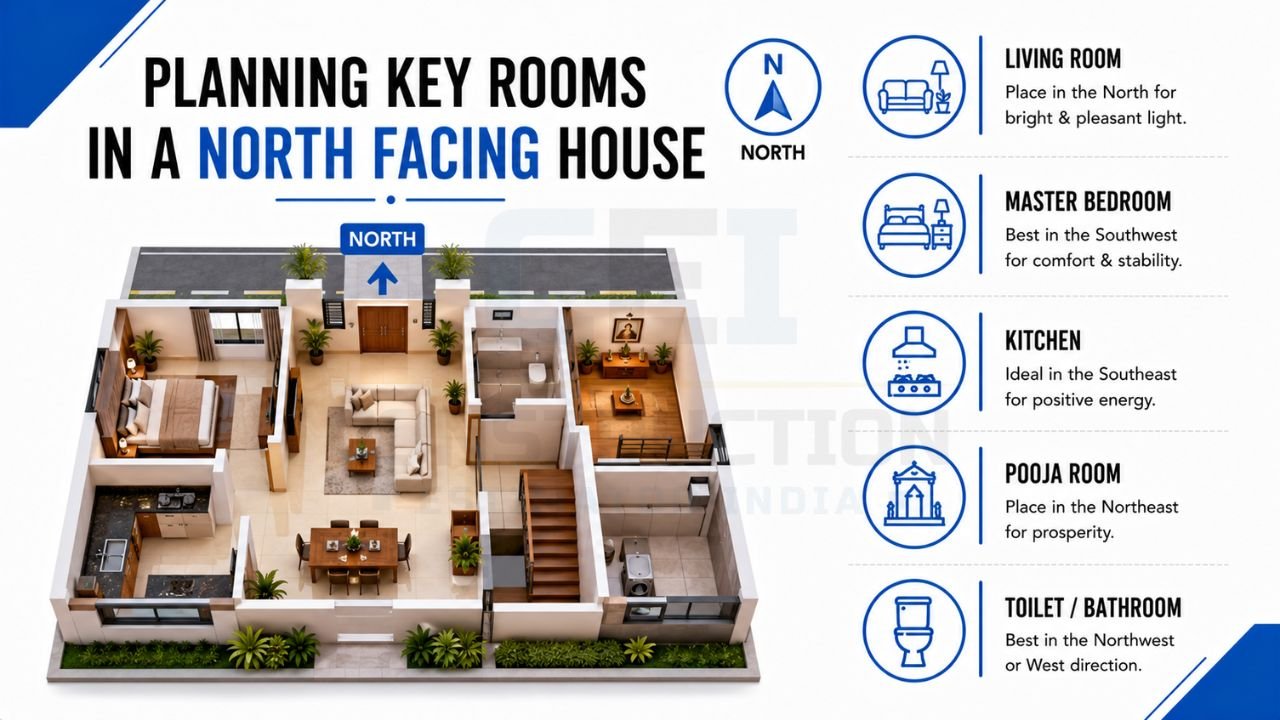
In a north facing house plan, the living room is best placed in the North-East or the North-center area. This ensures the room stays bright throughout the day. If you have a large family, consider an “open-plan” layout where the living and dining areas are connected. This creates a sense of vastness even on smaller 1200 sq ft plots. Large sliding glass doors on the north wall of the living room can connect the indoor space to a front balcony or veranda.
👉 Build a North-Facing Home That Combines Smart Design with Vastu Principles.
Kitchen Placement in a North Facing Plan
The kitchen is the “fire” element of the home. In most Indian layouts, the South-East corner (the Agni corner) is the preferred location for the kitchen.
- Practical Placement: If the South-East is not available, the North-West is the second-best option.
- Ventilation: Ensure there is a large window above the sink or cooking platform to allow smoke to escape and light to enter.
- Plumbing: Placing the kitchen near a utility area simplifies plumbing and waste disposal.
Bedroom Placement (Master, Children, Guest)
Privacy and stability are the main goals for bedroom placement.
- Master Bedroom: Should ideally be in the South-West corner of the house. This provides the most privacy and is considered a zone of stability.
- Children’s Bedroom: The North-West or West is often chosen for children’s rooms or study areas.
- Guest Bedroom: Can be placed in the North-West or near the living area for easy access without disturbing the private family zones.
Before you finalise your north facing house plan with the architect, Construction Estimator India can help you estimate your budget and compare different layout options.
Stairs, Toilets, and Service Areas
Staircase Position in a North Facing Layout
The staircase is a “heavy” structural element. In a north-facing house, it should ideally be placed in the South, West, or South-West part of the building. Placing a staircase in the North-East corner is generally avoided as it blocks the soft morning and northern light.
- Internal vs. External: If you plan to rent out the first floor, an external staircase is necessary. If it is a private duplex, an internal staircase in the living room can become a beautiful architectural feature.
- Cost Factor: Helical or spiral stairs look great but are more expensive than standard “dog-legged” stairs.
Toilet and Bathroom Placement
Sanitation zones should be placed in areas that handle waste effectively, adhering to quality standards often directed by the Central Public Works Department (CPWD).
- Ideal Locations: The North-West or South-East zones are typically used for toilets.
- Vertical Stacking: In multi-story houses, try to stack bathrooms vertically to save on plumbing and piping costs.
-
Waterproofing: Never compromise on the quality of waterproofing (learning how to use white cement for waterproofing in India is helpful for minor repairs), as leaks can damage the structural integrity of the entire floor.
Utility, Store, and Service Areas
Utility areas for washing machines and gas cylinders are best tucked away in the South-East or North-West corners, usually attached to the kitchen. A small store room near the kitchen or under the staircase helps keep the main house clutter-free. These “service cores” should be planned early to ensure they don’t block windows or natural air paths.
Simple Vastu‑Friendly Approach for North Facing Homes
Basic Vastu Ideas Without Overcomplication
You don’t need to be an expert to follow basic Vastu for a north facing house plan. The core principle is: “Keep the North and East light and open; keep the South and West heavy and closed.”
- Water: Underground water tanks are best in the North-East.
- Slopes: If possible, ensure the plot or the flooring has a very slight slope toward the North or East to help with drainage and energy flow.
- Colors: Use lighter shades like off-white, cream, or light blue for north-facing rooms to reflect the natural light.
Balancing Vastu with Practical Design and Budget
Sometimes, strict Vastu rules can conflict with modern plot constraints or your personal budget. For example, moving a kitchen to a specific corner might require expensive plumbing routes. Functional comfort and structural safety aligned with the Bureau of Indian Standards (BIS) should always come first.
- Priority: Functional comfort and structural safety should always come first.
- Remedies: If a room cannot be in its “perfect” corner, architects often use colors, mirrors, or specific lighting to balance the space without costly structural changes.
When to Talk to Architect/Estimator About Vastu Adjustments
The best time to make these decisions is during the “conceptual stage” on paper. Making changes after the foundation is laid is extremely expensive. Construction Estimator India helps homeowners estimate construction costs and quantities for different orientations, ensuring that your Vastu choices don’t lead to “budget shocks” later.
Cost Planning and Budgeting for a North Facing House
What Really Affects Cost (Orientation vs Size, Materials, Features)
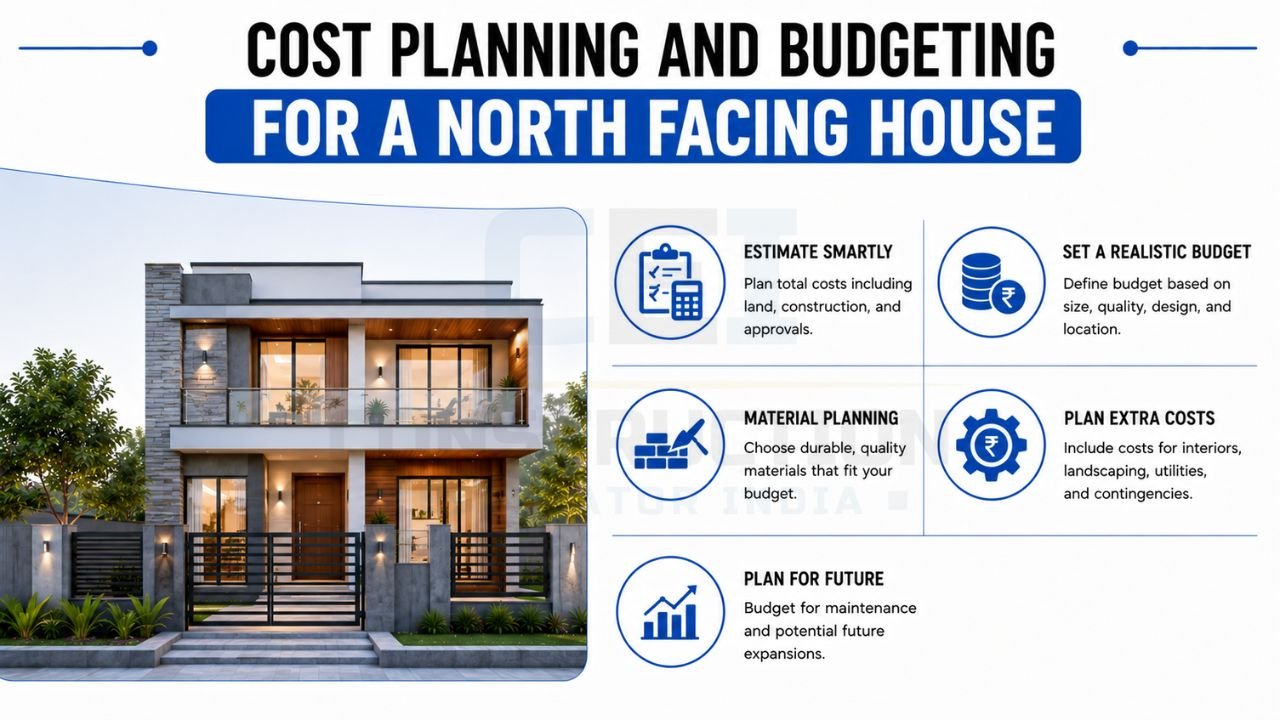
While orientation itself doesn’t significantly change the price of bricks and steel, the design choices driven by a north facing house plan do.
- Glass Work: Large north-facing windows for better light will cost more than standard brick walls.
- Front Elevation: North-facing homes often have more decorative front elevations. Your localized plaster cost per square foot with material in India will significantly impact this phase.
- RCC Structure: The “Grey Structure” (columns, beams, slabs) usually accounts for 40-50% of your total budget.
👉 Get Customized North-Facing House Plans and Accurate Cost Estimates from Industry Experts.
Built‑up Area vs Budget: Simple Thinking
Establishing your baseline house construction per sq ft rate in India early ensures you don’t overspend on the structure at the expense of finishing. In the current Indian market, construction costs can range from ₹1,800 to ₹3,500 per sq ft depending on the quality of finishes.
- Example: If your total budget is ₹40 Lakhs and the rate is ₹2,000 per sq ft, you should aim for a total built-up area of 2,000 sq ft.
- The Trap: Many homeowners try to build a larger area with a smaller budget, leading to poor-quality flooring, plumbing, and electrical work.
How Construction Estimator India Helps With Quantity and Cost Estimation?
Building a home is a journey of a thousand steps. Construction Estimator India acts as your financial guide, providing detailed Bill of Quantities (BOQ) and quantity takeoffs.
- Material Estimation: We tell you exactly how many bags of cement, tons of steel, and thousands of bricks you will need.
- Budget Control: By knowing the quantities beforehand, you can negotiate better rates with local contractors.
- Support: We offer support for self‑construction planning and material estimation, helping you stay in control of your site.
If you are planning a north facing house and want to understand realistic construction costs for your plot, you can contact Construction Estimator India on WhatsApp / Call +91 8630676890 for practical estimation support.
Common Mistakes in North Facing House Plans
Over‑focusing on Direction and Ignoring Basic Comfort
A common mistake is following Vastu so strictly that the house becomes dark or claustrophobic. For instance, avoiding a window on a certain wall because of a “rule” might result in a room that needs a lightbulb even at noon. Always prioritize natural light and cross-ventilation.
Poor Entrance and Parking Planning
Many people build a beautiful gate but forget the size of their future car. If the gate is too narrow or the porch is too short, you will end up parking on the road. Also, avoid having the main entrance door open directly into a cluttered kitchen or a toilet door.
Not Considering Future Changes or Extensions
If you are building a single-story house today but might add a first floor later, your current foundation must be designed for that extra load. Communicating this to your estimator is vital. Construction Estimator India provides guidance on planning built‑up area and structural elements to ensure your home can grow with your family.
👉 Start Your North-Facing House Project with Professional Planning and Cost Analysis.
FAQs: North Facing House Plan in India
Is a north facing house always better than other directions?
It is highly preferred because of the indirect lighting and cooling benefits in the Indian climate. However, any direction can be made excellent with smart architectural planning.
How should I place my kitchen in a north facing house?
The South-East (Agni corner) is the best choice for the kitchen. If that isn’t possible, the North-West is a solid alternative.
Can a small plot still have a good north facing house plan?
Yes. On small plots (like 20×40), vertical expansion (duplex) is the best way to get a functional north-facing layout with a dedicated car porch.
Does a north facing house cost more to build?
The orientation doesn’t change the material cost. However, premium front elevations and larger window sizes common in north-facing designs may slightly increase the finishing budget.
When should I contact an estimator like Construction Estimator India during planning?
The best time is after your architect provides the first “Draft Plan” but before you finalize the structural drawings. This allows you to adjust the design if the costs exceed your budget.
Conclusion: Design Your North Facing House for Light, Comfort, and Budget
A north facing house plan offers a fantastic opportunity to build a home that is naturally bright, thermally comfortable, and aligned with traditional prosperity. By focusing on a smart entrance, placing your kitchen and master bedroom in their ideal zones, and keeping your Vastu simple and practical, you can create a sanctuary for your family.
The most critical step, however, is knowing your numbers. Home construction is a major financial commitment, and “guessing” the cost often leads to stress. Always estimate your budget early to ensure a smooth, happy building experience.
Construction Estimator India is here to support you with professional-grade estimation and planning insights. Before you lay the first brick, reach out to us for clarity and precision.
Contact Construction Estimator India today:
- WhatsApp / Call: +91 8630676890
- Website: https://constructionestimatorindia.com/