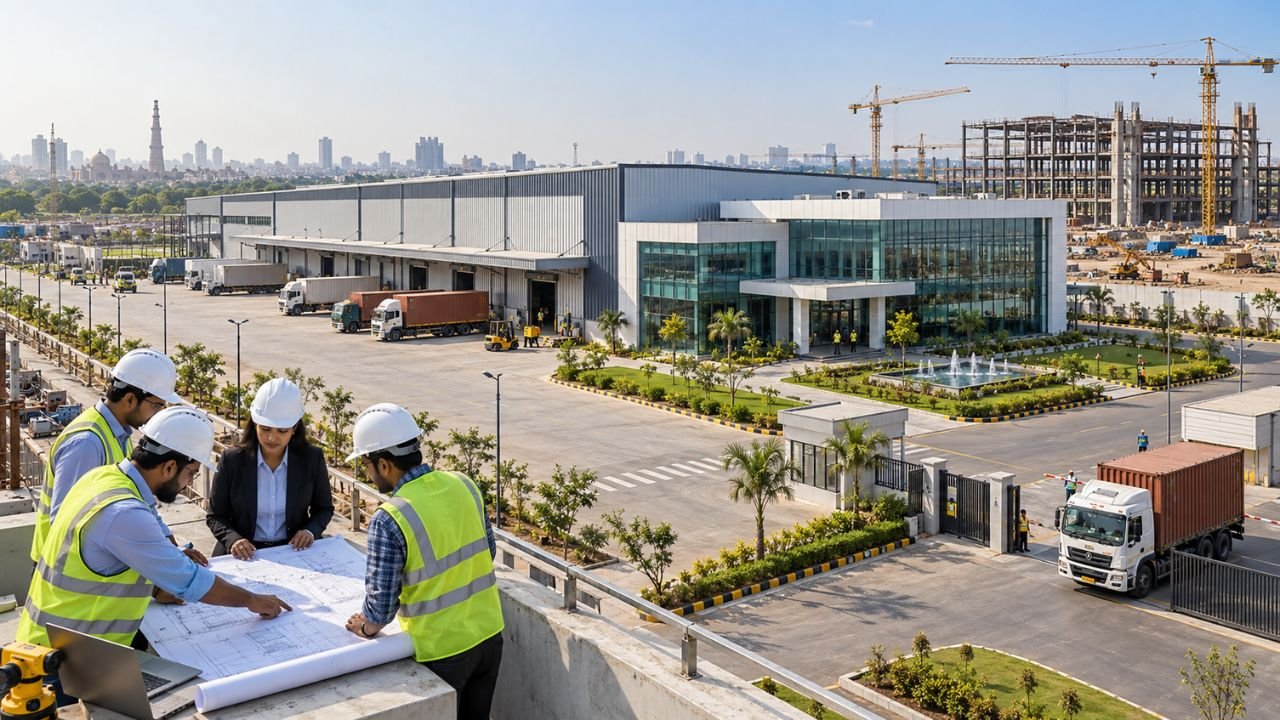
Designing an east facing house plan is a priority for many Indian families due to its reputation for bringing health, prosperity, and abundant natural light. When you build a home where the main entrance or the plot itself faces east, you align your lifestyle with the rising sun, creating a vibrant living environment. Smart planning of your layout ensures that this orientation translates into actual comfort and long-term value.
👉 Planning an East-Facing House? Get Expert Guidance for Design, Vastu, and Construction.
Understanding how to plan home construction in India begins with analyzing your plot’s orientation. If you are planning an east facing house and want to know how much it could cost on your plot, you can contact Construction Estimator India on WhatsApp / Call +91 8630676890.
Understand East Facing Plots and Orientation
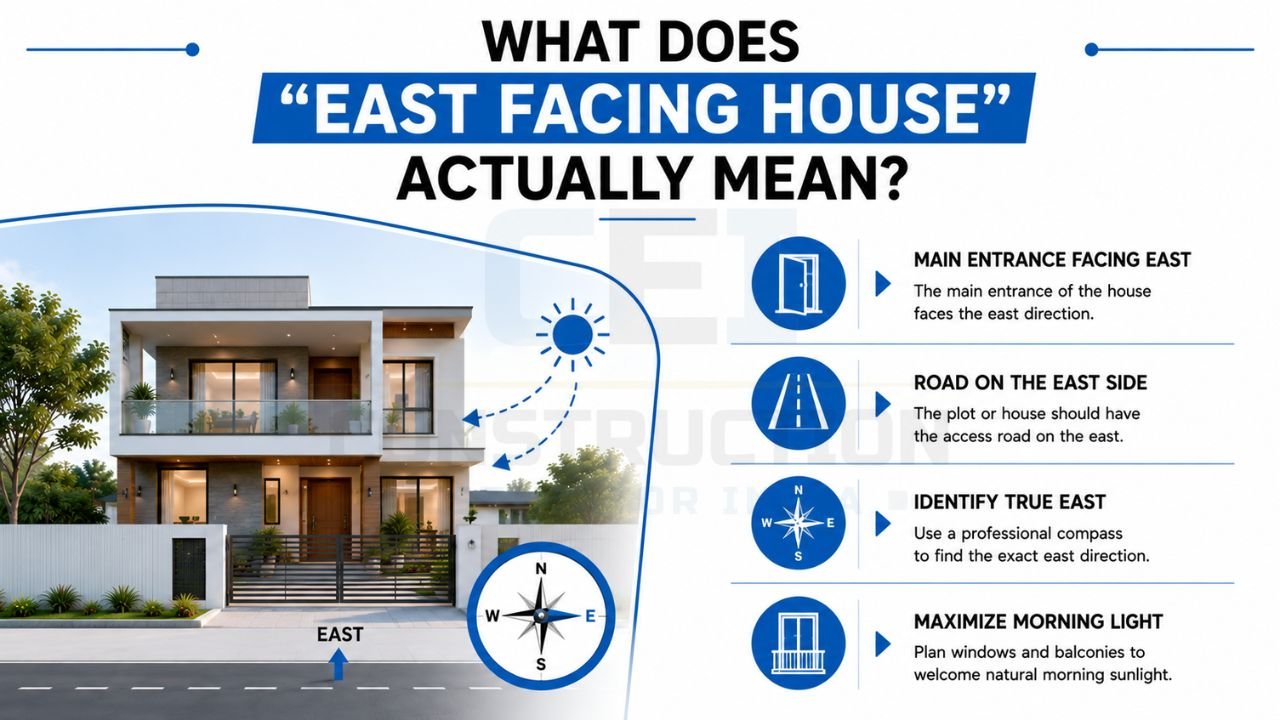
What Does “East Facing House” Actually Mean?
In simple terms, an east facing house is one where the main entrance faces the east direction. For a plot, it means the access road is on the eastern side. In India, this orientation is highly valued because it allows the first rays of the morning sun to enter the home, which is both culturally significant and scientifically beneficial as a natural disinfectant. However, “east” can vary slightly depending on the time of year and geographical location, so accurate measurement is key.
- Determine orientation based on the main entrance gate.
- The road should ideally be on the east side of the building.
- Ensure the “True East” is identified using a professional compass.
- Understanding orientation helps in deciding the placement of windows and balconies to maximize morning light.
Sunlight, Climate, and Comfort in East Facing Homes
Sunlight is the biggest advantage of an east facing house design. Morning sun is gentle and provides Vitamin D, while afternoon sun (which is harsher in India) usually hits the rear or side of the house. This natural cycle helps keep the front living areas bright early in the day and relatively cooler during the peak summer afternoons. Integrating sustainable design principles from the Indian Green Building Council (IGBC) can further optimize this thermal comfort.
- Place large windows in the east to capture morning rays.
- Use sunshades or “chajjas” to prevent excessive heat during late morning.
- Plan for cross-ventilation to ensure air doesn’t become stagnant.
- The thermal comfort of an east-facing home is generally superior in the Indian climate if the rear walls are well-insulated.
👉 Turn Your East-Facing House Plan into a Beautiful and Well-Planned Home.
East Facing House in Simple Vastu Terms
While this guide focuses on practical design, basic Vastu awareness is common in India. In practical terms, Vastu for an east facing house suggests that the Northeast corner (Ishaan) should be kept light and open, while the Southwest (Nairutya) should be heavy and solid. This creates a flow of energy that matches the solar path. Most Indian homeowners prefer an east-facing entrance because it is traditionally associated with the “Surya Dev” (Sun God), signifying power and growth.
- Keep the Northeast corner clean and open.
- Ensure the main door is placed in auspicious “padas” like Jayanta or Indra.
- Avoid placing heavy structures like stairs or toilets in the Northeast.
- Construction Estimator India can help you review your layout to ensure it balances these traditional needs with your modern budget.
Study Plot Size, Shape, and Basic Regulations
Common Plot Sizes and Frontages for East Facing Houses
In Indian residential planning, plot sizes often dictate the complexity of an east facing house plan. Common sizes include 30×40 (1200 sq ft), 30×50 (1500 sq ft), and 40×60 (2400 sq ft). The “frontage”—the width of the plot facing the road—is crucial. A wider frontage allows for a grander entrance and more windows facing east, whereas a narrow plot requires creative zoning to ensure light reaches the middle of the house.
- 30×40 plots are ideal for compact 2 or 3 BHK duplexes.
- Wider plots (40+ feet) allow for a side garden or better car parking layouts.
- Narrow plots (20-25 feet) should use skylights or internal courtyards.
- You can share your plot size and city with Construction Estimator India to establish your baseline house construction per sq ft rate for an accurate quantity takeoff.
Setbacks, Road Width, and Parking Constraints
Building regulations or “by-laws” in India, often structured by the Ministry of Housing and Urban Affairs (MoHUA), require you to leave space between your building and the boundary wall, known as setbacks. For an east facing plot, the front setback is the most important as it serves as your entry transition.
- Check local municipal rules for mandatory front and rear setbacks.
- Typically, leave more space in the North and East than in the South and West.
- Ensure the road width is sufficient for emergency vehicle access.
- Parking areas should be integrated into the front setback without blocking the main entrance path.
How Plot Shape Influences East Facing House Layout?
A perfectly rectangular plot is ideal, but many Indian plots are irregular. The shape determines how you can distribute the “built-up area.” Irregular shapes might lead to higher construction costs due to complex structural designs involving specific foundation types for house construction.
- Rectangular plots offer the most efficient room distribution.
- Avoid sharp angles in room corners to save on furniture costs and labor.
- If the plot is deep, use a central “Brahmasthan” or courtyard to bring light into the center.
- Structural complexity increases costs; Construction Estimator India provides guidance on planning built-up area and structural elements in line with your budget.
Entrance, Parking, and Frontage Planning
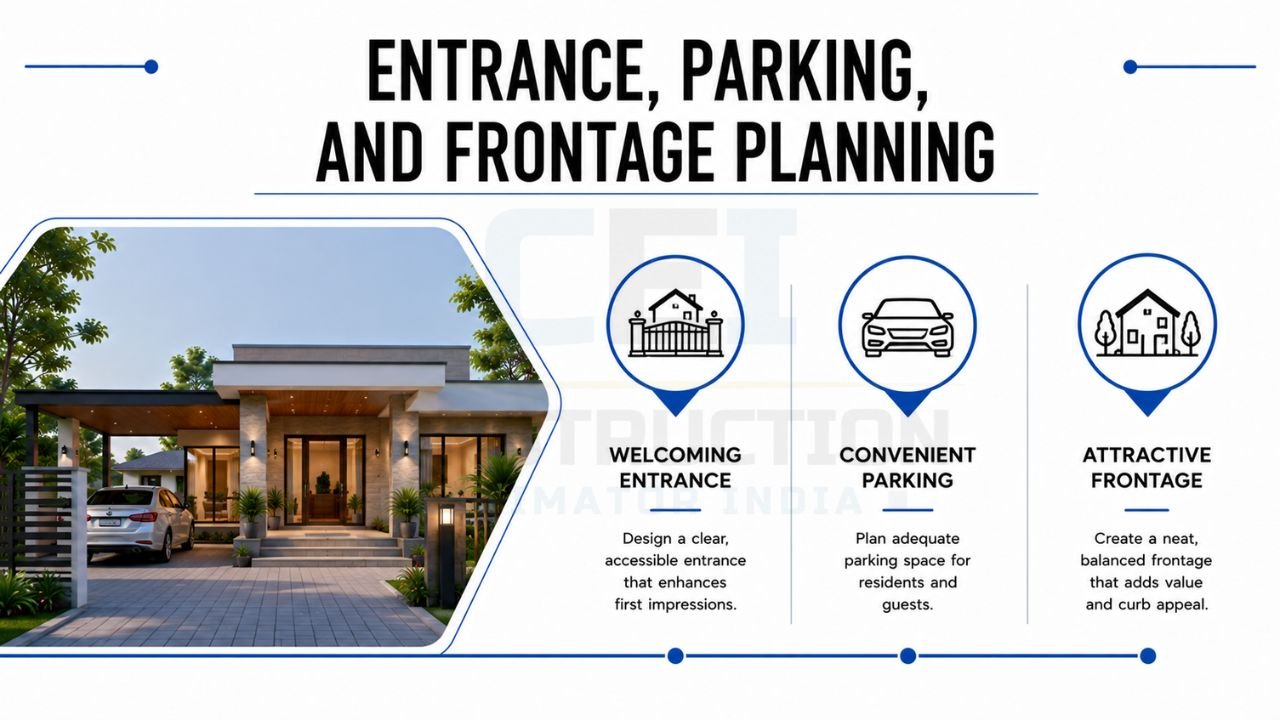
Main Gate and Entry Path for East Facing Plots
The east facing entrance is the focal point of the home. It should be welcoming and unobstructed. Practically, the entrance path should lead the visitor comfortably from the gate to the front door. It is often recommended to have a slightly raised threshold to prevent rainwater from entering and to signify a transition from the outside world to the private sanctuary.
- Place the main door in the 3rd (Jayanta) or 4th (Indra) pada of the east wall.
- Use high-quality wood for the main door to enhance the aesthetic.
- Avoid placing the gate directly in front of an electric pole or a large tree.
- Keep the entrance area well-lit with warm, inviting lights.
👉 Build an East-Facing Home That Balances Comfort, Style, and Vastu Principles.
Parking and Porch in an East Facing House Plan
For an east facing plot, the parking or porch is usually located in the Northeast or Southeast corner of the front area. The height of the porch should be carefully planned with top architects and architecture firms so it doesn’t block the morning sunlight from reaching the living room windows.
- A 10×15 ft porch is standard for most Indian hatchbacks and sedans.
- Use anti-skid tiles for the parking floor for safety during monsoons.
- Ensure the slope of the parking area drains water toward the road, not the house.
- Before you finalise your east facing house plan with the architect, Construction Estimator India can help you estimate your budget for different parking and porch options.
Front Landscape, Steps, and Veranda Options
The frontage is your home’s “face.” Even in a small east facing house design, a small patch of greenery or a few steps leading to a veranda can significantly boost curb appeal. A veranda serves as a buffer zone, keeping the dust away and providing a place to sit in the morning. Since the east gets the best sun, this is the perfect spot for flowering plants or a small “Tulsi” shrine.
- Low-height boundary walls in the east allow more light to enter.
- Use a “sit-out” or veranda to create a social space for the family.
- Incorporate planters that don’t require heavy maintenance.
- Ensure the steps are of a comfortable height (approx. 6 inches) for elders.
Planning Key Rooms in an East Facing House
Living Room and Dining Placement
In an east facing house plan, the living room is ideally placed in the Northeast or East side to capture that vibrant morning energy. Understanding what is RCC construction allows you to plan massive structural spans for large, column-free living spaces.
- Position sofas so that you face North or East while sitting.
- Keep the Northeast corner of the living room clutter-free.
- Large sliding glass doors can connect the living room to a front balcony.
- Construction Estimator India helps homeowners estimate costs for interior finishing like false ceilings and flooring for these high-visibility areas.
Kitchen Placement in an East Facing Plan
The kitchen is the “heart” of the Indian home. For an east-facing house, the Southeast (Agni or Fire corner) is the most preferred location. This allows the cook to face east while preparing meals, which is considered auspicious and practical as it aligns with the early light. If the Southeast is not available, the Northwest is a viable second option.
- Place the cooking platform in the Southeast corner of the kitchen.
- Ensure there is a window in the east for light and ventilation.
- Design a “U” or “L” shaped platform for maximum efficiency.
- Avoid placing the kitchen directly under or over a toilet to maintain hygiene.
Bedroom Placement (Master, Children, Guest)
Privacy and stability are key for bedrooms. The Master Bedroom should ideally be in the Southwest corner of an east facing home, as this “Earth” zone provides the most stability and authority for the head of the family. Children’s bedrooms can be in the West or Northwest, while a guest bedroom is best placed in the Northwest or even the East side if space permits.
- Master Bedroom: Southwest for stability.
- Children’s Room: West or South for good sleep.
- Guest Room: Northwest is ideal for transient visitors.
- Avoid bedrooms in the Northeast, as this area is too “active” for deep rest.
Stairs, Toilets, and Service Areas
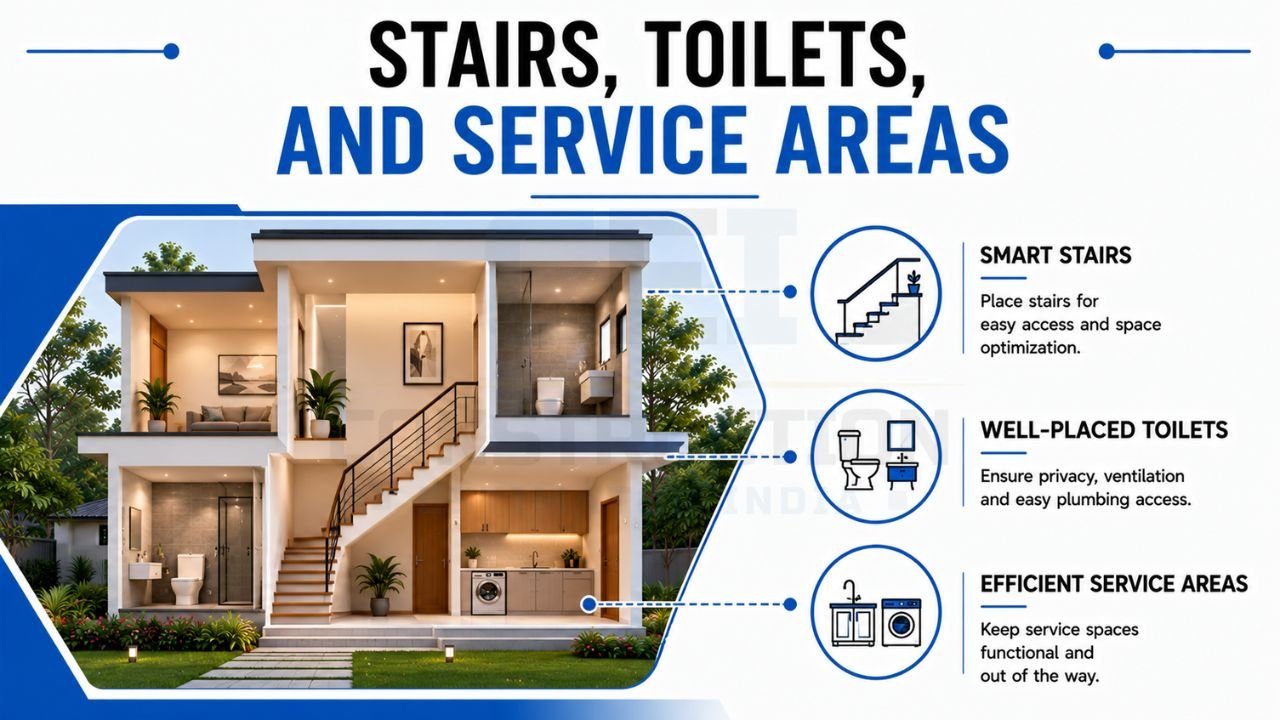
Staircase Position in an East Facing Layout
A staircase is a heavy structural element and should be placed in the “heavy” zones—South, West, or Southwest. In an east facing house plan, you must strictly avoid a staircase in the Northeast, as it blocks the positive energy flow and morning light. For duplexes, an internal staircase in the South or West can also serve as a thermal mass, keeping the house cooler by absorbing afternoon heat.
- Ensure the staircase moves in a clockwise direction as you go up.
- The number of steps should ideally be an odd number (15, 17, 19).
- Use the space under the stairs for storage, but never for a temple or toilet.
- Contact Construction Estimator India to understand how staircase design impacts your total slab area and construction cost.
👉 Get Customized East-Facing House Plans and Accurate Cost Estimates from Industry Experts.
Toilet and Bathroom Placement
Sanitation areas must be placed in zones that handle waste disposal efficiently. In an east-facing house, the best locations for toilets are the Northwest or Southeast. You must never place a toilet in the Northeast corner. Quality standards directed by the Central Public Works Department (CPWD) should be maintained for plumbing shafts.
- Avoid toilets in the Northeast or directly above the main entrance.
- Ensure the toilet seat is positioned so the user does not face East or North.
-
Use high-quality waterproofing (learn how to use white cement for waterproofing) for all wet areas to prevent future leaks.
- Grouping toilets vertically in a duplex saves significantly on piping costs.
Utility, Store, and Service Areas
Every functional home needs space for washing machines, gas cylinders, and bulk storage. The “utility” area is often attached to the kitchen, ideally in the Southeast or Northwest. A store room is best placed in the Northwest or West. These service areas should be tucked away from the main “flow” of the house but remain easily accessible for daily chores.
- The utility area should have a dedicated drain and tap for washing.
- Keep the store room organized with racks to maximize vertical space.
- Ensure the service entrance (if any) does not compete with the main east entrance.
- Proper planning of these areas prevents the “cluttered” look common in many Indian homes.
Simple Vastu-Friendly Approach for East Facing Homes
Basic Vastu Ideas Without Overcomplication
You don’t need to be an expert to follow basic Vastu. The core idea is “Light in the North/East, Heavy in the South/West”. Keep the center of the house (Brahmasthan) as open as possible. Engaging certified building contractors ensures these specific layouts are executed accurately on the ground.
- Identify your “True East” with a compass.
- Place the “Pooja Room” in the Northeast corner.
- Use lighter colors like white or light blue for the east-facing rooms.
- Don’t let trash or heavy junk accumulate in the North or East corners.
Balancing Vastu with Practical Design and Budget
Sometimes, strict Vastu can conflict with modern plot constraints or your personal budget. For example, moving a staircase to a specific corner might require expensive structural beams. In such cases, practical comfort and structural safety aligned with the Bureau of Indian Standards (BIS) should take priority.
- Prioritize light and ventilation over rigid corner placements if space is tight.
- Use “remedies” like Vastu pyramids or copper strips if a door is in the wrong place.
- Focus on functional flow—don’t make your kitchen too small just to fit a corner.
- Construction Estimator India provides support for self-construction planning, helping you balance these needs effectively.
When to Talk to Architect/Estimator About Vastu Adjustments
The best time to make changes is during the “paper stage.” Once the foundation is laid, changes become incredibly expensive. If you want a Vastu-compliant east facing house plan, talk to your architect early. Simultaneously, consult an estimator to see if your Vastu choices (like a double-height ceiling in the East) are pushing you over budget.
- Discuss the “pada” for your main entrance before finalizing drawings.
- Check if moving the kitchen to the SE increases your plumbing costs.
- Consult Construction Estimator India at +91 8630676890 for practical estimation support before you finalize your layout.
Cost Planning and Budgeting for an East Facing House
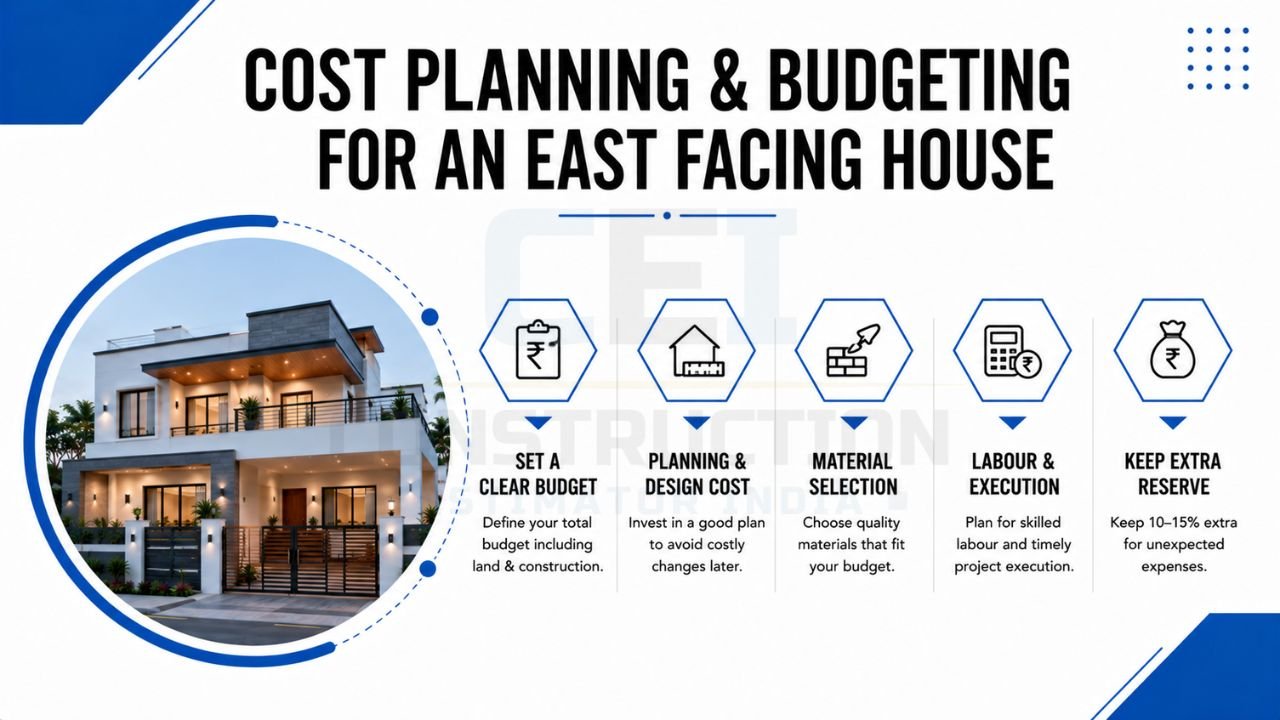
What Really Affects Cost (Orientation vs Size, Materials, Features)
The orientation itself doesn’t cost more, but the design choices you make for an east facing house plan do. For example, large glass windows on the east to capture light will cost more than standard brick walls. Premium materials like granite for an east-facing porch or a teak wood main door also add up. The “built-up area”—the total square footage you cover—remains the biggest cost driver.
- RCC structure and brickwork usually account for 50-60% of the cost.
- Finishing (tiles, paint, fixtures) can vary from ₹500 to ₹5000 per sq ft.
- Labor costs differ by city (e.g., higher in Noida vs. smaller towns).
- Soil quality on your plot can affect foundation costs regardless of orientation.
👉 Start Your East-Facing House Project with Professional Planning and Cost Analysis.
Built-up Area vs Budget: Simple Thinking
In 2026, construction costs in India typically range from ₹1,800 to ₹3,500 per sq ft depending on the quality. If your budget is ₹30 Lakhs, you should aim for a built-up area of about 1,200 to 1,500 sq ft. Trying to build “too much” house with “too little” money often leads to poor-quality finishes or unfinished upper floors.
- Calculate your “Ground Coverage” vs. “Total Built-up Area.”
- G+1 (Duplex) structures are often more cost-effective for small plots.
- Don’t forget to budget for “invisible” costs like borewells, septic tanks, and boundary walls.
- Construction Estimator India can help you estimate your budget and compare different layout options based on your target built-up area.
How Construction Estimator India Helps With Quantity and Cost Estimation?
Construction Estimator India bridges the gap between a dream plan and a finished home. By providing detailed Bill of Quantities (BOQ) and cost estimates, they help you avoid the “budget shocks” that happen halfway through construction. Whether you are building in Lucknow, Dehradun, or Coimbatore, having a clear roadmap of expenses is essential for self-construction.
- Get accurate quantity takeoffs for cement, steel, and sand.
- Compare different material grades (e.g., TMT 500 vs 550D).
- Understand the cost impact of architectural features like balconies or sloped roofs.
- WhatsApp +91 8630676890 to get a professional estimate for your project today.
Common Mistakes in East Facing House Plans
Over-focusing on Direction and Ignoring Basic Comfort
A common mistake is following Vastu or orientation so strictly that the house becomes impractical. For example, placing a kitchen in the Southeast but making it so small that two people can’t stand in it, or avoiding windows in the West entirely, which leads to a dark and stuffy rear bedroom. A good east facing house design must be livable first.
- Ensure every room has at least one window for light and air.
- Don’t compromise on room sizes just to fit a “sacred” corner.
- Think about how you will move from the kitchen to the dining table.
- Balance your traditional beliefs with modern-day functionality.
Poor Entrance and Parking Planning
Many homeowners build a beautiful east entrance but forget that they need to park a car and potentially a two-wheeler. If the gate is too narrow or the porch is too short, you will end up parking on the street, which is a security risk. Also, avoid having the main door open directly into a bathroom or a cluttered utility area.
- Test your car’s turning radius on the plan before building the gate.
- Ensure the porch height accommodates SUVs or roof carriers.
- The main entrance path should be clear and well-defined.
- Avoid placing the “shoe rack” or trash bins right at the main east entrance.
Not Considering Future Changes or Extensions
Families grow. A 2 BHK east facing house plan might be enough now, but what about 10 years later? Many people fail to design the foundation or the staircase for a future G+1 or G+2 expansion. Not planning for “vertical growth” means you might have to break your roof later, which is expensive and messy.
- Design the foundation for at least one extra floor than what you are building now.
- Place the staircase in a way that it can serve the upper floor independently.
- Ensure plumbing and electrical conduits are capped off for future extension.
- Consult with Construction Estimator India to see how much an “expandable” foundation adds to your initial cost.
👉 Build Smarter with Expert East-Facing House Design and Construction Solutions.
FAQs: East Facing House Plan in India
Is an east facing house always better than other directions?
It is highly preferred in India because of the morning sun and Vastu traditions. However, North-facing houses are also excellent. The “best” direction depends on your specific plot’s surroundings (like tall neighboring buildings) and your local climate.
How should I place my kitchen in an east facing house?
The Southeast corner (Agni) is the best choice, followed by the Northwest. Ensure the cook faces East while using the stove.
Can a small plot still have a good east facing house plan?
Absolutely. On a small plot (e.g., 20×30), you can build a duplex to maximize space. Use open-plan living and dining areas to make the house feel larger and brighter.
Does an east facing house cost more to build?
The orientation itself does not increase cost. However, if you add specialized features like large east-facing glass facades or specific Vastu-compliant structural changes, your costs might rise.
When should I contact an estimator like Construction Estimator India during planning?
You should contact them before you finalize your architectural drawings. This allows you to adjust the design if the estimated cost exceeds your available budget.
Conclusion: Design Your East Facing House for Light, Comfort, and Budget
An east facing house plan offers a unique opportunity to live in harmony with nature’s most powerful energy source—the sun. By understanding your orientation, planning your entrance and parking carefully, and placing your key rooms like the kitchen and master bedroom in their ideal zones, you can create a home that is both prosperous and incredibly comfortable.
Remember to keep your Vastu simple and practical. Don’t let rigid rules ruin the functionality of your home. Most importantly, always estimate your costs early. Building a home is a major financial commitment, and knowing your budget prevents mid-construction stress.
Before you finalise your east facing house plan, remember that Construction Estimator India is here to help you navigate the complexities of budgeting and material planning. Contact them on WhatsApp / Call +91 8630676890 today to start your journey toward a well-planned, cost-effective dream home.