Building a home or commercial project in India requires a deep understanding of the materials that provide structural integrity. If you are wondering how is concrete made for construction, the answer lies in the precise chemical and mechanical mixing of three key ingredients. Concrete is produced by mixing Portland cement (10–15%), water (15–20%), and aggregates like sand and gravel (65–75%). When combined, the cement and water form a paste that triggers a chemical reaction called hydration, eventually binding the aggregates into an impenetrable, rock-like mass.
At Construction Estimator India, we know that getting the mix right is the difference between a building that lasts decades and one that fails early. Whether you are a homeowner in Gurgaon or a contractor in Kerala, our professional material estimation services ensure you order exactly what you need, avoiding the waste that often inflates Indian project budgets by 15-20%.
How Is Concrete Made for Construction? (Quick Answer)
To understand how is concrete made for construction, you must view it as a composite material. The quality of your concrete depends entirely on the ratio of its components.
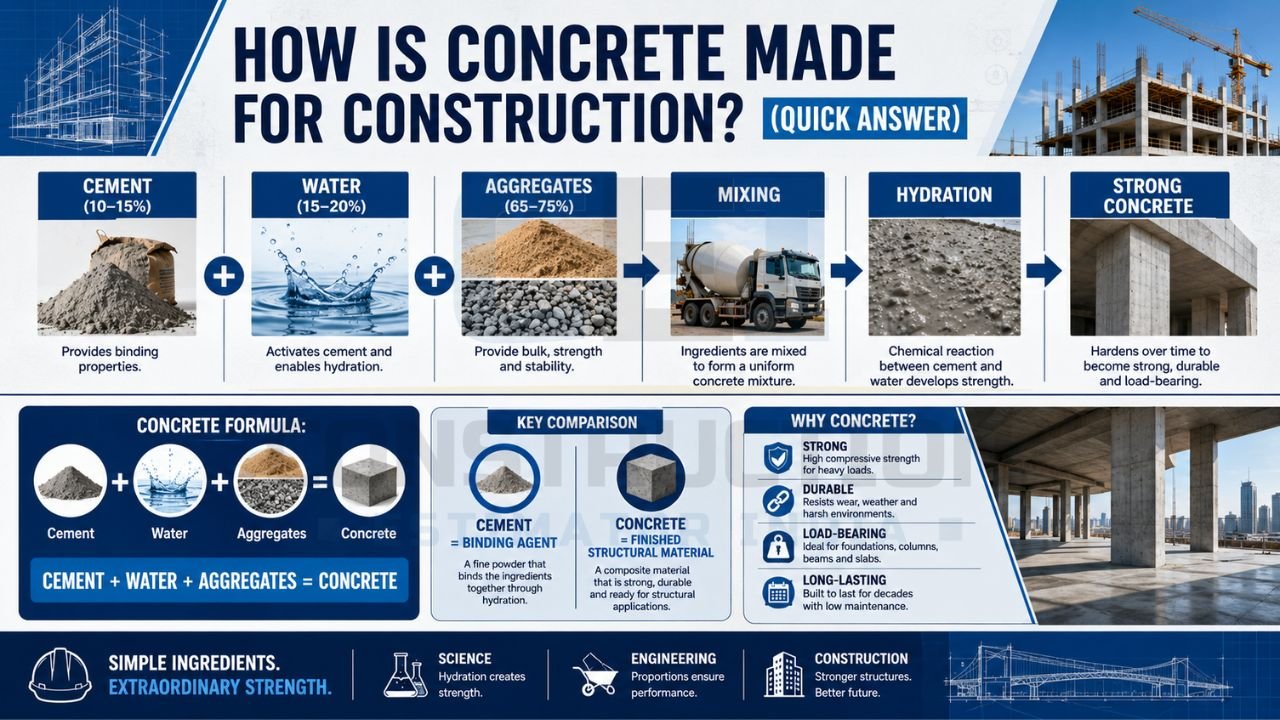
Concrete is made by mixing three main ingredients in specific proportions:
- Cement: 10–15% of the mixture.
- Water: 15–20% of the mixture.
- Aggregates (Sand, Gravel, Crushed Stone): 65–75% of the mixture.
The Concrete Formula:
Cement + Water (Paste) + Aggregates = Concrete
As the cement and water mix, they create a paste that coats every particle of sand and stone. Through hydration, this paste hardens and creates a solid, durable material used in everything from residential sidewalks to the foundations of high-rise buildings in Mumbai.
Important: Cement vs. Concrete India
One of the most common mistakes homeowners make is using the terms “cement” and “concrete” interchangeably.
- Cement is a manufactured mineral powder that acts as the “glue” or binding agent.
- Concrete is the finished structural material created when cement is mixed with water and aggregates.
Understanding this distinction is the first step toward avoiding 7 common expensive mistakes in house construction in India.
Part 1: How Cement Is Made (6 Steps)
Before we can mix concrete on-site, we must understand the industrial concrete manufacturing process India for its primary binder: cement. Cement is not found in nature; it is manufactured through a complex chemical combination of ingredients like limestone and clay.
Step 1: Mining for Raw Materials
The journey begins at quarries where raw materials, mainly limestone and clay, are extracted. Heavy mining machinery is used for blasting or drilling these materials, which are then transported to crushers via large dumpers.
Step 2: Crushing
The limestone undergoes two stages of crushing. The first reduces the rock to a maximum size of 6 inches. The second stage mixes in clays to reduce the particle size further, typically below 3 inches. The final raw mix usually consists of 70% limestone and 30% clay.
Step 3: Grinding (Raw Mill)
This raw mix is fed into a raw mill for drying and grinding. The mill uses hot gases from the kiln system to dry the materials while they are ground into a fine powder known as “kiln feed”.
Step 4: Sintering (Preheater Kiln)
This is the heart of the concrete production process India. The kiln feed is superheated to approximately 1400°C in a rotary kiln. At this extreme temperature, chemical bonds are broken and reformed into a new compound called clinker, which emerges red-hot with a consistency like lava flow.
Step 5: Cement Grinding
The cooled clinker is moved to cement mills where it is mixed with additives. For example, gypsum is added to produce Ordinary Portland Cement (OPC) to control the setting time. A ball mill then grinds this mixture into the fine powder we recognize as cement.
Learn more about Cement Grinding.
Step 6: Final Product
The finished cement is stored in concrete silos, ready for transport to construction sites or ready mix concrete India plants.
Part 2: How Concrete Is Made (From Cement)
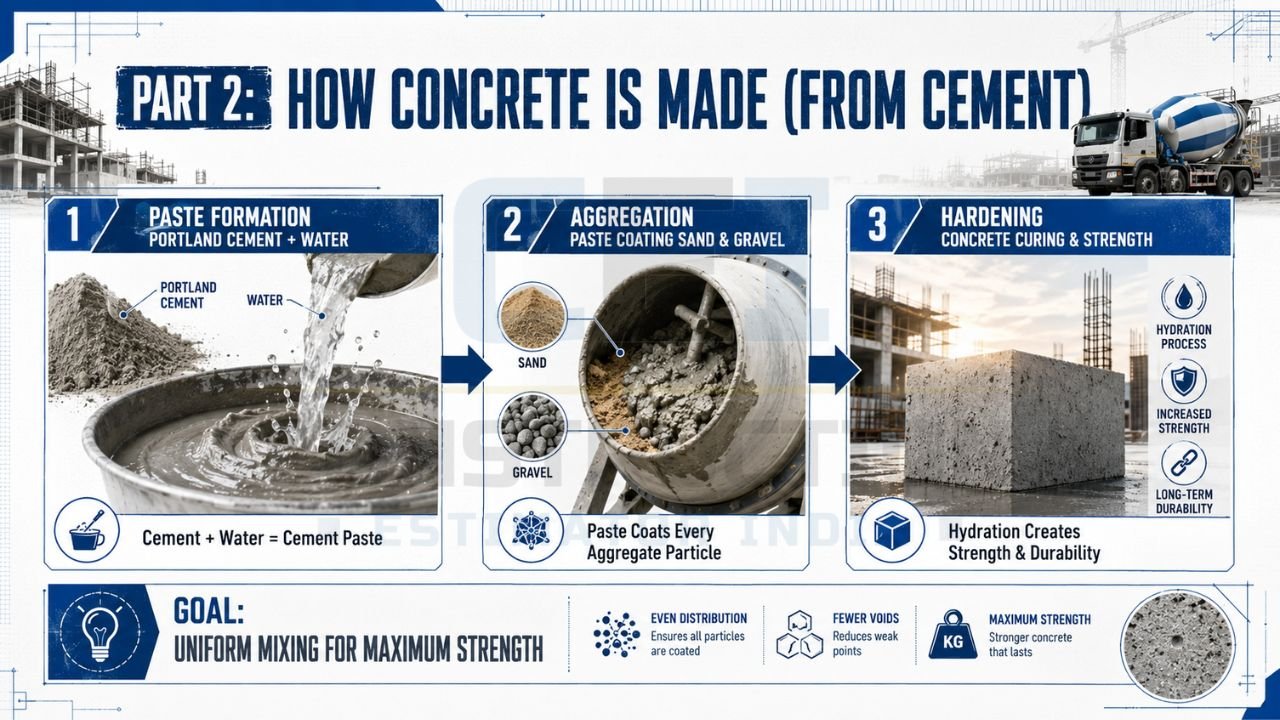
Once the cement reaches the site, the actual concrete mixing process construction begins. Whether you are doing it manually or using a machine, the goal is to ensure every aggregate particle is coated with cement paste.
Concrete Mixing Process
- Paste Formation: Portland cement creates a paste when mixed with water. This is the chemical engine of the concrete.
- Aggregation: This paste is mixed with aggregates (sand and gravel).
- Hardening: As the mixture sits, the paste hardens, binding the aggregates into an impenetrable mass.
Concrete Mix Ratios for Construction
The strength of your structure depends on the mix ratio used. For residential buildings in India, we typically use “Nominal Mixes”. To ensure your slab is strong, you must learn how to calculate cement sand and aggregate for slab.
| Mix Type | Ratio (Cement : Sand : Agg) | Common Use Case in India |
|---|---|---|
| M10 | 1 : 3 : 6 | Foundation bedding, what is PCC in construction |
| M15 | 1 : 2 : 4 | Light construction, flooring base |
| M20 | 1 : 1.5 : 3 | Standard residential slabs and beams |
| M25 | 1 : 1 : 2 | Heavy-duty RCC columns and high-rise slabs |
Common Types of Concrete in India
Different projects require different types of concrete performance. Understanding the difference between PCC and RCC in construction is vital for any builder.
- Plain Cement Concrete (PCC): A simple mix of cement, sand, and stone without steel. It is used as a leveling base under foundations.
- Reinforced Cement Concrete (RCC): Concrete embedded with steel rebar to handle both compression and tension. Essential for beams, columns, and roofs.
- Ready-Mix Concrete (RMC): Manufactured in a factory and delivered by transit mixers. It offers high consistency for urban projects in cities like Delhi or Bangalore.
- Site-Mixed Concrete: Mixed directly at the construction site using laborers or small mixers. Common in rural or individual house builds.
Quality Control in Concrete Production
Quality control is the most neglected part of construction in India. According to our audits at Construction Estimator India, nearly 30-40% of concrete failures stem from poor supervision.
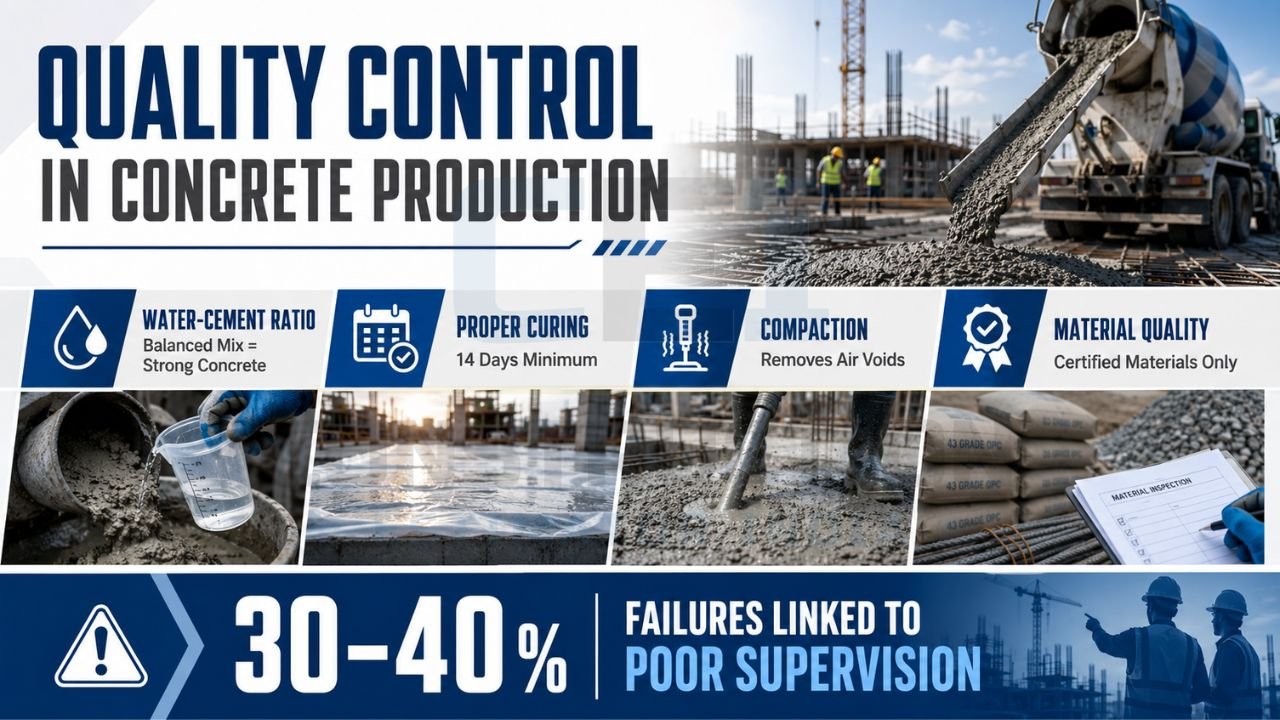
- Water-Cement Ratio: Adding too much water makes the concrete easier to pour but significantly reduces its strength once dry.
- Curing: Concrete doesn’t “dry”; it cures. Skipping the 14-day watering period can lead to a 40% loss in structural strength.
- Compaction: Trapped air can weaken concrete. Using a needle vibrator is essential to remove voids.
- Material Estimation: Using a professional construction material estimation in India service prevents using low-grade “black market” cement or silt-heavy sand that crumbles under pressure.
FAQ — How Is Concrete Made for Construction?
How is concrete made for construction?
Concrete is made by mixing Portland cement, water, and aggregates (sand and gravel). The cement and water form a paste that binds the aggregates together as it hardens.
What are the 3 main ingredients of concrete?
The ingredients are Cement (10-15%), Water (15-20%), and Aggregates (65-75%).
What is the difference between cement and concrete?
Cement is the powdered binding agent; concrete is the final solid building material made by mixing cement with water and stones.
How long does concrete take to harden in India?
Concrete reaches its initial set in a few hours, but it takes 7 days to reach significant strength and 28 days for full structural maturity.
What is the best mix ratio for a house slab?
In India, M20 (1 : 1.5 : 3) is the most common ratio used for standard residential house slabs.
How do I contact Construction Estimator India for help?
You can reach us for concrete quantity estimation, BOQ, and DPR reports at WhatsApp / Call: +91 8630676890.
Build with Confidence with Construction Estimator India
Understanding how concrete is made step by step is only the beginning. The real challenge is ensuring that your site team follows these standards and that you don’t overpay for materials.
At Construction Estimator India, we provide:
- Concrete Quantity Estimation: Know exactly how many bags of cement you need before the pour.
- BOQ & DPR Preparation: Detailed documents for bank loans and contractor tenders.
- Material Quality Guidance: Advice on the best cement brands and sand types for your local climate.
Don’t let poor concrete work ruin your dream home. Contact us today for a professional estimate that saves you money and ensures safety.
WhatsApp / Call: +91 8630676890
Email: info@constructionestimatorindia.com
Location: India-wide Service