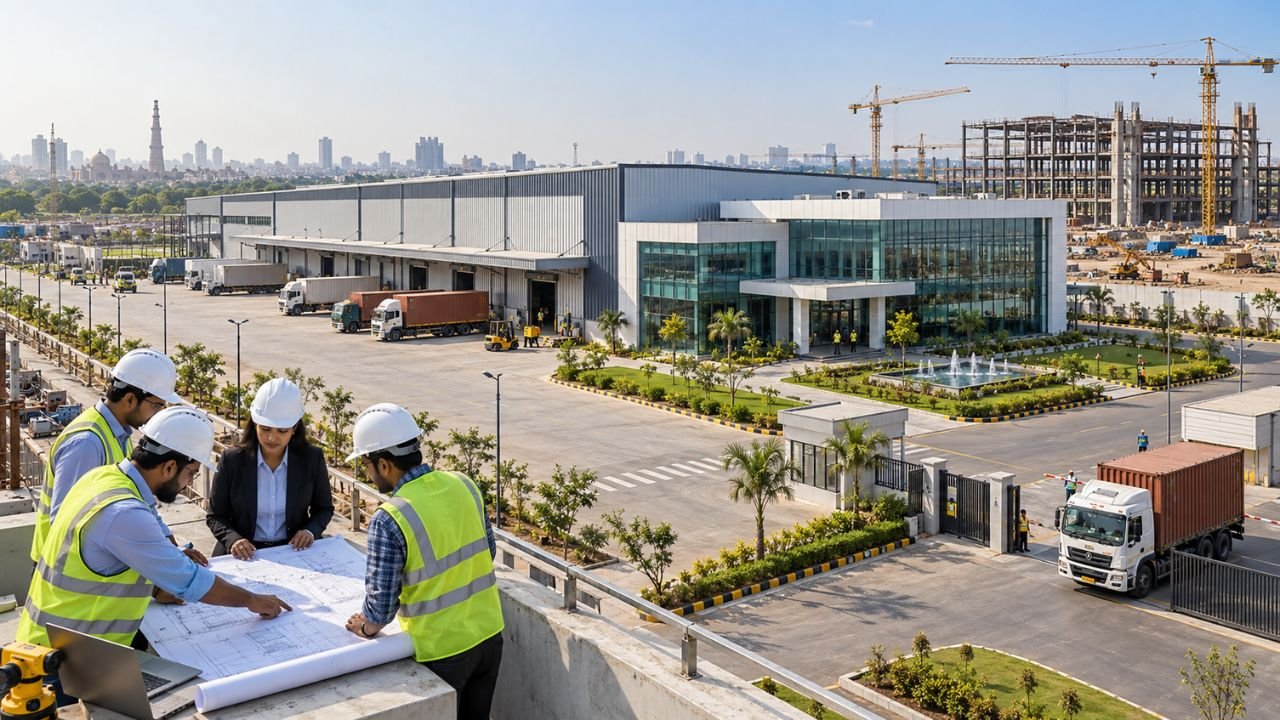
With cement prices hovering between ₹340 and ₹450 per 50 kg bag and steel at ₹62,000–₹72,000 per tonne in 2026, every bag and every cubic foot counts. Construction material estimation in India 2026 is no longer optional — it is the single most important skill that separates profitable projects from loss-making ones.
Materials typically form 50–60% of a project’s budget. To understand how these material quantities translate into a total budget, it is essential to first review the current construction cost per sq ft in India for 2026.
Whether you are a homeowner building a 2000 sq ft house in Agra, a contractor bidding on a G+2 project in Lucknow, or a site engineer in Delhi NCR, this guide gives you practical, step-by-step methods, current 2026 rates, thumb rules, and real examples. You will learn how to estimate materials manually, apply the dry volume factor, add proper wastage, and cross-check with DSR/PWD rates so you never over-order or run short again.
Why Accurate Construction Material Estimation Matters in 2026?
Materials typically form 50–60% of the total project cost. A small mistake in quantity can add ₹2–5 lakh to a 2000 sq ft house. In 2026, with labour shortages and fluctuating supply chains, precise material estimation for construction India 2026 delivers three big advantages:
- Avoids last-minute purchases at premium rates
- Strengthens your tender bids with realistic BOQs
- Helps control cash flow and reduces disputes during billing
Good estimation also ensures compliance with IS 456 and IS 1200 standards, making your project bank-loan ready and client-friendly.
Core Construction Materials: Technical Breakdown & Estimation Logic
In 2026, material estimation is no longer just about counting; it’s about understanding how variables like grade, zone, and waste factors impact your bottom line. Below is the essential breakdown of the “Big Five” materials required for any modern Indian build.
1. Binding Agents: Cement (OPC vs. PPC)
Cement is the chemical “glue” of your structure. In 2026, the choice between OPC (Ordinary Portland Cement) and PPC (Portland Pozzolana Cement) is determined by the specific application:
- Structural Elements: 53-grade OPC is preferred for high-strength requirements like columns and beams.
- Finishing & Masonry: PPC is often chosen for plastering and brickwork due to its superior workability and resistance to cracks.
- Estimation Logic: Always apply the Dry Volume Factor ($1.54$) to your wet concrete calculations. For instance, whether you choose UltraTech Cement vs ACC Cement, the volume of dry ingredients must be 54% higher than the finished wet slab to account for the air voids filled by water.
2. Reinforcement: TMT Steel (Fe500/Fe550)
Steel provides the tensile strength that prevents concrete from snapping under load. In 2026, Fe500D and Fe550 are the industry standards for seismic-resistant G+1 and G+2 frames.
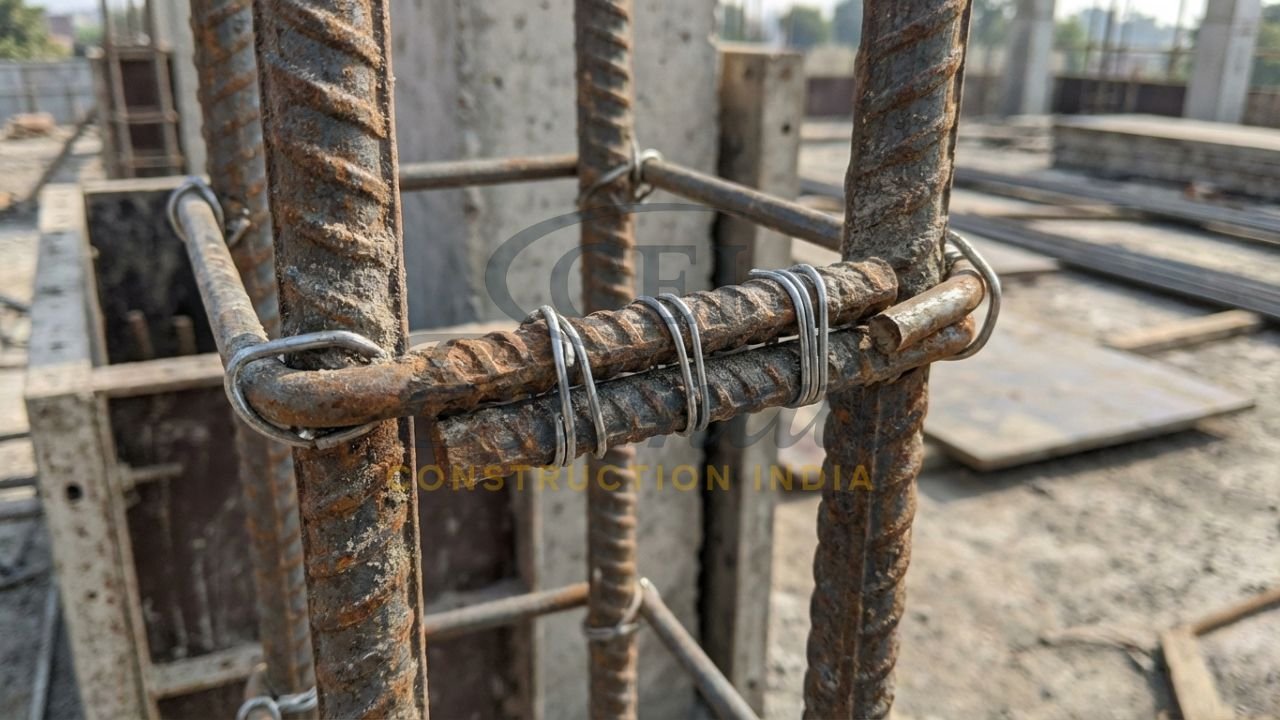
- Estimation Logic: Steel is calculated by weight ($Kg$ or $Tonnes$). A critical part of estimation is the “Lapping & Hook” factor, which typically adds 3–5% to your net structural requirements. Utilizing a specialized metal estimator is essential to track these invisible additions that manual “per sq ft” thumb rules often miss.
Choose Your Construction Services
Connect with verified experts for your project. We provide professional
General Contractors, Sub-contractors, Builders, and Material Suppliers.
Our network also includes specialized 3D Rendering Developers and Interior Experts.
3. Aggregates: The Bulk Fillers (Sand & Crushed Stone)
Aggregates make up nearly 60–75% of the concrete volume.
- Fine Aggregate (Sand): With river sand scarcity in 2026, M-Sand (Manufactured Sand) has become the standard. Ensure it is Zone II graded for concrete and finer for plastering.
- Coarse Aggregate: A mix of 20mm (for bulk) and 10mm (to fill gaps) is used to create a dense, void-free concrete estimator result.
- Estimation Logic: These are measured in Cum ($m^3$) or Cft. Always factor in a 5–7% moisture/bulking allowance for sand, especially during the monsoon season.
4. Wall Components: Bricks & AAC Blocks
The choice of wall material affects both the weight of your building and the cost of your plaster cost per square foot.
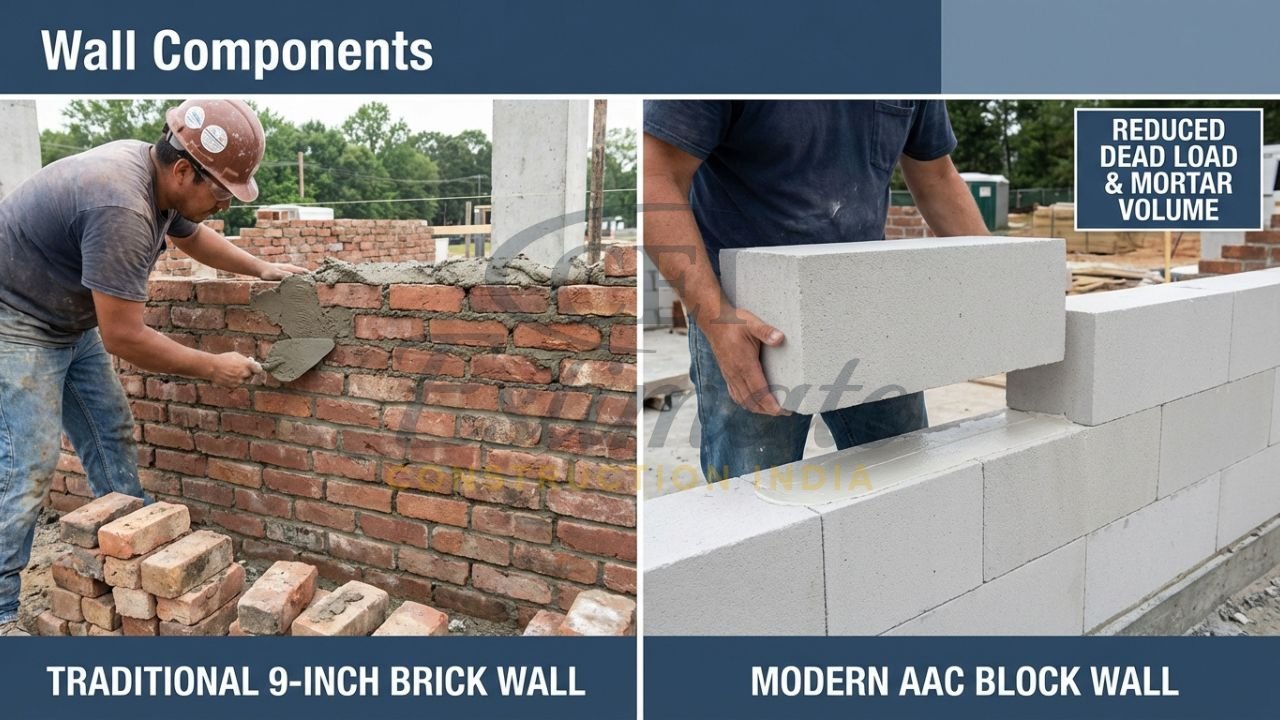
- Red Clay Bricks: Traditional, heavy, and labor-intensive ($500$ bricks per $m^3$ for 9-inch walls).
- AAC Blocks: Lightweight and larger, reducing the “dead load” on your slab and requiring less mortar.
- Estimation Logic: A dedicated masonry estimator should calculate not just the blocks, but also the volume of cement-sand mortar required to join them, which typically accounts for 20-25% of the total wall volume.
[Image showing a comparison between a traditional red brick wall and a modern AAC block wall with mortar joints]
5. Finishing Materials: Tiles, Paint & Woodwork
Finishing is where the most significant material wastage occurs.
- Tiles: Estimated in Sqm or Sq ft. In 2026, it is standard to add a 7–10% wastage factor for cutting and breakage.
- Paint: Calculated by surface area ($Sqm$). For a fresh build, the estimation must include 2 coats of putty, 1 coat of primer, and 2 coats of final emulsion. Use a painting estimator to avoid over-purchasing expensive 20L buckets.
Summary of Measurement Units & Wastage (2026 Standards)
| Material | Unit | Standard Wastage Factor |
| Cement | Bags (50kg) | 2% – 3% |
| Steel | Kg / MT | 3% – 5% (Hooks/Laps) |
| Sand/Aggregate | $m^3$ / Cft | 5% – 8% |
| Bricks/Blocks | Nos. | 5% – 10% (Breakage) |
| Tiles | $m^2$ / $ft^2$ | 8% – 10% (Cutting) |
Ready to move from basic logic to a formal bid?
Ensure all these individual quantities are compiled into a professional what is BOQ in construction document to maintain total financial control over your site.
Step-by-Step Process for Construction Material Estimation in India
Follow these six steps for every project:
- Study drawings & specifications — Note all dimensions, mix ratios (M20/M25), and finishes.
- Take quantities — Use long wall–short wall or centre line method as per IS 1200.
- Apply conversion factors — Wet volume × 1.54 = dry volume.
- Add wastage allowance — 5–10% depending on material.
- Use current 2026 rates — Update from local market or latest DSR.
- Prepare summary — Group by trade (civil, finishing, MEP) and add contingency.
Cement, Sand & Aggregate Estimation for RCC and PCC Works 2026
The most frequent calculation is for concrete (RCC/PCC).
Dry volume factor = 1.54 (accounts for 54% voids & shrinkage)
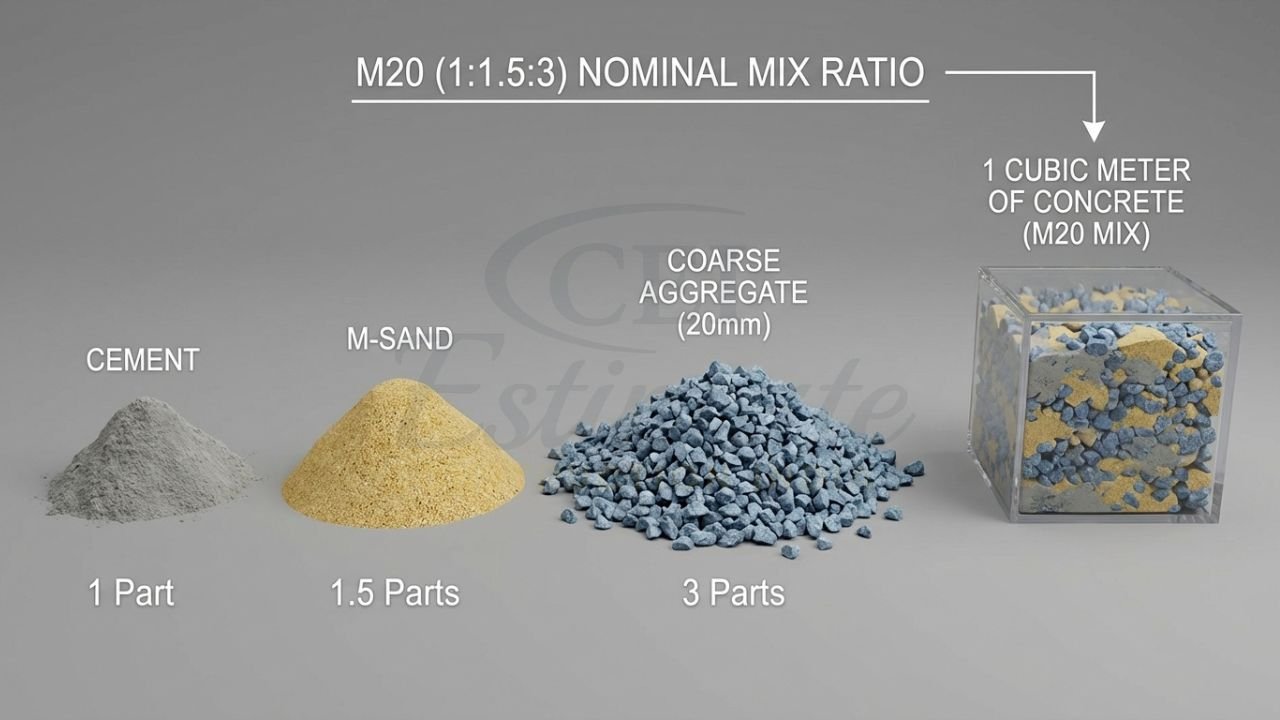
M20 Mix (1 : 1.5 : 3) per m³ (dry volume)
- Cement = 8 bags (400 kg)
- Sand = 0.45–0.48 m³ (16–17 cft)
- Aggregate = 0.90–0.92 m³ (32–33 cft)
M25 Mix (1 : 1 : 2) per m³
- Cement = 9 bags (450 kg)
- Sand = 0.42 m³ (15 cft)
- Aggregate = 0.84 m³ (30 cft)
Practical example – 1000 sq ft 5-inch RCC slab (M20)
Wet volume = 1000 sq ft × 5/12 ft × 0.3048 m/ft ≈ 11.8 m³
Dry volume = 11.8 × 1.54 = 18.17 m³ + 7% wastage = 19.44 m³
Cement bags = 19.44 ÷ 0.035 ≈ 105 bags (round up to 110–115 on site)
Sand = 5.30 m³ ≈ 187 cft + 10% = 205–220 cft
Aggregate = 10.60 m³ ≈ 374 cft + 10% = 410–430 cft
For a full 2000 sq ft house you can scale these numbers or use the thumb rules below.
Steel Reinforcement Estimation for Buildings
Steel is estimated as percentage of concrete volume:
- Slabs: 0.8–1.2%
- Beams & columns: 1.5–2.5%
- Footings: 0.8–1.0%
Thumb rule — 50–80 kg steel per sq ft of built-up area for G+1/G+2 residential buildings in 2026.
Add 2–3% for hooks, cranks, and laps.
Example — 2000 sq ft house: 100–160 quintals (10–16 tonnes) of TMT steel.
Brickwork, Flooring & Finishing Material Estimation
- 9-inch brick wall — 500 bricks per Cum (including mortar)
- 4.5-inch partition — 250 bricks per Cum
- Vitrified tile flooring — 1.05–1.07 sq m tiles per sq m area (5–7% wastage)
- 12 mm internal plaster — 1.2 bags cement + 0.35 m³ sand per 100 sq m
Wastage Allowance & Contingency in Material Estimation 2026
Standard wastage percentages used across India in 2026:
| Material | Wastage % |
| Cement | 2–3% |
| Sand & Aggregate | 5–7% |
| Steel | 3–5% |
| Bricks | 5–10% |
| Tiles | 5–8% |
Always add 3–5% overall contingency for price escalation and unforeseen site conditions.
Thumb Rules for Quick Material Estimation in Residential Projects
For a standard G+1 2000 sq ft house in Agra/UP (2026):
- Cement: 0.32–0.38 bags per sq ft → 640–760 bags total
- Sand: 1.0–1.2 cft per sq ft → 2000–2400 cft
- Aggregate: 2.0–2.4 cft per sq ft → 4000–4800 cft
- Steel: 55–75 kg per sq ft → 110–150 quintals
- Bricks (9″ walls): 1100–1300 per 100 sq ft of wall area
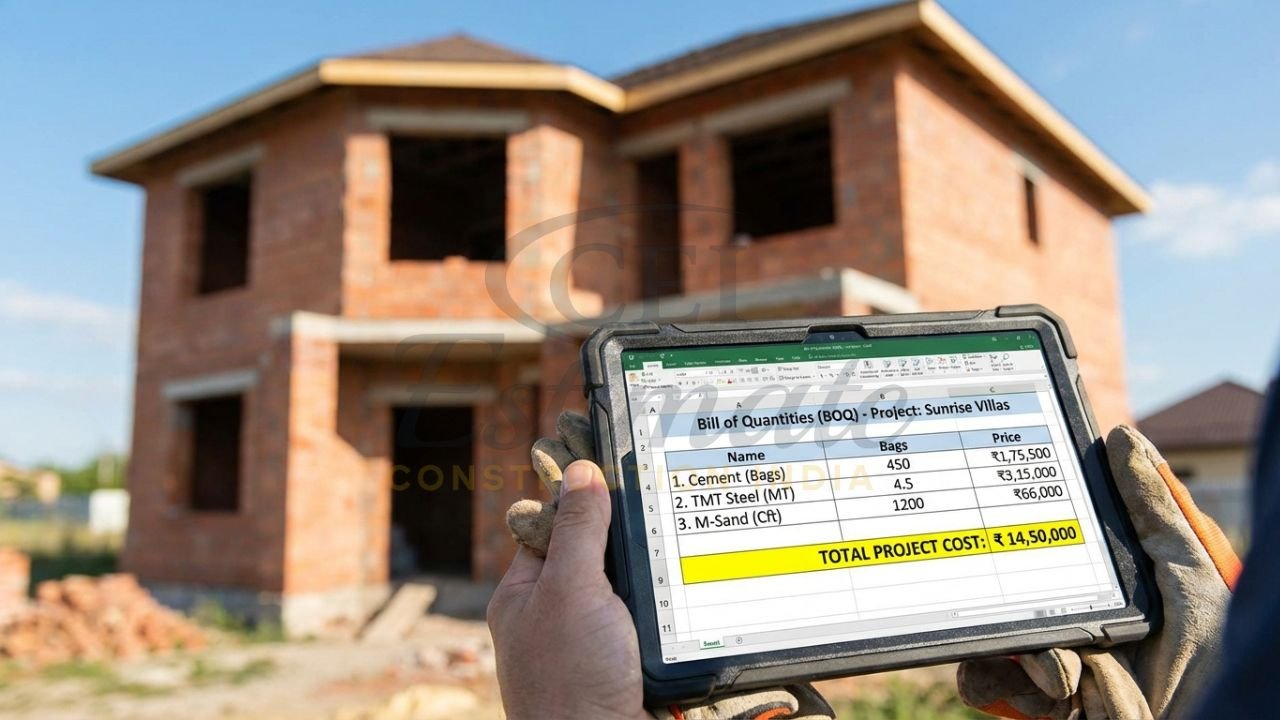
These thumb rules give you a fast check before detailed BOQ preparation.
Common Mistakes in Material Estimation and How to Avoid Them
- Using wet volume directly instead of ×1.54 → always apply dry volume factor.
- Forgetting wastage → add minimum 7% for concrete items.
- Outdated rates → update every quarter from local DSR/market.
- Wrong mix ratio → confirm M20/M25 from structural drawing.
- Measuring carpet area instead of built-up area → use built-up for estimation.
- Ignoring separate quantities for different floors or conditions.
- No summary sheet → always prepare trade-wise and grand total.
- Skipping contingency → keep 3–5% buffer for 2026 inflation.
Conclusion
Construction material estimation in India 2026 is a practical skill that directly impacts your project’s success and profitability. By mastering the step-by-step process, dry volume factor, wastage allowances, and thumb rules given in this guide, you can prepare accurate quantities for cement, sand, aggregate, steel, and bricks in minutes.
Start with thumb rules for quick budgeting, move to detailed quantity takeoff for BOQ, and always add realistic wastage and contingency. For complex or large projects, combine your manual estimation with professional services to achieve ±5% accuracy.
Accurate material estimation saves lakhs, reduces wastage, strengthens your tenders, and gives you confidence while building in today’s volatile market.
Ready to get an accurate, customised construction estimate for your project in 2026?
At Construction Estimator India our professional estimating team delivers detailed BOQ and cost reports in just 48 hours.
Construction cost estimation services start at just ₹10,000 INR only.
Contact us today:
📞 Phone / WhatsApp: +91 86306 76890
✉️ Email: info@constructionestimatorindia.com
Don’t overpay or underbid — get your precise 2026 construction cost per sq ft estimate now and win more projects with confidence!
Frequently Asked Questions (FAQs) on Construction Material Estimation in India 2026
How do I estimate cement, sand, and aggregate for a house in India 2026?
Calculate wet volume from slab/beam/column dimensions, multiply by 1.54 for dry volume, apply the mix ratio (M20 = 1:1.5:3), and divide by total parts. Convert cement to bags (0.035 m³ per bag) and sand/aggregate to cft. Add 7–10% wastage. This construction material estimation in India 2026 method is standard for residential projects and prevents shortages on concreting day.
What is the standard wastage percentage for construction materials in 2026?
Cement 2–3%, sand & aggregate 5–7%, steel 3–5%, bricks 5–10%, and tiles 5–8%. Most contractors apply an overall 7–10% wastage on concrete items. Including proper wastage in your material estimation for construction India 2026 avoids last-minute purchases at higher rates.
How much steel is required per sq ft in a residential building in India?
For G+1/G+2 residential buildings the thumb rule is 55–75 kg steel per sq ft of built-up area in 2026. Slabs need 0.8–1.2%, beams & columns 1.5–2.5%. For a 2000 sq ft house you will typically require 110–150 quintals of TMT steel.
What is the best way to do material estimation for a 2000 sq ft house?
Use a combination of thumb rules for quick budgeting and detailed quantity takeoff from drawings for accuracy. Calculate concrete first (dry volume × 1.54), then steel as percentage of concrete, and bricks/plaster separately. Add 7–10% wastage and 3–5% contingency. Cross-check the final figure with [Link: How Much Does It Cost to Build a 2000 Sq Ft House in India 2026] for realistic budgeting.
How much does accurate material estimation save on a construction project in 2026?
Accurate construction material estimation in India 2026 typically saves 8–15% of total project cost by preventing over-ordering, reducing wastage, and avoiding emergency purchases at premium rates. For a ₹50 lakh project this can mean ₹4–7.5 lakh in direct savings plus smoother cash flow and fewer disputes.