
One of the most common questions new homeowners, site supervisors, and junior engineers ask on Indian construction sites is about the difference between PCC and RCC. Both are cement-based concretes, yet they serve completely different purposes. Confusing them can lead to structural weakness, cost overruns, or cracks in the building.
In 2026, with cement prices between ₹340–₹450 per bag and stricter quality checks on residential projects in Agra, Delhi NCR, Lucknow, and across Uttar Pradesh, understanding PCC vs RCC in construction is essential. PCC (Plain Cement Concrete) is the non-reinforced base layer that provides a stable platform, while RCC (Reinforced Cement Concrete) is the steel-reinforced structural concrete used for load-bearing members. To see how these materials impact your overall project budget, start by reviewing the latest construction cost per sq ft in India for 2026.
This guide gives you a complete, side-by-side comparison covering definition, composition, strength, mix ratios, uses, cost, thickness guidelines, and practical site applications. Whether you are building a G+1 house or supervising a larger project, you will learn exactly when and where to use each type so your structure remains strong, durable, and economical.
What is PCC in Construction?
PCC stands for Plain Cement Concrete. It is a mixture of cement, fine aggregate (sand), coarse aggregate, and water with no steel reinforcement. PCC is never designed to take tensile loads on its own. Its main job is to act as a levelling course, provide a uniform and stable base, and protect the soil from direct contact with structural concrete. For a deeper dive into its specific applications, read our dedicated guide on what is PCC in construction.
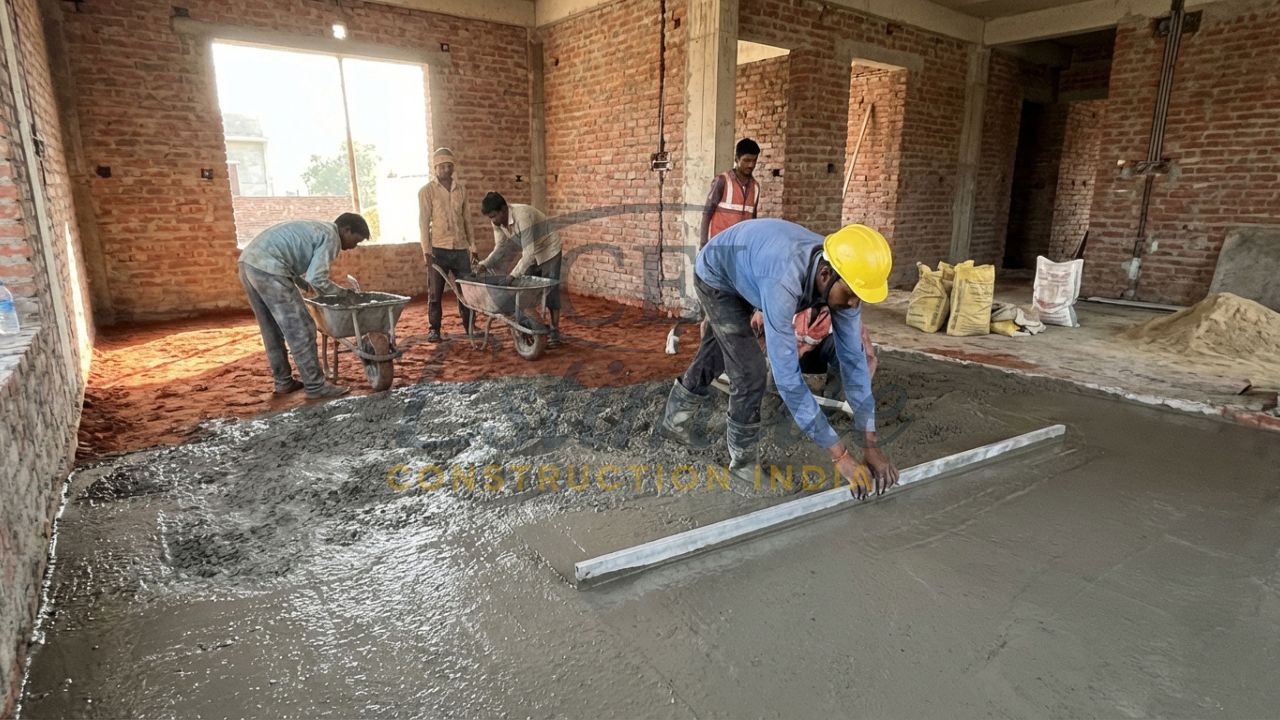
In Indian residential construction, PCC is typically laid under foundations, as a bedding for DPC (Damp Proof Course), and as a base for flooring. It is cheap, easy to place, and does not require complex formwork or vibration like RCC.
What is RCC in Construction?
RCC stands for Reinforced Cement Concrete. It is the same basic concrete mix as PCC but with the addition of steel reinforcement bars (TMT bars) to handle both compressive and tensile forces. RCC is the structural backbone of every modern building — columns, beams, slabs, footings, and retaining walls are all made of RCC.
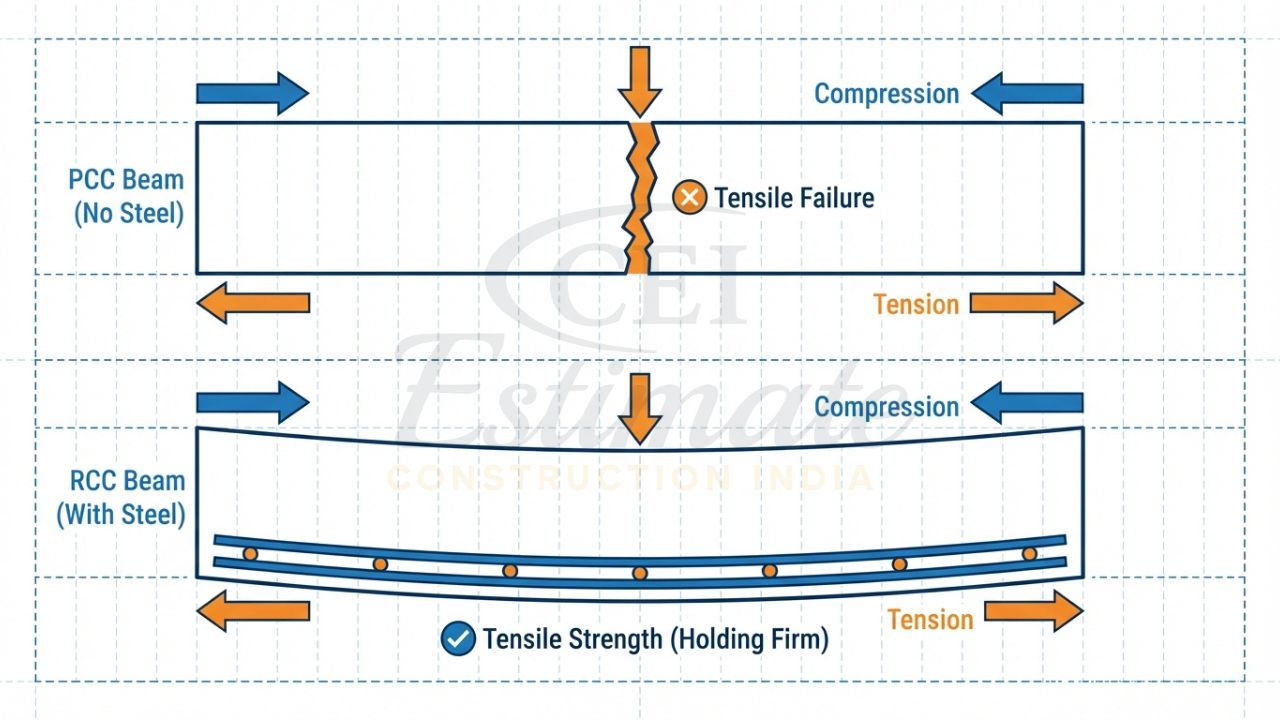
Because steel takes the tension and concrete takes the compression, RCC can span longer distances, carry heavy loads, and resist bending and cracking. It is the reason multi-storey buildings and long-span roofs are possible in India today.
Choose Your Construction Services
Connect with verified experts for your project. We provide professional
General Contractors, Sub-contractors, Builders, and Material Suppliers.
Our network also includes specialized 3D Rendering Developers and Interior Experts.
Key Difference Between PCC and RCC
The difference between PCC and RCC is best understood through this direct comparison:
| Feature | PCC (Plain Cement Concrete) | RCC (Reinforced Cement Concrete) |
| Full Form | Plain Cement Concrete | Reinforced Cement Concrete |
| Reinforcement | No steel bars | Contains TMT steel bars |
| Main Purpose | Levelling base, non-structural | Load-bearing structural members |
| Typical Grades | M5, M7.5, M10, M15 | M20, M25, M30 and higher |
| Compressive Strength | Lower (5–15 N/mm²) | Higher (20–40+ N/mm²) |
| Tensile Strength | Very low | High (due to steel) |
| Cost per m³ (2026) | ₹4,500–₹6,500 | ₹8,500–₹12,000+ (depending on steel %) |
| Thickness (typical) | 75–150 mm | 100–300 mm or as per design |
| Common Uses | Under foundation, DPC bedding, flooring base | Columns, beams, slabs, footings |
PCC is the supporting actor; RCC is the hero that actually carries the structural load.
Mix Ratio and Material Calculation – PCC vs RCC
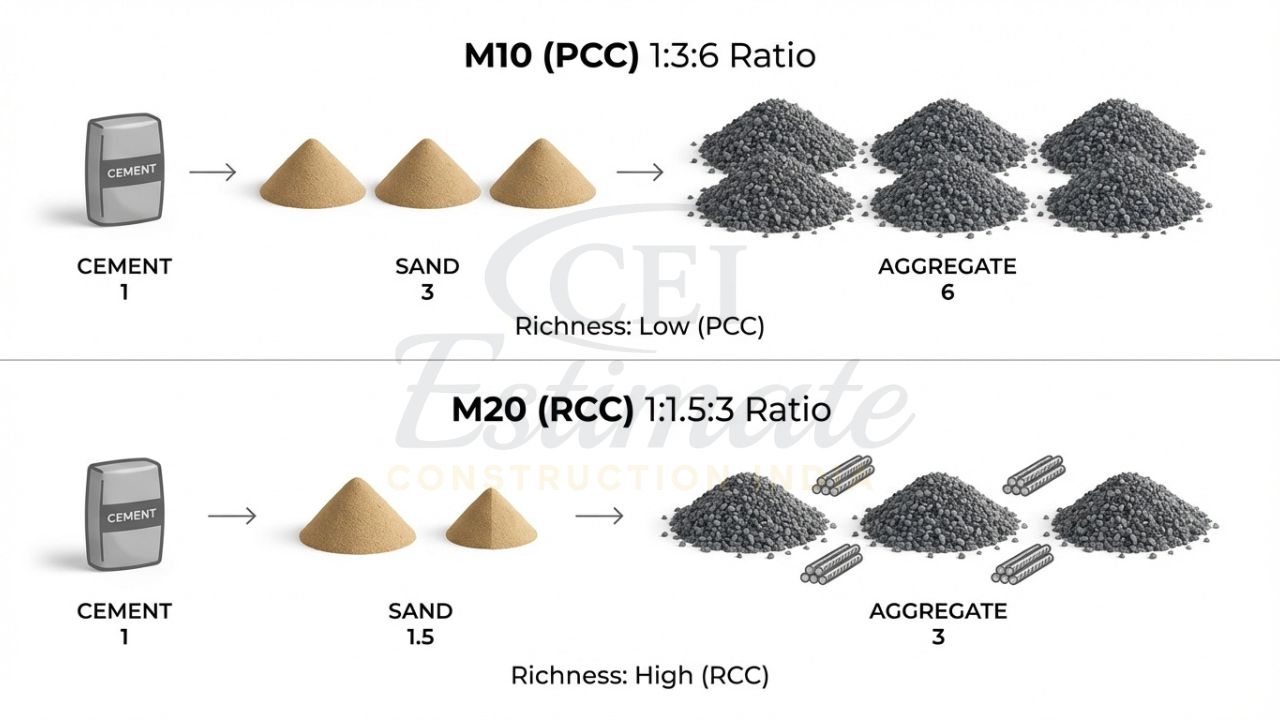
The mix ratios clearly show the difference between PCC and RCC:
PCC (common grades)
- M10 → 1 : 3 : 6
- M15 → 1 : 2 : 4
RCC (common grades for houses)
- M20 → 1 : 1.5 : 3
- M25 → 1 : 1 : 2
Material calculation tip
Both use the dry volume factor of 1.54.
For PCC, steel is zero.
For RCC, steel is calculated as 0.8–2.5% of concrete volume (or use bar bending schedule).
Both types use a Dry Volume Factor of 1.54 for calculations. However, for RCC, you must perform a detailed construction material estimation in India to account for the steel. For complex elements like beams, engineers use a bar bending schedule for beams to ensure the steel is cut and bent accurately.
Practical example for 100 sqm area, 100 mm thick layer
- PCC M10: ~44 cement bags, 163 cft sand, 326 cft aggregate
- RCC M20 (same volume): ~50–55 cement bags + 800–1,200 kg steel
How to Calculate Cement Sand and Aggregate for Slab explains the RCC calculation in detail.
Where to Use PCC and RCC in a House Construction Project?
In a typical G+1 or G+2 residential building in Agra or Uttar Pradesh, the correct placement is:
Use PCC for
- Levelling course under isolated/raft foundations (100–150 mm)
- Bedding below DPC at plinth level
- Base for ground floor vitrified tile or marble flooring
- Hardstanding in parking and approach roads
Use RCC for
- Footings and raft foundation (structural)
- Columns and beams
- Roof and floor slabs
- Staircase and lintels
- Retaining walls and water tanks
Never replace structural RCC with PCC, and never skip PCC under foundations on weak soil — it leads to settlement and cracks.
Cost Difference Between PCC and RCC in 2026
PCC cost (M10 grade): ₹4,500–₹6,500 per m³
RCC cost (M20 grade): ₹8,500–₹12,000+ per m³ (steel adds the major extra cost)
For a 2000 sq ft house:
- PCC layers (foundation + flooring base) ≈ ₹1.8–2.5 lakh
- RCC members (foundation, columns, beams, slab) ≈ ₹12–18 lakh
The cost difference between PCC and RCC is mainly due to steel and skilled labour for formwork and vibration. Using PCC where it is appropriate saves money without compromising safety.
Advantages and Disadvantages of PCC vs RCC
PCC Advantages
- Cheaper and faster to place
- No need for steel or complex formwork
- Good for non-structural levelling
PCC Disadvantages
- Cannot take tensile or bending loads
- Limited strength
RCC Advantages
- High tensile and compressive strength
- Can span long distances
- Essential for multi-storey and seismic zones
RCC Disadvantages
- More expensive
- Requires skilled labour, formwork, and proper curing
Common Mistakes While Using PCC and RCC on Site
- Using RCC mix for PCC (unnecessary cost).
- Skipping PCC under foundation on weak soil.
- Insufficient thickness of PCC (less than 100 mm).
- Poor compaction of PCC leading to voids.
- Adding extra water to PCC for easy placement (reduces strength).
- Placing RCC directly on soil without PCC bedding.
- Wrong grade selection (M10 for structural work).
- Inadequate curing of either PCC or RCC.
Always follow structural drawings and IS 456 guidelines.
Conclusion
The difference between PCC and RCC is not just technical — it is the difference between a stable, durable building and one that develops cracks and settlement issues. PCC provides the strong, level, non-structural base, while RCC delivers the tensile strength needed for the actual building frame. In 2026’s Indian construction scenario, using the right concrete at the right place saves money, speeds up work, and ensures long-term safety.
Remember: PCC under the foundation and RCC for columns, beams, and slabs is the golden rule for residential projects. Master this basic distinction, calculate quantities accurately, and follow proper site practices. Your building will stand strong for generations.
Ready to get an accurate, customised construction estimate for your project in 2026?
At Estimator Construction India our professional estimating team delivers detailed BOQ and cost reports in just 48 hours.
Construction cost estimation services start at just ₹10,000 INR only.
Contact us today:
📞 Phone / WhatsApp: +91 86306 76890
✉️ Email: info@constructionestimatorindia.com
Don’t overpay or underbid — get your precise 2026 construction cost per sq ft estimate now and win more projects with confidence!
Frequently Asked Questions (FAQs) – Difference Between PCC and RCC
What is the main difference between PCC and RCC in construction?
The main difference between PCC and RCC is reinforcement. PCC (Plain Cement Concrete) has no steel bars and is used for non-structural levelling bases. RCC (Reinforced Cement Concrete) contains steel reinforcement to resist tension and bending. PCC is cheaper and simpler; RCC is structural and stronger.
Can RCC be used in place of PCC or vice versa?
No. RCC can technically replace PCC but it is wasteful and expensive. PCC cannot replace RCC because it lacks tensile strength and will crack under load. Always follow structural drawings — use PCC only where no reinforcement is required and RCC for all load-bearing members.
Which grade of concrete is used for PCC and RCC in residential buildings in India 2026?
For PCC, M10 (1:3:6) is the standard grade for foundations and flooring beds. For RCC, M20 (1:1.5:3) is used for most residential columns, beams, and slabs, while M25 is preferred in seismic zones or longer spans. These grades are widely followed across Agra, UP, and other states in 2026.
Why is steel reinforcement added in RCC but not in PCC?
Concrete is strong in compression but weak in tension. Steel bars in RCC take the tensile forces and prevent cracking. PCC is used only where tensile stresses are negligible (levelling courses, bases), so no steel is needed. This is the fundamental reason for the difference between PCC and RCC.
How does the cost of PCC compare with RCC per cubic meter in 2026?
PCC (M10) costs ₹4,500–₹6,500 per m³. RCC (M20) costs ₹8,500–₹12,000+ per m³ because of steel (₹62–72/kg) and extra labour for formwork and vibration. The cost difference is mainly due to reinforcement and skilled workmanship.