Imagine waking up in the middle of the night to the rattling of windows and the unsettling sway of your bedroom furniture. For a homeowner in Noida during a severe seismic tremor, this was a terrifying reality in 2025. While the family escaped safely, the structural integrity of their newly built villa was compromised, with deep cracks running through the load-bearing walls. When they filed an insurance claim, they were met with a heartbreaking realization: their “home insurance” policy was primarily a contents-based plan that covered jewelry and electronics, but offered almost nothing for the building structure itself.
As we navigate the climate and economic landscape of 2026, this story has become alarmingly common. With the rising frequency of floods in the North Indian plains and the constant seismic activity in the Delhi-NCR region, understanding home structure building insurance in India is no longer a luxury—it is a fundamental pillar of financial survival. This guide will serve as your expert roadmap to navigating the complexities of structure insurance, ensuring that your largest physical asset is protected from the foundation to the rooftop.
What is Home Structure Building Insurance in India?
At its most basic level, home structure insurance is a specialized financial safeguard designed to cover the physical “bones” of your property. Unlike generic insurance products, this coverage focuses exclusively on the immovable parts of your home—the foundation, the load-bearing walls, the roof, and permanent fixtures like plumbing, concealed wiring, and built-in cabinetry.
Many Indian homeowners ask, “what is home structure building insurance” and how does it differ from other policies? In the 2026 Indian market, this insurance is largely standardized under the IRDAI-mandated Bharat Griha Raksha (BGR) framework. Every general insurer in India, from HDFC ERGO to ICICI Lombard, must offer this standard policy. It is designed to pay for the cost of repairing or completely rebuilding your home if it is damaged by an insured peril, such as a fire, earthquake, or flood.
A critical point to remember is that this insurance is based on the Reinstatement Value. This means the sum insured is calculated using the actual cost of labor and materials required to rebuild your structure at today’s rates, rather than the market value of the land, which does not need structural protection. For a construction professional or an estimator, this is the most vital line item in a Bill of Quantities (BOQ) for long-term risk management.
Building Insurance vs Home Insurance – Key Differences
One of the most frequent points of confusion I encounter as an advisor is the conflation of “building insurance” and “home insurance.” In India, “home insurance” is often used as an umbrella term for a comprehensive package that covers both the structure and the contents inside.

To truly protect your investment, you must understand the difference between building insurance and home insurance. While building insurance protects the “shell,” home insurance in India typically includes a broader scope, including protection against theft of movable items like televisions, laptops, and jewelry.
Comparison Table: Building vs. Home Insurance
| Feature | Home Structure Building Insurance | Comprehensive Home Insurance |
|---|---|---|
| Primary Focus | Walls, roof, foundation, plumbing. | Structure + Furniture, gadgets, jewelry. |
| Sum Insured Basis | Reinstatement cost of construction. | Reinstatement (structure) + Market value (items). |
| Theft Protection | Not included (unless following a catastrophe). | Standard inclusion for all contents. |
| Public Liability | Often excluded or limited. | Often included (covers injury to visitors). |
| Ideal For | Owners, Landlords, & Builders. | Owner-occupiers & Tenants (contents only). |
Under the 2026 Bharat Griha Raksha standards, most “building” policies now automatically include a 20% cover for general contents (capped at ₹10 lakh) without requiring an itemized list. However, if you have high-value items, a full home insurance policy remains the superior choice for total peace of mind.
What is Structure on the Property Insurance?
When you take out a home loan from a bank like SBI or HDFC Bank, the bank representative will often use the term “structure on the property insurance.” This is essentially a building insurance policy with a “Loss Payee Clause” or an “Agreed Bank Clause.”
Because the house serves as the collateral for your mortgage, the bank mandates this coverage to ensure that if a natural disaster levels the building, their financial interest is protected. In such cases, the insurance payout is first used to settle the outstanding loan amount, with the remainder going to the homeowner. For residents in high-risk zones like North India, this isn’t just a bank requirement; it’s a vital safety net that prevents you from paying a loan for a house that no longer exists.
What is Covered by Building Insurance in India?
Understanding the “fine print” of your policy is essential to avoid heartbreak during a claim. When you ask, “what is covered by building insurance,” you are looking at a policy designed to shield you from catastrophic, unforeseen events.
Standard Coverage Perils
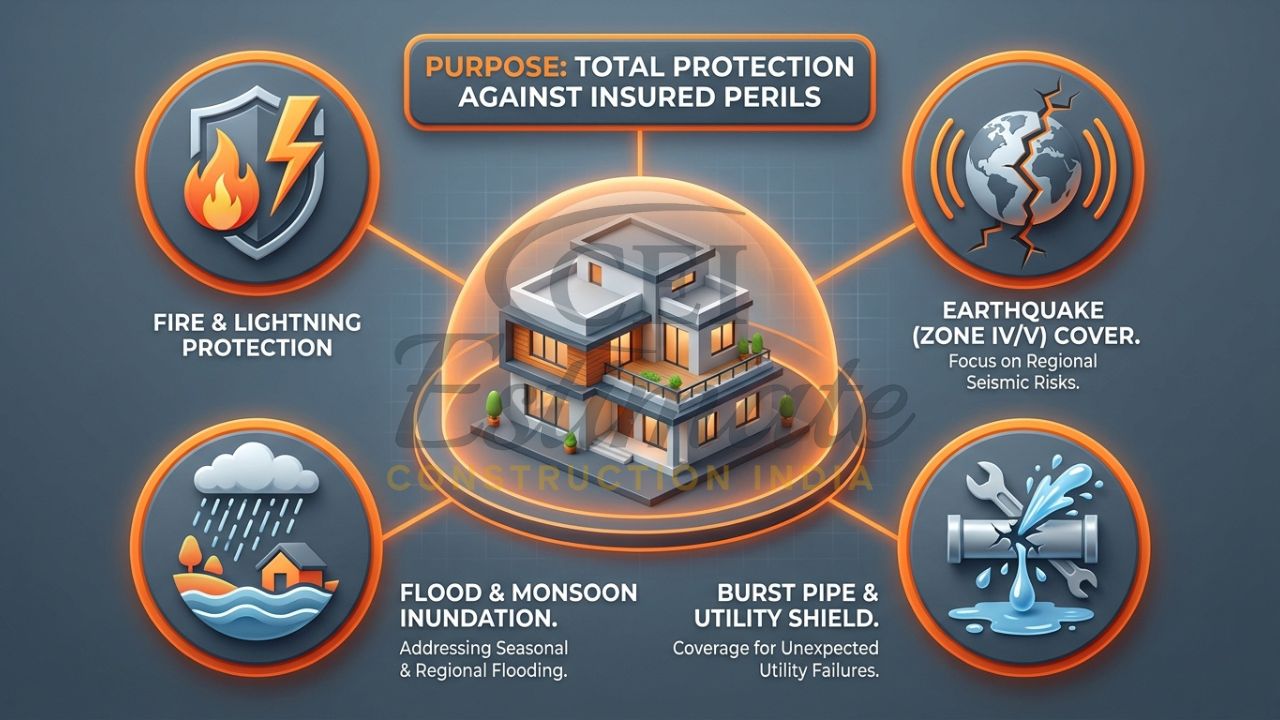
Under the BGR framework of 2026, standard coverage includes:
- Fire and Explosion: Accidental fires, lightning, and domestic gas cylinder explosions.
- Natural Calamities (STFI): Storms, Cyclones, Typhoons, Floods, and Inundations.
- Seismic Activity: Earthquakes and landslides (essential for Delhi-NCR).
- Impact Damage: Damage from falling trees, vehicles, or aircraft.
- Water Infrastructure: Bursting or overflowing of water tanks and pipes.
- Malicious Damage: Riots, strikes, and acts of terrorism (if opted).
Common Exclusions
It is equally important to know what is NOT covered:
- Normal Wear and Tear: Gradual deterioration, rust, or seepage due to age.
- Willful Negligence: Damage caused intentionally or by ignoring known structural flaws.
- Illegal Construction: Any portion of the home built without municipal approval (e.g., Meerut Development Authority).
- War and Nuclear Risks: Standard exclusions across the Indian insurance industry.
| Peril Category | Covered? | Context for 2026 |
|---|---|---|
| Earthquake/Flood | Yes | Non-negotiable for North India residents. |
| Plumbing Burst | Yes | Covers damage to walls/slabs from water. |
| Wall Cracks (Age) | No | Classified as maintenance responsibility. |
| Theft of Laptop | No* | Requires specific “Contents” or “Home” policy. |
| Terrorism | Optional | Recommended for high-value urban properties. |
*Note: 2026 BGR policies may include up to 20% auto-contents cover.
Important Add-ons and Extensions in Building Insurance
In 2026, a “basic” policy might not be enough. As construction costs for steel and cement fluctuate, certain riders have become essential for professional risk management.
- Escalation Cover: This is the most important rider for 2026. It automatically increases your sum insured by a percentage (usually 10% per year) to account for inflation in material costs.
- Loss of Rent / Alternative Accommodation: If a fire or flood makes your home uninhabitable, this add-on pays for your temporary stay in a hotel or rental home while your property is being rebuilt.
- Debris Removal: After a major collapse, clearing the site is an expensive task. This rider covers the costs of removing wreckage to prepare for reconstruction.
- Architect and Surveyor Fees: Rebuilding requires professional redesign. Most modern policies cover these fees up to 5% of the claim amount.
- Public Liability: This protects you if a structural failure (like a falling tile) injures a neighbor or a passerby, covering legal and medical costs.
How to Choose the Right Building Insurance Policy?
Choosing the right policy in 2026 requires a balance of technical accuracy and insurer trust. Follow these steps to ensure your property is correctly protected:
1. Calculate the Correct Sum Insured
Do not use the market value. Instead, use the Reinstatement Value formula:
Total Carpet Area (sq. ft.) × Current Construction Rate (₹/sq. ft.) = Sum Insured.
For example, a 2,000 sq. ft. home in Meerut with a reconstruction rate of ₹3,000/sq. ft. should be insured for at least ₹60 Lakhs.
2. Check the Claim Settlement Ratio (CSR)
In 2026, look for insurers with a high CSR specifically in the property segment. Private giants like ICICI Lombard and HDFC ERGO often report CSRs between 96% and 98%, making them reliable choices for structural claims.
3. Compare Aggregators vs. Direct
Platforms like Policybazaar are excellent for comparing multiple quotes side-by-side. However, buying directly from an insurer might offer specialized riders or better digital app support for managing claims in real-time.
4. Avoid Common Traps
- Under-insurance: If you insure your house for only 50% of its value to save on premiums, the insurer will only pay 50% of your claim, even for partial damage.
- Missing Natural Perils: Ensure “STFI” and “Earthquake” covers are active, especially if you live in a high-risk seismic zone.
Frequently Asked Questions (FAQs)
- Is building insurance mandatory in India?
While not legally mandatory by the government, it is almost always required by banks if you have an active home loan or mortgage. - Does building insurance cover my furniture and TV?
Standard building insurance focuses on the structure. However, modern BGR policies often include automatic contents cover up to 20% of the building’s value. - How much does building insurance cost in 2026?
It is surprisingly affordable. Annual premiums typically range from 0.02% to 0.05% of the reinstatement value. For a ₹50 Lakh home, this is roughly ₹2,500 to ₹5,000 per year. - What is the “Escalation Clause” I keep hearing about?
It’s a rider that increases your sum insured annually to keep pace with the rising costs of construction materials like steel and cement. - Can I buy insurance for a house that is still under construction?
No. Homes under construction require a “Contractors All Risk” (CAR) policy. You switch to building insurance once the house is finished and occupied. - Does the policy cover damage from a leaking roof?
If the leak is due to a storm or impact, it is covered. If it is due to lack of maintenance or old age, it is typically excluded as “wear and tear.” - Can a tenant buy building insurance?
No, only the property owner or the RWA (for apartments) has an “insurable interest” in the structure. Tenants should buy “Contents Insurance” instead. - Is earthquake coverage extra?
Under the Bharat Griha Raksha framework, earthquake coverage is a standard inclusion, but it is always wise to double-check your policy schedule.
Conclusion
Mastering the nuances of home structure building insurance in India is the final, non-negotiable step in your homeownership journey. In 2026, your home is more than just a place to live; it is a significant financial investment that faces evolving risks from climate change and economic inflation. By understanding the difference between the shell of your building and the contents within, and by accurately calculating your reinstatement value using a professional BOQ, you bridge the gap between a vulnerable asset and a protected legacy.
Don’t wait for a disaster to read your policy wordings. Whether you are building a new villa in Meerut or managing an apartment complex in Noida, ensure your structure is shielded today. For expert assistance in construction cost estimation and professional BOQs that include accurate insurance valuations, contact Construction Estimator India. Build with confidence, protect with precision, and secure your future.