Imagine you have just completed your dream home in Meerut, Uttar Pradesh, after months of meticulous planning and significant investment. The plaster is fresh, and the premium electrical wiring—which typically accounts for 10–18% of your construction cost—is safely concealed behind the walls. Suddenly, an unusually heavy monsoon triggers localized flooding or a short circuit leads to a devastating fire. In minutes, your hard-earned asset is compromised. This is a reality many face in North India today due to evolving climate risks and increasing natural calamities. To protect such investments, understanding home structure building insurance has become more critical than ever for every homeowner and builder in 2026.
As construction costs in India continue to rise, with high-end apartments in cities like Gurgaon or Mumbai requiring defensible, line-itemized data for any repair or restoration, you cannot afford to leave your property’s shell unprotected. Home structure building insurance is a specialized financial safeguard designed to cover the cost of repairing or rebuilding the physical framework of your house if it is damaged by an insured peril. While many confuse it with general home insurance, its primary focus is the “bricks and mortar.”
In this comprehensive guide, we will break down exactly what this insurance covers, how it differs from contents insurance, the role of the Bharat Griha Raksha policy, and why it is a non-negotiable component of modern project estimation. Whether you are an individual builder or a homeowner, this article equips you with the knowledge to secure your property and integrate insurance costs into your financial planning.
What Exactly is Home Structure Building Insurance?
At its core, home structure building insurance is a policy that covers the “shell” or the physical anatomy of your property. If you were to take your house, turn it upside down, and shake it, everything that stays attached is generally what this insurance protects. This includes the foundation, load-bearing walls, roof, floors, and permanent fixtures like windows and doors.
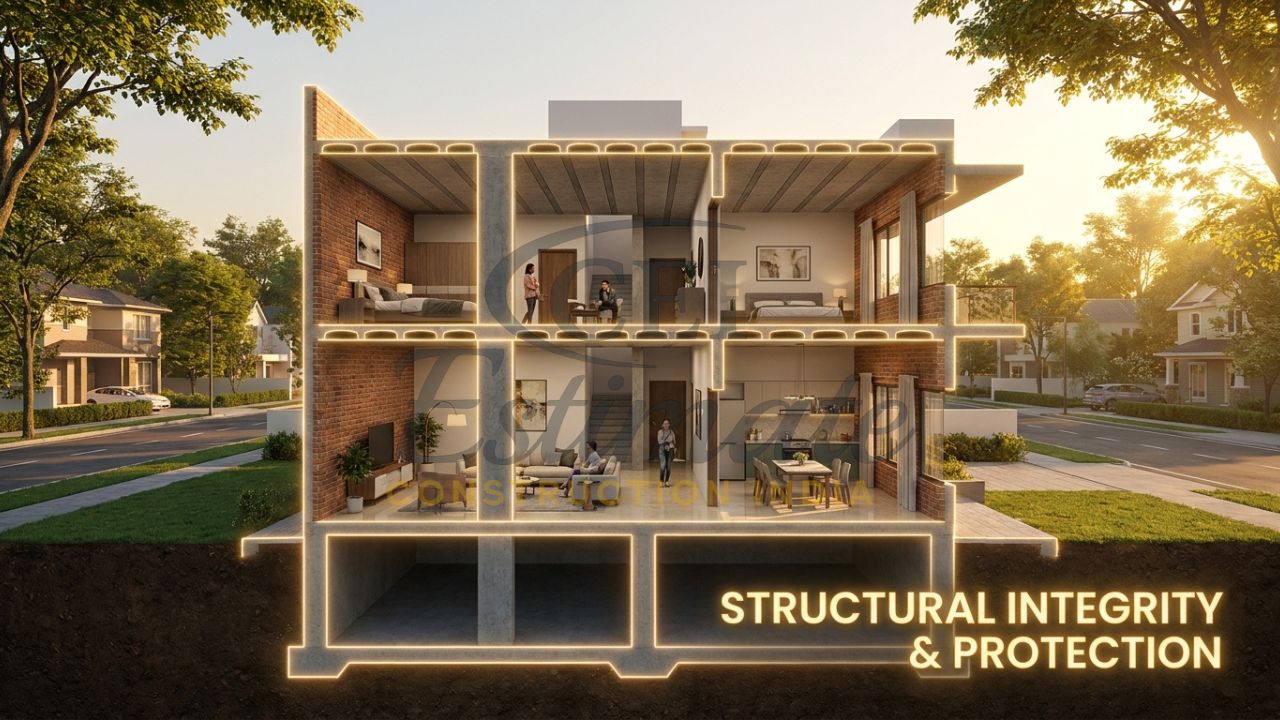
In the Indian context, especially for independent floors in Delhi NCR or villas in Tier-2 cities, this is often referred to as building structure insurance or dwelling coverage. It extends beyond just the walls to include permanent installations that you cannot take with you when you move, such as:
- Concealed plumbing and electrical systems.
- Built-in kitchen cabinets and bathroom fittings.
- Compound walls, gates, and fences.
- Solar panels or overhead water tanks fixed to the structure.
It is vital to recognize that this policy is designed to restore your home to its original state. In 2026, with the Indian insurance market shifting towards standardized data, insurers look for specific line items for restoration, such as the removal of gypsum boards or the application of emulsion paint. By securing this coverage, you ensure that the financial burden of these technical repairs does not fall solely on your shoulders.
Home Structure Insurance vs Home Contents Insurance – Key Differences
One of the most common mistakes Indian homeowners make is assuming that a single “home insurance” tag covers everything automatically. In reality, there is a distinct boundary between the structure and what lies within it. Understanding home structure insurance vs contents insurance is essential for determining the right level of protection.
While structure insurance covers the permanent building, contents insurance protects your movable belongings—electronics, furniture, jewelry, and clothes. For example, if a fire breaks out, the structure policy pays to repaint the charred walls, while the contents policy pays to replace your burnt television.
| Feature | Home Structure Building Insurance | Home Contents Insurance |
|---|---|---|
| What it Protects | Walls, roof, foundation, plumbing, and fixed wiring. | Furniture, appliances, jewelry, and personal items. |
| Target Audience | Homeowners and landlords. | Tenants and homeowners. |
| Basis of Sum Insured | Reinstatement/Reconstruction cost. | Market value or replacement value of items. |
| Key Example | Repairing a cracked pillar after an earthquake. | Replacing a laptop stolen during a burglary. |
| Mandatory Status | Often required by banks for home loans. | Purely voluntary. |
Many modern insurers in India, such as ICICI Lombard or HDFC Ergo, offer combined policies. However, as an estimator or builder, your primary focus should be the structure’s reinstatement value to ensure the project budget accounts for potential total loss scenarios.
To avoid confusion between these two terms, it is important to understand what is the difference between building insurance and home insurance. While both protect your property, building insurance primarily focuses on the physical structure, whereas home insurance is a broader term that may bundle structure and contents coverage together.
What Does Home Structure Building Insurance Cover in India?
Since 2021, the IRDAI home insurance landscape has been simplified through the introduction of the Bharat Griha Raksha (BGR) policy. This is a standard product that every general insurance company in India must offer, providing a uniform level of protection across the country.

When you purchase home building insurance India, the BGR framework typically covers the following major perils:
- Fire and Explosion: Protection against accidental fires, lightning strikes, or gas cylinder explosions.
- Natural Calamities: This is a crucial section for North India. It covers damage from floods, storms, cyclones, earthquakes, landslides, and rockslides.
- Malicious Damage: Coverage against riots, strikes, or acts of terrorism.
- Impact Damage: Damage caused by a vehicle, a falling tree, or even an aircraft.
- Water Infrastructure: Bursting or overflowing of water tanks, apparatus, and pipes.
- Theft Following an Event: If a wall collapses due to a storm and theft occurs within 7 days, it is often covered.
A significant benefit of the BGR policy is that it automatically includes “Escalation” coverage. This means your sum insured increases by a small percentage (usually 10% per year) to account for the rising cost of materials like steel and cement. For a contractor, this ensures that a claim filed two years after the policy inception still covers the inflated cost of reconstruction in 2026.
If you want a detailed breakdown of protections, read our guide on what is covered by building insurance in India. The standard policy typically includes fire, natural calamities, and impact damage, ensuring your property’s shell is financially protected against major risks.
Common Exclusions – What is NOT Covered
No insurance policy covers every possible scenario. To avoid disputes with loss assessors—a common issue in the Indian restoration industry—you must be aware of the “Fine Print.” Standard exclusions in home structure building insurance include:
- Wear and Tear: Gradual deterioration, rust, or damage caused by lack of maintenance is not covered.
- Willful Negligence: Damage caused intentionally by the insured person or their family.
- War and Nuclear Risks: Losses arising from war, invasion, or nuclear radiation.
- Under-Construction Properties: Standard home insurance does not cover a building while it is being built; you need a specific “Builder’s Risk” or “Construction All Risk” policy for that phase.
- Pre-existing Damage: Any cracks or structural issues that existed before the policy start date.
Always read your policy wording carefully. For instance, some policies might exclude damage to the compound wall unless the main building is also damaged.
Note that standard home structure insurance does not cover buildings while they are still under construction. For that specific phase, you need a dedicated under construction building insurance policy, also known as Builder’s Risk or Construction All Risk (CAR) insurance.
Is Home Structure Insurance Mandatory in India?
From a strictly legal standpoint, home structure insurance is not mandatory by law for individual homeowners. However, in practice, it is almost always required in two specific scenarios:
- Home Loans: If you take a mortgage from a bank like SBI or HDFC, they will insist on a home structure insurance policy. This protects the bank’s collateral (your house) against total loss.
- RERA Compliance: Under the Real Estate (Regulation and Development) Act, developers are often required to maintain insurance for the structure and title of the project until it is handed over to the residents’ association.
Buying it voluntarily is a hallmark of a “smart homeowner.” In a state like Uttar Pradesh, which sits on various seismic zones, the cost of the premium is a small price to pay for the peace of mind that your largest financial asset is secure.
How Much Does Home Structure Building Insurance Cost in India?
The cost of home structure insurance in India is surprisingly affordable compared to health or motor insurance. The premium is calculated based on the “Reinstatement Value,” which is the cost of rebuilding the house (materials + labor), not the market value (which includes land cost).
For a typical 1000 sq ft house in a city like Meerut, if the construction cost is ₹2,000 per sq ft, your sum insured should be ₹20 Lakhs. In 2026, realistic premium ranges are:
- Standard Rates: 0.15% to 0.40% of the Sum Insured.
- Premium for ₹20 Lakhs: Approximately ₹3,000 to ₹8,000 per year.
Factors affecting your premium include:
- Location: Coastal areas or high-seismic zones (Zone IV/V) attract higher rates.
- Construction Type: RCC (Reinforced Cement Concrete) structures get lower rates than those with wooden or temporary roofs.
- Policy Tenure: Buying a long-term policy (up to 15-20 years) often yields significant discounts.
Step-by-Step Guide to Buying Home Structure Insurance
Buying home structure building insurance in 2026 is a digital-first process. Follow these steps to ensure you get the right coverage:
- Calculate Reinstatement Value: Use an accurate material and labor breakdown. For example, if your electrical work cost ₹1.8 Lakhs, ensure that the total structure value reflects these high-end finishes.
- Compare Quotes: Use platforms like Policybazaar or go directly to insurer websites like ICICI Lombard or SBI General to compare BGR policies.
- Choose Add-ons: Consider “Debris Removal” (covers the cost of clearing the site after a fire) and “Architect’s Fees” (covers the cost of redesigning).
- Submit Documents: You typically need the property’s address, carpet area, and age of construction. No physical inspection is usually required for newer buildings.
Claims Process and Tips for Smooth Settlement
If disaster strikes, the claims process can be daunting. In 2026, insurance companies demand line-itemized data and photographic evidence.
- Immediate Intimation: Inform the insurer via their app or toll-free number within 24 hours.
- Document the Damage: Take high-quality photos and videos of the affected structure before starting any repairs.
- Provide a Defensible Estimate: Work with a professional estimator to create a BOQ for repairs that uses current market rates for cement, steel, and labor.
- Avoid Common Mistakes: Do not discard damaged parts before the surveyor arrives and do not under-declare the area of your home.
Why Every Home Builder and Estimator Should Factor It In?
For contractors and estimators, home structure building insurance is not just an “afterthought.” It is a vital line item in your Bill of Quantities (BOQ). When you provide a project estimate for a new villa or independent floor, including the first year’s insurance premium demonstrates professionalism and protects your client from day one.
As a builder or estimator, it is equally important to be aware of types of construction insurance in India. From structure coverage to contractor-specific policies, understanding the full spectrum helps you offer comprehensive risk management solutions to your clients. Beyond property protection, responsible contractors also secure insurance for construction workers in India. This covers injuries, accidents, and liabilities during the building phase, making your project safer and more professional.
Contractors and developers can further strengthen their risk management by exploring types of insurance for contractors in India. These policies complement home structure insurance and help safeguard both the project and the business.
At Construction Estimator India, we see insurance as a component of risk management. By factoring in these costs, you avoid under-bidding and ensure the project remains viable even if an unforeseen event occurs during the final stages of the build.
Conclusion
Protecting your home’s physical framework is not just a financial decision; it is about safeguarding your family’s future. Home structure building insurance provides a robust safety net against the unpredictable elements of nature and accidental hazards. From the foundation to the roof, ensuring your structure is insured allows you to build with confidence in 2026.
Don’t wait for a calamity to strike. Whether you are building a new home in Meerut or managing a large-scale development in North India, make insurance a priority. Summarizing our guide: understand your reinstatement value, choose a Bharat Griha Raksha policy, and always keep your documentation ready.
For professional construction cost estimation services that include detailed insurance premium projections and risk assessments, contact Construction Estimator India today. Let us help you build a home that is both beautiful and protected.
FAQ Section
What is the difference between home structure insurance and contents insurance?
Home structure insurance covers the physical building (walls, roof, fixtures), while contents insurance covers movable items inside the house like furniture and electronics.
Is home building insurance mandatory for home loans in India?
Yes, most Indian banks and financial institutions make it mandatory to buy structure insurance for the duration of the home loan to protect their collateral.
Does home structure insurance cover earthquake and flood?
Yes, under the standard Bharat Griha Raksha (BGR) policy, natural calamities like earthquakes, floods, and landslides are covered by default.
How is the sum insured calculated for home structure insurance?
It is calculated based on the “Reinstatement Value,” which is the current cost of construction (Area x Cost of construction per sq ft), excluding the land value.
Can I buy insurance for an under-construction home?
Standard home insurance is for completed buildings. For properties under construction, you need a “Builder’s Risk” or “Contractor’s All Risk” (CAR) policy.
What is the Bharat Griha Raksha policy?
It is a standardized home insurance policy introduced by IRDAI in 2021 that offers uniform coverage across all general insurance companies in India.
Does it cover the cost of a temporary house if mine is damaged?
Many policies offer an add-on called “Alternative Accommodation Cover,” which pays for your rent if your insured home becomes uninhabitable due to a covered peril.
Are built-in wardrobes covered under structure or contents?
Since built-in wardrobes are permanently fixed to the walls, they are generally covered under the home structure insurance policy.