
Imagine you are a homeowner in Meerut, Uttar Pradesh. After years of meticulous planning and a significant investment of nearly ₹80 lakhs, you have finally constructed your dream residence. You sensibly purchased what you thought was “home insurance” to protect your asset. However, during the severe monsoon rains of 2026, a major leakage leads to short-circuiting that destroys your high-end modular kitchen and premium Italian leather sofas. When you file a claim, the surveyor informs you that your policy was only for “building structure insurance,” and none of your expensive internal contents are covered. This heart-breaking scenario is all too common in India due to the deep-seated confusion regarding insurance terminology.
Understanding the difference between building insurance and home insurance is not just academic; it is a financial necessity for every property owner and construction professional. In simple terms, building insurance (also known as home structure or dwelling insurance) covers only the physical shell and permanent fixtures of the property, whereas home insurance is generally a comprehensive package that includes both the structure and the valuable contents inside. For contractors and estimators, getting this distinction right in a Bill of Quantities (BOQ) ensures that a project’s soft costs are accurately accounted for, protecting the client’s long-term interests. This guide will navigate the nuances of the Indian insurance landscape in 2026, comparing coverage, costs, and the IRDAI-mandated Bharat Griha Raksha policies to help you make an informed decision for your project.
For a broader understanding of the Indian insurance ecosystem, you may explore what is home insurance in India. This will help you see how structure coverage fits into the overall home protection strategy offered by insurers today.
What is Building Insurance?
Building insurance is specifically designed to protect the “bones” of your property. In the Indian context, this is often referred to as building structure insurance or dwelling coverage. It focuses exclusively on the physical construction of the house. If you were to turn your house upside down and shake it, everything that stays attached—the foundation, the walls, the roof, and the permanent internal wiring—falls under building insurance.
If you want a detailed breakdown of protections, read our guide on what is covered by building insurance in India. The standard policy typically includes fire, natural calamities, and impact damage, ensuring your property’s shell is financially protected against major risks.
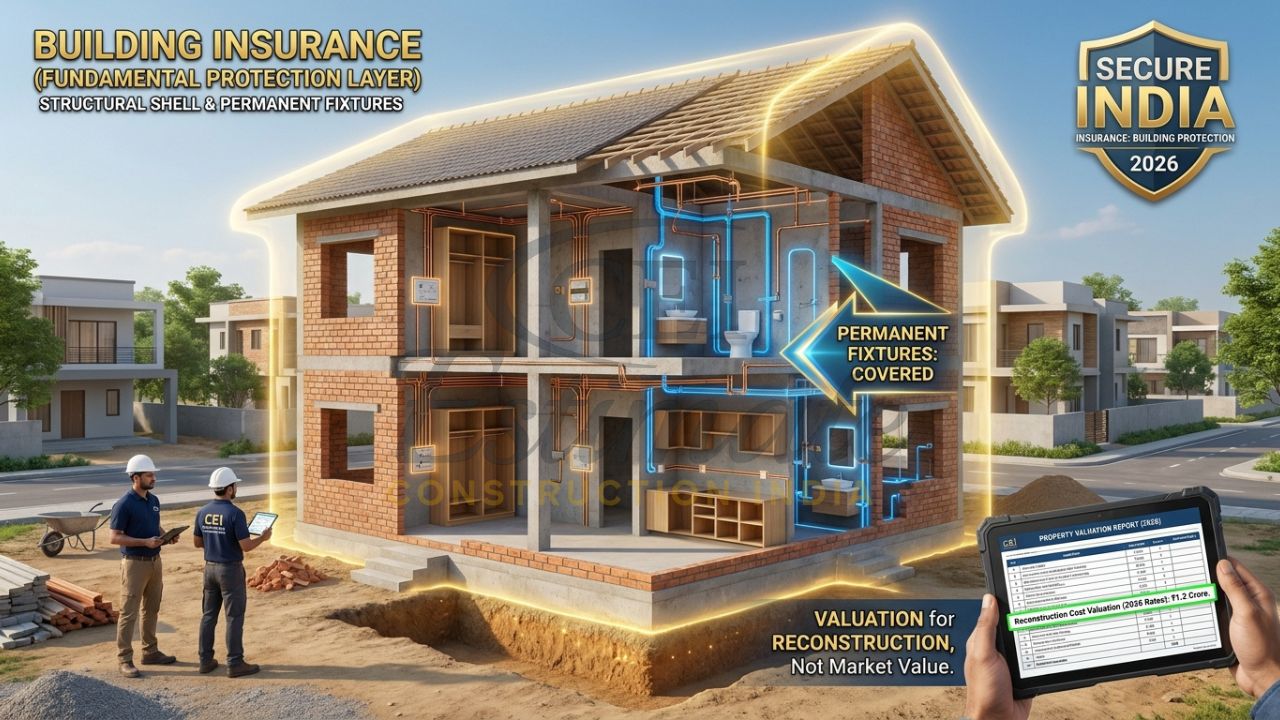
This policy covers the cost of repairing or rebuilding the structure if it is damaged by an insured peril like fire, earthquake, or floods. Crucially, it includes permanent fixtures that are considered part of the real estate. This includes your plumbing systems, electrical switchboards, built-in wardrobes, kitchen cabinets, and bathroom fittings. For homeowners in NCR high-rises or independent villas in cities like Meerut, this is the fundamental layer of protection required. It is suitable for both independent house owners and apartment owners (who cover their specific carpet area share). From a construction estimator’s perspective, the sum insured here is typically based on the reconstruction cost—the actual money needed to rebuild the structure at current 2026 material and labor rates—rather than the market value of the land.
What is Home Insurance?
In India, the term “home insurance” is frequently used as an umbrella term for a comprehensive package policy. Unlike the narrow focus of structure-only plans, a home insurance policy is a “Structure + Contents” solution. It is designed to safeguard not just the roof over your head but also the lifestyle you have built inside those walls.

When you opt for home insurance India plans, such as the standard Bharat Griha Raksha (BGR) policy mandated by the IRDAI, you are essentially buying a bundle. This bundle protects the physical building and your movable assets, such as furniture, electronic appliances (ACs, TVs, washing machines), clothing, jewelry (within limits), and kitchen utensils. Leading insurers like ICICI Lombard, HDFC Ergo, and Bajaj Allianz offer these bundled plans to provide 360-degree protection. For a tenant living in a rented apartment in Noida, home insurance might mean a “contents-only” policy, whereas for an owner-occupier, it means the full package. Understanding this distinction is vital because a structure-only policy will leave your expensive possessions vulnerable to theft or internal damage.
Key Differences Between Building Insurance and Home Insurance
To help you choose the right protection for your property, let’s look at a side-by-side comparison of these two categories in the current 2026 Indian market.
| Feature | Building Insurance (Structure Only) | Home Insurance (Package Policy) |
|---|---|---|
| Primary Scope | Only the physical structure and permanent fixtures. | Both the building structure and movable contents. |
| Sum Insured Basis | Calculated on the cost of reconstruction (Area x Construction Rate). | Reconstruction cost for building + Market value for contents. |
| Who Should Buy? | Landlords, builders, or owners of vacant property. | Owner-occupiers and residents of the home. |
| Key Inclusions | Walls, roof, flooring, plumbing, electrical wiring. | Structure plus ACs, TV, furniture, jewelry, and appliances. |
| Theft Protection | Generally does not cover theft (since you can’t steal a wall). | Includes coverage for burglary and housebreaking. |
| Premium Cost | Lower (approx. ₹2,000–₹4,000 for a ₹50L structure). | Higher (depends on value of contents; approx. ₹5,000–₹9,000). |
| Typical Policy Name | Building Structure Insurance / Fire & Special Perils. | Bharat Griha Raksha / Comprehensive Home Insurance. |
Major Distinctions to Note:
- Valuation Methodology: For building insurance, your estimator must provide an accurate BOQ reflecting current labor and material costs to avoid “under-insurance.” For home insurance, you must also maintain an inventory of your furniture and electronics.
- Liability: Comprehensive home insurance often includes “Public Liability,” which protects you if a visitor is injured on your property or if a fire in your kitchen damages a neighbor’s flat. Building insurance rarely includes this.
- Target Audience: If you are a real estate developer in Meerut selling a new build, you might only carry building insurance until the handover. Once a family moves in, they require the full home building insurance vs contents insurance balance to protect their daily lives.
What Does Building Insurance Cover in India?
Under the 2026 IRDAI guidelines, building insurance provides a robust safety net against “Fire and Special Perils.” It is a misconception that it only covers fire. A standard policy for building structure insurance typically covers:
- Natural Calamities: This is critical for Northern India. It covers damage from earthquakes (Zone IV/V risks in Delhi-NCR), floods, inundation, storms, cyclones, and landslides.
- Man-made Perils: This includes riots, strikes, and malicious damage.
- Impact Damage: If a vehicle or a falling tree crashes into your boundary wall or structure.
- Bursting of Pipes: Covers the structural damage caused by bursting or overflowing of water tanks and pipes (though the pipe repair itself might be excluded).
- Permanent Fixtures: All “built-ins” like modular kitchens, chimneys, false ceilings, and bathroom vanity units are covered as part of the structure.
- Additional Structures: Your garage, compound walls, and even a servant’s quarter are included if they are specified in the policy.
What Does Home Insurance Typically Cover?
When you step up to a full home insurance India policy, you are essentially getting everything mentioned in the building section plus a secondary layer for “Contents.”
- Content Protection: This covers your furniture, carpets, consumer durables (fridge, microwave, washing machine), and laptops against the same perils (fire, flood) and, most importantly, against burglary.
- Add-on Covers: In 2026, most Indian insurers offer specialized add-ons. These include “Loss of Rent” (if your house becomes uninhabitable), “Temporary Resettlement” (paying for your hotel stay while repairs happen), and “Debris Removal” (the cost of clearing the site after a fire).
- Jewelry and Valuables: While basic plans have small limits, you can add “Valuable Item” riders to cover gold jewelry or high-end art pieces.
Common Exclusions in Both Policies
No insurance policy covers everything. Whether you are looking at the difference between building insurance and home insurance, you must be aware of these standard 2026 exclusions:
- Normal Wear and Tear: You cannot claim for a wall that needs repainting due to age or a roof that leaks because it hasn’t been maintained for 10 years.
- Willful Negligence: If you leave your front door wide open and get robbed, or if you intentionally set fire to the property, the claim will be rejected.
- War and Nuclear Risks: Damage resulting from war, invasion, or nuclear radiation is universally excluded.
- Pre-existing Damage: Any cracks or structural issues that existed before the policy was purchased are not covered.
- Vacant Property: Most policies become void if the house is left unoccupied for more than 30 or 60 consecutive days without prior intimation to the insurer.
Which One Should You Buy? Practical Advice for Indian Homeowners & Builders
Choosing between building insurance vs home insurance India depends on your specific situation:
- For the New Builder/Estimator: If you are currently in the construction phase in Meerut or Delhi, you need “Contractor’s All Risk” (CAR) insurance first. Once the building is finished but unoccupied, building structure insurance is sufficient.
- For the Homeowner (Self-Occupied): Always go for a comprehensive home insurance policy. The price difference is negligible (often just ₹1,000–₹2,000 extra per year), but it protects your entire net worth stored inside the house.
- For the Landlord: You should buy building insurance to protect your asset. You don’t need to cover the tenant’s furniture. However, ensure you have a “Loss of Rent” add-on.
- For the Tenant: You only need “Contents Insurance.” You don’t need to pay to insure the landlord’s walls.
Expert Tip for Estimators: When creating a BOQ for a client, always include a line item for “Insurance during & post-construction.” Estimating the correct sum insured based on the Total Built-up Area x Current Construction Rate per Sq. Ft. ensures the client is never under-insured.
Note that standard home structure insurance does not cover buildings while they are still under construction. For that specific phase, you need a dedicated under construction building insurance policy, also known as Builder’s Risk or Construction All Risk (CAR) insurance. As a builder or estimator, it is equally important to be aware of types of construction insurance in India. From structure coverage to contractor-specific policies, understanding the full spectrum helps you offer comprehensive risk management solutions to your clients.
Beyond property protection, responsible contractors also secure insurance for construction workers in India. This covers injuries, accidents, and liabilities during the building phase, making your project safer and more professional.
Cost Comparison and How It Affects Your Home Project Budget
In 2026, insurance remains one of the most affordable components of a construction project. For a standard 2,000 sq. ft. home in a city like Meerut, with a reconstruction cost of ₹5,000 per sq. ft. (Total ₹1 Crore):
- Building Insurance Premium: Approximately ₹3,500 to ₹5,500 per year.
- Full Home Insurance (including ₹10L contents): Approximately ₹6,000 to ₹8,500 per year.
Factors affecting these costs include the age of the building, its proximity to water bodies (flood risk), and the earthquake zone. When budgeting, consider insurance as a “fixed soft cost.” It represents less than 0.1% of your total project value but protects 100% of it.
Step-by-Step Guide to Buying the Right Policy
- Calculate the Reconstruction Cost: Do not use the market value. Use the actual cost to rebuild. (Contact Person at Construction Estimator India for help with this).
- Inventory Your Contents: List major appliances and furniture with their approximate current purchase price.
- Check for ‘Bharat Griha Raksha’: Ensure the policy follows the IRDAI standard format, which is very consumer-friendly.
- Select Add-ons: If you live in a flood-prone area of Uttar Pradesh, ensure “STFI” (Storm, Tempest, Flood, Inundation) cover is active.
- Compare Quotes: Use platforms like PolicyBazaar or contact insurers like ICICI Lombard directly.
Conclusion
The difference between building insurance and home insurance is the difference between protecting a house and protecting a home. While building insurance focuses on the structural integrity of your investment, home insurance provides a holistic shield for your family’s assets and peace of mind. For homeowners and builders in Meerut, Delhi-NCR, and beyond, 2026 is the year to move beyond “lump sum” guesswork and embrace precise protection.
Don’t let your hard work go unprotected. At Construction Estimator India, we specialize in providing professional BOQs and cost estimation services that include accurate insurance valuations. We ensure your project is built on a foundation of financial security.
Ready to secure your project?
- Contact us for a Professional BOQ: Click here
- WhatsApp for Estimation Help: +91 8630676890
- Read our guide on “What is Home Structure Building Insurance?” to dive deeper into structural specifics.
FAQ – Difference Between Building and Home Insurance in India
What is the main difference between building insurance and home insurance in India?
Building insurance covers only the physical structure (walls, roof, fixtures), while home insurance is a package covering both the structure and the movable contents (furniture, electronics) inside.
Does building insurance cover contents?
No. Standard building insurance only covers the permanent structure and fixtures. You need a comprehensive home insurance policy or a contents add-on to protect movable items.
Is home insurance mandatory for home loans in India?
Banks usually mandate building structure insurance to protect their collateral. However, they may not require you to cover the contents. It is highly recommended to opt for full cover regardless.
Can I buy only building insurance?
Yes, landlords often buy structure-only policies. However, if you live in the house, a package policy is much better value.
How is sum insured calculated for building insurance?
It is calculated as: Total Built-up Area (sq. ft.) x Current Cost of Construction per sq. ft. It should not include the land value.
Does building insurance cover earthquake and flood damage?
Yes, under the standard Bharat Griha Raksha guidelines of 2026, natural calamities like earthquakes and floods are included as standard perils.
What is Bharat Griha Raksha policy?
It is the standard, easy-to-understand home insurance policy mandated by the IRDAI for all Indian insurers. it covers home building and/or home contents.
Which is cheaper — building insurance or full home insurance?
Building insurance is cheaper because it covers fewer items. However, the premium for full home insurance is usually only 20-30% higher for significantly better protection.
Can tenants buy building insurance?
No. Tenants do not have an “insurable interest” in the building structure. They should buy “Contents Insurance” to protect their own belongings.
What are the documents needed for a claim?
Typically, you need the policy document, a filled claim form, an FIR (for theft/malicious damage), and a detailed estimate of repairs from a professional like Construction Estimator India.