
Imagine investing lakhs in a premium Italian marble floor or a high-end granite driveway, only to find hollow sounds when you walk on it or hairline cracks appearing within the first year. For many Indian homeowners, this is a heartbreaking reality. We often spend weeks picking the perfect stone or tile but leave the choice of “glue”—the cement—to the last minute or to the discretion of a local contractor who might still be using methods from the 1990s.
In 2026, construction in India has evolved. With heavier vehicles, extreme temperature variations due to climate change, and the popularity of large-format vitrified slabs, the “one-size-fits-all” approach to cement is dead. Using the wrong best cement for flooring and structural works in India doesn’t just look bad; it compromises the safety and longevity of your home. Whether you are casting a column that must withstand seismic loads or repairing a garage floor that faces daily oil spills, your material choice determines if your building stays “as good as new” for 50 years or starts crumbling in five. This guide serves as your expert blueprint for making the right choice in the modern Indian market.
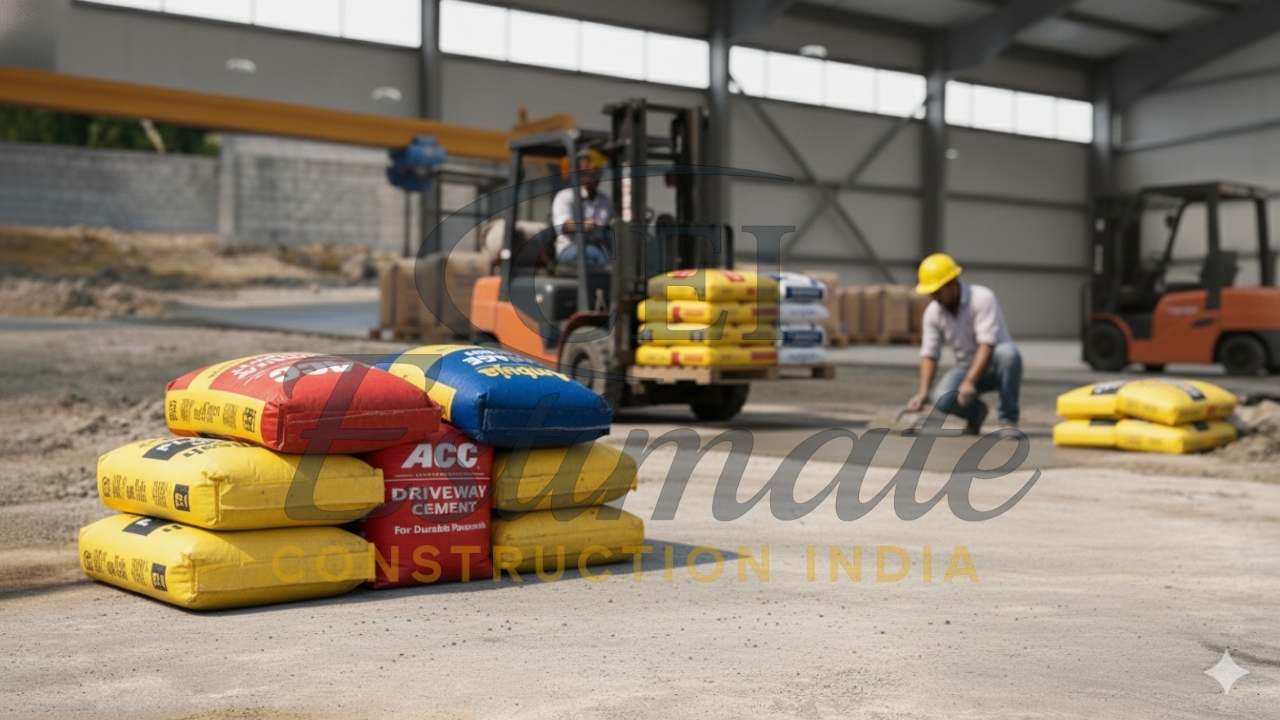
Understanding Cement Requirements: Flooring vs. Structural Works
Choosing the right material begins with understanding the physics of the application. Flooring and structural works have fundamentally different demands on a cementitious binder.
1. Flooring Demands (The Surface)
Flooring is all about finish, abrasion resistance, and bond strength. A driveway needs to withstand the “grinding” effect of car tires, while a living room floor must handle thermal expansion without popping the tiles. Standard cement-sand mortar often fails here because it shrinks significantly as it dries, leading to the dreaded “hollow” sound under granite or marble. Modern flooring requires binders with low shrinkage and high flexibility.
2. Structural Demands (The Skeleton)
Structural elements like RCC columns and beams are the skeleton of your house. Here, the primary requirement is compressive strength and steel protection. The cement must act as a dense shield, preventing water and sulfates from reaching the internal steel rebars. In structural work, we look for “early strength” to allow for faster deshuttering and “ultimate strength” to carry the building’s load for decades.
Best Cement for Flooring Applications
Selecting the right binder for flooring is no longer just about buying a bag of “grey cement.” It’s about matching the material to the specific exposure and stone type.
Best Cement for Granite Flooring
Granite is dense and has extremely low water absorption, which makes it very difficult for traditional cement mortar to “grip”. In the extreme heat of Indian summers, granite expands and contracts; if the mortar bed is too rigid, it will crack or debond.
For a high-end finish, experts in 2026 recommend using polymer-modified tile adhesives governed by IS 15477:2019 standards. If you must use a cement bed, ensure you are “back-buttering” the granite slabs with a slurry of white cement and polymer additives to prevent staining and ensure a 100% bond. You can find more details on achieving a flawless finish in our dedicated guide on the best cement for granite flooring.
Best Cement for Driveway in India
An Indian driveway faces the toughest conditions: heavy SUVs, monsoon flooding, and peak summer heat reaching 45°C. Using standard PPC (Portland Pozzolana Cement) alone can lead to surface dusting and “spalling” under heavy tire loads.
The ideal solution for a modern driveway is M25 to M30 grade concrete using PSC (Portland Slag Cement) or a high-performance PPC from top brands. These cements offer lower permeability, which protects the internal reinforcement from rainwater seepage. To ensure your entrance remains crack-free, check out our technical breakdown of the best cement for driveway in India.
Best Cement for Garage Floor Repair
Garage floors are unique because they aren’t just hit by weight; they are attacked by chemicals like motor oil, brake fluid, and grease. Once a garage floor starts “spalling” (surface peeling), standard cement mortar will not stick to the oil-soaked old concrete.
For long-lasting repairs, professionals use polymer-modified repair mortars or epoxy-based mortars. These materials have superior bonding strength and are resistant to chemical spills. Brands like Dr. Fixit, Fosroc, and Sika dominate this specialized niche. For a step-by-step professional repair method, read our guide on the best cement for garage floor repair.
Best Cement for Structural Works
Structural works are the non-negotiable part of house construction. While you can change a floor later, you cannot “fix” a weak column easily.
Best Cement for Column and Beam in India
For RCC (Reinforced Cement Concrete) structural members, OPC 53 Grade (Ordinary Portland Cement) has traditionally been the gold standard due to its high early strength. It allows contractors to remove the formwork (deshuttering) faster, which speeds up construction.
However, in 2026, PSC (Portland Slag Cement) and PPC are becoming the preferred choices for residential G+1 to G+3 buildings. Why? Because while OPC 53 is strong, it generates a lot of heat during setting, which can cause “micro-cracks”. PPC and PSC provide higher long-term durability and much better resistance to sulfate attacks from the soil. For a deep dive into mix designs and brand-wise comparisons, visit our page on the best cement for column and beam in India.
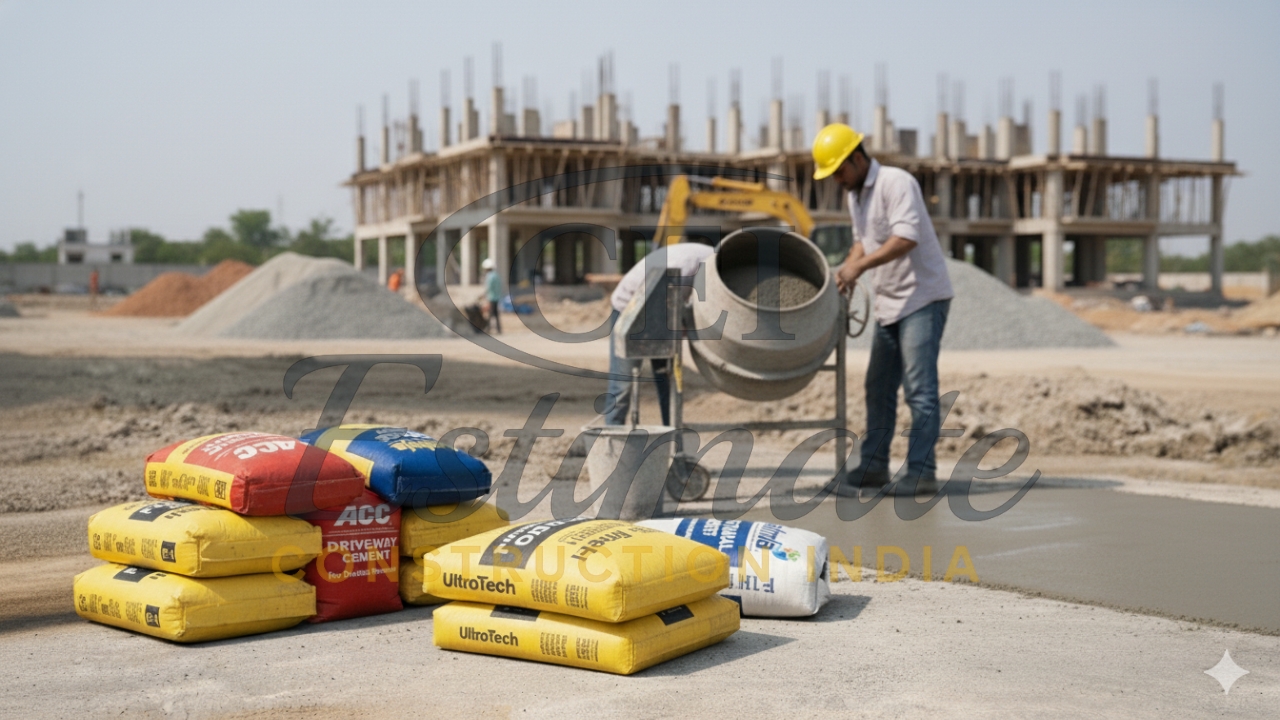
Key Requirements for RCC Structural Members
- High Compressive Strength: Minimum M20 grade concrete for residential projects, though M25 is safer for seismic zones.
- Low Permeability: To prevent the “rusting” of steel bars (corrosion).
- Freshness: Never use cement that is more than 3 months old from the date of manufacture, as it loses significant strength.
- Workability: The concrete must flow easily around congested steel cages without needing extra water, which weakens the mix.
Top 20 Cement Companies in India 2026 – Best Choices
The Indian cement market is dominated by a few giants that offer consistent quality across the country. Selecting a top-tier brand ensures that the bag you buy in a village in Bihar has the same quality as the one bought in Delhi.
| Tier | Brand Name | Best Suited For |
|---|---|---|
| Market Leaders | UltraTech, ACC, Ambuja | All-round performance, RCC, and Premium Flooring. |
| Durability Kings | Dalmia, Shree, J.K. Lakshmi | Foundation, Driveways, and Coastal Areas. |
| Value Picks | Wonder, Bangur, Birla Corp | Brickwork, Plaster, and General Flooring. |
UltraTech remains the national leader, recently commissioning new units in Chhattisgarh and Tamil Nadu to reach a massive 151.6 mtpa capacity. Meanwhile, the Adani Group (owners of ACC and Ambuja) is aggressively expanding with a goal to capture 20% of the market by 2028. For a full ranking of market share, pricing, and regional availability, see our comprehensive list of the top 20 cement companies in India 2026.
Comparison Table: Best Cement for Different Applications
| Application | Recommended Cement/Grade | Key Benefit | Typical Price (2026) |
|---|---|---|---|
| Granite Flooring | Polymer-Modified Adhesive (C2 Class) | Zero hollow sounds, no staining. | ₹600 – ₹1,200 per 20kg |
| Driveways | PSC / PPC (M25 Grade) | Resistance to rain and heavy loads. | ₹380 – ₹450 per 50kg |
| Garage Repair | Polymer Repair Mortar | Bonds to old concrete and oil resistance. | Specialized Pricing |
| Columns & Beams | OPC 53 / PSC (M25 Grade) | High strength and rebar protection. | ₹390 – ₹480 per 50kg |
| Roof Slabs | PPC / Water-Repellent PPC | Lower crack risk and leak-proofing. | ₹380 – ₹450 per 50kg |
Pro Tips for Best Results
As a civil engineer, I always tell my clients: the best cement in the world will fail if the execution is poor. Follow these non-negotiable rules for your site:
- Water-Cement Ratio: Keep it between 0.40 and 0.48. Adding too much water makes the concrete “runny” and easy to pour, but it leaves “pores” when it dries, leading to leaks and weak structures.
- Curing is King: Concrete needs water to gain strength. For flooring and structural works, cure for at least 14 to 21 days. Use “ponding” for slabs and “wet jute bags” for columns.
- Vibration: Always use a mechanical needle vibrator for columns and beams. Manual “tamping” with a rod leaves air pockets (honeycombing) which are a structural disaster.
- Avoid Cold Joints: When casting a floor or driveway, try to finish the entire section in one go. If you stop and restart the next day, a weak line (cold joint) forms where water will eventually leak.
Frequently Asked Questions (FAQs)
- Which grade of cement is best for a 1000 sq. ft. house floor?
For standard internal floors, a good quality PPC (Portland Pozzolana Cement) is excellent because it provides a smoother finish and has lower shrinkage cracks than OPC. - Can I use the same cement for my columns and my granite flooring?
Technically, yes, but practically, no. Use OPC 53 or PSC for columns for strength, but use a polymer-modified adhesive for granite to ensure it doesn’t come loose or sound hollow. - Why does my garage floor have cracks even after using “expensive” cement?
Garage floors often crack because the sub-base (the soil/sand layer below) wasn’t compacted properly or because the concrete was too “soupy” (high water content). - Is White Cement better for flooring?
White cement is essential for fixing light-colored marbles like Italian or Makrana because grey cement can “bleed” through and stain the stone. - How long should I wait before driving a car on a new concrete driveway?
Wait at least 21 to 28 days. Concrete achieves 90% of its strength in 28 days; driving too early can cause permanent structural cracks. - Does brand matter for structural work?
Yes. National brands (Tier-1) have much tighter quality control. A bag of UltraTech or ACC will consistently meet the strength standards, whereas local “non-branded” cements can vary from batch to batch. - What is “honeycombing” in columns?
Honeycombing refers to gaps or “voids” in the concrete where the cement paste didn’t reach. This happens due to poor vibration and can make a column weak enough to fail under load. - Can I mix different brands of cement in one slab?
Never mix brands in a single pour. Different brands have different setting times and chemical compositions, which can lead to uneven drying and cracks.
Conclusion
Choosing the best cement for flooring and structural works in India is a decision that impacts your daily life for the next half-century. Whether it is the quiet confidence of a solid-sounding granite floor or the hidden strength of the beams over your head, the quality of your binder is the hero of your construction story.
In 2026, don’t let a “contractor’s shortcut” ruin your investment. Demand modern materials like polymer adhesives for your granite, and durable PSC or PPC for your RCC structural members. Remember, a house is built with bricks and stone, but a home is held together by the right cement. Choose wisely, cure properly, and build a legacy that lasts.