
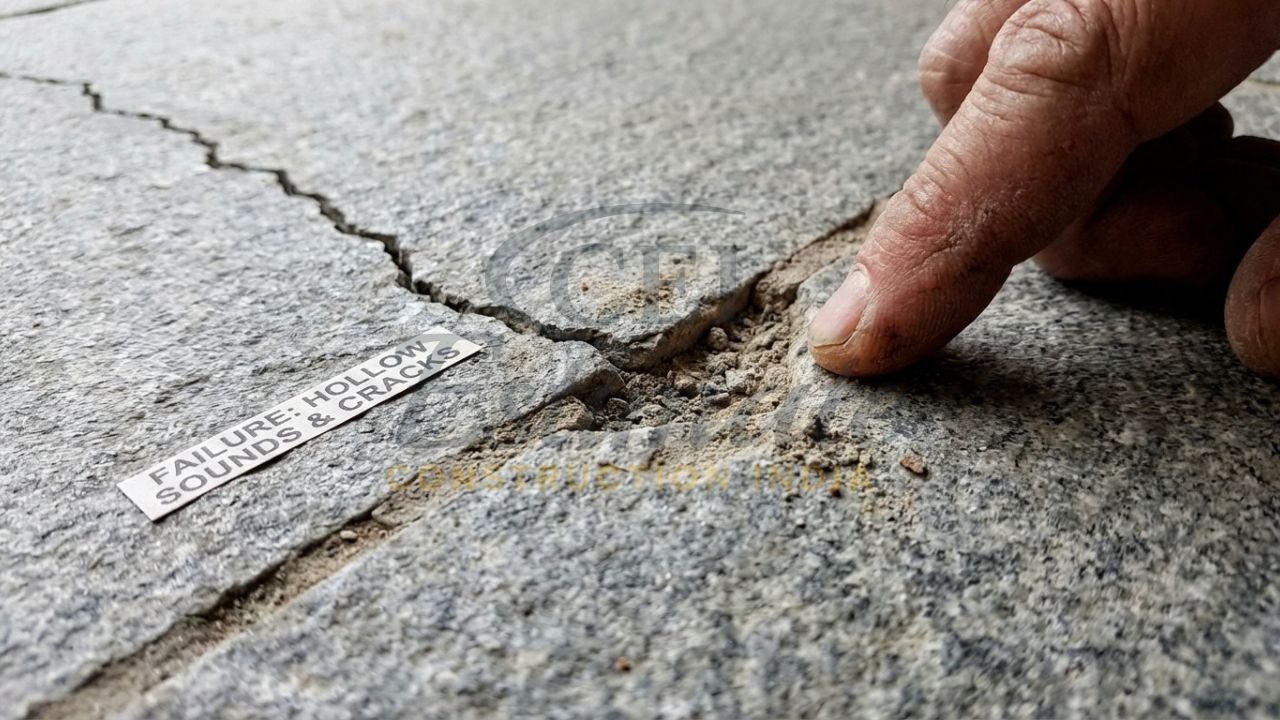
If you walk into many houses in Agra, Lucknow, Delhi-NCR, or across North India, you’ll notice something very common: beautiful granite flooring that starts making hollow sounds, loose edges, or cracks within 2–3 years.
Homeowners are often surprised because granite is one of the strongest natural stones available. But the real problem is rarely the granite itself — it’s the method used to fix the granite slabs.
For decades, Indian contractors traditionally used cement-sand mortar (usually OPC or PPC mixed with sand) for fixing granite flooring. This technique worked reasonably well when stones were smaller and construction quality was high. However, modern granite flooring involves:
- Large heavy slabs
- Highly polished low-porosity surfaces
- Precision leveling requirements
- Modern concrete subfloors
Because of this, the old mortar method often fails.
Granite slabs can weigh 18–25 kg per square foot, and they absorb very little water. That means the cement mortar underneath cannot easily bond with the stone surface. Over time, especially in hot climates like Uttar Pradesh where temperatures reach 45°C in summer, the flooring expands and contracts. If the bonding layer is weak, you start hearing:
- Hollow sounds
- Tile debonding
- Cracks along joints
- Loose granite edges
In 2026, professional builders are increasingly shifting from traditional cement mortar to polymer-modified tile adhesives for fixing granite and other natural stones.
Tile adhesives provide:
- Higher bonding strength
- Flexible performance during temperature changes
- Better durability in Indian climate
- Faster installation
However, many small builders and homeowners are still confused about the right choice. They ask questions like:
- Should I use OPC or PPC cement for granite flooring?
- Is tile adhesive really better than cement mortar?
- What is the best adhesive for heavy granite slabs?
- Which brands are reliable in India?
In this detailed expert guide, I will explain:
- Why granite flooring needs special fixing materials
- Differences between cement-sand mortar and tile adhesive
- The best cement or adhesive options for granite flooring in India
- Top brands available in 2026
- A step-by-step method to fix granite floors correctly
If you’re planning granite flooring in your home in Agra or anywhere in India, this guide will help you make the right decision and avoid costly flooring problems later.
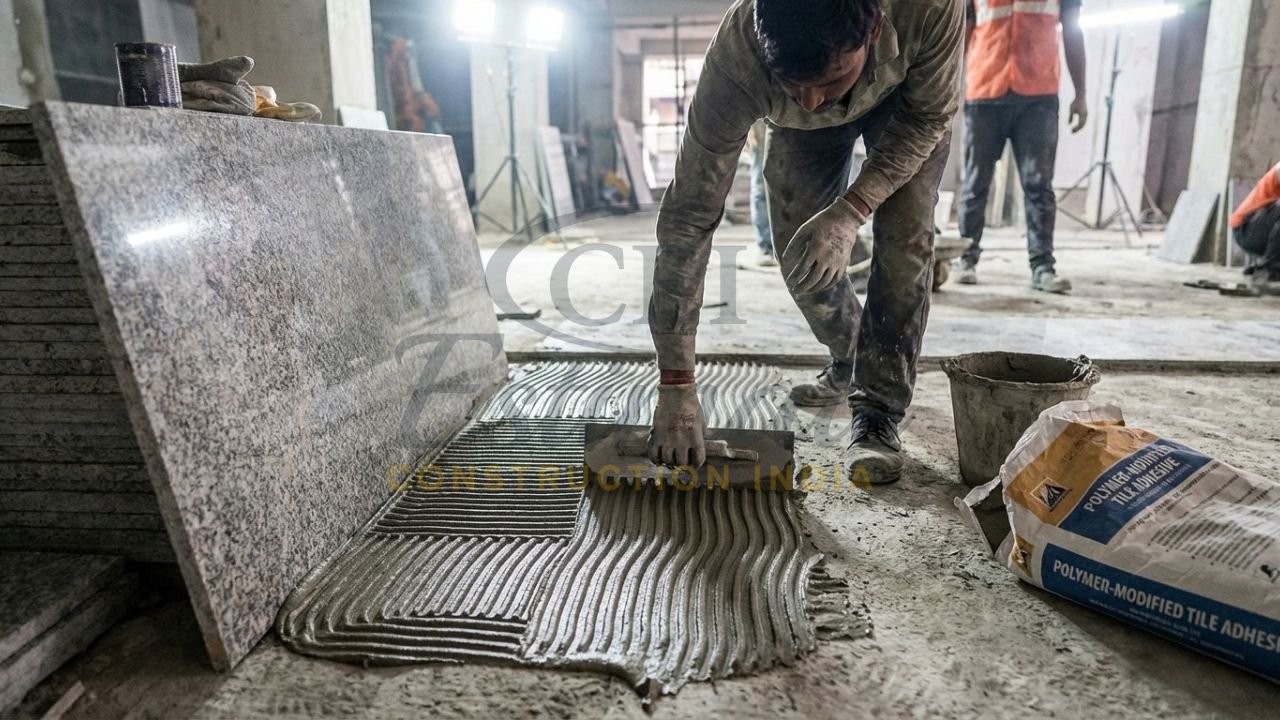
Why Granite Flooring Needs Special Cement/Adhesive? Key Requirements
Granite is one of the most durable natural stones used in flooring, but it also has unique physical properties that make installation more challenging.
Understanding these properties is important before choosing the best cement for granite flooring.
Granite is Very Dense and Heavy
Typical granite slab weight:
18–25 kg per square foot
Large granite tiles exert significant load on the bonding layer beneath them. If the bonding layer is weak or uneven, slabs can become loose.
This is why granite flooring requires high bond strength materials.
Granite Has Very Low Water Absorption
Unlike ceramic tiles, granite absorbs very little water.
Water absorption rate:
0.1%–0.3%
Traditional cement mortar relies on mechanical bonding and slight water absorption to grip the tile. Since granite absorbs almost no water, the mortar bond becomes weak.
Thermal Expansion in Indian Climate
In cities like Agra, temperatures can vary dramatically:
- Summer: up to 45°C
- Winter: near 5°C
Granite expands and contracts with temperature changes. The bonding material must have flexibility to handle movement.
Rigid mortar beds often crack under these conditions.
Required Bond Strength
For granite flooring, adhesives should ideally provide:
Shear bond strength >1 MPa
Modern tile adhesives designed for natural stone meet these requirements.
Shrinkage Problems in Cement Mortar
Traditional cement mortar shrinks during curing. This shrinkage can cause:
- Micro gaps under slabs
- Hollow sounds
- Edge cracking
Polymer-modified adhesives have low shrinkage, preventing these issues.
Relevant Standards for Tile Adhesives
In India, tile adhesives are governed by IS 15477:2019.
Adhesives are classified as:
- C1 – Standard adhesive
- C2 – High strength adhesive
- S1 / S2 – Flexible adhesive
For granite flooring, experts recommend C2TE or S1 adhesives, which are suitable for heavy natural stones.
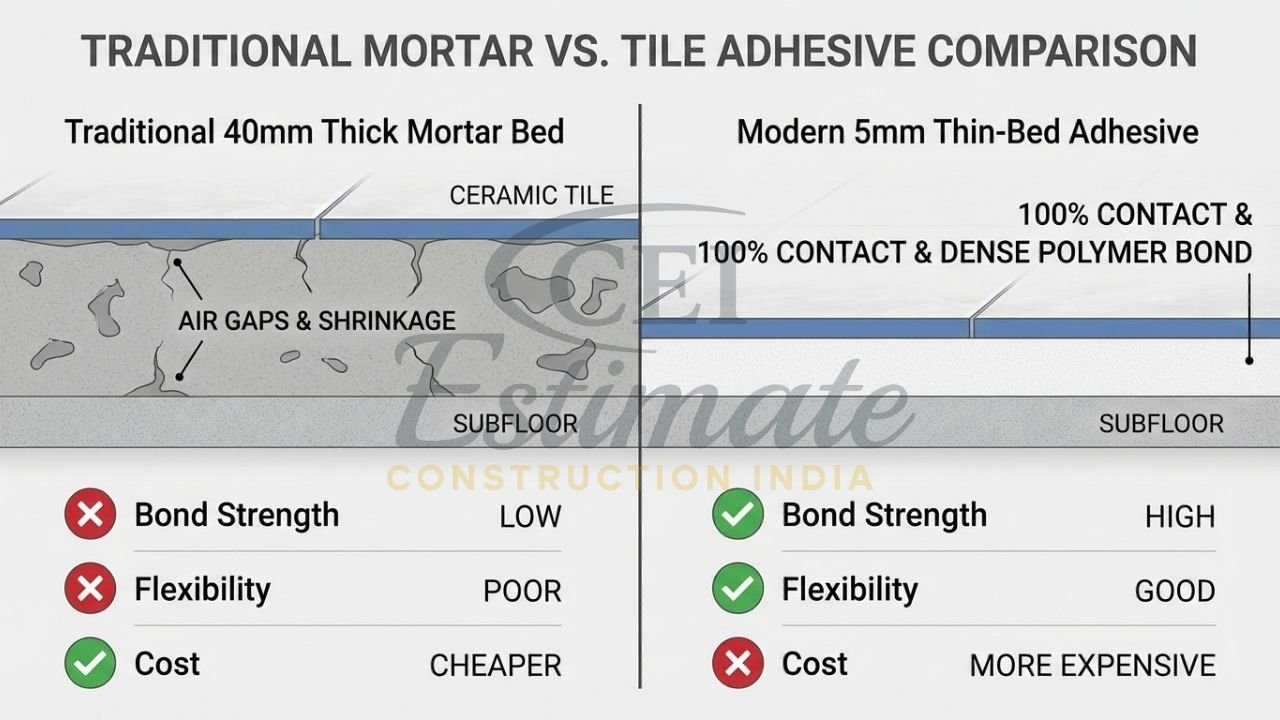
Traditional Cement Mortar vs Modern Tile Adhesive for Granite Flooring
Traditional Method: Cement-Sand Mortar
The traditional method uses a mix of:
- OPC or PPC cement
- Sand
- Water
Typical ratio:
1:4 or 1:6 (cement:sand)
A thick mortar bed (20–40 mm) is placed, and granite slabs are laid on top.
Advantages
- Low material cost
- Familiar to traditional masons
- Works for smaller stones
Disadvantages
- Weak bond with granite
- Higher risk of hollow tiles
- Requires thick mortar bed
- Shrinkage cracking
- Longer curing time
Many rural and low-budget projects still use this method.
Modern Method: Polymer-Modified Tile Adhesive
Tile adhesives are factory-manufactured cement-based powders mixed with polymers.
They require only water for mixing.
Key properties:
- High bond strength
- Flexibility
- Low shrinkage
- Thin bed application (3–6 mm)
Comparison Table
| Factor | Cement-Sand Mortar | Tile Adhesive |
| Bond Strength | Low | Very High |
| Flexibility | Poor | Excellent |
| Hollow Tile Risk | High | Very Low |
| Thickness Required | 20–40 mm | 3–6 mm |
| Curing Time | Long | Short |
| Suitability for Granite | Limited | Ideal |
| Crack Resistance | Low | High |
| Durability | Moderate | Excellent |
| Cost | Low | Higher |
Why Adhesives Are Better for Granite
Tile adhesives provide:
- Strong chemical bonding
- Reduced shrinkage
- Faster installation
- Longer life
For large granite slabs, adhesives are now the preferred option.
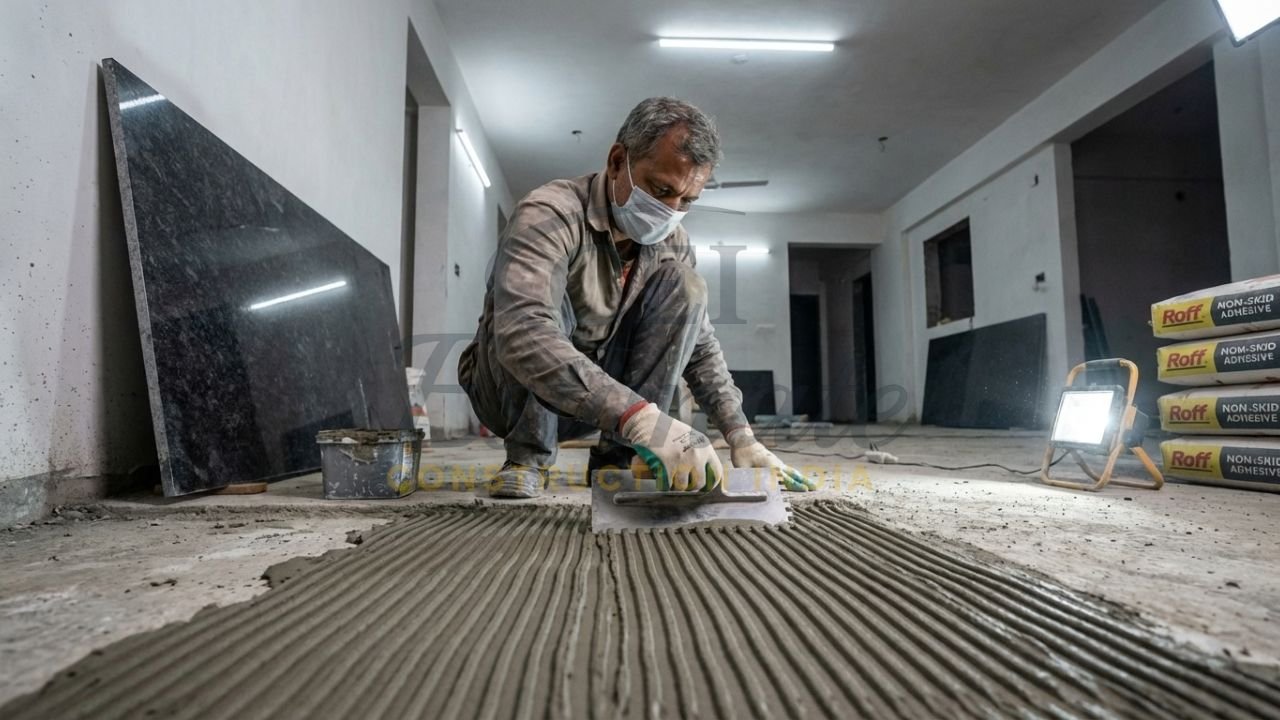
Best Options for Granite Flooring in India 2026 – Recommendations
Best Choice: Polymer Modified Tile Adhesives
For modern construction, tile adhesives are the best solution.
Advantages:
- Strong bonding
- Thin application
- Better durability
- No hollow tiles
They are ideal for:
- Large granite slabs
- High traffic areas
- Commercial flooring
When Traditional Mortar May Still Work
Cement mortar can still be used in:
- Low-budget houses
- Small granite tiles
- Rural construction
However, proper technique is critical.
White Cement-Based Adhesives
For light colored granite such as:
- White granite
- Cream granite
Use white adhesive to avoid grey stains.
Epoxy Adhesives
Epoxy adhesives are used for:
- Wet areas
- Industrial floors
But they are expensive and rarely used in residential flooring.
Top Recommended Brands & Products for Granite Flooring 2026
Several reliable brands supply granite flooring adhesives in India.
- UltraTech Tile Fixo Popular adhesive used for:
- Granite
- Marble
- Natural stone Price range: ₹450–₹750 per 20 kg bag.
- Weber (Saint-Gobain) Weber provides high-performance adhesives. Recommended products:
- Weberset Firm
- Weberset Pro
- MYK Laticrete Premium brand used in commercial projects. Known for:
- High bonding strength
- Flexible adhesives
- Ardex Endura Widely used for natural stone installation. Provides:
- Excellent bond strength
- Low shrinkage
- Roff (Pidilite) One of the most popular brands in India. Products include:
- Roff Non-Skid
- Roff Stone Adhesive
- JK WallMaxX Affordable adhesive option widely available in North India.
- SikaCeram Professional-grade adhesive used in high-end construction.
Price range of adhesives in 2026:
₹400–₹900 per 20 kg bag
Step-by-Step Guide: How to Fix Granite Flooring Properly
Step 1: Surface Preparation
Ensure the floor surface is:
- Clean
- Level
- Free from dust
Step 2: Mixing Adhesive
Most adhesives require:
- Only water
- Mechanical mixing
Follow manufacturer instructions.
Step 3: Applying Adhesive
Use a notched trowel.
Spread adhesive evenly.
Step 4: Back Buttering
For granite slabs, apply adhesive on both:
- Floor surface
- Back of slab
This ensures full contact.
Step 5: Laying the Slab
Place granite slab carefully.
Tap lightly with rubber mallet.
Maintain 2–3 mm joint spacing.
Step 6: Grouting
After 24 hours:
- Fill joints using grout
- Clean excess material
Step 7: Curing
Avoid foot traffic for 24–48 hours.
Tips for Agra / UP Climate
- Avoid flooring during extreme heat
- Protect flooring during monsoon
- Use skilled tilers
FAQs on Best Cement/Adhesive for Granite Flooring
Is cement mortar good for granite flooring?
It works but has higher risk of hollow tiles.
Which is better for granite: OPC or PPC?
Both can work in mortar, but adhesives are better.
Best adhesive for heavy granite slabs?
Polymer modified tile adhesives (C2TE class).
Can white cement be used for granite?
Yes, but mainly for light colored stones.
How to avoid hollow sounds in granite floors?
Use proper adhesive and full bedding.
Conclusion
Granite flooring is a premium flooring choice, but its durability depends largely on the fixing material used underneath.
In modern construction (2026):
- Polymer modified tile adhesives are the best choice for granite flooring.
- They provide stronger bonding, better durability, and prevent hollow tiles.
- Traditional cement-sand mortar is gradually becoming outdated for high-quality work.
For long-lasting granite floors, always:
- Use quality adhesive
- Hire skilled tilers
- Follow proper installation methods.
Need accurate quantity takeoff for granite flooring materials, adhesive estimates, or full-house flooring cost breakdown? Get professional, fast help from experts today!
WhatsApp: +91 8630676890