
Building a home is perhaps the most significant emotional and financial investment an Indian family ever makes. However, nothing breaks a homeowner’s heart more than seeing hairline cracks appearing in a newly constructed plinth beam or, worse, damp patches spreading across a fresh roof slab during the first monsoon. These issues often stem from one critical mistake: improper cement selection or failing to verify material quality on-site. In 2026, with construction technology advancing and climate patterns becoming more unpredictable, choosing the right “best cement for plinth beam and roof slab in India” is no longer just a recommendation—it is a structural necessity.
As an experienced civil engineer at Construction Estimator India, I have seen projects thrive or fail based on the bond between steel and concrete. Whether you are dealing with the moisture-prone environment of a foundation or the heavy load-bearing requirements of an RCC slab, your choice of brand and grade determines the longevity of your structure. This guide will walk you through the nuances of modern cement selection, from brand comparisons to practical field tests, ensuring your home remains a safe haven for generations.

Best Cement for Plinth Beam in India
The plinth beam is the unsung hero of your home’s skeleton. It connects your columns, prevents differential settlement of the foundation, and acts as a primary barrier against moisture rising from the soil into your walls. Because the plinth beam sits directly on the ground, it is constantly exposed to moisture, sulfates, and soil chemicals.
For 2026 construction projects, the standard recommendation for a durable plinth beam is using OPC 53 Grade cement. This grade is preferred because it offers high early strength and creates a dense bonding matrix that is essential for structural members under load. However, if your site is located in an area with high moisture content or aggressive soil (like black cotton soil), Portland Slag Cement (PSC) is often a superior choice due to its high resistance to chemical and sulfate attacks.
When searching for the best cement for plinth beam in India, you should aim for a concrete mix design between M25 and M30. This typically requires about 360-400 kg of cement per cubic meter to ensure the beam can withstand the load of the entire superstructure. Brands like UltraTech, ACC, and Ambuja are the top contenders for this structural work in 2026, with prices usually ranging between ₹380 and ₹520 per bag. Remember, using a lower grade like OPC 43 for plinth beams is a risk you shouldn’t take, as it increases the chance of settlement cracks and moisture seepage.
Best Cement for Roof Slab in India
The roof slab is the most exposed part of your house, bearing the brunt of scorching heat, heavy rainfall, and structural loads. To ensure a leak-proof and durable RCC (Reinforced Cement Concrete) slab, your cement must possess high compressive strength and low shrinkage properties.
In 2026, homeowners have several specialized options. While OPC 53 is excellent for fast-track projects where you want to remove shuttering early, Portland Pozzolana Cement (PPC) is highly recommended for residential slabs because it produces less heat during hydration, leading to fewer thermal cracks and a smoother finish. For those building in coastal or heavy rainfall regions, specialized water-repellent variants are a game-changer.
Finding the best ACC cement for roof slab in India often leads builders to products like ACC Gold Water Shield, which is engineered specifically to prevent water seepage through the slab. Another high-performance option is ACC F2R, though it requires a strict 14-to-21-day curing period to reach its full potential without cracking. Regardless of the brand, always ensure the use of a needle vibrator during casting to eliminate air pockets (honeycombing), which are the primary cause of future leakages.
ACC vs Ultratech Cement – Detailed Comparison
When it comes to the heavyweights of the Indian market, the choice usually boils down to ACC vs Ultratech cement. Interestingly, since 2022, both brands have operated under the Adani Group umbrella, yet they maintain distinct product identities to serve different regional needs.
UltraTech remains the largest manufacturer in India, boasting a capacity exceeding 200 MTPA, giving it a logistical advantage in almost every state. In terms of performance, UltraTech OPC 53 is often cited for having a slight edge in early strength gain, making it a favorite for contractors working on tight schedules for RCC slabs and columns.
ACC, on the other hand, holds a legendary status for its consistency, especially in Northern and Central India. ACC PPC is frequently chosen for finishing works and slabs because it offers a smoother texture and better workability, which helps in achieving a crack-resistant surface.
Comparative Overview: 2026 Market Data
| Feature | UltraTech Cement | ACC Cement |
|---|---|---|
| Market Presence | Pan-India (200+ MTPA) | Strong in North/Central India |
| Best For | Heavy RCC Work & Early Strength | Plastering, Finishing & Crack Resistance |
| Specialized Variants | UltraTech Weather Pro, Super | ACC Gold Water Shield, F2R |
| Price Point (Avg) | ₹400 – ₹530 per bag | ₹380 – ₹510 per bag (Approx. 5-10% lower) |
| Risk Factor | Higher risk of counterfeit bags | Highly reliable and established supply chain |
While UltraTech might be the go-to for raw structural speed, ACC often offers better value for money and specialized water-shielding technology that is vital for Indian monsoons.
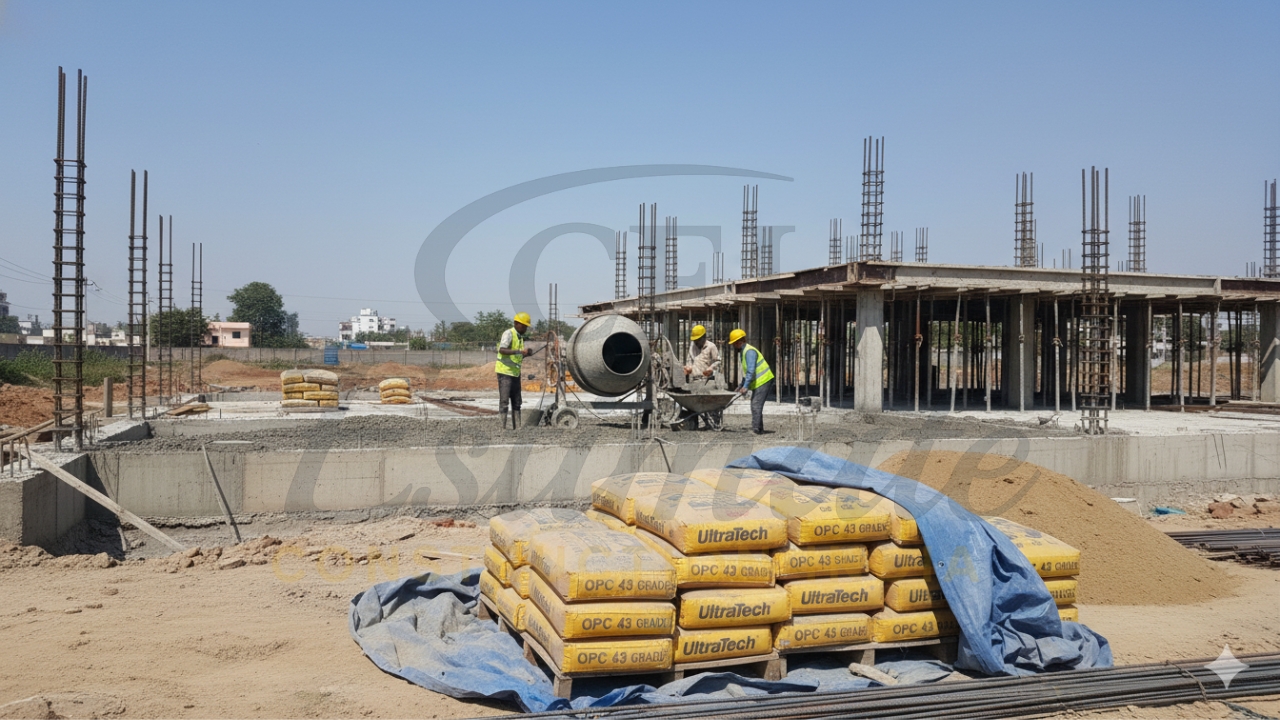
How to Check Cement Quality in India?
Buying a premium brand doesn’t guarantee quality if the cement has been stored poorly or is nearing its expiry. Knowing how to check cement quality in India on-site can save you from a structural disaster. High-quality cement should be a uniform greenish-grey color and feel cool to the touch when you thrust your hand into the bag.
Essential On-Site Quality Checklist
| Test Type | Procedure | Ideal Result |
|---|---|---|
| Manufacturing Date | Check the bag print | Less than 90 days (3 months) old |
| Lump Test | Feel for hard chunks | No hard lumps should be present |
| Float Test | Throw a handful in water | Cement should sink slowly; not float |
| Rubbing Test | Rub between fingers | Should feel smooth, not gritty or sandy |
| Strength Test | Make a small block and submerge | Should not break easily after 3 days |
Crucial Advice: Always verify the ISI mark and the manufacturing date. Cement loses about 20-30% of its strength after three months of storage. If you find hard lumps that cannot be crushed with your fingers, the cement has already reacted with moisture and is unfit for structural work like plinth beams or roof slabs. Furthermore, be wary of bags with tampered stitching or missing holograms, as counterfeit cement is a growing issue in 2026.
How to Use White Cement for Waterproofing in India?
Many homeowners overlook white cement, thinking it is only for decorative finishes or tile grouting. However, learning how to use white cement for waterproofing in India can provide an affordable layer of protection for your roof and bathroom walls.
White cement has a much finer particle size than grey cement, allowing it to penetrate and seal micro-cracks that are invisible to the naked eye. For effective waterproofing in 2026, the polymer slurry method is most effective:
- Surface Preparation: Clean the area thoroughly to remove dust and loose particles.
- Mixing: Mix white cement (like JK or Birla White) with water and a waterproofing additive like SBR latex or acrylic polymers.
- Application: Apply two coats using a brush, ensuring the first coat is dry before applying the second.
- Curing: Maintain a wet curing period of 5 to 7 days to ensure the layer doesn’t crack.
This method is particularly useful for sealing the top of a roof slab or as a primer before external painting, as it reflects heat and reduces the internal temperature of the home.
Smart Cement Selection Guide for 2026
To simplify your construction journey, here is a quick decision framework for cement selection guide for RCC works:
- For Foundation & Plinth Beams: Use OPC 53 Grade for maximum load-bearing or PSC if the soil is damp/salty.
- For Columns & Beams: OPC 53 is the gold standard for high compressive strength and faster shuttering removal.
- For Roof Slabs: PPC (for crack resistance) or specialized water-shield variants like ACC Gold.
- For Brickwork & Plastering: PPC or OPC 43 provide better workability and a smoother finish.
- For Minor Cracks & Sealing: White cement mixed with polymers.
Frequently Asked Questions (FAQs)
- Which is better for a roof slab, OPC 53 or PPC?
For residential homes, PPC is generally better as it produces less heat during curing and is more resistant to cracks and chemical attacks. Use OPC 53 only if you need very high early strength for fast-paced commercial projects. - Can I use cement that is 4 months old?
It is not recommended for structural members like plinth beams or slabs. Cement strength degrades significantly after 90 days. - Why are there cracks in my plinth beam?
Cracks often occur due to poor curing, using an incorrect grade like OPC 43, or high soil moisture attacking the concrete. - How many bags of cement are needed for a 1000 sq. ft. roof slab?
Typically, for a 5-inch thick slab with an M25 mix, you will need approximately 130 to 150 bags, depending on the beam design. - Is UltraTech more expensive than ACC?
Generally, yes. UltraTech is often priced 5-10% higher than ACC depending on the region and the specific variant. - Does white cement really stop leaks?
When mixed with specialized polymers, white cement is excellent for sealing micro-cracks on roofs and walls. - What is the “float test” for cement?
A good quality cement should sink slowly in water. If it floats immediately, it likely contains heavy impurities or is highly adulterated. - How long should I cure my roof slab?
For most modern cements, a minimum of 14 to 21 days of pond curing is essential to prevent structural failure. - Can I mix two different brands of cement?
No. Different brands use different chemical additives and limestone sources; mixing them can lead to unpredictable setting times and weakened strength. - What is the best cement brand for structural work 2026?
UltraTech and ACC remain the market leaders, but brands like Ambuja and Dalmia are equally reliable for high-strength RCC work.
Conclusion
Choosing the best cement for plinth beam and roof slab in India is the foundation of a safe and durable home. In 2026, the market offers incredible specialized products, but their effectiveness depends entirely on your vigilance. Remember to match the grade to the structural element—OPC 53 or PSC for plinth beams and PPC or specialized water-repellent variants for roof slabs.
Never compromise on quality checks. Spend those extra ten minutes on-site to verify the manufacturing date and perform the simple float and rub tests. Whether you choose the early strength of UltraTech or the trusted consistency of ACC, proper storage and a strict curing schedule remain the non-negotiables of construction. Build with care, verify your materials, and ensure your investment stands strong for decades to come.