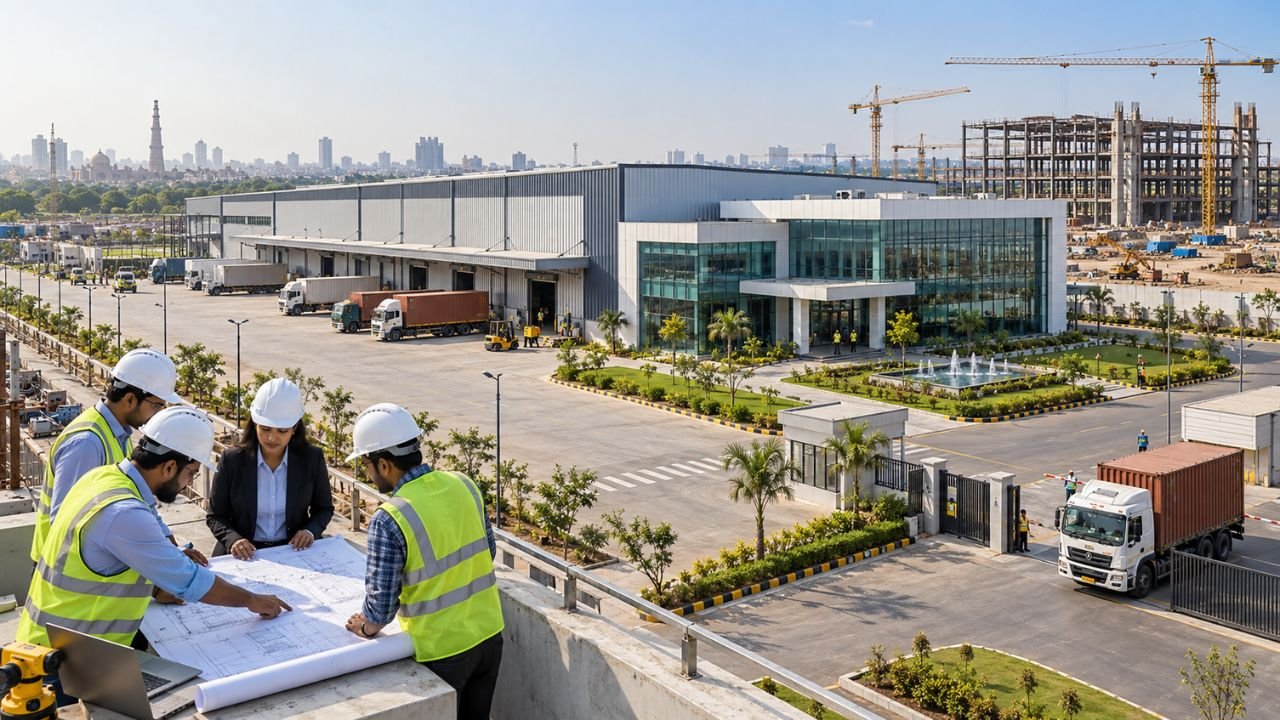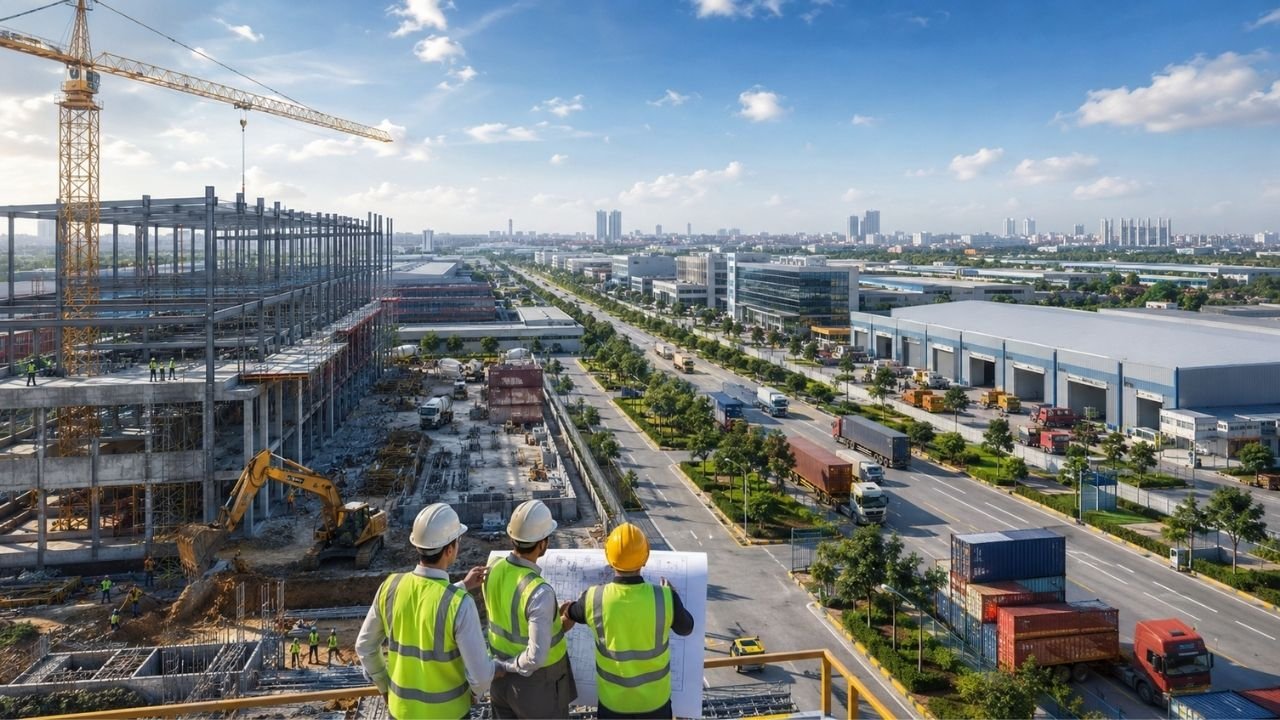
In the 15 years I have spent on Indian construction sites—from the rapid urban sprawls of Agra to the high-rises of NCR—one truth remains absolute: steel is the backbone of modern civilization. However, as we navigate through 2026, the complexity of material selection has reached a new peak. Understanding the different types of steel used in construction works is no longer just a task for structural engineers; it is essential knowledge for every contractor, builder, and homeowner.
Choosing the wrong type of steel can lead to disastrous structural compromises or unnecessarily inflated project budgets. In 2026, with India’s building codes emphasizing seismic zones and climate resilience, the focus has shifted toward high-ductility grades and corrosion-resistant alloys. Whether you are pouring a slab for a residential villa or erecting a commercial steel warehouse, the specific types of steel in construction India 2026 you choose will dictate the building’s lifespan.
This comprehensive guide explores everything from TMT steel bars vs mild steel to the latest steel cost in construction 2026. We will break down the technical properties of Fe500 TMT bars, HYSD steel, and CRS steel to help you make an informed, cost-effective, and safe decision for your next project. To see how steel fits into your broader financial planning, start by checking the latest construction cost per sq ft in India for 2026.
Why Steel is Essential in Construction Works?
Steel and concrete are the ultimate “power couple” of the construction world. While concrete is incredibly strong under compression, it is brittle and weak under tension. Steel provides the necessary tensile strength to prevent structures from snapping or collapsing under load.
According to IS 456 and IS 1786 standards, steel reinforcement serves three primary roles:
- Tensile Support: It absorbs the pulling forces that occur in beams and slabs.
- Ductility: It allows a building to bend slightly during an earthquake without collapsing, providing a critical window for evacuation.
- Durability: Modern steel reinforcement types are designed to resist the thermal expansion and contraction that occurs in India’s varying climate, from the heat of Rajasthan to the humidity of Uttar Pradesh.
Before purchasing your steel, it is vital to perform a professional construction material estimation in India to account for the exact tonnage required for your specific slab and column design.
Main Types of Steel Used in Construction
In the Indian market of 2026, the “steel” you order isn’t just one material. It is a category of several specialized products. Here are the primary different types of steel used in construction works:
1. Thermo-Mechanically Treated (TMT) Bars
TMT bars are the gold standard for best steel for house construction India today. They are manufactured using a unique quenching process where red-hot steel bars are sprayed with water, creating a hard outer layer (Martensite) and a soft, ductile inner core (Ferrite-Pearlite).
- Grades: Fe415, Fe500, Fe500D, Fe550, Fe600.
- Properties: High weldability, superior bendability, and excellent earthquake resistance.
- 2026 Cost Range: ₹68,000 – ₹78,000 per ton (Primary brands).
Choose Your Construction Services
Connect with verified experts for your project. We provide professional
General Contractors, Sub-contractors, Builders, and Material Suppliers.
Our network also includes specialized 3D Rendering Developers and Interior Experts.
2. High Yield Strength Deformed (HYSD) Bars
Before TMT became dominant, HYSD steel was the go-to. These bars are produced by either hot or cold working (stretching or twisting).
- Properties: They have ribs on the surface to increase the bond with concrete. While strong, they lack the superior ductility and corrosion resistance of modern TMT.
- Uses: Small-scale residential works where seismic risk is very low.
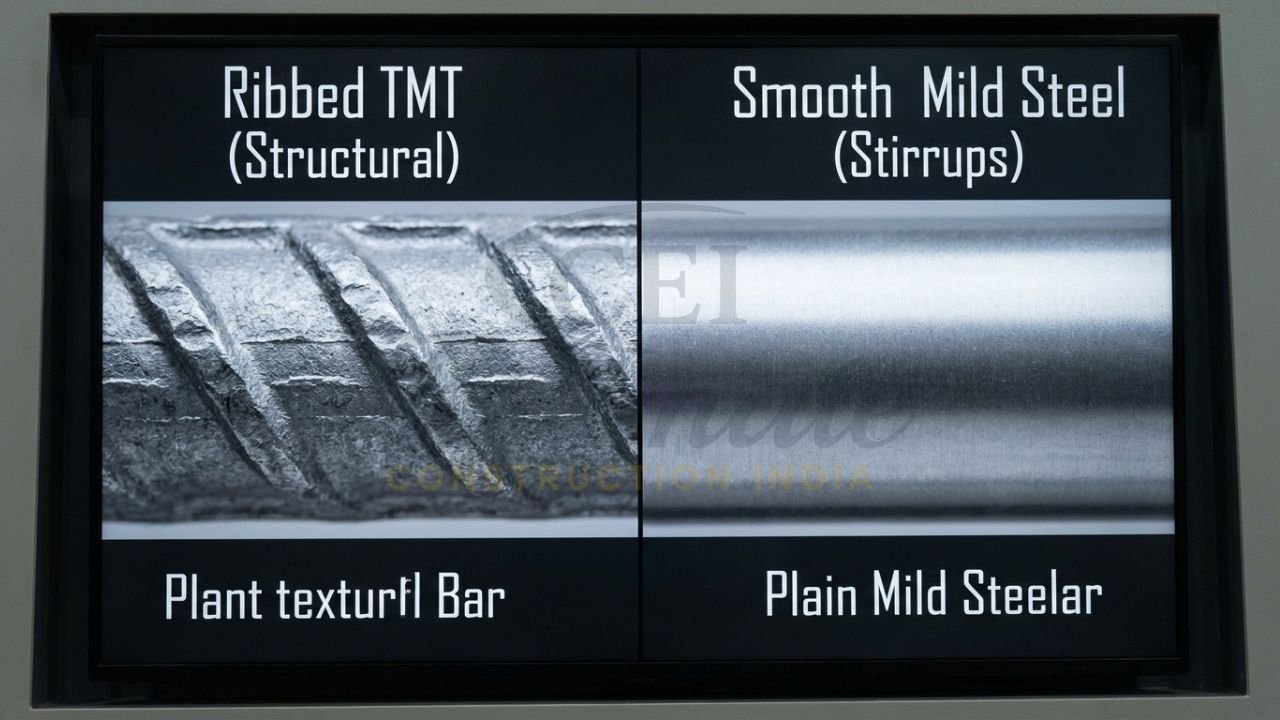
3. Mild Steel (MS)
Mild steel is a plain, smooth-surfaced bar with low carbon content ($0.05\%$ to $0.25\%$).
- Properties: It is highly ductile and easy to cut/weld but lacks the surface “grip” or ribs of deformed bars.
- Uses: Largely used for stirrups (lateral ties), window grills, and decorative ironwork rather than main structural reinforcement in 2026.
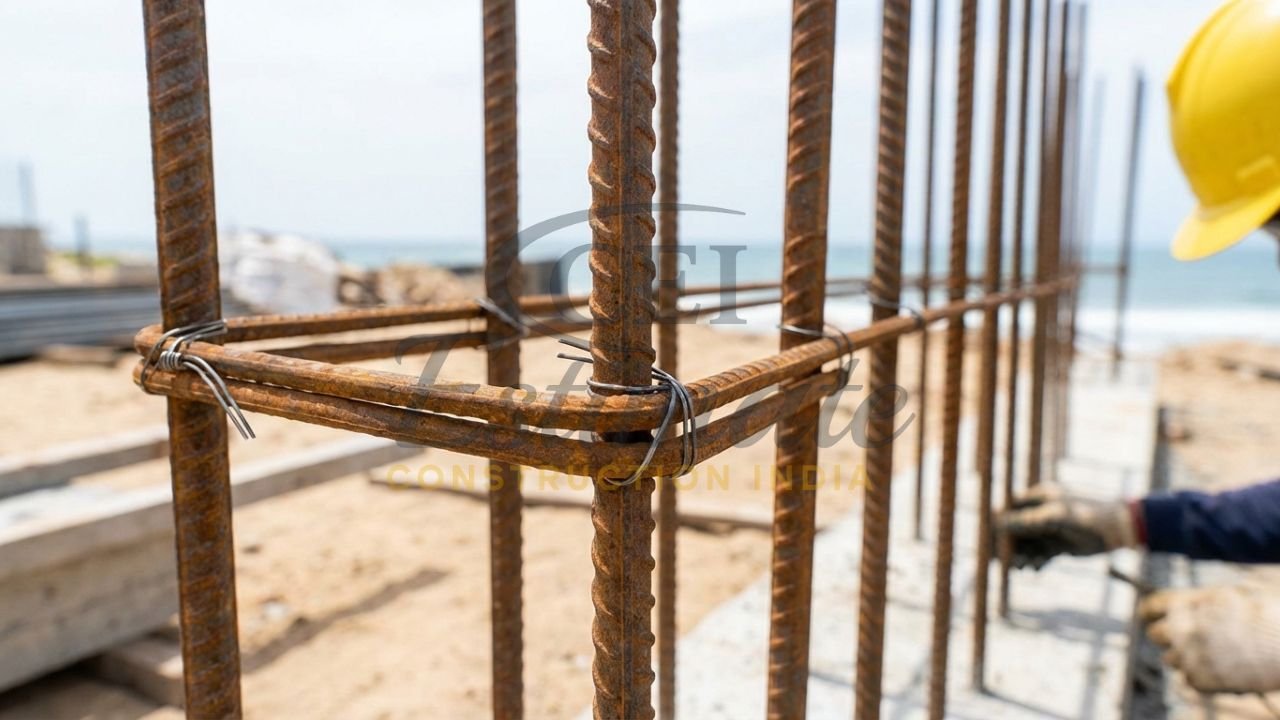
4. Corrosion Resistant Steel (CRS)
In 2026, CRS steel is witnessing massive demand in coastal regions and high-pollution areas like Agra. These bars contain alloying elements like Copper, Phosphorus, and Chromium.
- Properties: They form a protective “patina” layer that slows down the rusting process.
- Uses: Bridges, dams, and homes in high-moisture environments.
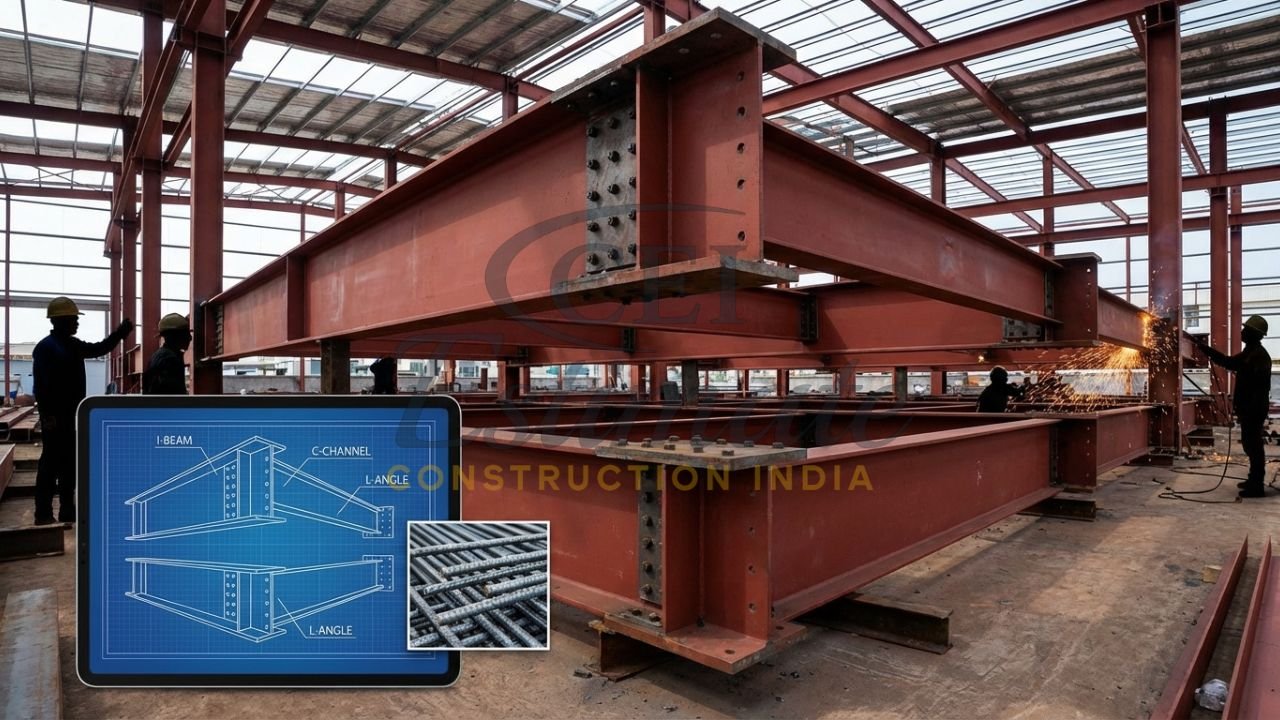
5. Structural Steel
Unlike reinforcement bars (rebar), structural steel comes in pre-formed shapes.
- Shapes: I-Beams, Channels, Angles, and Hollow Sections.
- Uses: Industrial sheds, warehouses, and the frameworks of modern high-rise glass buildings.
6. Stainless Steel
While expensive, stainless steel is increasingly used in 2026 for high-end residential aesthetics and critical structural components in extremely corrosive environments.
- Grades: 304 and 316 are most common.
- Uses: Railings, support brackets, and coastal infrastructure.
TMT Bars vs Mild Steel vs HYSD Bars – Detailed Comparison
Choosing between these different types of steel used in construction works requires looking at the data. Use this table for your site planning:
| Feature | TMT Bars (Fe500D) | Mild Steel (MS) | HYSD Bars |
| Yield Strength | Very High ($500\text{ MPa}$) | Low ($250\text{ MPa}$) | High ($415\text{–}500\text{ MPa}$) |
| Ductility | Excellent (High Elongation) | Very High | Moderate |
| Earthquake Resistance | Best Choice | Poor | Average |
| Corrosion Resistance | High | Low | Low |
| Rib Pattern | Advanced Ribs for Grip | Smooth Surface | Twisted Ribs |
| Best Application | All RCC Structures | Stirrups / Grills | Small low-rise builds |
While TMT is used for structural strength, you might still use mild steel for non-structural elements. To understand the difference in how these are used in foundation work, read our guide on the difference between PCC and RCC.
Cost Impact and Estimation in 2026
Steel typically accounts for 20% to 25% of the total structural cost of a building.
- For a 1000 sq ft House: You can expect to use approximately 3 to 4.5 tons of steel. Review our specific 1000 sq ft house construction cost guide for a deeper breakdown.
- Estimation Logic: A “per sq ft” guess is similar to an Abstract Estimate. However, for actual procurement, you need a Detailed Estimate to avoid wasting expensive TMT bars. You can learn the detailed estimate vs abstract estimate differences to see why precision is key in 2026.
Best Steel for Different Construction Applications in India 2026
As a senior engineer, my 2026 recommendations for specific project types are as follows:
- Residential House (Columns, Beams, Slabs): Use Fe500D TMT bars. The “D” stands for ductility, which is essential for earthquake safety in North India.
- Foundations and Footings: Use Fe550 or CRS TMT bars, as foundations are most susceptible to groundwater corrosion.
- High-rise Buildings (10+ floors): Fe600 TMT bars are now the 2026 standard to reduce the congestion of steel in columns.
- Bridges and Heavy Structures: Structural steel sections (I-Beams) combined with high-grade reinforcement.
- Coastal or Corrosive Environments: Exclusively CRS (Corrosion Resistant Steel) or Epoxy-coated TMT bars.
Key Factors to Consider When Choosing Steel in 2026
When buying steel for your project, don’t just look at the price tag. Check these “Senior Engineer” markers:
- The Grade: For 2026 Indian projects, Fe500D is the perfect balance of strength and safety. Avoid Fe415 for main structural members.
- BIS Certification: Always look for the IS 1786 stamp on the bars. This ensures the steel meets Bureau of Indian Standards for chemical and physical properties.
- Manufacturer Reputation: Brands like Tata Tiscon, JSW Neosteel, and SAIL offer primary steel, which is made from virgin iron ore. Secondary steel (made from scrap) is cheaper but often inconsistent in quality.
- Rib Pattern: Ensure the ribs are sharp and consistent. This provides the “mechanical interlock” between the steel and concrete.
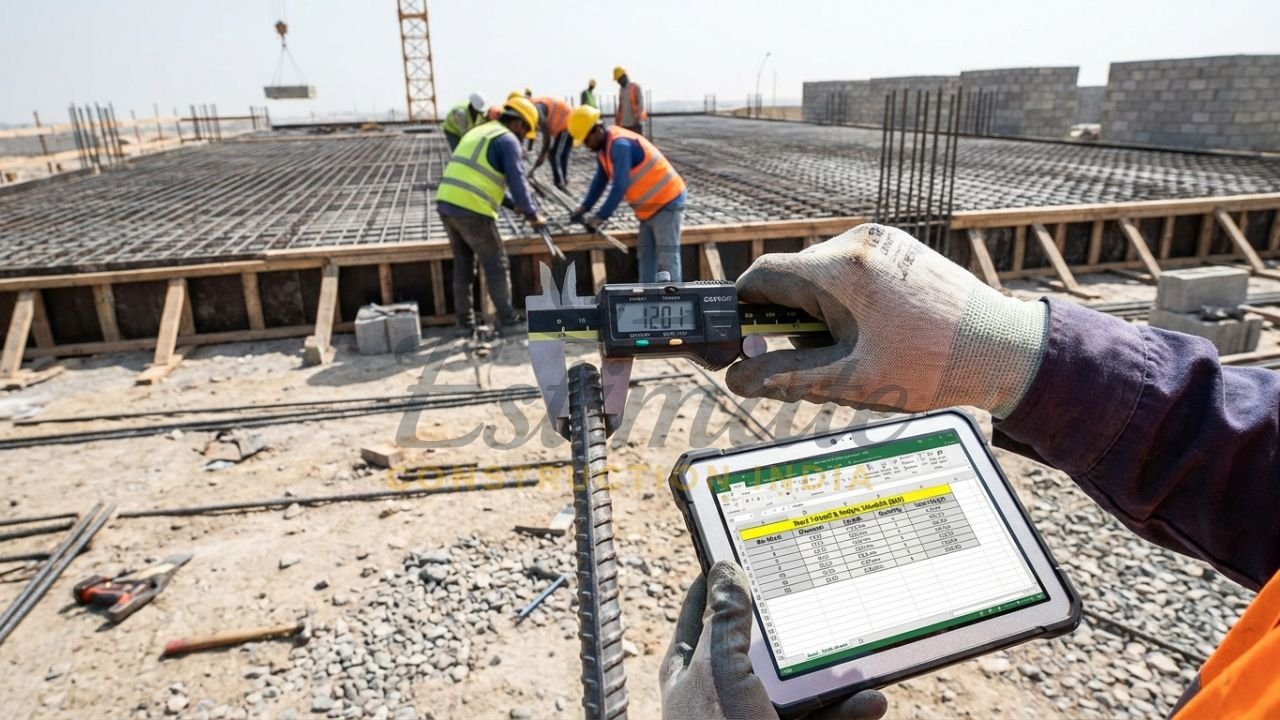
- Diameter Verification: Use a vernier caliper on-site. An $8\text{mm}$ bar should actually be $8\text{mm}$. Sub-standard “underrated” bars are a major risk in 2026.
Current Steel Prices and Cost Impact on Construction in 2026
As of early 2026, steel prices in India have stabilized after the volatility of the mid-2020s, but they remain a significant part of your budget.
- Primary Steel (Tata/JSW): ₹72 – ₹80 per kg.
- Secondary Steel (Local Brands): ₹62 – ₹68 per kg.
- Structural Steel: ₹75 – ₹85 per kg.
- For a 1000 sq ft House: You can expect to use approximately 3 to 4.5 tons of steel. Review our specific 1000 sq ft house construction cost guide for a deeper breakdown.
- Estimation Logic: A “per sq ft” guess is similar to an Abstract Estimate. However, for actual procurement, you need a Detailed Estimate to avoid wasting expensive TMT bars. You can learn the detailed estimate vs abstract estimate differences to see why precision is key in 2026.
Cost Impact: Steel typically accounts for $20\%$ to $25\%$ of the total structural (civil) cost of a building. In a standard 2000 sq ft house in India, you can expect to use approximately $3.5$ to $4.5$ tons of steel. Choosing a higher grade like Fe550 can sometimes reduce the total quantity of steel needed, actually lowering your steel cost in construction 2026.
Common Mistakes While Using Steel in Construction
Even the best different types of steel used in construction works will fail if handled poorly. Avoid these 8 common site mistakes:
- Using Rusted Steel: Light surface rust is okay, but scaling rust reduces the bar’s diameter and bond strength.
- Wrong Storage: Storing steel directly on the ground. Always use wooden sleepers to keep steel off the soil.
- Manual Bending: Bending bars with a pipe and a hammer can cause micro-cracks. Use a bar-bending machine for diameters over $16\text{mm}$.
- Insufficient Concrete Cover: Failing to use “cover blocks” leads to the steel being exposed to air, causing rapid corrosion.
- Inadequate Lapping: Not providing enough overlap when joining two bars. Standard lap length is usually $50 \times \text{Diameter}$.
- Mixing Grades: Using Fe415 and Fe550 in the same beam can cause unpredictable structural behavior.
- Over-Congestion: Placing too many bars in a small column, which prevents the concrete from flowing properly.
- Buying by “Weight” alone: Some local suppliers sell “lightweight” bars that don’t meet the sectional weight requirements of IS 1786.
Conclusion
Mastering the different types of steel used in construction works is the first step toward building a structure that lasts for generations. In 2026, the focus is clearly on Fe500 TMT bars and CRS steel for their superior safety profiles. While the initial steel cost in construction 2026 might seem high, investing in primary, BIS-certified steel is an insurance policy for your building’s future.
Whether you are a contractor in Agra or a homeowner in Bangalore, always prioritize ductility and brand reliability. A building is only as strong as the steel within its walls.
Ready to get an accurate, customised construction estimate for your project in 2026?
At Estimator Construction India our professional estimating team delivers detailed BOQ and cost reports in just 48 hours.
Construction cost estimation services start at just ₹10,000 INR only.
Contact us today:
📞 Phone / WhatsApp: +91 86306 76890
✉️ Email: info@constructionestimatorindia.com
Don’t overpay or underbid — get your precise 2026 construction cost per sq ft estimate now and win more projects with confidence!
Frequently Asked Questions (FAQs) – Different Types of Steel Used in Construction Works
FAQ 1: Which is the most commonly used steel in residential construction in India 2026?
The most commonly used steel is Fe500D TMT bars. These bars offer high yield strength ($500\text{ MPa}$) and the “D” denotes higher ductility, which is critical for earthquake resistance. For most G+1 and G+2 homes in 2026, engineers prefer Fe500D from primary brands like Tata or JSW due to their consistent quality and superior bonding with concrete.
FAQ 2: What is the difference between TMT bars and mild steel bars?
The main difference lies in strength and surface texture. Mild steel is smooth and has a lower yield strength ($250\text{ MPa}$), making it unsuitable for modern RCC beams and columns. TMT bars undergo a special heat-treatment process that gives them a hard outer core and a soft inner core, along with ribs on the surface for a better grip on concrete. TMT is much stronger and more earthquake-resistant than mild steel.
FAQ 3: What does Fe500 mean in TMT steel bars?
In the term “Fe500,” Fe stands for Iron (from the Latin Ferrum), and 500 represents the minimum yield strength of the steel in Megapascals ($\text{MPa}$). Essentially, it tells you that the steel can withstand a stress of $500\text{ N/mm}^2$ before it starts to permanently deform. It is the standard strength requirement for most modern Indian construction works in 2026.
FAQ 4: Which type of steel is best for coastal or high-corrosion areas?
For coastal areas or places with high groundwater salinity, Corrosion Resistant Steel (CRS) or Epoxy-coated TMT bars are the best choice. These types of steel in construction India 2026 contain special alloys like Chrome and Copper that prevent the formation of rust. Using standard TMT in coastal areas can lead to “concrete spalling,” where rusting steel expands and cracks the surrounding concrete within just a few years.
FAQ 5: How does the grade of steel affect the overall cost of construction?
While higher grades like Fe550 or Fe600 cost more per kg, they can actually lower the total steel cost in construction 2026. This is because stronger steel allows you to use fewer or thinner bars to carry the same load, reducing the total tonnage required. However, for residential projects, the savings are usually minor, so Fe500D remains the most balanced choice for both safety and budget.