
Proper curing is one of the simplest yet most powerful steps in concrete construction. Many people ask what is curing in concrete, especially when they see cracks appearing just weeks after slab casting or when the contractor insists on keeping the surface wet for days. In simple terms, curing is the process of maintaining adequate moisture, temperature, and time in freshly placed concrete so that the cement can fully hydrate and develop its designed strength and durability.
In 2026, with rising cement prices and stricter quality expectations on residential projects in Agra, Delhi NCR, Lucknow, and other parts of Uttar Pradesh, skipping or doing poor curing remains one of the leading causes of early-age cracking, reduced strength, and long-term durability issues. A well-cured concrete slab or column can gain up to 50% more strength compared to poorly cured concrete. To understand how these quality measures affect your overall budget, review the current construction cost per sq ft in India for 2026. This guide explains everything you need to know about what is curing in concrete, why it matters, the exact duration as per IS 456, proven methods used on Indian sites, and practical tips to avoid common mistakes.
Whether you are a homeowner building a G+1 house, a site supervisor, or a contractor, understanding curing will help you deliver stronger, crack-free structures and save money on future repairs.
What is Curing in Concrete? Definition and Process?
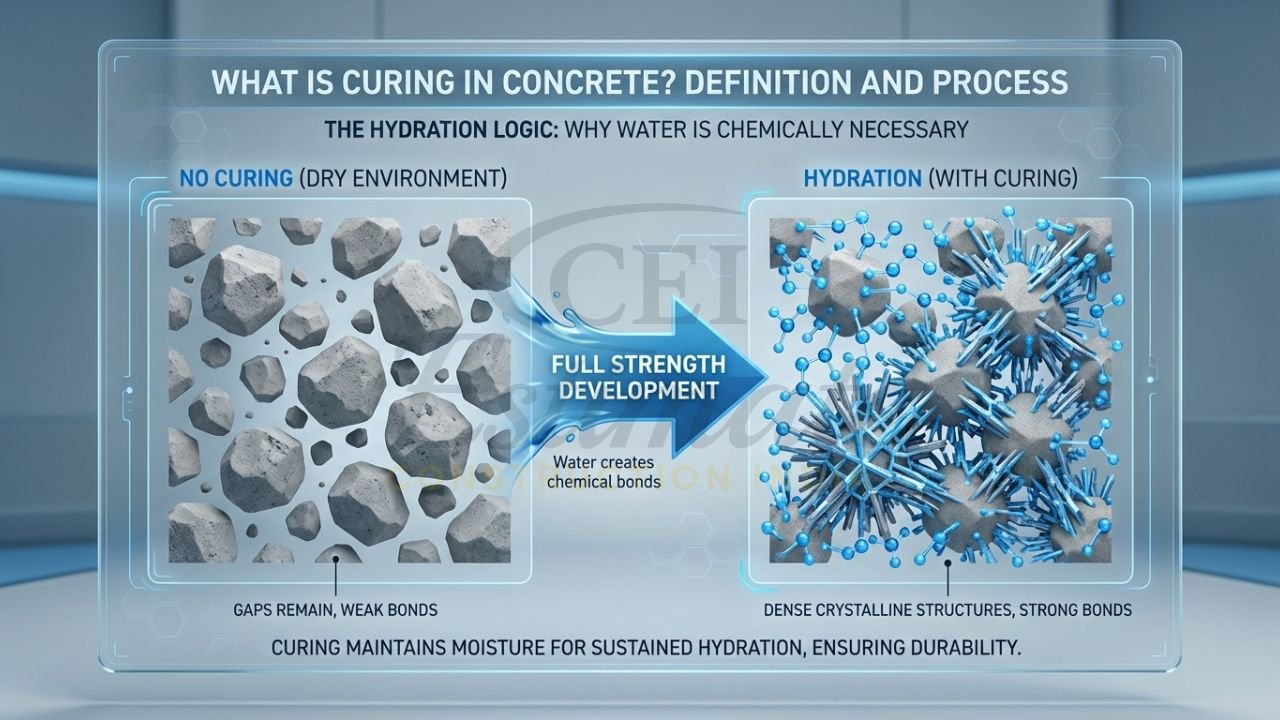
Curing in concrete is the process of protecting freshly placed concrete from moisture loss and extreme temperature changes so that the chemical reaction between cement and water (called hydration) can continue properly. Hydration is what gives concrete its strength. When you mix cement with water, a series of complex reactions start that bind the aggregates together. If the concrete dries out too quickly, hydration stops prematurely, resulting in lower strength, surface cracks, and higher permeability.
Curing does not mean adding extra water to the mix. It means keeping the already placed concrete continuously moist and at the right temperature for a sufficient period. The process usually begins immediately after the initial setting (when the concrete can bear light foot traffic) and continues for a minimum number of days specified by IS 456:2000.
Whether you are using top-rated cement for homes in India or a local brand, the chemical necessity for water remains the same. Curing usually begins as soon as the concrete sets enough to bear light foot traffic.
Importance of Curing in Concrete Construction
The importance of curing concrete cannot be overstated. Here is what happens when you do it right:
- Strength development — Concrete can reach 70–85% of its 28-day strength in the first 7–14 days with proper curing.
- Reduced shrinkage and cracking — Proper moisture control minimizes plastic shrinkage and drying shrinkage cracks.
- Better durability — Well-cured concrete has lower permeability, making it more resistant to water, chemicals, and carbonation.
- Improved surface finish — Floors and slabs look better and last longer.
- Cost savings — Prevents expensive repairs later; good curing is one of the cheapest ways to improve concrete quality.
In hot and dry climates of Uttar Pradesh and Rajasthan, where temperatures often cross 40°C in summer, inadequate curing is a major reason for early-age surface cracking on RCC slabs and beams.
Standard Curing Duration as per IS 456:2000 in India
IS 456:2000 gives clear guidelines that are followed across India in 2026:
- Ordinary Portland Cement (OPC) — Minimum 7 days curing.
- Blended cements (PPC/PSC) — Minimum 10 days; 14 days is strongly recommended.
- Mass concrete or hot weather — Extend curing period.
- Vertical surfaces (columns, walls) — Keep continuously moist for the full period.
- Slabs and horizontal surfaces — Ponding or wet covering is preferred.
In practice, most responsible contractors in Agra and UP cure slabs for 14 days and columns for 10–14 days to ensure full strength development.
Different Methods of Curing in Concrete
Several proven methods are used on Indian sites. Each has its advantages depending on the element and weather.
- Water Curing (Most Effective)
- Ponding — Creating small ponds with earthen bunds on slabs. Excellent for flat surfaces.
- Spraying / Fogging — Continuous misting using sprinklers.
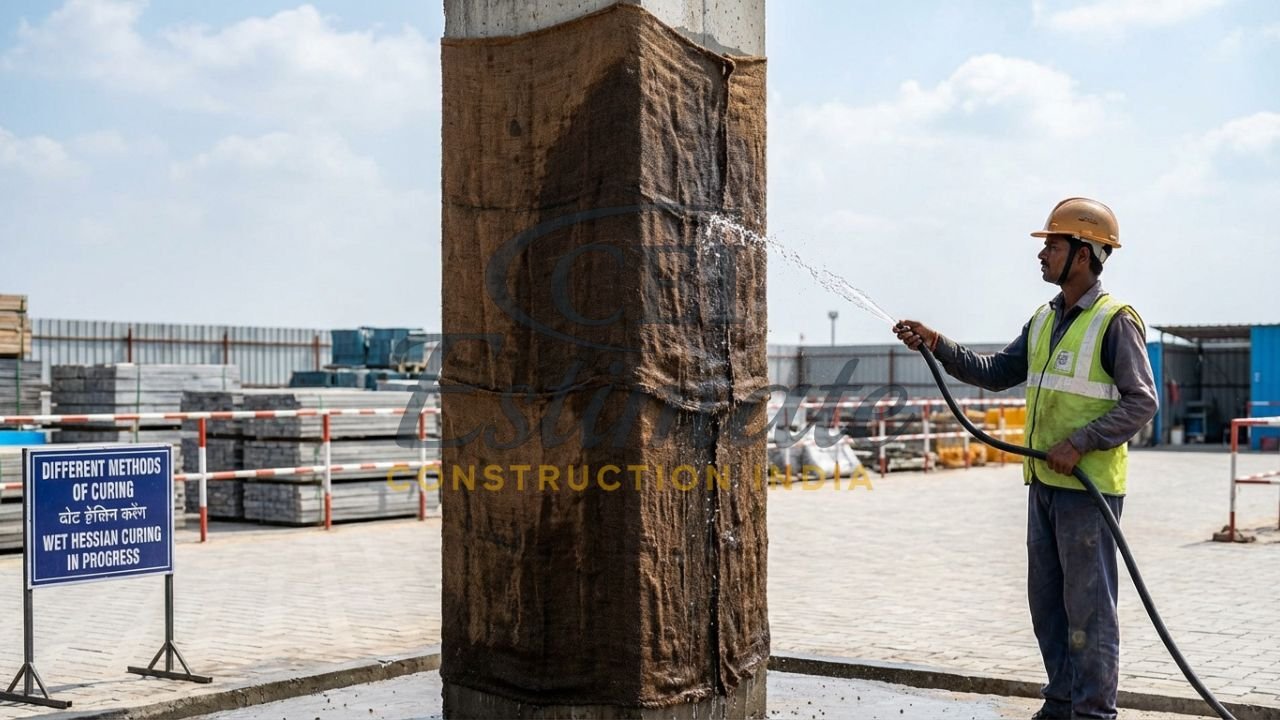
- Wet Coverings — Hessian cloth, gunny bags, or jute sheets kept continuously wet.
- Membrane Curing
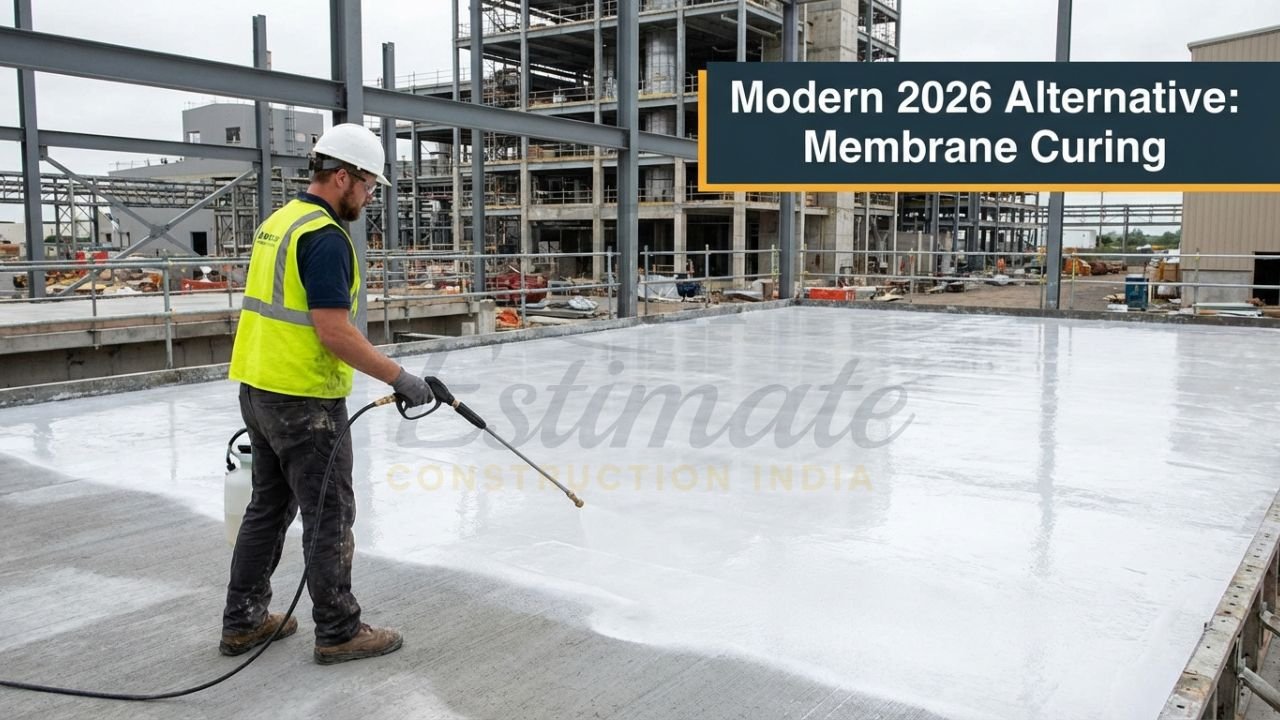
- Liquid curing compounds (wax-based, resin-based, or acrylic) sprayed on the surface to form a moisture-retaining film.
- Useful when water is scarce or for vertical surfaces.
- Sheet Curing
- Covering with polythene or plastic sheets to trap moisture.
- Structural Context
- The need for curing varies between different concrete types. For example, understanding the difference between PCC and RCC in construction is important; while both need curing, the reinforced RCC elements (slabs/beams) are more susceptible to structural cracks if curing is neglected.
Comparison Table – Curing Methods
| Method | Effectiveness | Cost | Best For | Limitations |
| Ponding | Excellent | Low | Slabs, floors | Labour intensive, not for slopes |
| Wet Hessian | Very Good | Low | Slabs, columns | Needs frequent rewetting |
| Curing Compound | Good | Medium | Vertical surfaces, large areas | Slightly lower strength than water curing |
| Polythene Sheet | Good | Low | Small areas | Can cause discolouration |
In 2026, many contractors combine ponding for slabs with curing compounds for columns to balance effectiveness and labour cost.
Curing and Material Estimation
Proper curing ensures that the materials you paid for actually reach their intended strength.
- Quantity Takeoff: Before you even begin curing, you must ensure your quantity takeoff in construction was accurate so that the slab thickness is uniform, allowing for even water distribution during ponding.
- Mix Accuracy: Curing works best when the initial construction material estimation in India was precise. If the water-cement ratio was wrong during mixing, even the best curing won’t fix the structural integrity.
- Slab Focus: Since slabs are the largest exposed surface area, homeowners must know how to calculate cement sand and aggregate for slab work to ensure the concrete grade (M20/M25) matches the required hydration period.
Choose Your Construction Services
Connect with verified experts for your project. We provide professional
General Contractors, Sub-contractors, Builders, and Material Suppliers.
Our network also includes specialized 3D Rendering Developers and Interior Experts.
Best Practices for Curing Concrete on Site in 2026
- Start curing as soon as the concrete can bear light foot traffic (usually 6–12 hours after placing).
- For slabs, begin ponding within 24 hours.
- Keep the surface continuously moist — never allow it to dry even for a few hours.
- Use clean, potable water for curing.
- In hot weather, shade the area or start curing earlier.
- Vertical surfaces need continuous spraying or wet coverings.
- Record curing start and end dates in the site register.
Common Mistakes in Concrete Curing and How to Avoid Them
- Delaying curing → Start within 24 hours maximum.
- Intermittent wetting → Keep surface continuously moist.
- Insufficient duration → Follow IS 456 minimum days.
- Using dirty water → Always use clean water.
- Skipping edges and corners → Pay special attention to edges.
- Removing formwork too early → Keep formwork in place longer in hot weather.
- Using curing compound on dusty surface → Clean the surface first.
- Not curing during night → Maintain moisture 24 hours.
Effect of Improper Curing on Concrete Strength and Durability
Poor curing leads to:
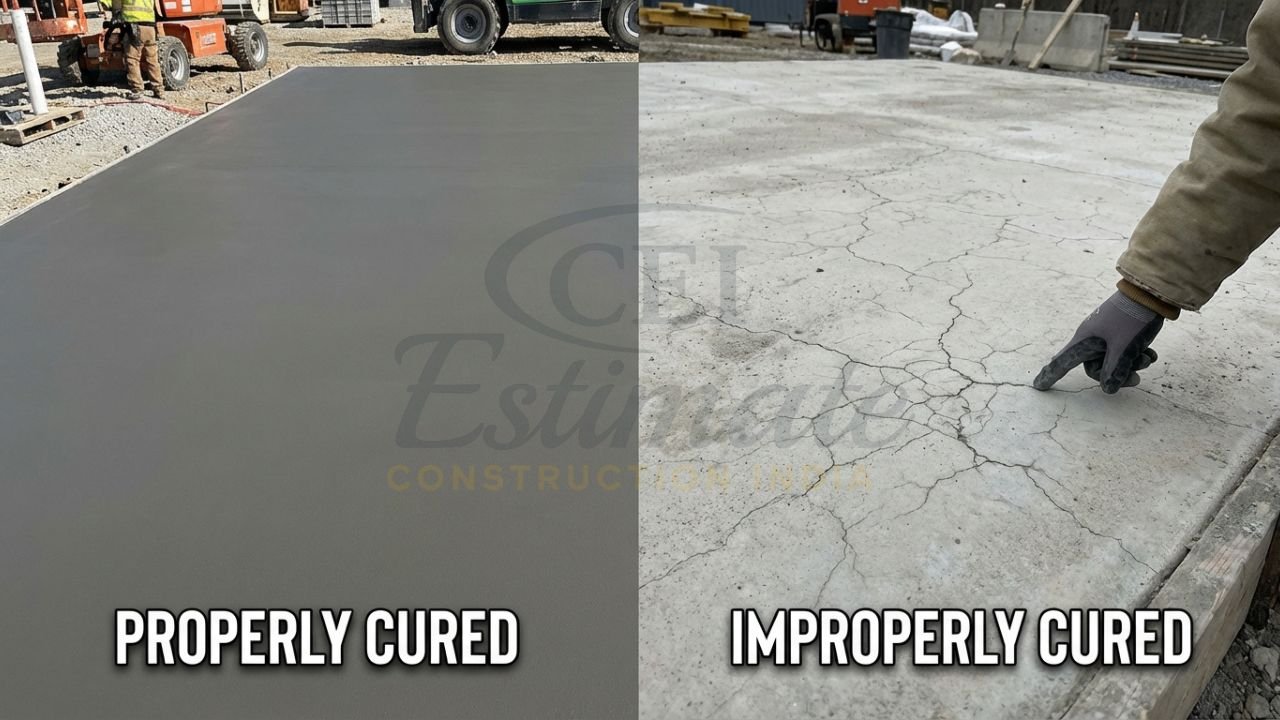
- 20–40% lower final strength
- Surface cracks and crazing
- Higher permeability (water and chemical attack)
- Reduced resistance to abrasion and weathering
- Early-age shrinkage cracks on slabs
Many cracks seen on Indian rooftops and floors are directly linked to inadequate curing rather than structural design issues.
Conclusion
What is curing in concrete? It is the simple but vital process of keeping freshly placed concrete moist and at the right temperature so that cement hydration can continue and the concrete can achieve its full strength and durability. Following IS 456 guidelines, choosing the right method (ponding, wet coverings, or membrane compounds), and maintaining continuous moisture for the recommended duration are the easiest ways to build stronger and longer-lasting structures.
In 2026’s Indian construction scenario, where material costs are rising and clients demand better quality, proper curing is one of the most cost-effective ways to improve concrete performance. Make curing a non-negotiable part of your site practice — your buildings will thank you for decades. Ready to get an accurate, customised construction estimate for your project in 2026?
At Estimator Construction India our professional estimating team delivers detailed BOQ and cost reports in just 48 hours.
Construction cost estimation services start at just ₹10,000 INR only.
Contact us today:
📞 Phone / WhatsApp: +91 86306 76890
✉️ Email: info@constructionestimatorindia.com
Don’t overpay or underbid — get your precise 2026 construction cost per sq ft estimate now and win more projects with confidence!
Frequently Asked Questions (FAQs) – What is Curing in Concrete
What is the meaning of curing in concrete and why is it important?
Curing in concrete is the process of maintaining moisture and temperature in freshly placed concrete to allow complete hydration of cement. It is important because it increases strength by up to 50%, reduces cracking and shrinkage, improves durability, and lowers permeability. Without proper curing, concrete will not achieve its designed strength and will develop early-age cracks.
How many days should concrete be cured as per IS 456 in India?
As per IS 456:2000, OPC concrete should be cured for a minimum of 7 days, while blended cements (PPC/PSC) require a minimum of 10 days (14 days is recommended). In hot weather or for mass concrete, the period should be extended. Many contractors in UP follow 14 days for slabs and important members.
What is the best method of curing for RCC slabs in residential construction?
The best method for RCC slabs is ponding or wet gunny bag/hessian covering. Ponding creates a continuous water layer that ensures excellent moisture retention. In water-scarce areas, wet coverings or approved curing compounds can be used, but water-based methods are still preferred for maximum strength gain.
Can curing compounds replace water curing completely?
Curing compounds can replace water curing in many situations, especially on vertical surfaces or large areas where ponding is difficult. However, they generally give slightly lower strength gain compared to continuous water curing. Use high-quality, approved membrane-forming curing compounds and apply them immediately after finishing.
What happens if concrete is not cured properly?
Improper curing results in lower final strength, surface crazing and cracks, higher permeability, reduced durability, and increased risk of carbonation and corrosion of reinforcement. In Indian conditions, many slab and beam cracks are directly linked to inadequate curing rather than design issues.