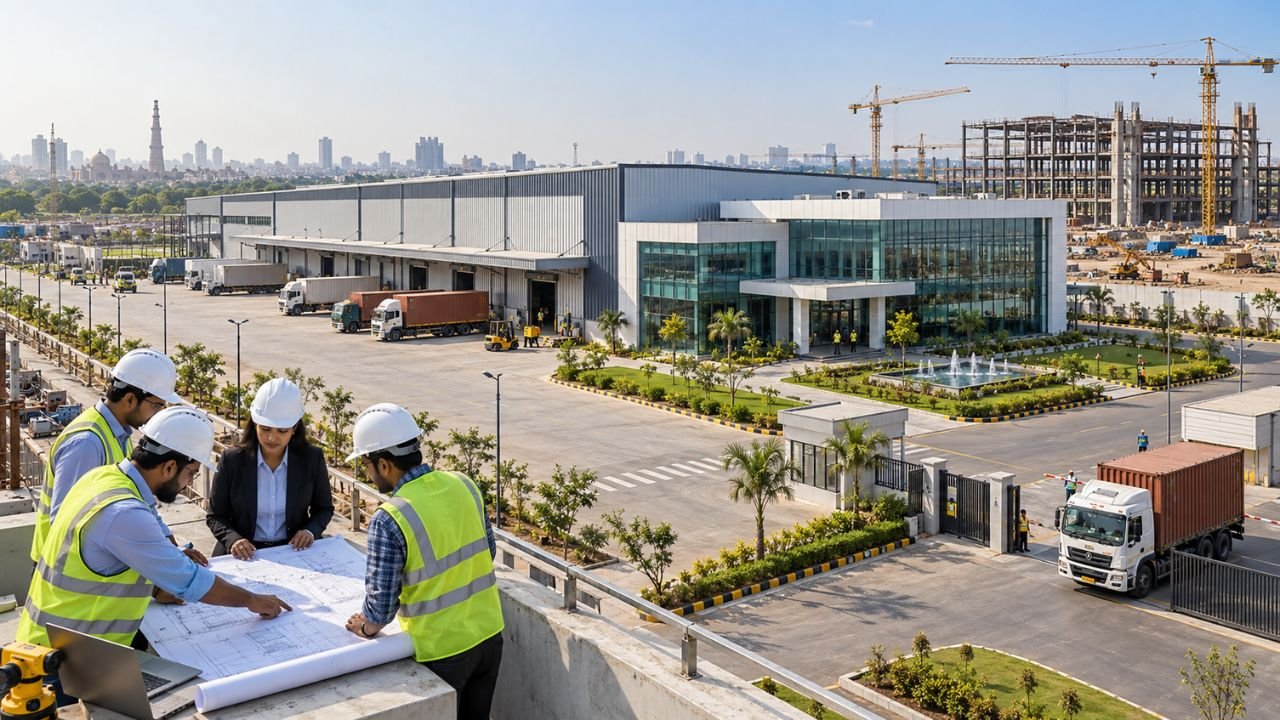
In the rapidly evolving landscape of the Indian infrastructure sector, performing a precise construction rate analysis 2026 is the most critical step for any builder, contractor, or developer. As we look toward the 2026 fiscal year, the market is witnessing significant shifts driven by technological integration, fluctuating raw material costs, and revised labour regulations across various Indian states. Whether you are preparing a tender for a government project or budgeting for a private residential building, understanding the “how” and “why” behind every rupee spent is essential for profitability. Grasping how to plan home construction in India begins with these analytical foundations.
Steel, cement, and labour remain the three pillars of any construction budget. However, their rates are no longer static. Global supply chain movements, energy prices affecting cement kilns, and the increasing demand for skilled manpower mean that last year’s data is effectively obsolete. This guide serves as a technical deep-dive into the updated variables you must consider. At Construction Estimator India, we specialize in decoding these complexities to provide you with actionable financial data.
👉 Plan Your Construction Budget with the Latest Rate Analysis from Industry Experts.
This comprehensive guide will cover the fundamental concepts of rate analysis, the specific factors influencing 2026 price trends, and practical examples for Reinforced Cement Concrete (RCC), brickwork, and plastering. We will also highlight common pitfalls that lead to cost overruns. If you want project-specific construction rate analysis 2026 based on your city and project type, contact Construction Estimator India on WhatsApp / Call +91 8630676890.
What Is Construction Rate Analysis and Why It Matters in 2026?
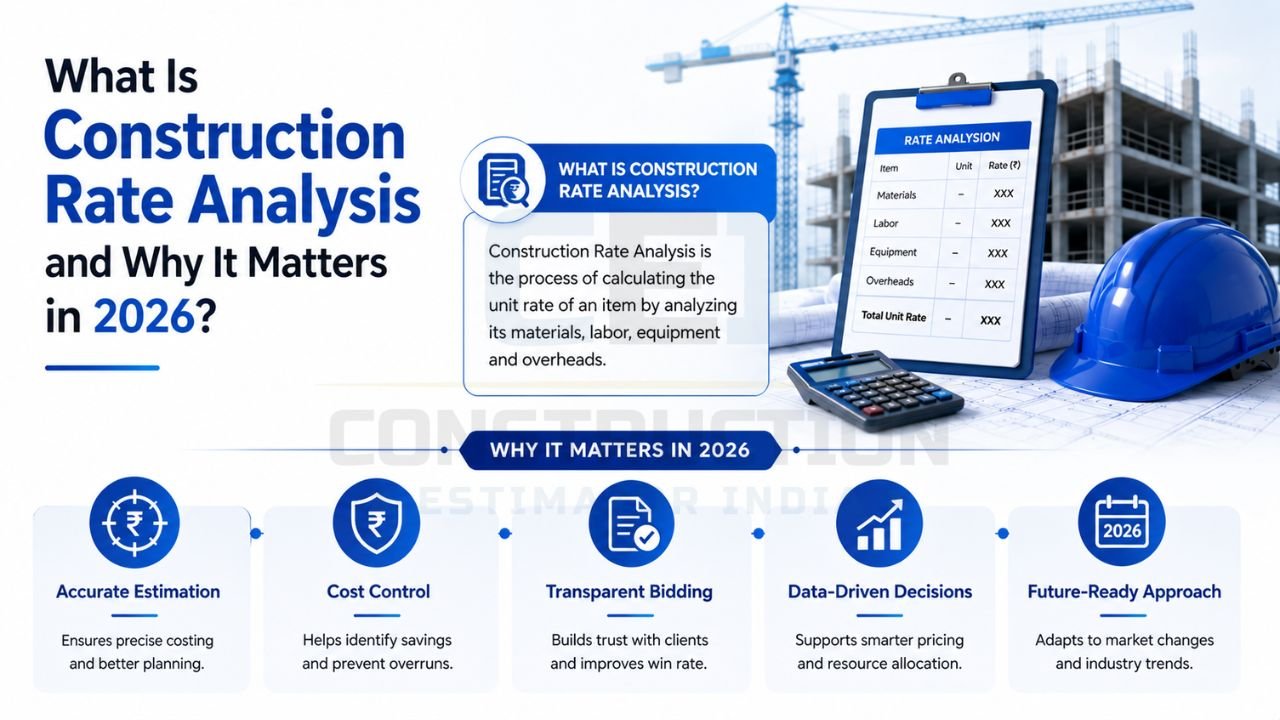
Simple Definition of Rate Analysis
Construction rate analysis is the systematic process of determining the cost per unit for a particular item of work, such as one cubic meter of concrete or one square meter of plaster. It isn’t just a “guess-estimate.” It involves breaking down the total cost into five core components:
- Material Cost: The market price of raw materials including wastage.
- Labour Cost: The wages for skilled, semi-skilled, and unskilled workers.
- Equipment/Machinery: Charges for mixers, vibrators, cranes, or scaffolding.
- Overheads: Office expenses, site electricity, and insurance.
- Contractor’s Profit: Usually calculated as a percentage (typically 10-15%) of the total cost.
👉 Get Accurate Construction Rate Analysis Before You Start Your Project.
Why Rate Analysis Must Be Updated Regularly?
The Indian market is highly sensitive to commodity price changes. In 2026, we expect a heightened volatility in steel and fuel prices. If you use a rate analysis from 2024 to bid on a project in 2026, you might find that the cost of TMT bars has risen by 15%, or that the local daily wage for masons has been revised upward by the state government. An outdated analysis leads to “budget bleeding,” where the estimated profit margin is consumed by rising input costs.
How Construction Rate Analysis 2026 Affects Tenders and Budgets?
For contractors, the construction rate analysis 2026 is the shield against financial loss. When bidding for tenders, especially those without a strong price escalation clause, your initial rate analysis must be robust enough to withstand minor market fluctuations. For project owners, it ensures that the quotes they receive from builders are realistic and not artificially inflated or dangerously low. Construction Estimator India helps contractors and builders understand these current price trends to ensure every bid is both competitive and sustainable.
Key Components of Construction Rate Analysis 2026 in India
The construction rate analysis 2026 for any Indian project must account for regional variations. A project in Mumbai will have vastly different logistics and labour costs compared to a project in Patna or Lucknow.
Steel Rates and Their Impact on RCC Items
Steel is the structural “muscle” of a building. In 2026, TMT (Thermo-Mechanically Treated) bars are expected to follow a trend influenced by iron ore availability and global scrap prices.
-
Grade Variations: Most structural designs now specify Fe500D or Fe550 as per the Bureau of Indian Standards (BIS). Understanding what is RCC construction reveals that the “D” stands for ductility, which is essential in earthquake-prone zones across India.
- Wastage: A standard rate analysis must include at least 2% to 5% wastage for cutting and overlaps (lapping).
- Structural Impact: Since steel can account for nearly 25% of the total RCC cost, a fluctuation of even ₹5 per kg can change your per-cubic-meter concrete rate by thousands of rupees.
Cement Rates and Volume-Based Consumption
Cement is the “glue” of construction. For 2026, we see a shift toward more specialized cements like Portland Pozzolana Cement (PPC) for masonry and Ordinary Portland Cement (OPC 43/53 Grade) for high-strength structural work.
- Storage and Logistics: Cement rates are highly sensitive to transport costs (diesel prices).
- Bulk vs. Bag: Large projects in 2026 are moving toward RMC (Ready Mix Concrete) or bulk supply, which requires a different rate analysis approach than traditional on-site mixing.
Labour Rates in Different Regions of India
Labour remains the most variable component. With the implementation of new labour codes monitored by the Ministry of Labour & Employment and the migration of skilled workers to mega-infrastructure projects, local availability for residential projects is tightening.
- Skill Categories: Rates must be calculated separately for Head Masons, Masons, Bar Benders, Carpenters (for shuttering), and helpers (Mazdoors).
- Productivity Constants: In 2026, we use IS 7272 (Part 1) as a guideline, but actual site productivity in India often varies based on weather conditions and site height.
Other Inputs: Aggregates, Sand, Admixtures and Transport
- Crushed Sand (M-Sand): Due to environmental bans on river sand, M-Sand is now the standard in most Indian cities. Its rate analysis must include fineness modulus checks.
- Admixtures: Modern 2026 concrete often requires plasticizers to improve workability without increasing water content.
Example Rate Analysis 2026 for Common Construction Items
Note: These numbers are indicative and based on rounded 2026 projections. For exact figures, you can reach out to Construction Estimator India on WhatsApp / Call +91 8630676890.
RCC Concrete (M20 Mix) – Example Rate Analysis
To calculate 1 Cubic Meter (Cum) of M20 (1:1.5:3) concrete. This mix is often the baseline when evaluating different foundation types for house construction in India.
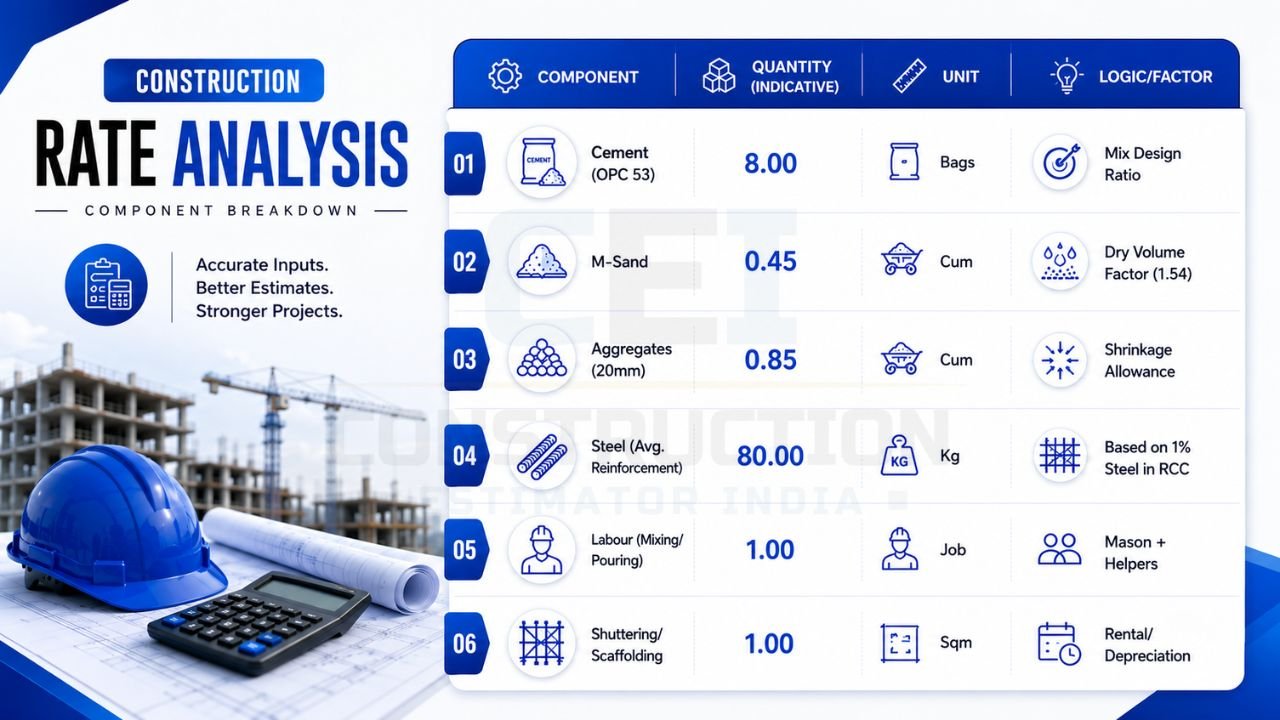
| Component | Quantity (Indicative) | Unit | Logic/Factor |
|---|---|---|---|
| Cement (OPC 53) | 8.00 | Bags | Mix Design Ratio |
| M-Sand | 0.45 | Cum | Dry Volume Factor (1.54) |
| Aggregates (20mm) | 0.85 | Cum | Shrinkage Allowance |
| Steel (Avg. Reinforcement) | 80.00 | Kg | Based on 1% Steel in RCC |
| Labour (Mixing/Pouring) | 1.00 | Job | Mason + Helpers |
| Shuttering/Scaffolding | 1.00 | Sqm | Rental/Depreciation |
In 2026, the cost of shuttering is expected to rise due to higher timber and ply prices, making it a critical variable in your construction rate analysis 2026.
👉 Build with Confidence Using Updated Material and Labor Cost Insights.
Brickwork (1:6 Mortar)
Knowing the difference between RCC and brick construction in India dictates how much mortar and labour is allocated here. For 1 Cum of 230mm thick brickwork:
- Bricks: Approx. 500 nos (Standard modular size).
- Cement: 1.2 to 1.5 bags.
- Sand: 0.25 Cum.
- Labour: One mason and two helpers can typically complete 1.25 Cum per day.
Plastering (12mm Internal, 1:4 Mortar)
Selecting which grade cement is best for plastering in India influences the material pricing. This helps you calculate an accurate plaster cost per square foot with material in India. For 100 Square Meters (Sqm):
- Cement: ~12-15 bags.
- Sand: ~1.8 Cum.
- Scaffolding: Essential for heights above 3 meters.
Construction Estimator India can provide project-wise rate analysis that accounts for your specific local leads (distance from source) and brand preferences.
Tracking Market Trends for 2026: Steel, Cement and Labour
Factors Influencing Steel Prices in 2026
Steel prices in India are influenced by initiatives outlined by the Ministry of Steel and global iron ore demand. In 2026, the push for “Green Steel” (low carbon emission) might introduce a premium on certain high-grade TMT bars. Contractors should watch for seasonal dips, usually during the monsoon when construction activity slows down.
Factors Influencing Cement Prices in 2026
The Indian cement industry is energy-intensive. Any rise in coal or petcoke prices directly hits the bag price. Furthermore, as the Indian government continues its “Housing for All” and “Gati Shakti” initiatives, the massive demand-supply gap in certain regions like North and North-East India could lead to localized price hikes.
Factors Influencing Labour Rates in 2026
Inflation is the primary driver for labour. As the cost of living in Indian Tier-1 and Tier-2 cities rises, the minimum wage is frequently adjusted. Additionally, specialized tasks like specialized flooring or “Smart Home” wiring require technicians whose rates are significantly higher than traditional electricians.
How to Use Construction Rate Analysis 2026 in Tenders and Project Planning?
A well-prepared construction rate analysis 2026 is the foundation of your Bill of Quantities (BOQ). Government bodies like the Central Public Works Department (CPWD) often rely on meticulously structured rate analyses. Understanding your localized house construction per sq ft rate helps you sanity-check the bottom-line numbers.
- BOQ Pricing: Instead of using “thumb rules,” use the derived rates from your analysis to fill the BOQ. This ensures that every item (from excavation to painting) is self-sustaining.
- Cash-Flow Planning: Knowing exactly how much cement is needed per month (based on rate analysis) allows you to negotiate better “bulk buy” discounts with suppliers.
- Avoiding Fixed Rates: For projects spanning more than 18 months, ensure your analysis includes a “Sensitivity Analysis” to see how a 10% hike in steel would affect the total project cost.
If you want to align your tenders and project budgets with realistic construction rate analysis 2026, contact Construction Estimator India on WhatsApp / Call +91 8630676890. We help integrate these rates with detailed project scheduling.
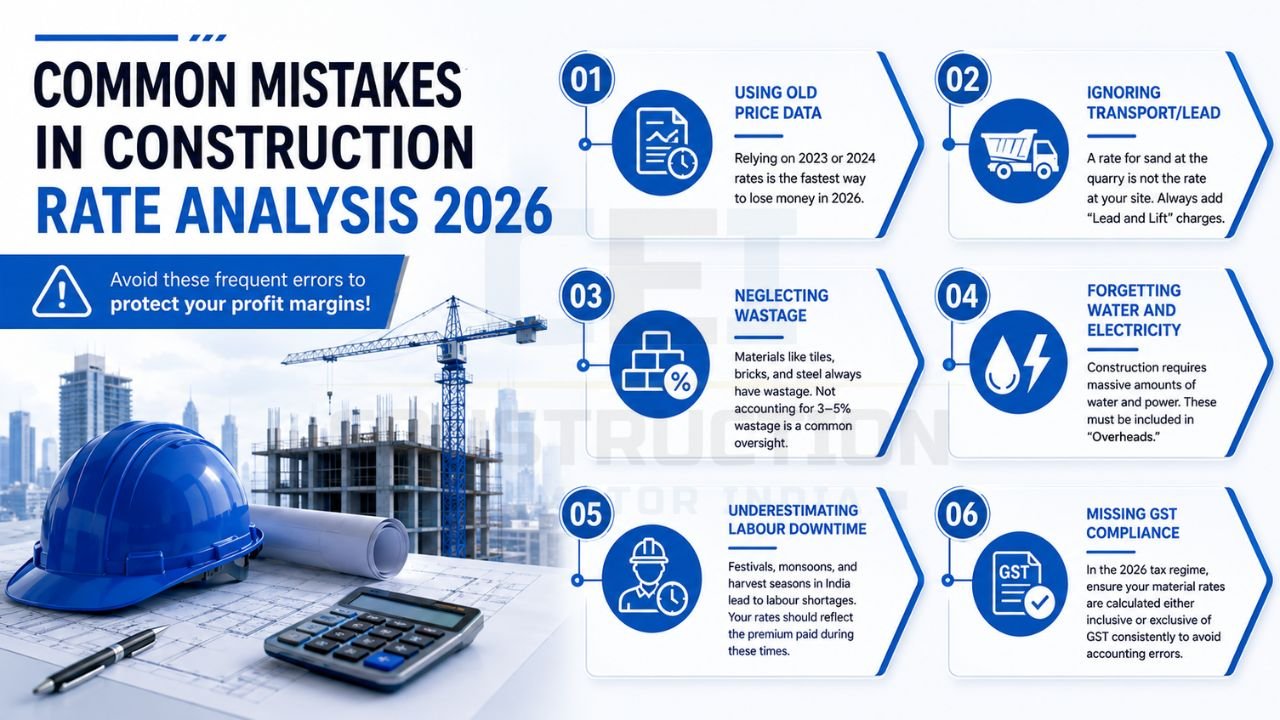
Common Mistakes in Construction Rate Analysis 2026
Avoid these frequent errors to protect your profit margins:
- Using Old Price Data: Relying on 2023 or 2024 rates is the fastest way to lose money in 2026.
- Ignoring Transport/Lead: A rate for sand at the quarry is not the rate at your site. Always add “Lead and Lift” charges.
- Neglecting Wastage: Materials like tiles, bricks, and steel always have wastage. Not accounting for 3-5% wastage is a common oversight.
- Forgetting Water and Electricity: Construction requires massive amounts of water and power. These must be included in “Overheads.”
- Underestimating Labour Downtime: Festivals, monsoons, and harvest seasons in India lead to labour shortages. Your rates should reflect the premium paid during these times.
- Missing GST Compliance: In the 2026 tax regime, ensure your material rates are calculated either inclusive or exclusive of GST consistently to avoid accounting errors.
👉 Build Smarter with Data-Driven Construction Cost Analysis.
Best Practices for Reliable Construction Rate Analysis in 2026
Always Verify Rates Close to Tender Date
Market rates on the day of estimate preparation might change by the time the tender is awarded. Always include a validity period in your analysis.
Keep Separate Rate Analysis Sheets for Materials and Labour
This allows you to update only the component that has changed. If cement prices go up but labour remains steady, you only need to tweak one column in your spreadsheet.
Involve Professional Estimators for Complex Items
Items like specialized waterproofing, structural glazing, or HVAC require expert knowledge. Construction Estimator India supports these best practices for clients across India, ensuring that even complex items are estimated with precision.
FAQs: Construction Rate Analysis 2026 in India
What is the basic concept of construction rate analysis 2026?
It is the mathematical breakdown of a construction task’s cost into materials, labour, machinery, and profits based on the market conditions expected in the year 2026. It ensures that every item in a building project is priced accurately according to current Indian market trends.
How often should contractors update their rate analysis in 2026?
Given the volatility of the Indian market, it is advisable to review material rates (especially steel and cement) every month and labour rates every six months or whenever state notifications are released.
Why do steel and cement price changes have such a big impact on RCC item rates?
In a typical RCC member, steel and cement together can constitute up to 60-70% of the material cost. Therefore, even a minor percentage increase in these commodities results in a significant jump in the per-cubic-meter cost of concrete.
How can I get project-specific construction rate analysis 2026 for my city?
You can reach out to professional services like Construction Estimator India. We use localized data for cities across India to provide you with a customized report that reflects your local supplier prices and labour availability.
How does Construction Estimator India help with rate analysis for tenders?
We provide detailed quantity takeoffs and rate analysis sheets that you can directly use to fill your tender documents. This reduces the risk of under-quoting and helps you stand out with a professional, data-backed bid.
Conclusion
The year 2026 presents both challenges and opportunities for the Indian construction industry. With the right construction rate analysis 2026, you can navigate the complexities of fluctuating steel prices, varying cement grades, and rising labour costs. Successful project management is no longer just about “getting the work done”—it is about financial precision and strategic planning.
By breaking down costs into atomic units and staying updated with market trends, you ensure that your projects are not only structurally sound but also financially viable. Remember, a small error in rate analysis at the start of a project can grow into a massive financial burden by the end.
If you want expert, updated construction rate analysis 2026 for your projects anywhere in India, contact Construction Estimator India on WhatsApp / Call +91 8630676890. Before finalizing your tender or budget, reach out to us for a professional review that protects your bottom line.