Choosing the right waterproofing material for roof India is the most critical decision a homeowner or contractor can make to prevent structural decay. In the diverse Indian climate, where roofs must withstand 45°C summers and torrential monsoons, a standard “one-size-fits-all” paint is a recipe for disaster. EPDM rubber is undoubtedly the best waterproofing material for roofs in India because it expands and contracts without cracking during thermal cycles. However, for many residential terraces, liquid waterproofing membranes and polyurethane coatings work best due to their seamless application and resistance to heavy rain. If you are looking for a budget-friendly option for flat roofs, cementitious coatings provide a reliable, albeit less flexible, barrier. Understanding what is waterproofing in construction is the first step toward safeguarding your home from the silent threat of moisture.
Waterproofing Material for Roof India (Quick Answer)
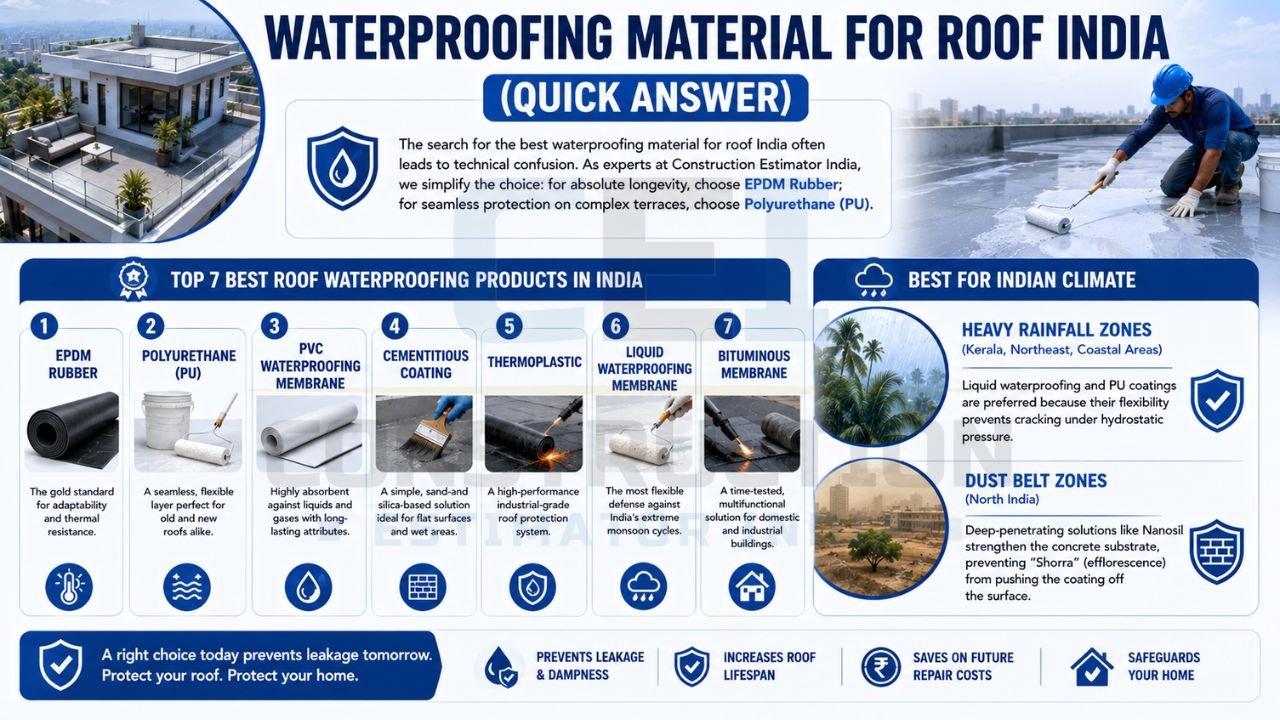
The search for the best waterproofing material for roof India often leads to technical confusion. As experts at Construction Estimator India, we simplify the choice: for absolute longevity, choose EPDM Rubber; for seamless protection on complex terraces, choose Polyurethane (PU).
Top 7 Best Roof Waterproofing Products in India
- EPDM Rubber: The gold standard for adaptability and thermal resistance.
- Polyurethane (PU): A seamless, flexible layer perfect for old and new roofs alike.
- PVC Waterproofing Membrane: Highly absorbent against liquids and gases with long-lasting attributes.
- Cementitious Coating: A simple, sand-and-silica-based solution ideal for flat surfaces and wet areas.
- Thermoplastic: A high-performance industrial-grade roof protection system.
- Liquid Waterproofing Membrane: The most flexible defense against India’s extreme monsoon cycles.
- Bituminous Membrane: A time-tested, multifunctional solution for domestic and industrial buildings.
Best for Indian Climate
The effectiveness of any roof waterproofing solutions India 2026 depends on localized weather exposure. In heavy rainfall zones like Kerala or the Northeast, liquid waterproofing and PU coatings are preferred because their flexibility prevents cracking under hydrostatic pressure. In the “Dust Belt” of North India, deep-penetrating solutions like Nanosil strengthen the concrete substrate, preventing “Shorra” (efflorescence) from pushing the coating off the surface.
Top 7 Waterproofing Materials for Roof in India (Ranked)
1. EPDM Rubber
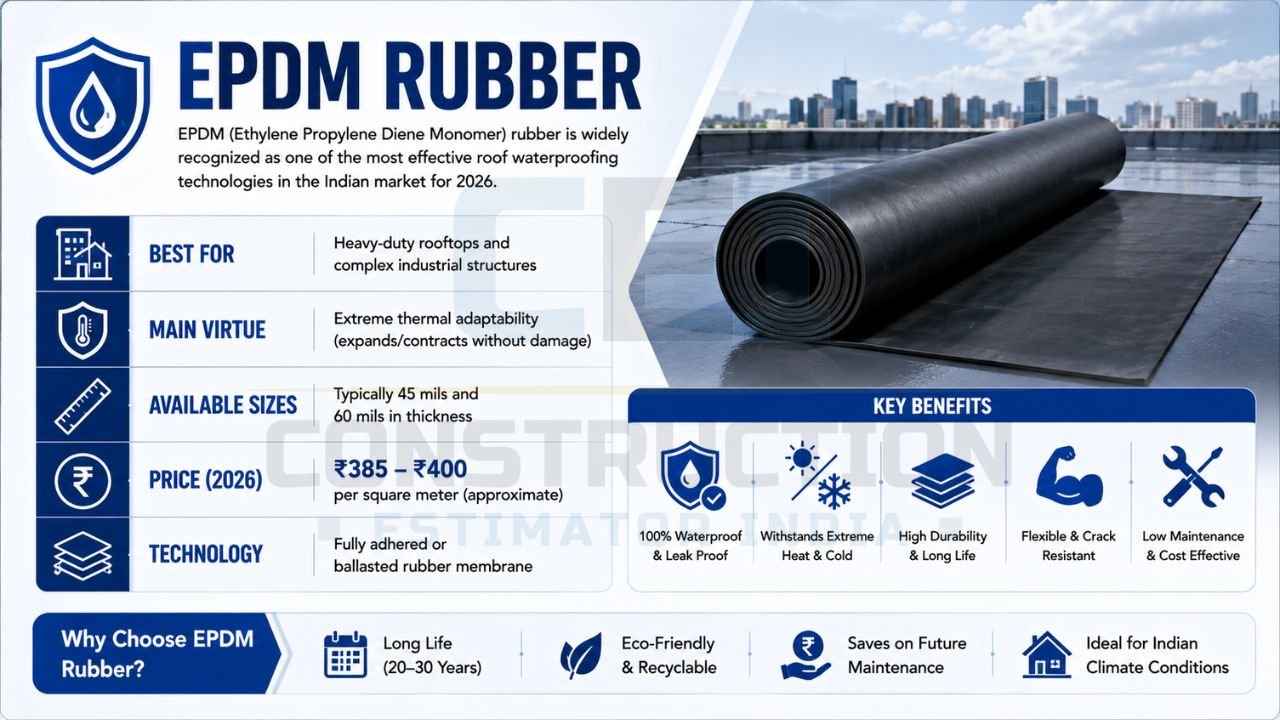
EPDM (Ethylene Propylene Diene Monomer) rubber is widely recognized as one of the most effective roof waterproofing technologies in the Indian market for 2026.
| Feature | Details |
|---|---|
| Best For | Heavy-duty rooftops and complex industrial structures |
| Main Virtue | Extreme thermal adaptability (expands/contracts without damage) |
| Available Sizes | Typically 45 mils and 60 mils in thickness |
| Price (2026) | ₹385 – ₹400 per square meter (approximate) |
| Technology | Fully adhered or ballasted rubber membrane |
2. Polyurethane (PU)
PU is a premium, easy-to-apply liquid that creates a seamless, flexible protective layer across the entire roof surface.
| Feature | Details |
|---|---|
| Best For | Old roof repairs, terraces, and exterior walls |
| UV Resistance | Excellent; prevents the “baking” effect of the Indian sun |
| Special Use | Immediate control of active water leakage |
| Thermal Benefit | Significantly lowers the temperature of ceilings and walls |
3. PVC Waterproofing Membrane
Recurrently applied for high-end residential and commercial roofs, PVC membranes offer incredible longevity to the structure. They are effortless to configure and provide a superior barrier against both liquid water and gases.
4. Cementitious Coating (Cementite)
Compositionally made of sand, silica-based substances, and chemical compounds, cementitious coatings are a staple for waterproofing professionals.
| Feature | Details |
|---|---|
| Best For | Flat roofs, water tanks, and bathrooms |
| Pros | Low price point, extremely simple to mix and apply |
| Cons | Lack of flexibility; may crack if the building settles |
| Expert Tip | Best suited for areas without high thermal movement |
5. Liquid Waterproofing Membrane
Liquid-applied membranes are the most versatile terrace waterproofing material India has to offer. They cure into a rubber-like, flexible film that can bridge micro-cracks in the concrete, making them ideal for the shifting temperatures of the Indian subcontinent.
6. Bituminous Membrane
Bituminous membranes combine bitumen with a blend of specialized substances to create a thick, slippery material with a very long shelf life. They remain a preferred choice for large industrial rooftops and domestic basements.
7. Thermoplastic
Used primarily in industrial applications, thermoplastic membranes are highly durable and resistant to chemical exposure, ranking among the top seven most reliable products in India for 2026.
Popular Waterproofing Products for Indian Climate
1. Nanosil
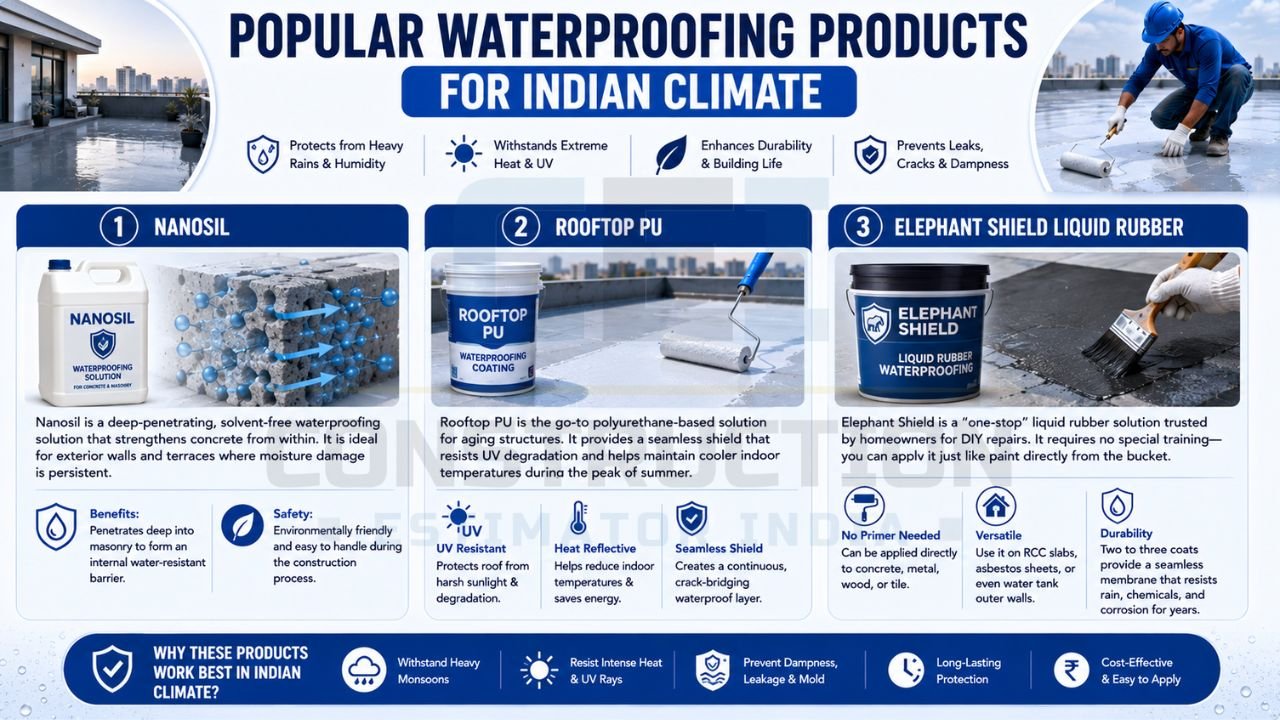
Nanosil is a deep-penetrating, solvent-free waterproofing solution that strengthens concrete from within. It is ideal for exterior walls and terraces where moisture damage is persistent.
- Benefits: Penetrates deep into masonry to form an internal water-resistant barrier.
- Safety: Environmentally friendly and easy to handle during the construction process.
2. Rooftop PU
Rooftop PU is the go-to polyurethane-based solution for aging structures. It provides a seamless shield that resists UV degradation and helps maintain cooler indoor temperatures during the peak of summer.
3. Elephant Shield Liquid Rubber
Elephant Shield is a “one-stop” liquid rubber solution trusted by homeowners for DIY repairs. It requires no special training—you can apply it just like paint directly from the bucket.
- No Primer Needed: Can be applied directly to concrete, metal, wood, or tile.
- Versatile: Use it on RCC slabs, asbestos sheets, or even water tank outer walls.
- Durability: Two to three coats provide a seamless membrane that resists rain, chemicals, and corrosion for years.
Types of Roof Waterproofing Methods
Choosing the right method is as important as the material. At Construction Estimator India, we help you calculate the construction material estimation in India to ensure you don’t overspend on the wrong technology.
| Type | Best For | Key Features |
|---|---|---|
| Acrylic Coatings | General rooftops and terraces | Easy to apply; cost-effective |
| PU Coatings | Old roofs and UV-exposed areas | Seamless, flexible, and heat-reflective |
| EPDM Membranes | Critical rooftops (Best overall) | Highest adaptability to thermal effects |
| Liquid Membranes | Complex shapes and high-rain zones | Seamless barrier; resists heavy rain/heat |
| Cementitious | Bathrooms and flat internal roofs | Rigid, durable, and very affordable |
When to Use Which Waterproofing Material
| Situation | Recommended Material | Expert Reasoning |
|---|---|---|
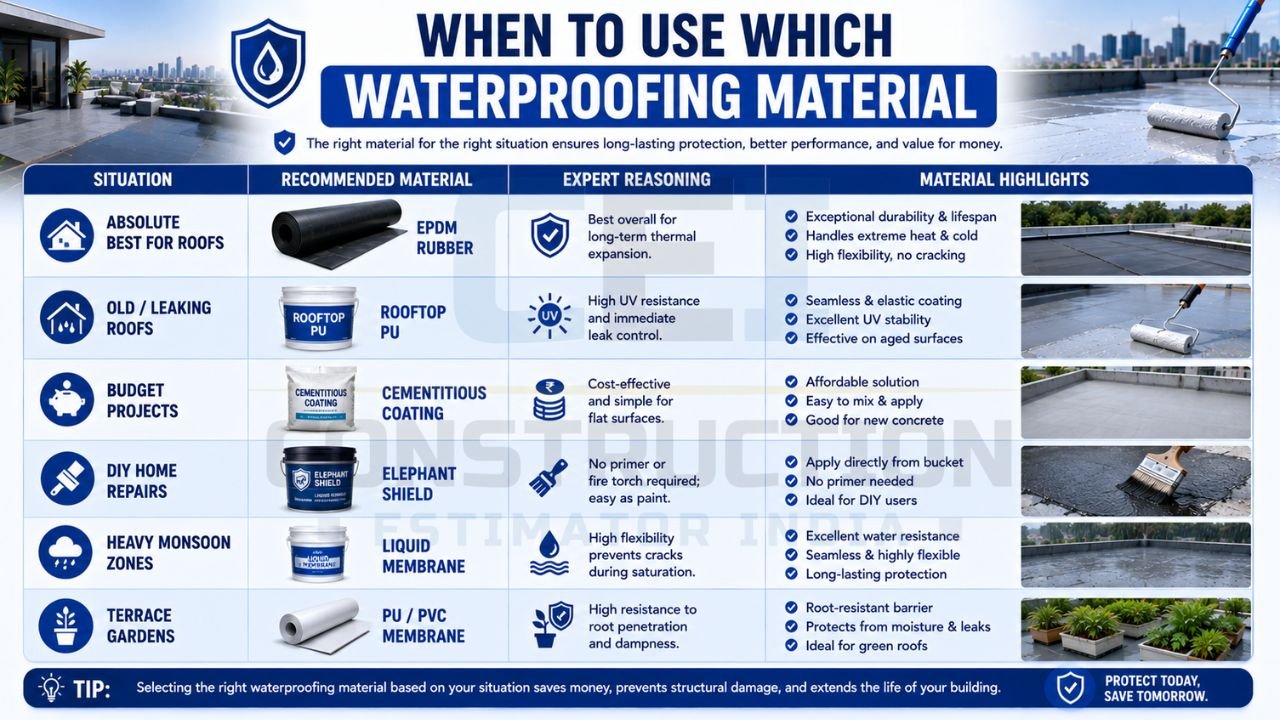
| Absolute Best for Roofs | EPDM Rubber | Best overall for long-term thermal expansion. |
| Old/Leaking Roofs | Rooftop PU | High UV resistance and immediate leak control. |
| Budget Projects | Cementitious Coating | Cost-effective and simple for flat surfaces. |
| DIY Home Repairs | Elephant Shield | No primer or fire torch required; easy as paint. |
| Heavy Monsoon Zones | Liquid Membrane | High flexibility prevents cracks during saturation. |
| Terrace Gardens | PU/PVC Membrane | High resistance to root penetration and dampness. |
How to Choose Waterproofing Material for Your Roof?
Selecting the best waterproofing material for roof India requires a balance of three factors: the specific roof area, climate exposure, and the house construction step by step process in India.
- Thermal Movement: If your roof is exposed to direct sunlight, EPDM rubber is the best because it adapts to size changes caused by heat.
- Surface Texture: For metal or asbestos sheets, liquid rubber products like Elephant Shield are superior as they adhere without a primer.
- Future Use: If the terrace will be a garden, you need a high-strength PU or PVC membrane to resist water pressure and biological growth.
- Curing Time: Modern “Smart” coatings like Nanosil or PU systems cure faster than traditional bituminous felt, which is vital if you are waterproofing during the pre-monsoon rush.
Common Waterproofing Mistakes to Avoid
Waterproofing is a technical field where shortcuts lead to expensive failures. Before you start, review the 7 common expensive mistakes in house construction in India.
- Mistake 1: Choosing Rigid Materials for Active Roofs. Using a non-supple cementitious coating on a roof with high thermal movement will lead to cracking within one season.
- Mistake 2: Skipping Surface Preparation. Even the best EPDM rubber or PU will fail if the concrete is dusty or contaminated with “Shorra” (efflorescence).
- Mistake 3: Insufficient Coating Thickness. Applying only one coat of liquid rubber is a common DIY error. Most professional systems require 2-3 coats to form a fully adhered membrane.
- Mistake 4: Not Considering UV Resistance. Standard bituminous products can “bake” and crack under the 45°C Indian sun if not covered with a UV-reflective topcoat or ballast.
Conclusion
If you are facing roof leakage issues or planning a new project in India, don’t leave your structural safety to guesswork. At Construction Estimator India, we provide expert guidance on waterproofing material selection, cost estimation, and technical planning.
We specialize in:
- Professional Waterproofing Consultation
- Waterproofing Material and Cost Estimation
- Preparation of what is BOQ in construction for waterproofing projects
- DPR (Detailed Project Report) for commercial buildings
Stop the seepage before it stops you.
WhatsApp / Call: +91 8630676890
FAQ — Waterproofing Material for Roof India
What is the best waterproofing material for roof India?
EPDM rubber is widely considered the best for roofs due to its thermal adaptability. For terraces, liquid polyurethane (PU) membranes are often the most practical choice.
Which waterproofing solution is best for the Indian climate?
Liquid waterproofing membranes and PU coatings are best because they offer the flexibility needed to handle India’s extreme heat and heavy rainfall.
What is the price of EPDM rubber waterproofing in India?
In 2026, the estimated cost ranges between ₹385 and ₹400 per square meter, depending on the brand and membrane thickness.
Is polyurethane (PU) waterproofing good for old roofs?
Yes, Rooftop PU is specifically recommended for old roofs as it provides a seamless, flexible layer that controls leaks immediately.
What is the best waterproofing for flat roofs in India?
Cementitious coatings are highly recommended for flat roofs due to their low cost and ease of application.
Is Elephant Shield Liquid Rubber good for DIY?
Yes, it can be applied like paint with no special training or primers required, making it ideal for home DIY projects.
How long does roof waterproofing last?
High-quality membranes like EPDM or PVC can last 15–20 years, while liquid PU coatings typically offer 10–12 years of protection when maintained correctly.