
If you are planning to build your dream home in India, the question of M20 vs M25 concrete which is better is critical for your building’s structural health. For most modern residential projects, M25 concrete is better because it offers superior compressive strength (25 MPa vs 20 MPa), enhanced durability, and significantly better resistance against shrinkage cracks. While M20 concrete is a practical and budget-friendly choice for simple G+1 (Ground + 1 Floor) residential houses with moderate slab spans, M25 is the standard recommendation for G+2 buildings, commercial structures, or any roof slab where long-term durability is the priority. Choosing the right grade today prevents expensive repairs tomorrow.
M20 vs M25 Concrete Which Is Better? (Quick Answer)
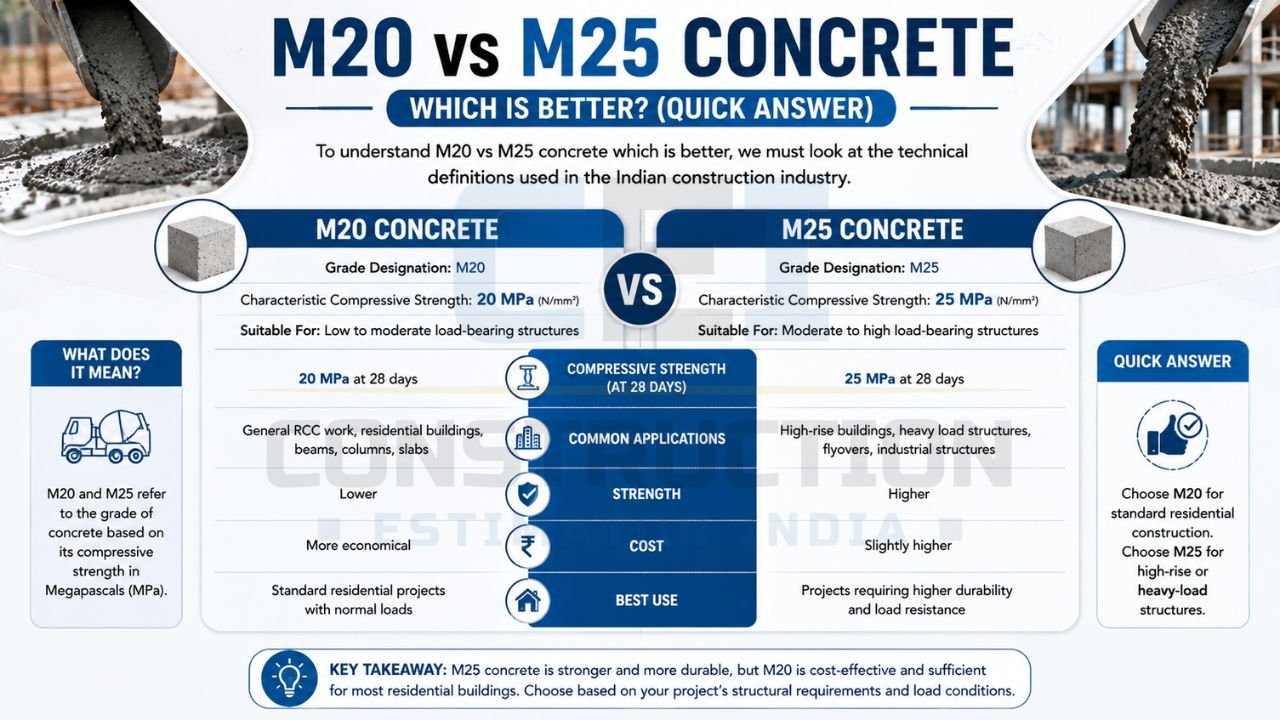
To understand M20 vs M25 concrete which is better, we must look at the technical definitions used in the Indian construction industry.
Concrete Grade Definition
- Concrete grades are represented by the letter M followed by a number.
- The letter M stands for “Mix”, and the number indicates the characteristic compressive strength of the concrete in Newtons per square millimeter (N/mm² or MPa) after 28 days of proper curing.
- M20 = 20 MPa strength; M25 = 25 MPa strength.
- Simply put, the higher the number, the stronger and more durable the concrete will be once fully hardened.
M20 Concrete Overview
- M20 concrete has a compressive strength of 20 MPa after 28 days.
- It is the standard grade for what is concrete in construction in small-scale Indian residential projects.
- It offers a practical balance between strength and affordability, making it ideal for G+1 houses with moderate load requirements.
- The standard nominal mix for M20 is 1 : 1.5 : 3 (1 part Cement : 1.5 parts Sand : 3 parts Stone Aggregates).
M25 Concrete Overview
- M25 concrete has a compressive strength of 25 MPa.
- This grade is widely used for what is RCC in construction including beams, roof slabs, and columns in modern residential and medium-sized commercial buildings.
- It is now the recommended choice in modern construction because it provides 25% more strength than M20, leading to improved structural reliability.
- The approximate mix ratio for M25 used at most sites is 1 : 1 : 2.
Final Recommendation
While M20 is suitable for simple residential buildings with moderate loads, M25 is recommended if you want higher durability, better crack resistance, and stronger long-term structural safety. For roof slabs, durability should always be a priority over minor cost savings.
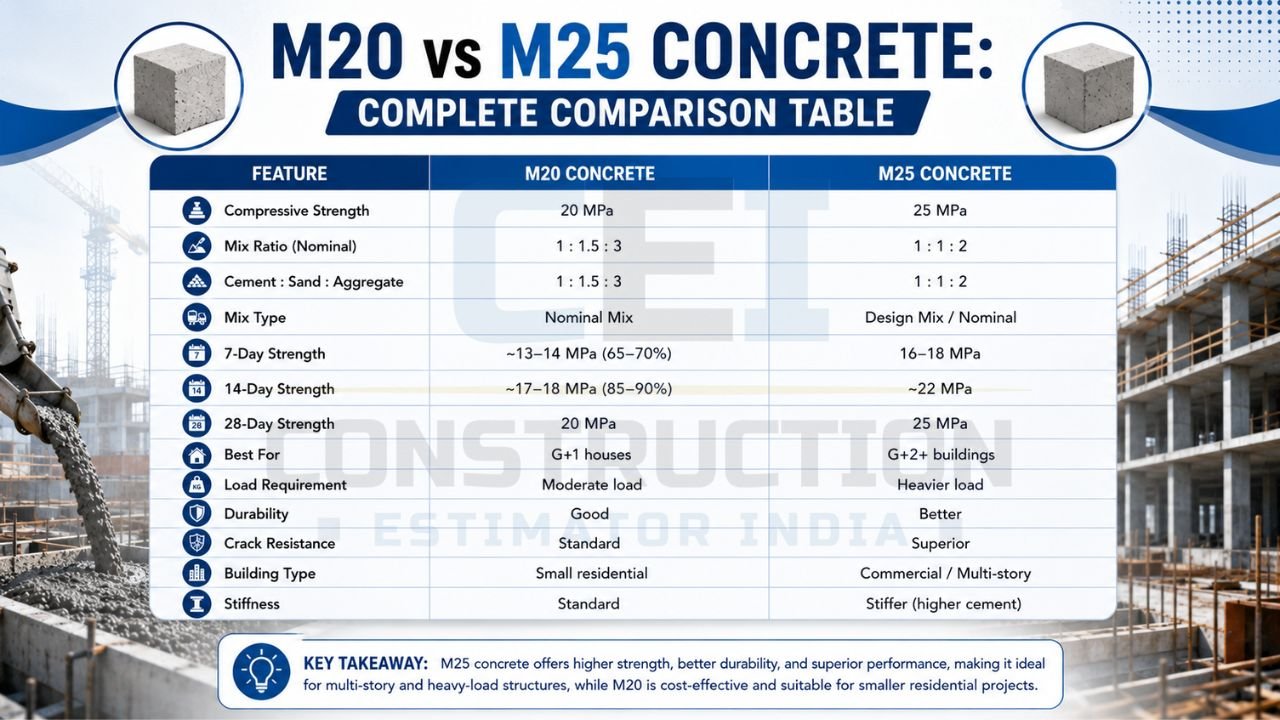
M20 vs M25 Concrete: Complete Comparison Table
| Feature | M20 Concrete | M25 Concrete |
|---|---|---|
| Compressive Strength | 20 MPa | 25 MPa |
| Mix Ratio (Nominal) | 1 : 1.5 : 3 | 1 : 1 : 2 |
| Cement : Sand : Aggregate | 1 : 1.5 : 3 | 1 : 1 : 2 |
| Mix Type | Nominal Mix | Design Mix / Nominal |
| 7-Day Strength | ~13–14 MPa (65–70%) | 16–18 MPa |
| 14-Day Strength | ~17–18 MPa (85–90%) | ~22 MPa |
| 28-Day Strength | 20 MPa | 25 MPa |
| Best For | G+1 houses | G+2+ buildings |
| Load Requirement | Moderate load | Heavier load |
| Durability | Good | Better |
| Crack Resistance | Standard | Superior |
| Building Type | Small residential | Commercial / Multi-story |
| Stiffness | Standard | Stiffer (higher cement) |
M20 vs M25 Strength Comparison
The M20 vs M25 concrete strength difference is the most significant factor for engineers. M25 provides roughly 25% more load-bearing capacity than M20. This extra margin is vital in regions like North India, where extreme temperature fluctuations can cause thermal expansion and contraction in concrete slabs.
Strength at Different Ages
The strength of concrete is not instant; it develops through a chemical process called hydration.
| Age | M20 Strength (Approx) | M25 Strength (Approx) |
|---|---|---|
| 7 Days | 13.5 MPa | 17 MPa |
| 14 Days | 18 MPa | 22 MPa |
| 28 Days | 20 MPa | 25 MPa |
Key Strength Facts:
- M20 concrete reaches 20 N/mm² after 28 days of proper curing.
- M25 concrete reaches 25 N/mm² under the same conditions.
- The higher the grade, the denser the concrete matrix, which prevents water seepage and protects the steel reinforcement from rust.
Verdict: If your structure involves heavy loads or long slab spans, M25 provides 25% higher strength and is the safer choice.
M20 vs M25 Mix Ratio Comparison
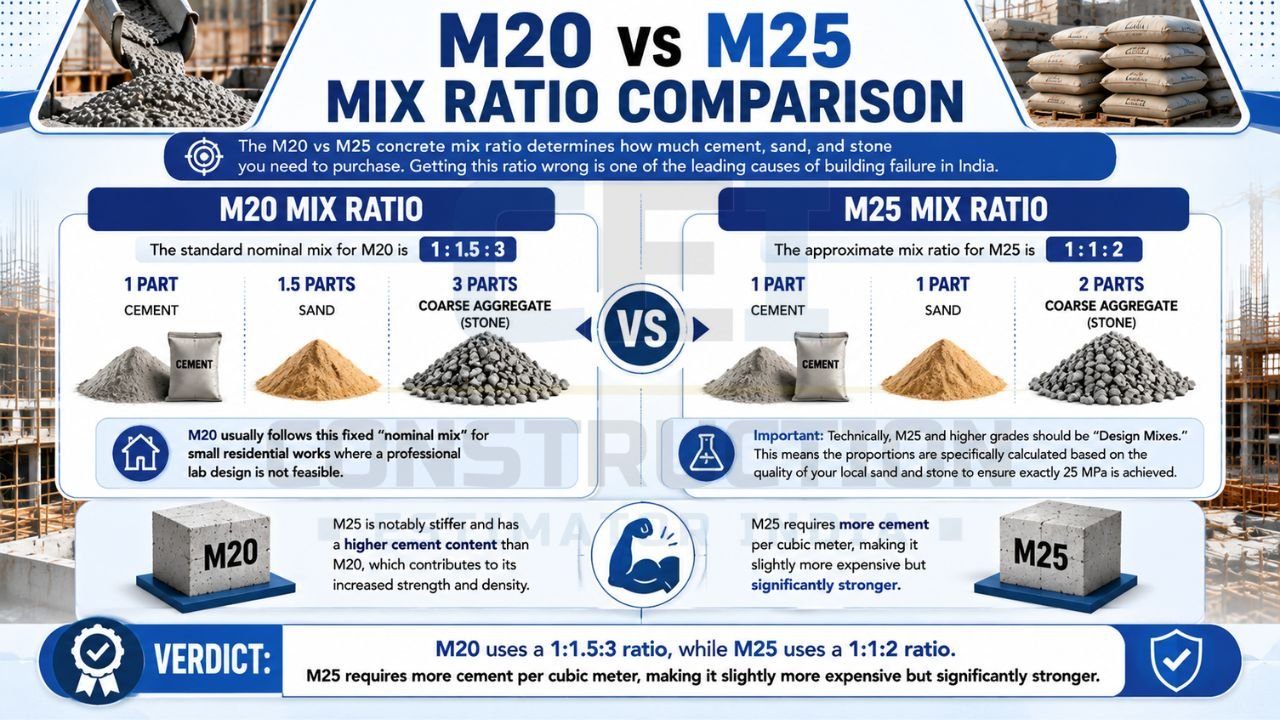
The M20 vs M25 concrete mix ratio determines how much cement, sand, and stone you need to purchase. Getting this ratio wrong is one of the leading causes of building failure in India.
M20 Mix Ratio
The standard nominal mix for M20 is 1 : 1.5 : 3.
- 1 part Cement
- 1.5 parts Sand
- 3 parts Coarse Aggregate (Stone)
- M20 usually follows this fixed “nominal mix” for small residential works where a professional lab design is not feasible.
M25 Mix Ratio
The approximate mix ratio for M25 is 1 : 1 : 2.
- 1 part Cement
- 1 part Sand
- 2 parts Coarse Aggregate
- Important: Technically, M25 and higher grades should be “Design Mixes.” This means the proportions are specifically calculated based on the quality of your local sand and stone to ensure exactly 25 MPa is achieved.
- M25 is notably stiffer and has a higher cement content than M20, which contributes to its increased strength and density.
Verdict: M20 uses a 1:1.5:3 ratio, while M25 uses a 1:1:2 ratio. M25 requires more cement per cubic meter, making it slightly more expensive but significantly stronger.
When to Use M20 vs M25 Concrete
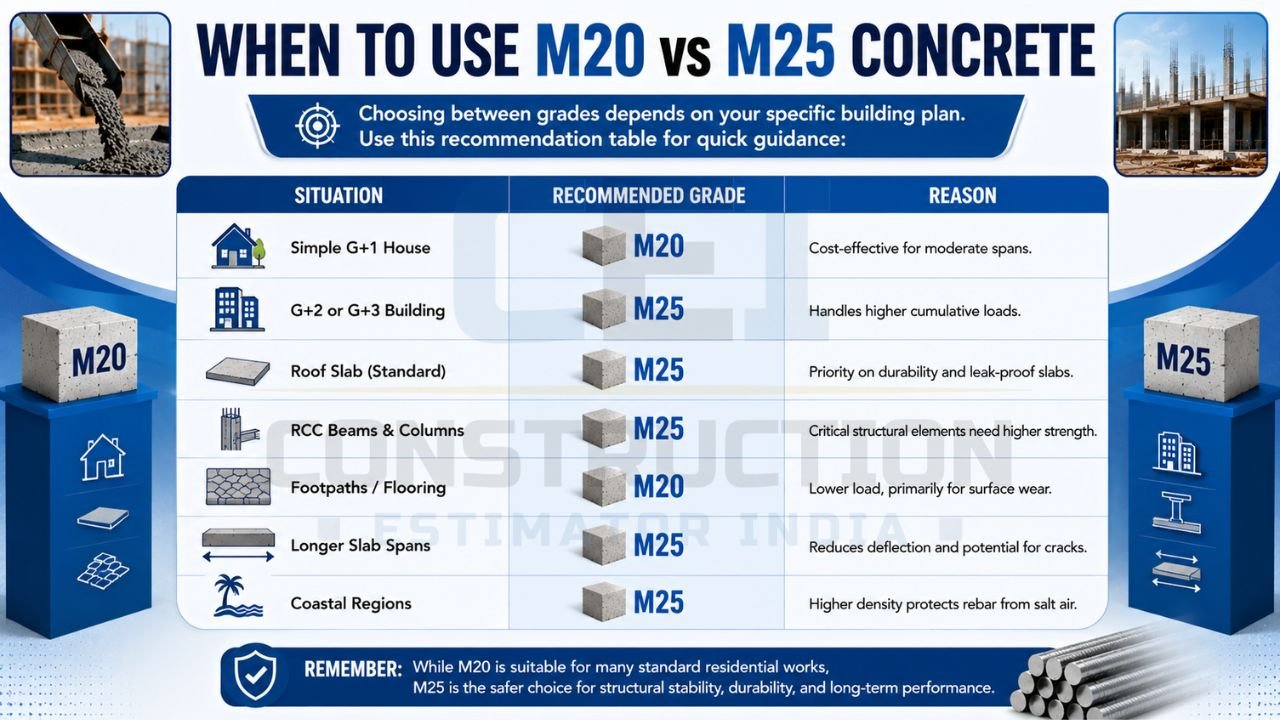
Choosing between grades depends on your specific building plan. Use this recommendation table for quick guidance:
| Situation | Recommended Grade | Reason |
|---|---|---|
| Simple G+1 House | M20 | Cost-effective for moderate spans. |
| G+2 or G+3 Building | M25 | Handles higher cumulative loads. |
| Roof Slab (Standard) | M25 | Priority on durability and leak-proof slabs. |
| RCC Beams & Columns | M25 | Critical structural elements need higher strength. |
| Footpaths / Flooring | M20 | Lower load, primarily for surface wear. |
| Longer Slab Spans | M25 | Reduces deflection and potential for cracks. |
| Coastal Regions | M25 | Higher density protects rebar from salt air. |
M20 Concrete: Uses and Applications
M20 is the “workhorse” of the Indian housing sector. It is widely used in semi-urban and rural areas for standard residential builds.
M20 Common Uses
- Small Residential Buildings: Ideal for G+1 houses with standard room sizes.
- Light RCC Works: Suitable for chajjas, small lintels, and non-load-bearing elements.
- Foundations: Often used in footings for single-story houses where soil bearing capacity is high.
- Paving: Excellent for driveways, footpaths, and courtyard flooring.
M20 Advantages
- Affordability: Low material cost due to lower cement requirement.
- Ease of Mixing: Standard 1:1.5:3 ratio is easy for local labor to follow without complex supervision.
Best For: Small residential buildings, moderate loads, and budget-conscious G+1 projects.
M25 Concrete: Uses and Applications
M25 is considered a “standard grade” of reinforced concrete (RCC) that offers the structural integrity required for modern architectural designs.
M25 Common Uses
- Critical RCC Structures: Recommended for main columns, heavy beams, and large roof slabs.
- Multi-story Buildings: The preferred grade for G+2 and above to manage increased vertical loads.
- Medium Commercial Buildings: Used in offices, shops, and warehouses where floor loads are higher.
- Long-Span Beams: Necessary when designing large open halls or parking areas.
M25 Advantages
- Durability: Higher cement content creates a denser surface that resists moisture and sulfate attacks.
- Crack Resistance: The tighter mix design helps in reducing shrinkage cracks in hot climates like Rajasthan or Uttar Pradesh.
Best For: G+2+ buildings, roof slabs, critical structural columns, and long-term safety.
Cost Comparison and Selection Guidelines
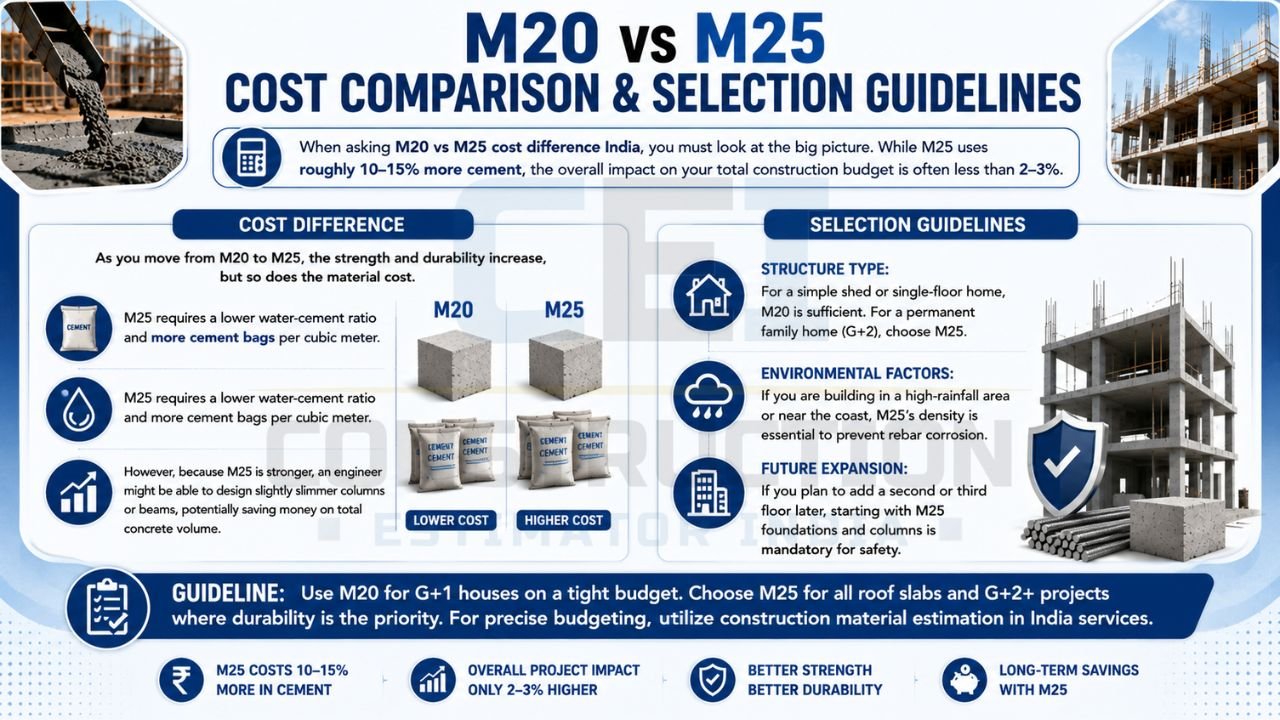
When asking M20 vs M25 cost difference India, you must look at the big picture. While M25 uses roughly 10-15% more cement, the overall impact on your total construction budget is often less than 2-3%.
Cost Difference
- As you move from M20 to M25, the strength and durability increase, but so does the material cost.
- M25 requires a lower water-cement ratio and more cement bags per cubic meter.
- However, because M25 is stronger, an engineer might be able to design slightly slimmer columns or beams, potentially saving money on total concrete volume.
Selection Guidelines
- Structure Type: For a simple shed or single-floor home, M20 is sufficient. For a permanent family home (G+2), choose M25.
- Environmental Factors: If you are building in a high-rainfall area or near the coast, M25’s density is essential to prevent rebar corrosion.
- Future Expansion: If you plan to add a second or third floor later, starting with M25 foundations and columns is mandatory for safety.
Guideline: Use M20 for G+1 houses on a tight budget. Choose M25 for all roof slabs and G+2+ projects where durability is the priority. For precise budgeting, utilize construction material estimation in India services.
Common Concrete Grade Mistakes to Avoid
- Wrong Grade for Height: Using M20 for a G+3 building. This can lead to structural instability or settlement cracks over time.
- Ignoring Durability: Choosing M20 for a roof slab just to save a few thousand rupees. Roofs face the most weather stress; M25 is always the better choice here.
- Inaccurate Mixing: Using a “1:2:4” mix (M15) and calling it M20. Always use a measuring box (farmi) to ensure ratios like 1:1.5:3 are followed exactly.
- Skipping Curing: Even M25 will fail if not cured. Proper curing for at least 14 days is essential for concrete to reach its designed MPa.
- Over-specifying: Using M40 for a simple residential house. This increases cost unnecessarily without providing meaningful benefits for small loads.
To avoid these and other pitfalls, read our guide on 7 common expensive mistakes in house construction in India.
Conclusion
If you are planning a construction project in India and feel overwhelmed by technical choices, don’t leave your structural safety to chance. Construction Estimator India provides professional expertise to help you build with confidence.
We specialize in:
- Concrete Grade Consultation: Helping you choose between M20, M25, or M30.
- Accurate Material Estimation: Knowing exactly how many cement bags you need.
- Mix Design Guidance: Ensuring your site team follows the correct ratios.
- Professional BOQ & DPR: Essential for bank loans and contractor tenders. Learn more about what is BOQ in construction.
Contact us today for a professional estimate that saves you money and ensures structural safety.
WhatsApp / Call: +91 8630676890
Email: info@constructionestimatorindia.com
Service Area: India-wide (Delhi NCR, UP, Rajasthan, Bihar, MP, and more)
FAQ — M20 vs M25 Concrete Which Is Better
M20 vs M25 concrete which is better?
M25 is better for strength and durability. M20 is a suitable budget option for small G+1 residential houses.
What is the difference between M20 and M25 concrete?
The main difference is compressive strength (20 MPa vs 25 MPa) and the mix ratio (1:1.5:3 vs 1:1:2).
What is the M20 concrete mix ratio?
The standard ratio is 1 : 1.5 : 3 (Cement : Sand : Aggregate).
What is the M25 concrete mix ratio?
The approximate ratio is 1 : 1 : 2, though a design mix is preferred for accuracy.
Which concrete grade is best for roof slab?
M25 is the best grade for roof slabs because it provides better crack resistance and waterproofing compared to M20.
Which concrete grade is best for G+1 house?
M20 is suitable and commonly used for G+1 residential buildings with moderate loads.
Which concrete grade is best for G+2 house?
M25 is highly recommended for G+2 and taller buildings to handle the increased load.
What is the 28-day strength of M20 and M25?
M20 reaches 20 MPa, and M25 reaches 25 MPa at 28 days.
Is M25 more expensive than M20?
Yes, M25 is slightly more expensive due to higher cement content, but the cost difference is minimal relative to the building’s lifespan.
How do I contact Construction Estimator India for concrete grade selection?
You can call or WhatsApp us at +91 8630676890 for expert consultation and BOQ reports.