
Are you planning your dream home in India and feeling overwhelmed by material choices? One of the most common questions homeowners ask is: which sand is best for construction? Choosing the right sand is critical because it forms the bulk of your mortar and concrete, directly impacting the structural integrity and finish of your building. In India’s diverse construction landscape, the “best” sand depends entirely on the specific application—whether you are casting a slab, laying bricks, or plastering walls.
Which Sand Is Best for Construction? (Quick Answer)
If you are looking for a direct answer to which sand is best for construction, the secret lies in matching the sand’s grain size and origin to your project’s needs. In the modern Indian market, the choice often boils down to M-Sand (Manufactured Sand) and traditional River Sand.
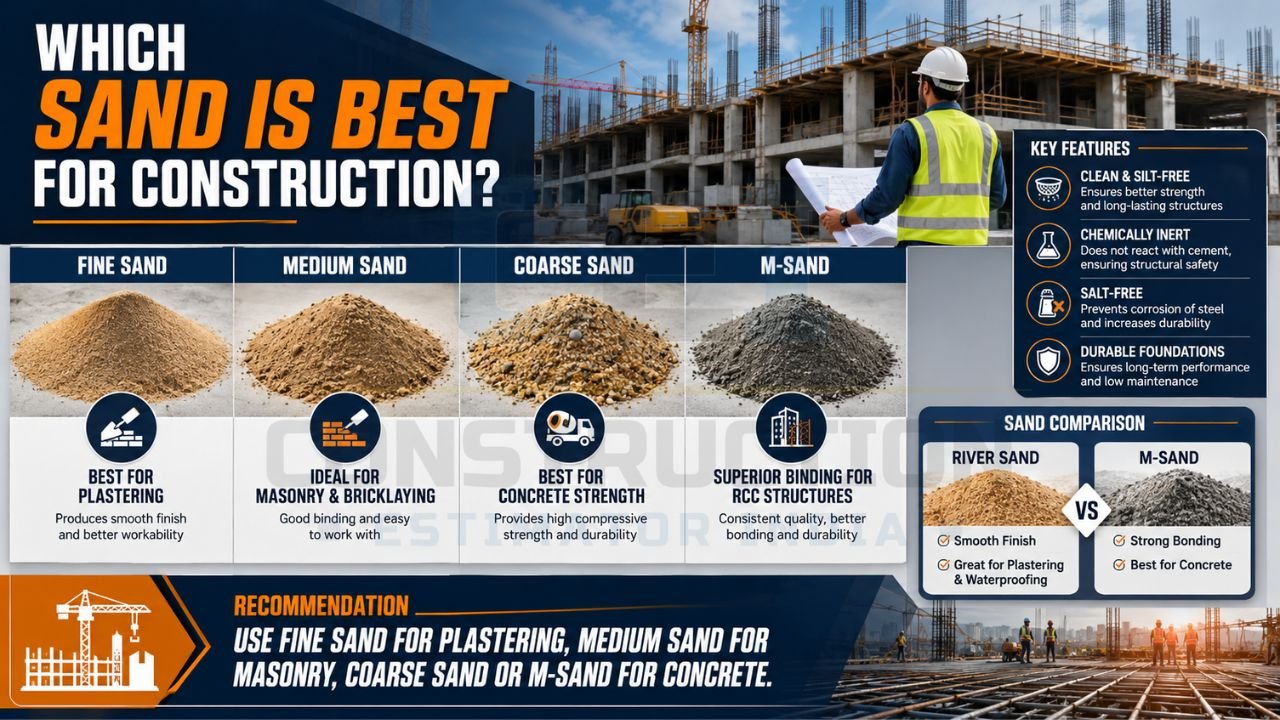
Sand Types by Size and Use
- Fine Sand: Primarily used for plastering work due to its smooth texture.
- Medium Sand: The ideal choice for masonry work and bricklaying.
- Coarse Sand: Specifically used for concrete work to ensure structural strength.
- Recommendation: For sand for concrete, well-graded coarse sand or high-quality M-Sand is highly recommended to achieve the best results.
Quality Sand Properties
No matter your construction project, you will want to use quality sand that meets these essential criteria:
- Cleanliness: Must be free of impurities like silt and clay.
- Inertness: Should be chemically inert and free of organic materials.
- Salt-Free: Excess salt can cause corrosion in steel reinforcement.
- Durability: High-quality sand is essential for strong, durable foundations, ensuring long-term stability and longevity.
River Sand vs M-Sand
- River Sand: Its rounded particles make it excellent for plastering and waterproofing because it creates a flawlessly smooth surface.
- M-Sand: Its angular shape provides superior binding strength, making it the top choice for concrete structures.
- Professional Tip: High-quality river sand ensures better workability, but not all river sand is suitable; always verify the silt content.
Summary: For the best results, use fine sand for plastering, medium sand for masonry, and coarse sand or M-Sand for concrete.
Types of Sand Used in Construction (By Size)
The size of the sand particles, often determined by sieve analysis, dictates where it should be used on your site.
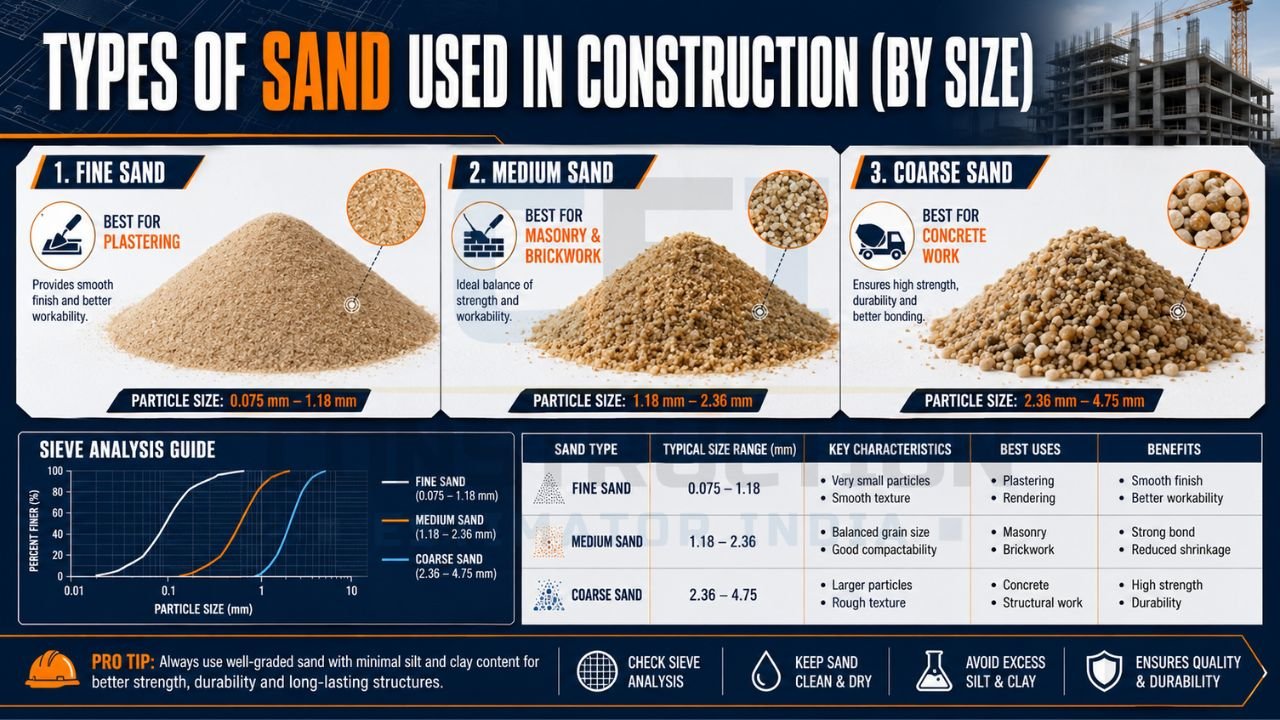
| Sand Type | Size | Best For | Texture |
|---|---|---|---|
| Fine Sand | Small particles | What is plastering in construction | Smooth, fine |
| Medium Sand | Medium particles | Masonry and Brickwork | Medium grain |
| Coarse Sand | Large particles | What is concrete in construction | Rough, coarse |
River Sand vs M-Sand: Which Is Better?
In 2026, the debate between M sand vs river sand for construction is more relevant than ever due to environmental regulations and cost fluctuations in India.
| Feature | River Sand | M-Sand (Manufactured Sand) |
|---|---|---|
| Particle Shape | Smooth, rounded particles | Angular shape |
| Best For | Plastering, waterproofing | Concrete work |
| Surface Texture | Smooth | Rough |
| Binding Strength | Standard | Better binding strength |
| Clay Content | Higher clay content (naturally) | Lower clay content (controlled) |
| Impurities | May contain organic matter, silt, clay | Fewer impurities due to washing |
| Particle Size | Typically larger and varied | Typically smaller and uniform |
| Workability | Good workability in concrete and mortar | Excellent for structural concrete |
| Sustainability | Extraction has high environmental impact | Produced from local rocks, sustainable |
| Quality | High-quality ensures durability | High-quality recommended for RCC |
When to Use River Sand?
River sand remains a favorite for finishing works. Because the particles have been rounded by water over time, they slip past each other easily, creating a “buttery” mortar that is easy for laborers to apply.
- Plastering: Essential for achieving a crack-free, smooth wall finish.
- Waterproofing: The rounded grains help create a dense, less permeable layer.
- Note: High-quality river sand is becoming rare and expensive in many Indian states.
When to Use M-Sand?
Manufactured sand vs river sand India comparisons often favor M-Sand for structural elements.
- Concrete Work: The angular shape of M-Sand creates an interlocking effect with cement and aggregate, leading to higher compressive strength.
- Sustainability: It is a responsible choice as it reduces the illegal dredging of riverbeds.
- Availability: Can be produced locally, reducing transportation costs and carbon footprint.
Other Types of Construction Sand
Beyond the two giants, there are specialized varieties found on Indian construction sites:
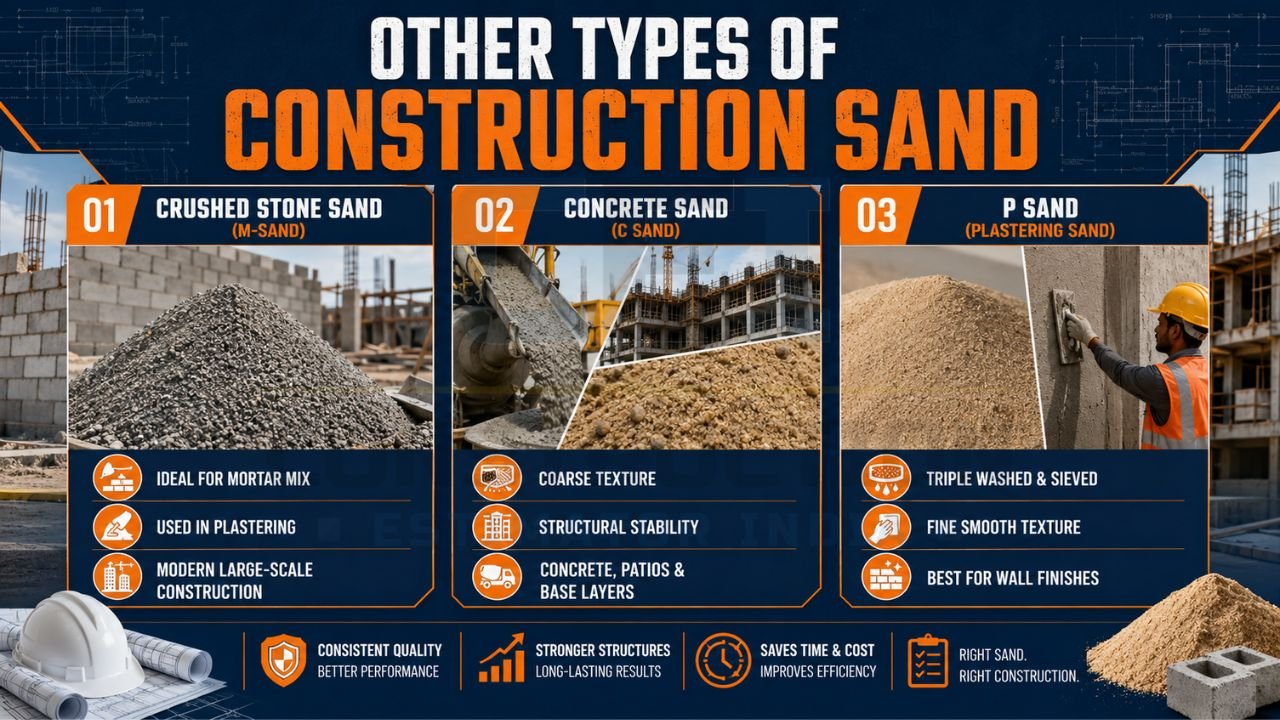
1. Crushed Stone Sand
This is essentially M-Sand in its primary form. Crushed stone sand is primarily used as a mortar mix for plastering, making it a staple on virtually every modern construction site involving large-scale building.
2. Concrete Sand
Often referred to as C Sand (Concrete Sand), this type is coarse-textured and specifically graded for structural stability. While primarily used to mix cement, it also serves as a robust base layer for above-ground pools, patios, and asphalt mixing.
3. P Sand (Plastering Sand)
This is a highly refined version of manufactured sand. Types include P sand for plastering, which is triple-washed and sieved to remove all larger grains, ensuring a fine texture suitable for internal and external wall finishes.
How to Identify Good Quality Construction Sand?
As an expert at Construction Estimator India, I cannot stress enough: poor quality sand is a primary cause of wall cracks and dampness.
Quality Sand Must Be:
- Clean: Free from dust, dirt, and organic matter.
- Inert: Should not react with the chemical properties of cement.
- Strong and Durable: Capable of withstanding the structural loads of the building.
- Salt-Free: It should not contain any chloride salts, which lead to “efflorescence” (white patches) on walls.
Impurities to Avoid
- Silt and Clay: High silt content weakens the bond between cement and sand.
- Organic Matter: Roots and leaves can rot within the wall, creating voids and structural weaknesses.
Quality Check Tips for Homeowners
- Rub Test: Take a small amount of damp sand and rub it between your palms. If your palms stay clean, the sand is good. If they become stained, it contains too much silt or clay.
- Glass Test: Mix sand in a glass of water and let it settle. A thick layer of silt at the top indicates poor quality.
- Taste Test: If the sand tastes salty, it is likely sea sand or poorly washed river sand—avoid it at all costs for RCC work.
- Visual Check: Ensure the sand is of a uniform color and free from lumps or stones.
Common Sand Mistakes to Avoid
In our years of providing construction material estimation in India, we’ve seen these six mistakes cost homeowners lakhs in rework:
- Using the Wrong Sand Type: Using coarse sand for plastering will result in a rough, uneven finish, while using fine sand for concrete will drastically reduce its strength.
- Using Low-Quality Sand: Many contractors use “pit sand” or unwashed river sand to save money, which often contains high clay content that weakens the structure.
- Not Checking Quality: Never assume the supplier is providing the grade you ordered. Always perform a silt test on every new load.
- Ignoring Sustainability: With strict environmental laws, using M-Sand is often more reliable and legal than sourcing river sand in restricted zones.
- Choosing Price Over Quality: High-quality sand is essential for strong, durable foundations. Saving a few thousand rupees now could lead to foundation failure later.
- Not Washing Sand: If your river sand feels “dusty,” it needs to be washed to remove fine silt before it is used in difference between PCC and RCC in construction.
To avoid costly material mistakes, read our guide on 7 common expensive mistakes in house construction in India.
Build With Confidence With Construction Estimator India
Choosing the right sand is just one piece of the puzzle. At Construction Estimator India, we ensure your entire material procurement process is optimized for cost and quality. Whether you are an NRI building from abroad or a local homeowner, we provide the professional data you need to succeed.
Our Expert Services Include:
- Sand Quantity Estimation: Know exactly how many cubic feet or tons you need.
- Construction Material Consultation: Help choosing the right brands and types.
- BOQ (Bill of Quantities): Precise breakdowns for bank loans and contractor tenders.
- DPR (Detailed Project Report): Full project roadmaps.
- Construction Planning: Strategic advice for residential and commercial builds.
Don’t leave your foundation to chance. Contact us today for a professional consultation.
WhatsApp / Call: +91 8630676890
Location: India-wide Service
FAQ — Which Sand Is Best for Construction
Which sand is best for construction?
The best sand depends on the work: Fine sand for plastering, Medium sand for masonry, and Coarse or M-Sand for concrete.
Is M sand or river sand better for construction?
M-Sand is better for concrete due to its angular shape and strength. River sand is better for plastering due to its smooth texture.
What sand is best for concrete?
Well-graded coarse sand or high-quality M-Sand (C-Sand) is best for concrete.
What sand is best for plastering?
Fine river sand or P-Sand (Plastering M-Sand) is best for a smooth finish.
What sand is best for masonry work?
Medium-grained sand is the ideal choice for brick and block masonry.
What are the properties of good quality construction sand?
It must be clean, chemically inert, salt-free, durable, and free of clay, silt, and organic matter.
Is M sand sustainable for construction?
Yes, it is a sustainable alternative that reduces riverbed erosion and can be produced locally.
What is the difference between P sand and M sand?
P-Sand (Plastering Sand) is a finer, washed version of M-Sand specifically for plastering, while regular M-Sand is usually for concrete.
How do I check if sand is good quality?
Perform a rub test for silt, a settle test in water for clay content, and a taste test for salt.
How do I contact Construction Estimator India for sand estimation?
You can reach our experts via WhatsApp or Call at +91 8630676890.