Imagine you are a contractor in Meerut, Uttar Pradesh, managing a high-stakes residential project in July 2026. After months of meticulous planning, a sudden, unprecedented monsoon downpour triggers a localized flash flood that submerges your site. Within hours, your unfinished boundary wall collapses, thousands of bags of cement are ruined, and, tragically, a worker is injured during the chaos. Without the right types of insurance for contractors, this single incident could lead to millions in losses, legal battles, and the potential closure of your business.
In India’s booming construction sector, where infrastructure push and urban development are at an all-time high, your risks are equally massive. Whether you are building independent floors in Delhi-NCR or managing a large-scale commercial project, understanding the different types of insurance for contractors is no longer optional—it is a cornerstone of professional risk management, legal compliance, and tender success.
Contractors today require a strategic mix of project-specific policies and mandatory covers to protect their works, materials, equipment, and third parties. This guide will walk you through the primary types of insurance for contractors, explaining what they cover, their approximate costs in the 2026 market, and how to accurately include them in your Bill of Quantities (BOQ) to ensure your project remains financially secure. By the end of this article, you will have a clear roadmap to selecting the best safety net for your construction business.
For larger commercial projects, specific requirements often apply. Read our guide on commercial construction insurance requirements in India.
Why Contractors in India Need Multiple Types of Insurance?
As we navigate the complexities of construction in 2026, relying on a single insurance policy is a dangerous gamble. Contractors face a multi-front risk environment where legal requirements are becoming stricter. For instance, the Building and Other Construction Workers (BOCW) Act and the Employees’ Compensation Act 1923 make it legally mandatory to protect your workforce. If a worker is injured on your site and you lack proper coverage, the legal penalties and compensation payouts can derail your project’s solvency.
Furthermore, most lenders, banks, and government departments now mandate specific types of insurance for contractors before releasing funds or awarding tenders. Beyond compliance, the physical risks are rising; urban flooding, seismic activity in Delhi-NCR (Zone IV/V), and site theft are frequent occurrences that standard home insurance policies simply do not cover. Effective insurance ensures that your project continues even after a disaster, protecting your margins and maintaining your reputation in a competitive market.
The benefits of proper coverage go far beyond compliance. Explore the key advantages in our article on benefits of insurance for construction projects in India.
Main Types of Insurance for Contractors in India
Navigating the 2026 insurance landscape requires a clear understanding of which policy serves which purpose. For Indian contractors, the primary goal is to ensure that every “work-in-progress” has a dedicated shield.
| Policy Type | Primary Purpose |
|---|---|
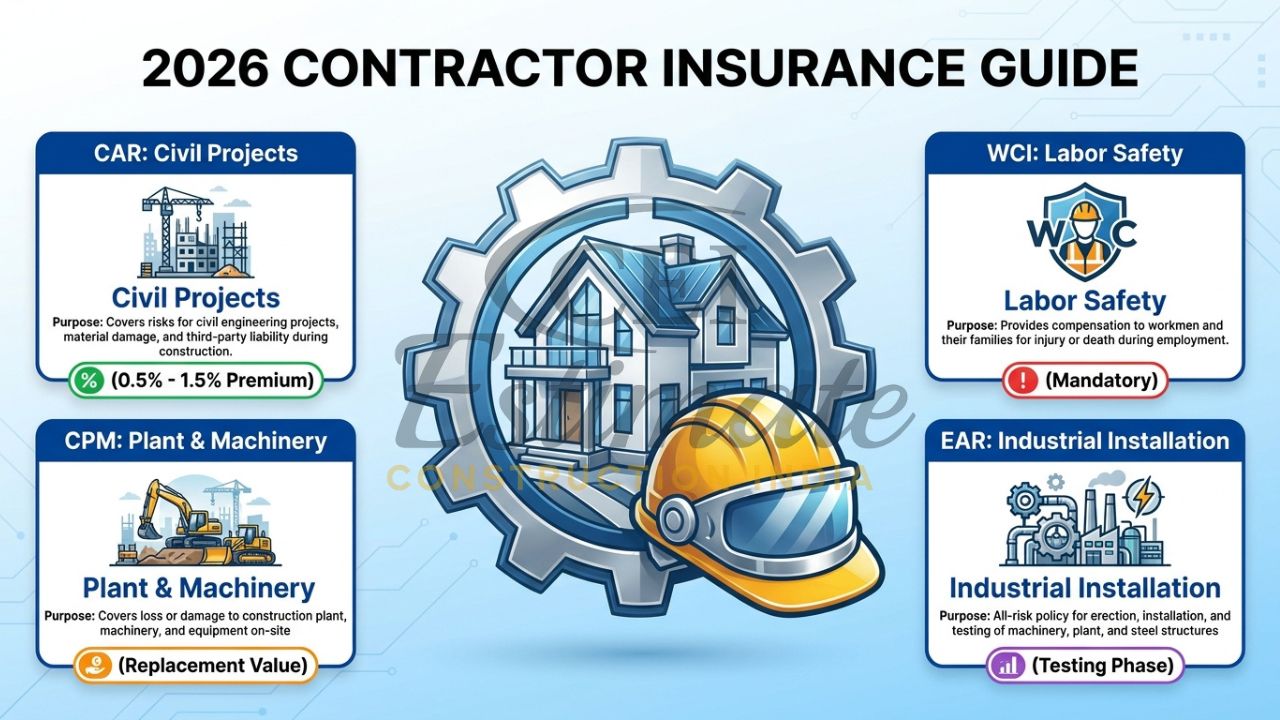
| Contractors All Risk (CAR) | Comprehensive cover for civil works, materials, and third-party liability. |
| Workmen Compensation (WCI) | Mandatory cover for worker death, disability, and medical expenses. |
| Erection All Risk (EAR) | Specialized for installation and commissioning of machinery and structures. |
| Plant & Machinery (CPM) | Protects owned or hired equipment like cranes, mixers, and excavators. |
| General Liability (CGL) | Covers legal costs and damages for third-party injury or property damage. |
1. Contractors’ All Risk (CAR) Insurance
In the Indian residential and civil market, contractors all risk insurance CAR India is the most vital policy you will purchase. It is a specialized product designed to protect the “physical anatomy” of your project from groundbreaking until final handover. This policy is “all-risk,” meaning it covers all physical loss or damage except for specific exclusions like faulty design or wear and tear.
For a residential project in a city like Meerut, a CAR policy covers the permanent structure (walls, slabs), construction materials (steel, cement) stored on-site or in transit, and temporary works like scaffolding. Crucially, it provides a shield against “Fire and Special Perils,” which include floods, inundations during monsoons, and earthquakes—all critical for projects in North India. The sum insured is typically based on the estimated Total Contract Value plus an escalation clause to account for rising material costs during the build.
For accurate costing of this essential policy, check our detailed breakdown on how much does builders risk insurance cost in India.
2. Erection All Risk (EAR) Insurance
While CAR focuses on civil works, erection all risk EAR insurance is essential for contractors involved in industrial setups or projects with heavy machinery installation. If your contract involves the erection of steel structures, boilers, or large-scale HVAC systems, EAR is the appropriate choice.
The key difference is that EAR focuses on the risks associated with the assembly and installation phase. It covers the equipment from the moment it arrives at the site, during storage, throughout the erection process, and most importantly, during the testing and commissioning period. For a factory project in an industrial hub like Noida, EAR ensures that if a machine is damaged during a trial run, your financial interests are protected.
3. Workmen Compensation Insurance (WCI)
Under the Employees’ Compensation Act 1923 and the BOCW Act, workmen compensation insurance for contractors is a non-negotiable legal requirement. Construction is inherently dangerous; if a laborer falls from scaffolding or suffers a permanent disability on your site, you are legally liable to pay compensation.
WCI covers death, permanent total or partial disability, and medical expenses for all employees on your muster roll. In 2026, many contractors also integrate this with government schemes like the Pradhan Mantri Suraksha Bima Yojana (PMSBY) for added layers of protection. Failing to maintain this insurance can lead to criminal charges, heavy fines, and the blacklisting of your firm from future tenders.
For specific legal obligations, refer to our guide on workers comp requirements for construction businesses in India.
4. Contractors Plant & Machinery (CPM) Insurance
Your equipment is your livelihood. Whether it is an excavator you own or a concrete mixer you have hired, contractors plant and machinery CPM insurance provides dedicated protection that a standard CAR policy might limit. While CAR covers “temporary works,” it often has lower limits for high-value machinery.
CPM covers both static and mobile equipment against fire, external damage, theft, and even damage during transit between sites. This is particularly useful for contractors in 2026 who move machinery across different projects in the Delhi-NCR region. It also covers the breakdown of machinery, which is essential to avoid project delays when a critical piece of equipment fails.
5. Other Important Types of Insurance for Contractors
Beyond the core policies, modern construction insurance for contractors often includes specialized covers to address specific business risks.
- Commercial General Liability (CGL): While CAR has a third-party section, a standalone CGL provides much higher limits for public liability. If a falling brick damages a neighbor’s luxury car or injures a passerby, CGL handles the legal defense and payouts.
- Professional Indemnity (PI): If you provide design-build services, PI protects you against claims of “negligent design” or professional errors that lead to structural failures.
- Marine/Inland Transit: Essential for the safe transport of high-value materials like Teak wood or premium tiles from distant suppliers.
- Advance Loss of Profits (ALOP): This covers the loss of revenue you or the project owner might face if an insured event (like a fire) delays the project completion date.
Comparison of Major Types of Insurance for Contractors
To help you decide, the following table compares the most common types of insurance for contractors in the 2026 Indian market.
| Feature | CAR Insurance | WCI Insurance | CPM Insurance |
|---|---|---|---|
| Primary Cover | Physical works & materials. | Worker death/injury. | Moving equipment/machinery. |
| Who Buys It | Contractor or Owner. | Every Contractor/Employer. | Equipment Owner/Hirer. |
| Sum Insured | Total Project Value. | Total Wage Bill. | Replacement Value of Machine. |
| 2026 Premium | 0.5% – 1.5% of value. | 0.5% – 2% of wages. | 1% – 2.5% of machine value. |
| Best For | Residential/Civil builds. | All Labor-intensive sites. | Projects with heavy infra. |
How to Choose the Right Types of Insurance for Contractors
Selecting the right coverage depends on your specific project profile. For a small residential renovation in Meerut, a basic CAR policy with a WCI rider might suffice. However, for a high-rise in Gurgaon, you must consider seismic risks, deep excavation hazards, and high-value third-party liabilities.
Always check your contract conditions; most FIDIC or CPWD-style contracts will specify the exact insurance requirements you must meet. Consider the location—building near a river or in a landslide-prone area requires specific “Special Perils” extensions. For small contractors, starting with a comprehensive CAR policy is the most cost-effective way to get broad protection.
Smaller contractors and businesses should explore best insurance for small construction business in India to find cost-effective yet comprehensive solutions.
Cost of Insurance for Contractors in India & Impact on Project Estimates
Understanding the cost is critical for how to include contractor insurance in BOQ. In 2026, the cost of CAR insurance typically ranges from 0.5% to 1.5% of the total project value. For a project worth ₹1 Crore, your premium could be between ₹50,000 and ₹1,50,000. WCI costs are generally based on your wage bill, often ranging from 0.5% to 2%.
As an estimator, you must never treat insurance as an “unforeseen” expense. It should be a dedicated line item in your Bill of Quantities. By accurately pricing these premiums during the bidding stage, you avoid eating into your profit margins later when a bank or client mandates a policy you didn’t budget for.
Step-by-Step Guide to Buying Insurance for Contractors
- Define the Scope: List your project value, labor count, and equipment list.
- Gather Documents: Prepare your project site address, building plans, and estimated schedule.
- Consult IRDAI Guidelines: Ensure the policy follows IRDAI guidelines for contractor insurance to guarantee claim validity.
- Compare Quotes: Obtain quotes from major insurers like New India Assurance, HDFC Ergo, or ICICI Lombard.
- Check Add-ons: Ensure you have “Debris Removal” and “Escalation” clauses included.
When working with subcontractors, ensure proper coverage arrangements. Learn more in our guide on how to get insurance for subcontractors in India.
Conclusion
Navigating the various types of insurance for contractors is the hallmark of a responsible and successful construction professional in 2026. From protecting your physical works with CAR to fulfilling your legal duties with WCI, these policies are your ultimate financial safety net. Don’t let a single monsoon storm or a site accident erase years of hard work.
Ensure your project is built on a foundation of total security. At Construction Estimator India, we provide professional BOQ and construction cost estimation services that properly factor in all contractor insurance costs, ensuring your bids are both competitive and defensible. Review your current covers today and build with confidence.
FAQ Section
What are the main types of insurance for contractors in India?
The primary types include Contractors All Risk (CAR), Workmen Compensation Insurance (WCI), Erection All Risk (EAR), and Contractors Plant & Machinery (CPM) insurance.
What does Contractors All Risk (CAR) insurance cover?
CAR covers physical damage to the building structure, materials on-site, temporary works like scaffolding, and third-party liability during construction.
Is Workmen Compensation Insurance mandatory for contractors?
Yes, it is legally mandatory under the Employees’ Compensation Act 1923 and the BOCW Act for any site employing laborers.
What is the difference between CAR and EAR insurance?
CAR is for civil engineering and building projects, while EAR is for projects involving the installation and commissioning of machinery and plant equipment.
How much does insurance cost for contractors in India?
In 2026, CAR premiums typically range from 0.5% to 1.5% of the project value, while WCI is around 0.5% to 2% of the wage bill.
How do I include different types of contractor insurance in my BOQ?
Insurance should be listed as a separate line item under “General Requirements” or “Preliminaries,” using the estimated premium based on project value.
Does CAR insurance cover third-party liability?
Yes, most CAR policies include a standard section for third-party liability to cover injuries or property damage to outsiders.
Which insurers offer good policies for contractors in India?
Major providers include New India Assurance, HDFC Ergo, ICICI Lombard, and SBI General.
Suggestions: