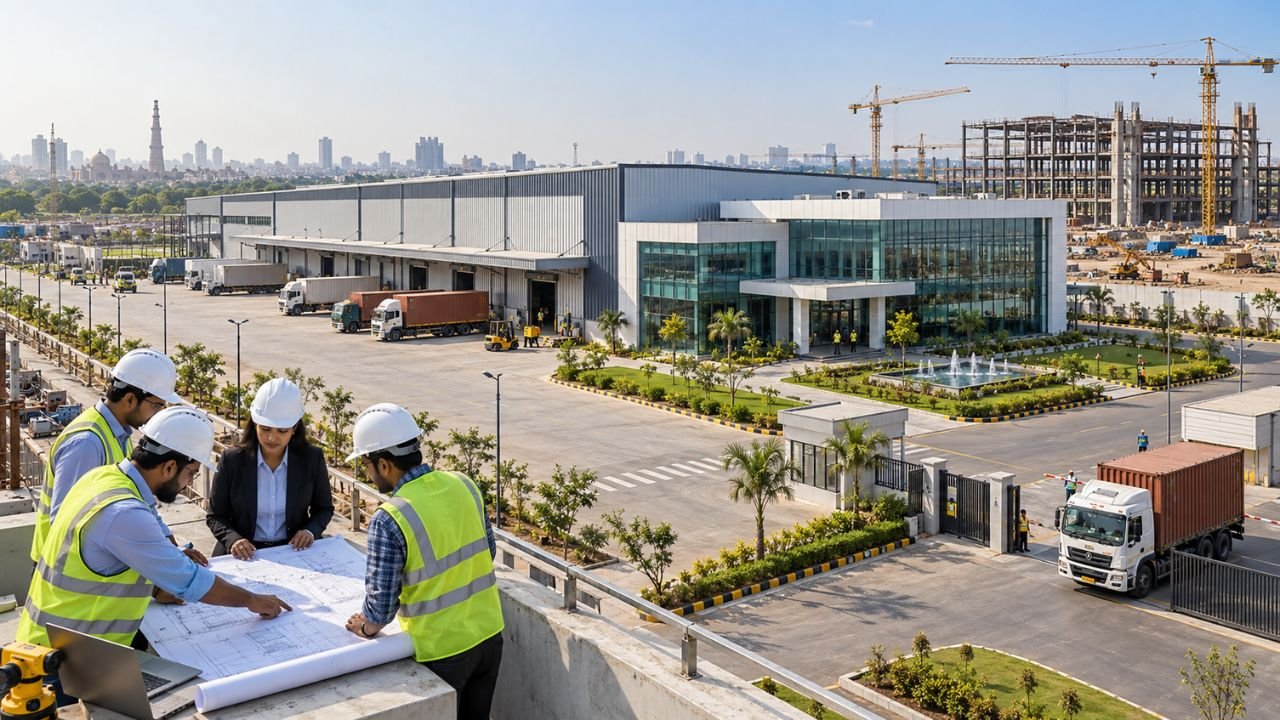
As a construction company owner in Meerut or Uttar Pradesh, you are managing multiple projects, hundreds of workers, expensive heavy equipment, and shifting client expectations. In the bustling 2026 infrastructure boom across the Delhi-NCR region, the pressure to deliver on time and within budget is higher than ever. However, one major structural collapse, a severe worker injury, or a third-party liability claim can wipe out your annual profits or even force you to shut down operations permanently. That is why the question “what insurance do I need for construction company” is not just a checklist item; it is a critical pillar of your business survival strategy.
The Indian construction sector is inherently high-risk, facing threats from unpredictable monsoons, seismic tremors in Zone IV areas, and rising material thefts. To navigate these challenges, every construction company requires a strategic mix of mandatory and recommended policies. These safeguards ensure legal compliance with acts like the BOCW Act 1996, help secure bank loans from institutions like SBI or HDFC, and maintain your project’s financial liquidity. In this guide, we will break down the essential insurance needed for construction company in India 2026, including CAR, Workmen Compensation, and CGL policies, their typical costs, and how to include them in your Bill of Quantities (BOQ). Protecting your business today provides the peace of mind and competitive advantage you need to win larger tenders in an increasingly regulated market.
For a broader understanding of all available protections, read our complete guide on types of construction insurance in India.
Why Insurance is Non-Negotiable for Construction Companies?
Operating a construction business in India without adequate cover is a gamble with your corporate assets. First and foremost, insurance is a legal mandate. The Employees’ Compensation Act 1923 and the Building and Other Construction Workers (BOCW) Act require you to provide financial protection for your workforce. Failing to comply can lead to heavy penalties, project shutdowns, and even criminal liability for directors.
Beyond legalities, insurance is a prerequisite for growth. Most government and private tenders in 2026 require proof of comprehensive coverage before you can even bid. Banks and financial institutions also mandate “Builders Risk” or CAR policies to protect their collateral during the construction phase of any financed project. Furthermore, a robust insurance portfolio builds your reputation. It signals to clients that you are a professional, low-risk partner capable of handling unforeseen disasters like fires, floods, or structural defects without halting the project. In essence, insurance transfers catastrophic financial risks to a third party, ensuring that an accident remains a manageable incident rather than a bankruptcy-level event.
For insights into the advantages of proper coverage, explore benefits of insurance for construction projects in India.
Mandatory & Essential Insurance for Construction Companies
When determining what insurance do I need for construction company operations, you must start with the core policies that provide the broadest protection and satisfy legal requirements.
1. Contractors’ All Risk (CAR) Insurance
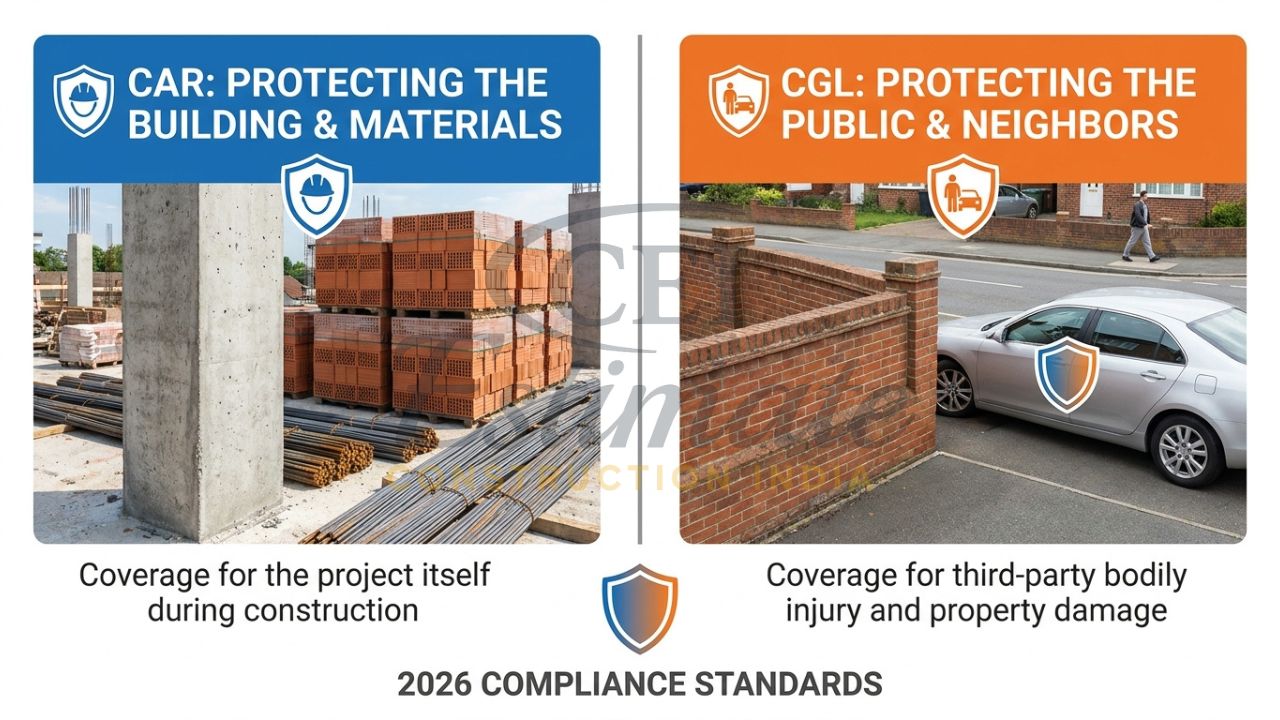
CAR insurance for construction company projects is widely considered the “gold standard” foundation. It is a comprehensive policy that covers physical damage to the permanent and temporary works, including materials stored on-site. Whether it is a fire at a villa project in Meerut or a flood damaging foundation work in Noida, CAR provides the funds to reinstate the project. Crucially, it usually includes a third-party liability section to cover bodily injury or property damage to outsiders occurring near your site.
For accurate costing of this essential policy, check our breakdown on how much does builders risk insurance cost in India.
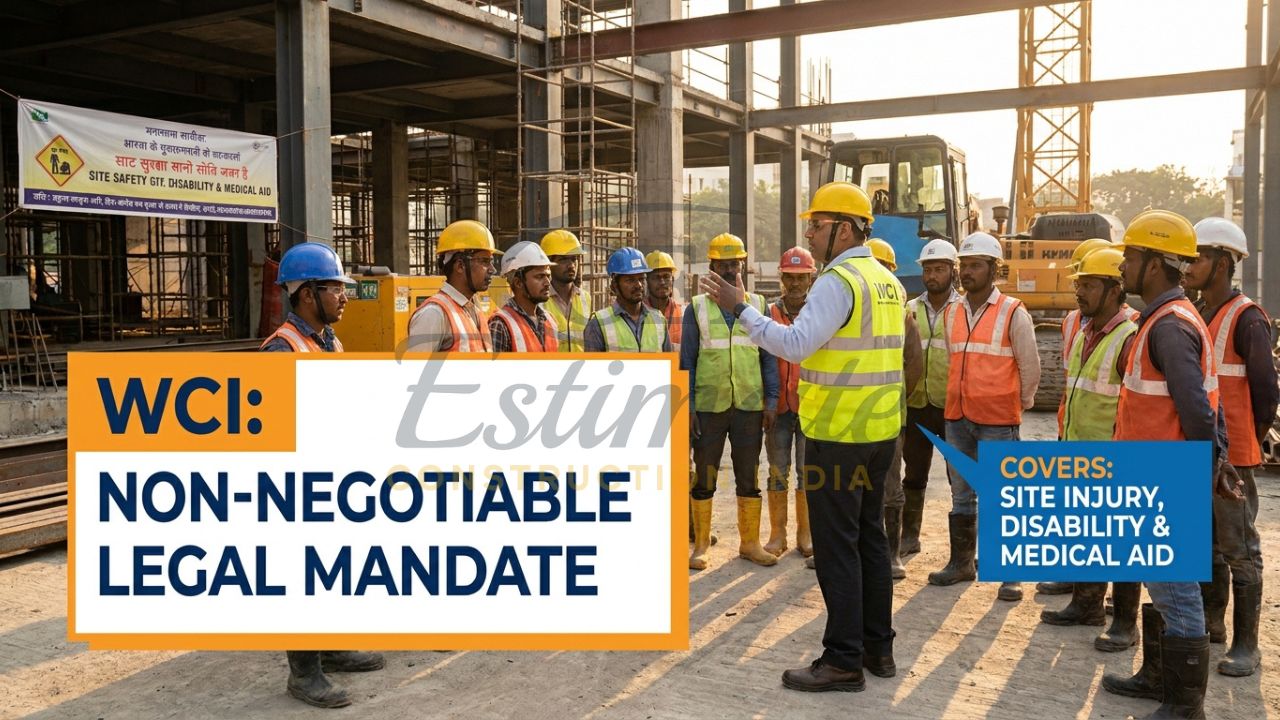
2. Workmen Compensation Insurance (WCI)
This is the most critical mandatory insurance for construction companies India. Under the Employees’ Compensation Act, you are legally responsible for the medical expenses and compensation of any worker who suffers an injury, disability, or death while on duty. WCI covers these legal liabilities, protecting your company from massive out-of-pocket settlements and legal battles in labor courts.
To understand statutory obligations in detail, refer to our guide on workers comp requirements for construction businesses in India.
3. Commercial General Liability (CGL) / Third-Party Liability
While CAR covers basic third-party risks, CGL insurance for contractors offers much broader protection. It covers public liability claims, such as a falling brick damaging a neighbor’s luxury vehicle or a visitor tripping over debris. Many large-scale commercial developers in 2026 mandate CGL with high limits to ensure that any litigation does not halt the project’s progress.
Highly Recommended Insurance Policies
To truly build a resilient business, you should look beyond the basics and consider specialized covers based on your specific project types and equipment fleet.
- Contractors Plant & Machinery (CPM) Insurance: Your excavators, cranes, and concrete mixers are high-value assets. CPM insurance protects these against accidental damage, theft, and mechanical breakdown, whether they are working on-site or in transit.
- Erection All Risk (EAR) Insurance: If your company specializes in installing machinery, HVAC systems, or industrial plants, EAR is more suitable than CAR. It focuses on the mechanical and electrical risks during the installation and testing phases.
- Professional Indemnity (PI) for Construction Firms: Essential for companies offering design-build services. It protects against claims of professional negligence or errors in architectural and structural design.
- Directors & Officers (D&O) Liability: Protects the personal assets of your company’s leadership from legal claims arising from management decisions or corporate governance failures.
- Advance Loss of Profits (ALOP): Also known as Delay in Start-up (DSU) insurance, this covers lost revenue if a project is delayed due to an insured physical event like a fire.
- Marine/Inland Transit: Covers premium materials—like imported marble or high-end tiles—while they are being transported from the supplier to your site in Uttar Pradesh.
For commercial and large-scale projects, specific compliance is crucial. Read our guide on commercial construction insurance requirements in India. For growing or smaller firms, explore tailored solutions in our article on best insurance for small construction business in India. When coordinating with external teams, proper documentation is key. Learn more in our guide on how to get insurance for subcontractors in India.
Comparison – What Insurance Do Different Construction Companies Need?
The insurance needed for construction company in India 2026 varies significantly based on your scale of operations. A solo independent contractor has different needs compared to a multi-state infrastructure firm.
| Company Scale | Essential Policies | Recommended Add-ons | Priority Level |
|---|---|---|---|
| Independent/Small | CAR, WCI | Personal Accident, CPM | High |
| Mid-Size (Tier-2) | CAR, WCI, CGL | CPM, Transit Insurance | Very High |
| Large/Infrastructure | CAR, WCI, CGL, EAR | PI, D&O, ALOP, Cyber | Mandatory |
Note: For all scales, ensure the sum insured is based on the 2026 reinstatement value (rebuilding cost) rather than historical costs.
How Much Will These Insurance Policies Cost?
Budgeting for insurance is vital for maintaining your profit margins. In 2026, the cost of insurance for a construction company is influenced by project location (e.g., higher in seismic Zone IV/V), duration, and safety track records.
- CAR Insurance: Typically ranges from 0.5% to 1.5% of the total project value.
- Workmen Compensation: Generally costs 0.5% to 2% of your total wage bill.
- CPM Insurance: Usually 1.0% to 2.5% of the asset’s current market value.
Table: Estimated Insurance Premiums for 2026 Projects
| Project Type | Project Value | Estimated Total Premium | Insurance cost in BOQ |
|---|---|---|---|
| Residential Villa | ₹1 Crore | ₹60,000 – ₹1,20,000 | 1.0% – 1.2% |
| Mid-Rise Apartment | ₹10 Crore | ₹6,00,000 – ₹12,00,000 | 0.8% – 1.5% |
| Infrastructure/Roads | ₹50 Crore | ₹35,00,000 – ₹75,00,000 | 0.7% – 1.8% |
Tip: Always include insurance as a distinct line item in your Bill of Quantities (BOQ) under “Preliminaries” to avoid absorbing these costs into your profit.
Step-by-Step Guide – How to Choose Insurance for Construction Business
Navigating the insurance market in 2026 requires a structured approach to ensure no “gaps” exist in your coverage.
- Assess Risks: Evaluate your current projects, labor count, and equipment fleet to identify primary threats like monsoon floods or theft.
- Define Reinstatement Values: Use current 2026 labor and material rates for your sum insured. Never under-insure to save on premiums.
- Consult Brokers/Insurers: Obtain quotes from reputable Indian providers like ICICI Lombard, HDFC Ergo, New India Assurance, or Bajaj Allianz.
- Compare and Customize: Look for the “Claim Settlement Ratio” and add critical riders like “Debris Removal” or “Escalation Clauses”.
- Review Subcontractors: Ensure your policy covers subcontractors or mandate that they carry their own WCI and liability covers.
- Annual Audit: Review your covers yearly as your project portfolio and fleet size grow.
Common Mistakes to Avoid When Buying Insurance
Many Indian construction firms fall into traps that lead to claim rejections. Avoid these common errors:
- Under-insuring: If you insure a ₹10 crore project for only ₹7 crore, the “Condition of Average” applies, and the insurer will only pay a fraction of any claim.
- Ignoring Add-ons: Standard policies often exclude debris removal, architect fees, and surrounding property damage unless you specifically add them.
- Relying Only on CAR: CAR does not cover mechanical breakdowns of heavy machinery or management errors; you need CPM and PI/D&O for those.
- Skipping Maintenance Period Cover: Structural defects often appear after construction ends. Ensure your policy includes a 12-month maintenance/testing period.
Conclusion
Determining what insurance do I need for construction company operations is the hallmark of a professional builder in 2026. From mandatory Workmen Compensation that protects your people to CAR insurance that shields your physical works, these policies form the invisible foundation of your company’s growth. In the competitive landscape of Uttar Pradesh and the Delhi-NCR, comprehensive risk management is not just about safety—it is your greatest competitive advantage.
Don’t let a single unforeseen accident derail your corporate vision. Determine exactly what insurance you need for your construction company today and contact Construction Estimator India for professional BOQ and cost estimation services that accurately factor in all insurance premiums.
FAQ Section
What insurance do I need for my construction company in India?
At a minimum, you need Contractors’ All Risk (CAR), Workmen Compensation Insurance (WCI), and Commercial General Liability (CGL). Larger firms should also consider CPM, EAR, and Professional Indemnity.
Is CAR insurance mandatory for construction companies?
While not always a legal requirement for private builds, it is almost always mandatory for bank-financed projects, government tenders, and RERA-registered developments.
What is the difference between CAR and CGL insurance?
CAR covers physical damage to the construction project itself, whereas CGL focuses on legal liabilities arising from injury or property damage caused to third parties (outsiders).
Is Workmen Compensation Insurance required by law?
Yes, it is legally mandatory under the Employees’ Compensation Act 1923 and the BOCW Act for any employer hiring construction labor in India.
How much does insurance cost for a construction company?
In 2026, total insurance costs typically range from 1% to 2.5% of the project value. CAR premiums alone are usually 0.5%–1.5%.
Do small construction companies need the same policies as large ones?
The core needs (CAR, WCI) are the same, but larger companies require higher liability limits and specialized covers like D&O or Professional Indemnity.
Should I buy Professional Indemnity insurance?
Yes, if your company provides design, engineering, or project supervision services. It protects you against claims of design errors or professional negligence.
How do I include insurance costs in my BOQ?
List insurance as a specific line item under “Preliminaries” or “Project Overheads.” Calculate it as a percentage of the total project value based on current market quotes.
Can one policy cover everything for my construction business?
No. While CAR is broad, you need separate policies for worker compensation (WCI) and heavy machinery (CPM) to ensure full protection across all risk categories.
Which insurers are best for construction companies in India?
Top-rated providers in 2026 include ICICI Lombard, HDFC Ergo, New India Assurance, and Bajaj Allianz, known for their project-specific covers and claim settlement ratios.
Other Guide Suggestions: