A west facing house plan is often a subject of much debate among Indian homeowners, frequently surrounded by myths regarding its auspiciousness or concerns about the intense afternoon heat. In simple terms, a west facing house is one where the main entrance or the primary side of the plot faces the west direction, meaning you face west when exiting your home onto the road. While some believe these plots are less desirable than north or east facing ones, mastering how to plan home construction in India can transform a west facing plot into a stunning, ventilated, and comfortable residence.
👉 Planning a West-Facing House? Get Expert Guidance for Design, Vastu, and Construction.
By strategically managing window openings, incorporating effective shading, and placing rooms with care, you can harness the evening light without the associated heat gain. Construction Estimator India specializes in helping homeowners navigate these complexities by providing realistic cost estimations and material quantities for various plot orientations. If you are currently planning your dream home and want to understand the potential budget before finalizing your west facing house plan, feel free to contact Construction Estimator India on WhatsApp or Call at +91 8630676890 for professional guidance.
Understand West Facing Plots and Orientation
What Does “West Facing House” Actually Mean?
To correctly identify a west facing house plan, one must look at the orientation of the property in relation to the access road and the main entrance. Many homeowners mistakenly believe that the direction the house faces from the inside defines its orientation, but in the professional design world, we look at the primary frontage. If your plot has its main road on the western boundary and your front door opens toward that road, you are dealing with a west facing orientation. This direction is significant because it dictates how the sun will interact with your living spaces throughout the day. In the Indian context, the sun rises in the east and moves across the southern sky, eventually setting in the west. This means that the front of your house will receive the most direct and intense sunlight during the afternoon and early evening hours, which is a critical factor to consider during the initial layout phase.
Understanding orientation is the first step toward creating a functional home that responds to the local climate. For many buyers, the road position is fixed, and they must adapt their floor plan to suit this reality. It is a common misconception that west facing homes are inherently flawed; in fact, many of the most iconic modern residences in India utilize this orientation to create dramatic sunset views and unique façade designs. The key is to recognize that the west side of your home will be your public face and your primary source of late-day light. By acknowledging this from the start, you can work with experts like Construction Estimator India to ensure that your design choices align with your functional needs and your construction budget, avoiding costly modifications later in the project.
Sunlight, Heat, and Comfort in West Facing Homes
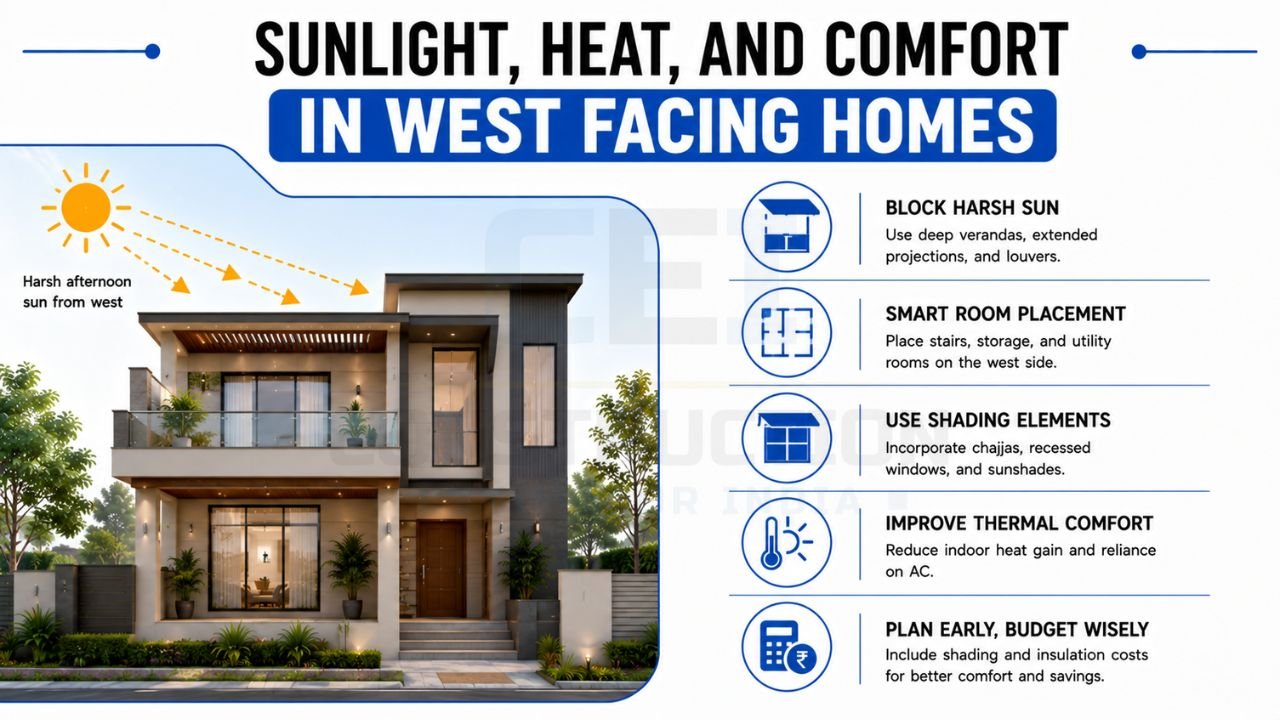
The primary challenge of a west facing house plan in the tropical Indian climate is the management of the harsh afternoon sun. Unlike the gentle morning light from the east, the western sun hits at a lower angle during the hottest part of the day, which can cause significant glare and a sharp rise in indoor temperatures. Incorporating building strategies endorsed by the Indian Green Building Council (IGBC) can drastically improve this thermal performance.
Strategic design elements such as deep verandas, extended roof projections, and the use of vertical louvers can effectively block the most intense solar radiation while still allowing for natural illumination. By placing less-frequented areas like staircases or storage rooms on the western side, you create a thermal buffer that protects the primary living areas from direct heat. Furthermore, recessed windows and the inclusion of “chajjas” or sunshades can significantly reduce the internal heat gain. Planning these features early is essential for accurate budgeting, as specialized shading systems or thicker wall insulation can impact the overall cost. Homeowners are encouraged to consult with Construction Estimator India to compare different shading strategies and their associated costs, ensuring a cool and comfortable home within a realistic financial framework.
West Facing House in Simple Vastu Terms (Non-technical)
In the realm of traditional Indian planning, a west facing house plan is often viewed through the lens of Vastu Shastra, which many families prioritize for peace of mind. While there is a common myth that west facing homes are less favorable, many Vastu experts clarify that any direction can be highly auspicious if the internal arrangement is correct. For a west facing plot, the focus usually shifts toward the specific placement of the main entrance within the western frontage to ensure it aligns with positive energy zones. The goal is to create a sense of balance and harmony, ensuring that the flow of energy within the house supports the well-being of the inhabitants.
Practical Vastu for a west facing home often involves placing the master bedroom in the south-west to provide stability and the kitchen in the south-east or north-west to manage the fire element effectively. These guidelines often overlap with good architectural practices, such as keeping the south-west corner heavier and more solid, which incidentally helps in blocking the intense western and southern heat. When you are planning these zones, it is important to remember that Vastu adjustments can sometimes influence the complexity of the plumbing or structural design involving specific foundation types for house construction in India.
👉 Turn Your West-Facing House Plan into a Beautiful and Well-Planned Home.
Study Plot Size, Shape, and Basic Regulations
Common Plot Sizes and Frontages for West Facing Houses
The dimensions of your plot significantly influence how a west facing house plan is developed, particularly regarding the width of the frontage available for the main entrance and parking. In many urban Indian settings, plots are often narrow and deep, which means the western façade might be limited in size, requiring a more vertical approach to design.
A wider frontage allows for more creative freedom with the main gate, a larger front garden, and multiple windows that can be shaded with architectural fins or balconies. If you are unsure how your specific plot size will accommodate your desired room requirements, establishing a baseline house construction per sq ft rate helps frame your possibilities.
Setbacks, Road Width, and Parking Constraints
Municipal regulations and local building codes play a vital role in determining the final footprint of any west facing house plan, usually adhering to guidelines set by the Town and Country Planning Organisation (TCPO).
-
Setbacks: These rules dictate the mandatory “setbacks,” which are the empty spaces you must leave between your building and the plot boundaries. In a west facing scenario, the front setback is usually the most important, as it provides the space for your parking and front landscaping that helps shade the house.
-
Road Width: The width of the road in front of your plot influences how much space you might need to leave for easy vehicular entry and exit.
-
Drainage: You must consider the slope of the driveway for proper drainage during monsoons and ensure that the parking area does not block the main pedestrian path.
How Plot Shape Influences West Facing House Layout?
Not every residential plot in India is a perfect rectangle, and irregular shapes present both challenges and opportunities for a west facing house plan. An L-shaped or trapezoidal plot might require a more customized architectural response to ensure that the main rooms still receive good light and ventilation while respecting the property lines. For instance, an irregular plot might allow for a private courtyard on the side or rear, which can act as a light well, bringing brightness into the center of the house and reducing the need for large windows on the hot western façade.
The shape of the plot also dictates the “flow” of the house. In a rectangular plot, the layout is often linear, with rooms following a specific sequence from the front to the back. In more complex shapes, top architects and architecture firms might use the corners for utility areas or specialized niches like a prayer room or a home office.
Entrance, Parking, and Frontage Planning
Main Gate and Entry Path for West Facing Plots
The main gate is the first point of interaction with your west facing house plan and serves as a significant design statement. For a west facing property, the gate should be positioned to allow for a smooth transition from the road to the porch while considering local security and privacy needs. A well-designed entry path should be clear and well-lit, guiding guests toward the main door without making them walk through the parking area if possible. Using materials like anti-skid tiles or natural stone for the walkway ensures safety during the rainy season and adds a touch of elegance to the frontage.
Beyond aesthetics, the entry path must be planned with drainage in mind. The height of the plinth—the base of the house—should be carefully calculated in relation to the road level to avoid flooding, aligning with standards defined by the Central Public Works Department (CPWD).
Parking and Porch in a West Facing House Plan
In a west facing house plan, the porch or car parking area can serve a dual purpose: providing shelter for vehicles and acting as a massive sunshade for the main body of the house. By extending the porch slab, you create a buffer zone that prevents the afternoon sun from hitting the front wall of the living room directly. Understanding what is RCC construction allows you to leverage these concrete slabs for structural shading.
The design of the porch also impacts the internal layout, as it often dictates where the main door will be located. Some homeowners prefer a “stilt” parking arrangement where the entire ground floor is dedicated to vehicles and utilities, which is common in congested urban areas. This approach keeps the living spaces on higher floors, providing better views and ventilation away from the street level. Whatever your preference, the structure of the porch and the choice of flooring materials will influence your costs. Construction Estimator India can help you compare different parking configurations and estimate the concrete, steel, and finishing materials required for each option.
Front Landscape, Steps, and Shading Elements
Landscaping is a powerful tool for enhancing a west facing house plan and managing its microclimate. Tall, leafy trees or a vertical garden on the western boundary can act as a natural screen, filtering the harsh sunlight before it reaches the building. Even on smaller plots, using large potted plants or creepers on a trellis can provide significant cooling effects. The front steps leading to the main door should be designed to be wide and comfortable, perhaps incorporating integrated planters to soften the look of the concrete structure.
Architectural shading elements like “jaalis” (perforated screens) or horizontal fins are also highly effective for west facing façades. These elements create beautiful patterns of light and shadow inside the house while blocking the majority of the heat. They also add a contemporary look to the house, making it stand out in the neighborhood. When planning these decorative and functional features, it is important to consider their maintenance and initial cost. For a realistic view of how these design choices will affect your overall investment, you can reach out to Construction Estimator India for a comprehensive cost breakdown and planning support.
Planning Key Rooms in a West Facing House
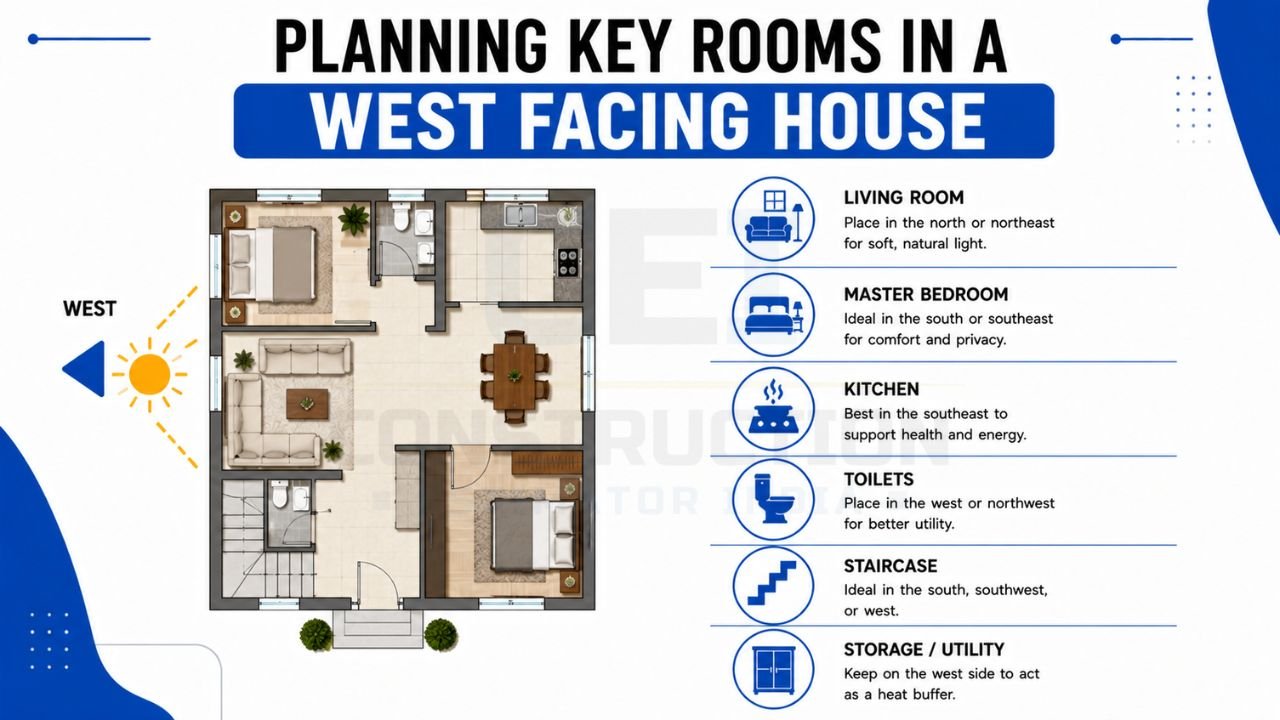
Living Room and Dining Placement
The living room is often the heart of the home, and in a west facing house plan, its placement requires careful thought to ensure it remains a comfortable space for the family to gather. If the living room is placed right at the front, it will have the advantage of being easily accessible from the entrance but the disadvantage of potential heat gain. To counter this, architects often use large overhangs or balconies on the floor above to shade the living room windows. Another popular strategy is to place the dining area in a more central, protected part of the house, perhaps near a small internal courtyard, which stays cool throughout the day.
A well-planned living and dining area should feel connected yet distinct. In many modern Indian homes, an open-plan layout is preferred to create a sense of spaciousness. However, in a west facing home, you might want to use partition walls or large sliding doors to control airflow and light at different times of the day. The orientation of the furniture also matters; you wouldn’t want the television to be placed where the afternoon sun creates a heavy glare. Before finalizing your room sizes and positions, it is highly recommended to contact Construction Estimator India on WhatsApp or Call +91 8630676890 to discuss how your layout choices will impact the total built-up area and your construction budget.
👉 Build a West-Facing Home That Combines Smart Design with Vastu Principles.
Kitchen Placement in a West Facing Plan
For a west facing house plan, the kitchen is traditionally placed in either the south-east or the north-west corner. The south-east placement is often preferred for Vastu reasons as it represents the direction of fire, while the north-west is considered a good alternative that offers excellent ventilation. Practically speaking, the kitchen needs to be located where it can have easy access to a utility area for washing and dry storage. Proper ventilation is non-negotiable for an Indian kitchen, given the heavy use of spices and oil, so having at least one window that opens to an airy side of the plot is essential.
The service routing for the kitchen, including gas pipelines and plumbing, should be planned to be as efficient as possible. Placing the kitchen near the dining area makes serving meals easier, but it should also be tucked away enough to provide some privacy from the main entrance. The choice of kitchen platform materials, cabinetry, and tiling can vary widely in price. By working with Construction Estimator India, you can get a clear picture of the material quantities needed for your kitchen and service areas, helping you balance your aesthetic desires with your financial reality.
Bedroom Placement (Master, Children, Guest)
In any west facing house plan, the placement of bedrooms is perhaps the most critical decision for long-term comfort. The master bedroom is frequently placed in the south-west corner of the house, which is not only considered stable and private but also allows for the construction of thicker walls that can absorb and slowly release the day’s heat. Children’s bedrooms are often best placed in the west or north-west, provided they have adequate shading, while guest bedrooms can be situated in the north or east to take advantage of the cooler morning light.
Privacy and quiet are the top priorities for bedrooms, so they should ideally be located away from the main road noise of the western frontage. If a bedroom must face the west, using double-glazed windows or heavy thermal curtains can help maintain a pleasant temperature. Balconies attached to bedrooms can also act as shading devices for the rooms below. Because bedrooms often involve specific flooring choices and attached wardrobes, the costs can add up quickly. Construction Estimator India provides detailed estimations for bedroom finishes and built-in features, ensuring you have a complete understanding of the costs before you begin construction.
Stairs, Toilets, and Service Areas
Staircase Position in a West Facing Layout
The staircase is a significant structural element that can also serve as a functional buffer in a west facing house plan. By placing the staircase on the western side of the building, you create a large mass of concrete and masonry that protects the internal living spaces from the afternoon sun. Furthermore, a staircase with a large window at the mid-landing can act as a “wind tower,” encouraging hot air to rise and escape through the top, which significantly improves the overall ventilation of the house.
The design of the staircase also affects the “curb appeal” and the internal circulation. Whether you choose a modern floating staircase, a traditional U-shaped one, or an external staircase for a multi-family rental setup, the location will dictate how you move through the house. An internal staircase can be a beautiful focal point in the living room, while an external one provides more privacy for the upper floors. Each design has different structural requirements and costs. Construction Estimator India can assist you in calculating the steel and concrete quantities for various staircase designs, helping you choose an option that fits both your aesthetic and your budget.
Toilet and Bathroom Placement
Planning the toilets and bathrooms in a west facing house plan involves a careful balance of privacy, plumbing efficiency, and ventilation. Ideally, bathrooms should be stacked vertically if you have multiple floors to minimize the length of plumbing pipes and reduce costs. They are often placed on the sides of the house, away from the main western frontage, to ensure that ventilation windows can open into the side setbacks. This prevents any unsightly plumbing pipes from being visible on the main façade of the house.
From a practical perspective, bathrooms should be easily accessible from the bedrooms but discreetly placed so they are not directly visible from the living or dining areas.
High-quality waterproof treatments are essential for these areas to prevent future leakages. Learning how to use white cement for waterproofing in India is useful for minor fixes, but major execution requires robust chemical barriers.
Utility, Store, and Service Areas
Often overlooked, the utility and service areas are the “engine room” of a functional west facing house plan. The utility area, typically located next to the kitchen, provides space for the washing machine, heavy scrubbing, and drying of clothes. In a west facing home, placing these service areas on the west or south side can be beneficial as the sun helps in drying clothes and keeping the area free from dampness. A small store room or pantry near the kitchen is also a must-have for organizing household supplies and reducing clutter in the main living spaces.
Proper planning of service entries—where the milkman or garbage collector might come—is also important for a smooth daily routine. These areas should be functional and easy to clean, often using durable materials like kota stone or rough tiles. While they might seem minor, the cost of finishing these spaces and installing the necessary plumbing and electrical points can be surprising. To ensure your budget accounts for every square foot of your home, including these essential service zones, you should consult with Construction Estimator India for a detailed and realistic cost estimation.
Managing Heat, Light, and Ventilation
Shading, Projections, and Window Design for West Sun
Effective heat management in a west facing house plan starts with the design of the “skin” of the building. Windows on the west side should ideally be smaller or protected by deep overhangs and vertical fins. Vertical shading is particularly effective for the western sun because the sun is lower in the sky during the afternoon. Architects often use “box” windows or recessed openings that create their own shadows, significantly reducing the amount of direct sunlight that enters the room.
The choice of window frames and glass also plays a major role. Using UPVC or aluminum frames with thermal breaks can prevent heat transfer, while tinted or reflective glass can block a significant portion of solar radiation. For those looking for a more traditional look, wooden louvers or bamboo screens can provide excellent shading while allowing for air movement. These specialized treatments can impact your initial investment, so it is important to contact Construction Estimator India to understand the cost-benefit ratio of different window designs and shading materials before making a final decision.
Cross Ventilation and Room Depth
Ventilation is the natural antidote to the heat issues sometimes associated with a west facing house plan. For a house to remain cool, air must be able to flow freely from one side to the other. This is known as cross ventilation. In your floor plan, this means ensuring that every room has openings on at least two different walls, or that there is a clear path for air to move from the front of the house to the back. A central courtyard or a skylight can act as a powerful ventilation tool, pulling cool air from the ground level and venting hot air out through the roof.
The depth of your rooms also affects how well they stay cool. Very deep rooms with only one window can become stuffy and dark in the center. By keeping the rooms relatively shallow or using internal “jaalis” and open doorways, you can ensure that every corner of the home feels fresh. Planning for these airflow paths during the layout stage is much easier than trying to fix a stuffy house later. Construction Estimator India can support your self-construction planning by helping you visualize how different room depths and partitions will affect your material needs and total cost.
Material and Color Choices That Help With Heat
The materials you choose for your west facing house plan have a direct impact on its thermal performance. For the exterior finish, lighter colors are far superior to dark ones as they reflect more sunlight. Many modern homeowners are also opting for “cool roof” tiles or specialized thermal coatings for the terrace to prevent the top floor from becoming an oven. You must monitor your localized plaster cost per square foot with material in India to ensure exterior insulative finishes remain within budget.
Simple Vastu-Friendly Approach for West Facing Homes
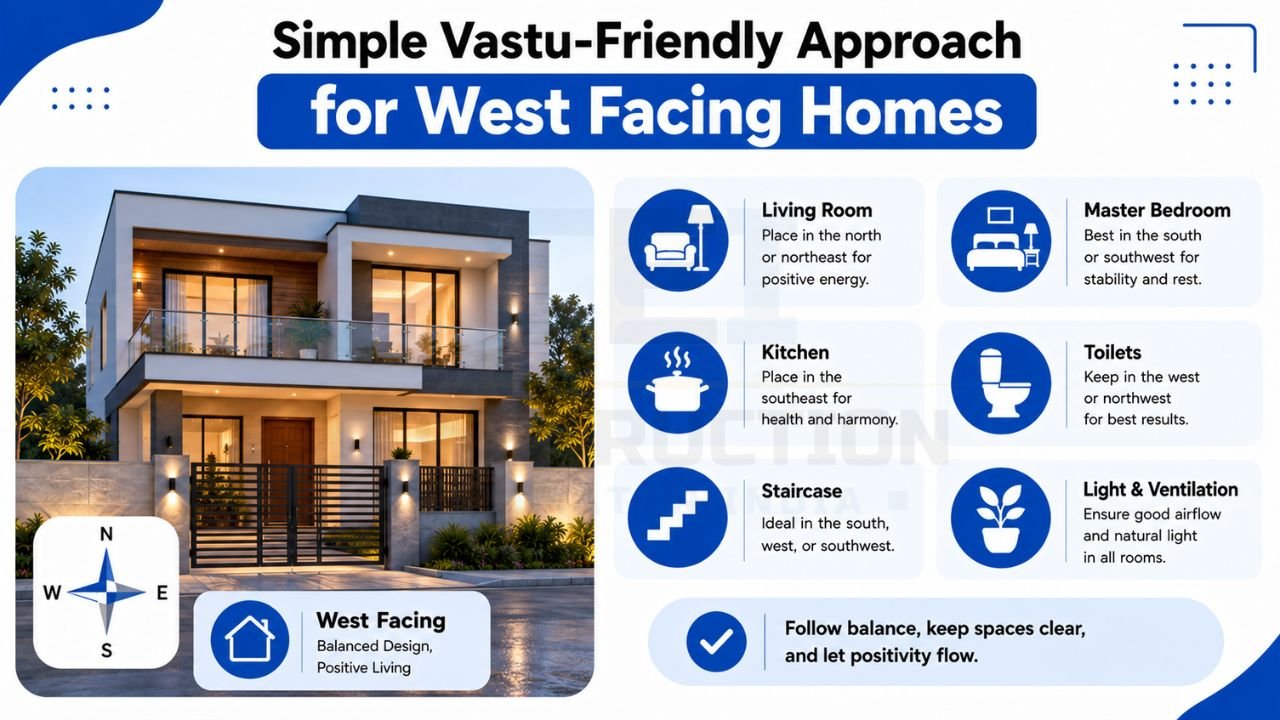
👉 Get Customized West-Facing House Plans and Accurate Cost Estimates from Industry Experts.
Basic Vastu Ideas Without Overcomplication
Adopting a Vastu-friendly approach for your west facing house plan does not have to be complicated or restrictive. The most important thing is to focus on a few key principles that promote balance and a positive environment. For a west facing plot, the main entrance is often recommended to be in the 3rd, 4th, or 5th “pada” (sections) of the western side, which are considered the most auspicious. This simply means avoiding the extreme corners and keeping the entry more toward the center-right or center-left depending on the specific grid.
Another simple principle is the “weight” distribution. Vastu suggests that the south and west portions of the house should be slightly higher and heavier than the north and east portions. Architecturally, this translates to placing your master bedroom or a storage room on the upper floor in the south-west, which is also practical for sun protection. These simple adjustments can give you the best of both worlds: a home that feels traditionally correct and architecturally sound. If you are worried about how Vastu will affect your plan, Construction Estimator India can help you estimate the cost of different layout scenarios, ensuring your peace of mind doesn’t come with an unexpected price tag.
Balancing Vastu with Practical Design and Budget
The key to a successful west facing house plan is finding the “sweet spot” where Vastu, modern design, and your budget all meet. It is important to prioritize what matters most to your family—whether it is a large kitchen, a grand entrance, or strict adherence to a specific orientation. Engaging certified building contractors ensures these specific layouts are executed accurately on the ground according to Bureau of Indian Standards (BIS) safety codes.
When to Talk to Architect/Estimator About Vastu Adjustments
The best time to address Vastu and cost concerns for your west facing house plan is during the very first phase of conceptual design. Once the foundation is laid or the structural columns are placed, making changes becomes extremely difficult and expensive. If you have specific Vastu preferences, share them with your architect and your estimator before any detailed drawings are finalized. This allows them to incorporate these ideas into the core structure of the house, ensuring a seamless and cost-effective build.
A proactive approach also prevents the need for “remedies” or corrections later, which can be visually unappealing and financially draining. By having a clear roadmap from the start, you can move through the construction process with confidence. Construction Estimator India is an invaluable partner during this early stage, providing the necessary quantity and cost data to help you and your architect refine the plan. For anyone planning their new home construction in India, a quick call to +91 8630676890 can provide the clarity needed to proceed with your west facing project successfully.
Cost Planning and Budgeting for a West Facing House
What Really Affects Cost (Orientation vs Size, Materials, Features)
It is a common misconception that a west facing house plan is naturally more expensive than others. In reality, the direction your house faces has a relatively small impact on the total cost compared to major factors like the total built-up area and the quality of finishes. The primary drivers of cost are always the “big three”: the amount of steel and concrete used in the structure, the type of flooring and woodwork you choose, and the luxury level of your kitchen and bathrooms. Orientation only subtly influences cost through specific requirements like extra shading elements or high-performance glass for the west-facing windows.
That being said, a well-planned west facing home might incorporate features like deeper balconies or vertical fins, which do add a small amount to the structural and finishing budget. However, these are often offset by the long-term savings in energy bills due to better natural cooling. To get a true sense of where your money is going, you need a detailed Bill of Quantities (BOQ). Construction Estimator India excels at breaking down these costs, showing you exactly how much you are spending on the west-facing façade versus the internal structures, allowing you to allocate your resources where they matter most.
Built-up Area vs Budget: Simple Thinking
The most effective way to control the cost of your west facing house plan is to be disciplined about your total built-up area. Every extra square foot you add to the plan—whether it is an oversized guest room or a massive foyer—multiplies the cost of everything from the foundation to the final coat of paint. In the Indian context, homeowners often feel pressured to build as much as the local laws allow, but this can lead to “dead spaces” that are expensive to build and maintain. A more compact, well-designed home is often much more comfortable and luxurious than a sprawling, poorly planned one.
When planning your budget, it is helpful to think in terms of “must-haves” versus “nice-to-haves.” You might prioritize high-quality waterproofing and thermal insulation over expensive Italian marble in every room. By making these trade-offs early, you can ensure that the core quality of your home is excellent without exceeding your financial capacity. Construction Estimator India can provide you with different cost scenarios based on varying built-up areas, helping you find the perfect size for your family and your wallet.
How Construction Estimator India Helps With Quantity and Cost Estimation?
Construction Estimator India provides a professional bridge between your architectural dreams and the practical reality of building a home. For a west facing house plan, they can offer precise quantity takeoffs that cover everything from the number of bricks required for a thick western wall to the exact amount of steel needed for an extended porch slab. This level of detail is crucial for avoiding the “budget creep” that plagues so many home construction projects in India, where final costs often end up 30-40% higher than the initial estimates.
By providing professional Bill of Quantities (BOQ) preparation, Construction Estimator India allows you to get accurate quotes from multiple contractors, ensuring you get the best value for your money. They also provide guidance on material selection and process workflows, which is particularly helpful for homeowners who are managing their own construction. Whether you are in the middle of planning your layout or just starting to look at plots, contacting Construction Estimator India on WhatsApp or Call +91 8630676890 will provide you with the professional support needed to build your west facing home with confidence and clarity.
Common Mistakes in West Facing House Plans
Ignoring Heat and Sun Control on the West Side
The single biggest mistake homeowners make with a west facing house plan is failing to account for the intensity of the afternoon sun. Many people fall in love with a modern look that features massive glass windows but forget that without proper shading, those windows will turn their living room into a greenhouse. Ignoring heat control leads to a home that is physically uncomfortable for several hours every day, regardless of how beautiful it looks. This mistake often results in a late-stage scramble to install expensive blinds or ugly external shades that ruin the original design of the house.
To avoid this, heat management must be baked into the design from day one. This includes thinking about the thickness of the western walls, the depth of the sunshades, and the possibility of using vertical greenery to block the sun. Planning for these features early also ensures they are included in your initial budget. Construction Estimator India can help you account for the costs of these critical shading elements, ensuring your west facing home is as cool as it is beautiful.
Over-Focusing on Direction and Ignoring Basic Comfort
Another common pitfall is becoming so obsessed with Vastu or the “perfect” direction that you ignore the basic principles of comfortable living. Sometimes, homeowners will insist on placing a room in a specific corner for Vastu reasons, even if it means the room will have no natural light or will be located right next to a noisy road. A house is, first and foremost, a place to live, and its design should prioritize the daily comfort and needs of your family.
A successful west facing house plan strikes a balance between tradition and practicality. It is important to remember that most Vastu principles were developed to ensure good light, air, and health, so they usually align with good architectural practices. However, if a rule seems to make your home less livable, it is worth discussing alternatives with your architect and an estimator. Construction Estimator India can help you weigh the cost and functional implications of different layout choices, helping you build a home that respects your beliefs while serving your family perfectly.
Poor Entrance and Parking Planning
In the rush to design the interior of a west facing house plan, many owners neglect the planning of the entrance and parking area. This leads to common issues like a driveway that is too steep for a car to climb without scraping its bottom, or a main gate that is so narrow it makes parking a daily struggle. Furthermore, if the entrance path is not clearly defined, guests may find themselves wandering through the parking area or around the back of the house to find the front door.
A well-planned frontage should be functional, secure, and inviting. This includes thinking about where you will store your generator or inverter, where the water meters will be placed, and how you will manage the security of the main gate. These external works are a significant part of your overall construction cost and should not be an afterthought. For a comprehensive look at the quantities and costs involved in creating a professional and functional entrance for your west facing home, you should reach out to Construction Estimator India for expert guidance.
👉 Start Your West-Facing House Project with Professional Planning and Cost Analysis.
FAQs: West Facing House Plan in India
Is a west facing house bad according to Vastu?
No, a west facing house plan is not inherently bad. Many Vastu experts believe that west facing homes can be very prosperous and successful, especially for business people and those in certain professions. The key is the internal arrangement, particularly the placement of the main entrance in the correct “pada” or division of the western side. By following a few simple guidelines for room placement, such as the master bedroom in the south-west, a west facing home can be a very positive and harmonious living environment.
How do I reduce the heat in a west facing house?
Reducing heat in a west facing house plan involves a combination of architectural and material choices. You can use deep balconies, vertical fins, and “chajjas” to shade your windows from the afternoon sun. Additionally, using lighter exterior colors, thermal insulation in the walls, and high-performance glass can significantly lower indoor temperatures. Natural cooling methods like cross ventilation and internal courtyards are also highly effective at keeping the air fresh and cool without constant air conditioning.
Can a small plot have a good west facing house plan?
Yes, small plots can accommodate excellent west facing plans with a bit of creative thinking. In a small space, every square inch counts, so architects often use verticality to their advantage. A narrow but tall house can have a stunning west-facing façade with recessed windows and a beautiful entry porch. By prioritizing multi-functional spaces and ensuring good light from the top through a skylight or a small internal shaft, a small west-facing home can feel surprisingly spacious and comfortable.
Is the cost of building a west facing house higher?
The cost of building a west facing house plan is generally the same as any other orientation. While you might spend a little more on specific shading elements like louvers or specialized glass to manage the heat, these costs are usually a very small percentage of the total construction budget. Most of your expenses will still be driven by the size of the house, the structural materials, and the quality of the finishes. Working with Construction Estimator India can help you manage these costs and find the most efficient ways to build a comfortable home.
When should I contact Construction Estimator India?
The ideal time to contact Construction Estimator India is before you finalize your house drawings. By bringing them in during the planning stage, you can get a realistic cost estimate and a Bill of Quantities (BOQ) that reflects your specific west facing house plan. This allows you to make informed decisions about your budget, material choices, and room sizes while you still have the flexibility to make changes. Whether you need help with quantity takeoff or cost planning, you can reach them on WhatsApp or Call at +91 8630676890 for expert support.
Conclusion: Design Your West Facing House for Comfort, Light, and Budget
In conclusion, a west facing house plan offers a unique opportunity to build a modern, stylish, and comfortable home in India, provided it is approached with a clear understanding of the sun’s path and local climate. By moving away from myths and focusing on practical design solutions—such as strategic shading, intelligent room placement, and efficient ventilation—you can create a residence that is bright during the day and cool in the evenings. Remember that the orientation of your plot is just the starting point; the real success of your home lies in the details of its layout and the quality of its construction.
Careful cost planning is equally essential for a stress-free building experience. Knowing your budget and understanding the material quantities involved will help you avoid the common pitfalls of self-construction and ensure that your project remains on track. Construction Estimator India is here to support you at every step of this journey, providing the professional estimation and planning services you need to turn your vision into a reality. Before you finalize your west facing house plan, take the first step toward a successful build by contacting Construction Estimator India on WhatsApp or Call +91 8630676890 for an accurate cost estimation and expert guidance.
The meta title for this guide is “West Facing House Plan Ideas and Practical Tips in India”. The meta description is “Discover essential tips for a west facing house plan in India, covering heat control, Vastu, layout, and cost estimation with Construction Estimator India.” The suggested SEO-friendly URL slug is west-facing-house-plan-india-tips. Alternative SEO titles include: “How to Design a Comfortable West Facing House in India”, “Vastu and Design Tips for West Facing Residential Plots”, and “Estimating Construction Costs for West Facing Indian Homes”. Suggested image alt texts are: “Modern west facing house plan with vertical shading in India”, “Architectural layout of a west facing residence in an Indian city”, and “Traditional west facing home entrance with Vastu friendly gate placement”.