To understand how to check quality of steel India, you must look beyond just the price tag. In 2026, the Indian construction market is flooded with various grades, and ensuring structural safety starts with verifying the ISI mark (IS 1786:2008) and ISO 9001:2015 certification. A direct answer to quality verification involves a multi-step process: inspect the surface for rust or cracks, verify embossed logos and grades (like Fe 500D), weigh samples against standard charts, and perform a manual bend test to check for ductility. Buying only from authorized, trustworthy suppliers is essential to avoid substandard materials. For complex projects, always insist on a manufacturer’s test certificate or use third-party laboratory testing to verify chemical and mechanical properties.
How to Check Quality of Steel India (Quick Answer)
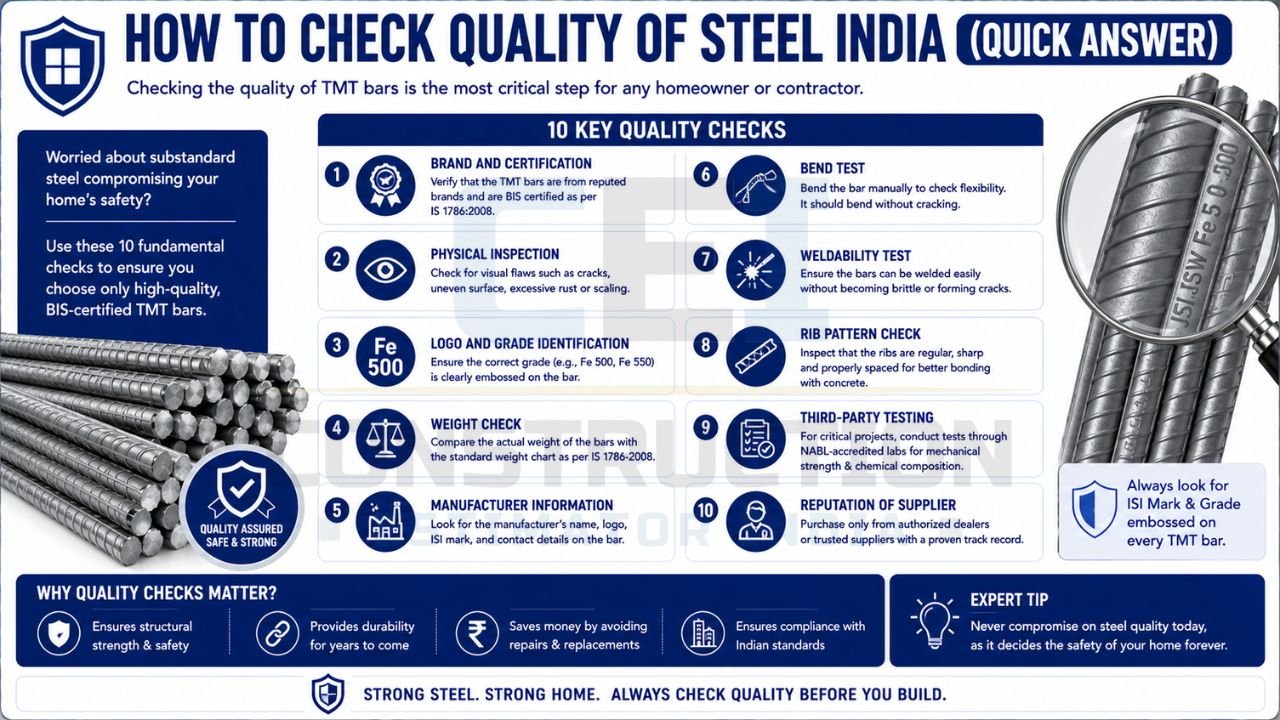
Checking the quality of TMT bars is the most critical step for any homeowner or contractor. If you are wondering how to check quality of steel India, here are the 10 fundamental checks you should perform:
10 Key Quality Checks
- Brand and Certification: Verify global and national standards.
- Physical Inspection: Check for visual flaws and rust.
- Logo and Grade Identification: Ensure the right grade is embossed.
- Weight Check: Compare actual weight with IS 1786-2008 charts.
- Manufacturer Information: Look for complete contact and brand details.
- Bend Test: Manually test for flexibility without cracking.
- Weldability Test: Ensure bars bond well without becoming brittle.
- Rib Pattern: Look for regular, sharp ribs for concrete bonding.
- Third-Party Testing: Use specialized labs for critical structural verification.
- Reputation of Supplier: Only buy from authorized dealers.
Check Certifications First
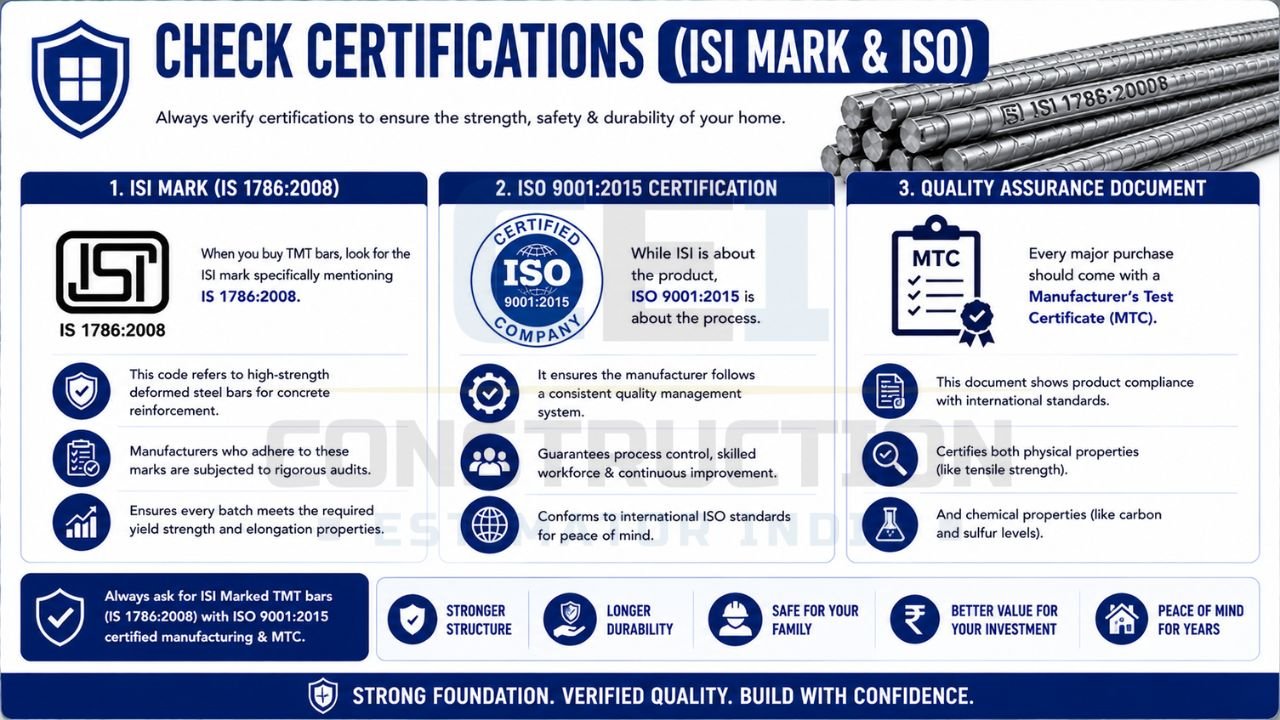
Before the steel even arrives at your site, verify the paperwork. While purchasing TMT bars, always check for certificates from organizations recognized by the Government of India. Specifically, look for the ISI mark (IS 1786:2008) and ISO 9001:2015 certification. These certifications act as a quality assurance document, proving the product complies with both physical and chemical international standards. Choosing reputable manufacturers that adhere to these established quality standards is non-negotiable for a long-lasting home.
Physical Surface Inspection
A quick visual examination can reveal a lot about the manufacturing quality. The bar should be clean and rust-free. A quality TMT bar must have a smooth and uniform surface without any cracks, dents, or deep pitting. A smooth surface is a sign of a refined TMT steel manufacturing process.
Bend Test (Most Important)
Ductility is what keeps a building standing during an earthquake. To test this, try to manually bend the bar. A high-quality TMT bar will flex without developing cracks. Brittle bars that crack or break during this test indicate poor quality and should be rejected immediately.
Check Certifications (ISI Mark & ISO)
The foundation of steel quality in India is the Bureau of Indian Standards (BIS).
ISI Mark (IS 1786:2008)
When you buy TMT bars, look for the ISI mark specifically mentioning IS 1786:2008. This code refers to high-strength deformed steel bars for concrete reinforcement. Manufacturers who adhere to these marks are subjected to rigorous audits, ensuring that every batch meets the required yield strength and elongation properties.
ISO 9001:2015 Certification
While ISI is about the product, ISO 9001:2015 is about the process. It ensures the manufacturer follows a consistent quality management system. Make sure the bars you select conform to these international ISO standards for peace of mind.
Quality Assurance Document
Every major purchase should come with a Manufacturer’s Test Certificate (MTC). This is a document that shows product compliance with international standards, certifying both physical properties (like tensile strength) and chemical properties (like carbon and sulfur levels).
Physical Surface Inspection
Visual Examination
Inspect the bars in broad daylight. Look at the physical surface closely. Any sign of “pockmarks” or scales indicates that the steel was either stored poorly or made from contaminated scrap.
Size and Length Check
Check that the diameter and length are consistent throughout the bundle. The actual diameter should match the specifications mentioned by the manufacturer (e.g., 8mm, 10mm, 12mm). Use a vernier caliper for precision if you are supervising a large project.
Logo and Grade Identification
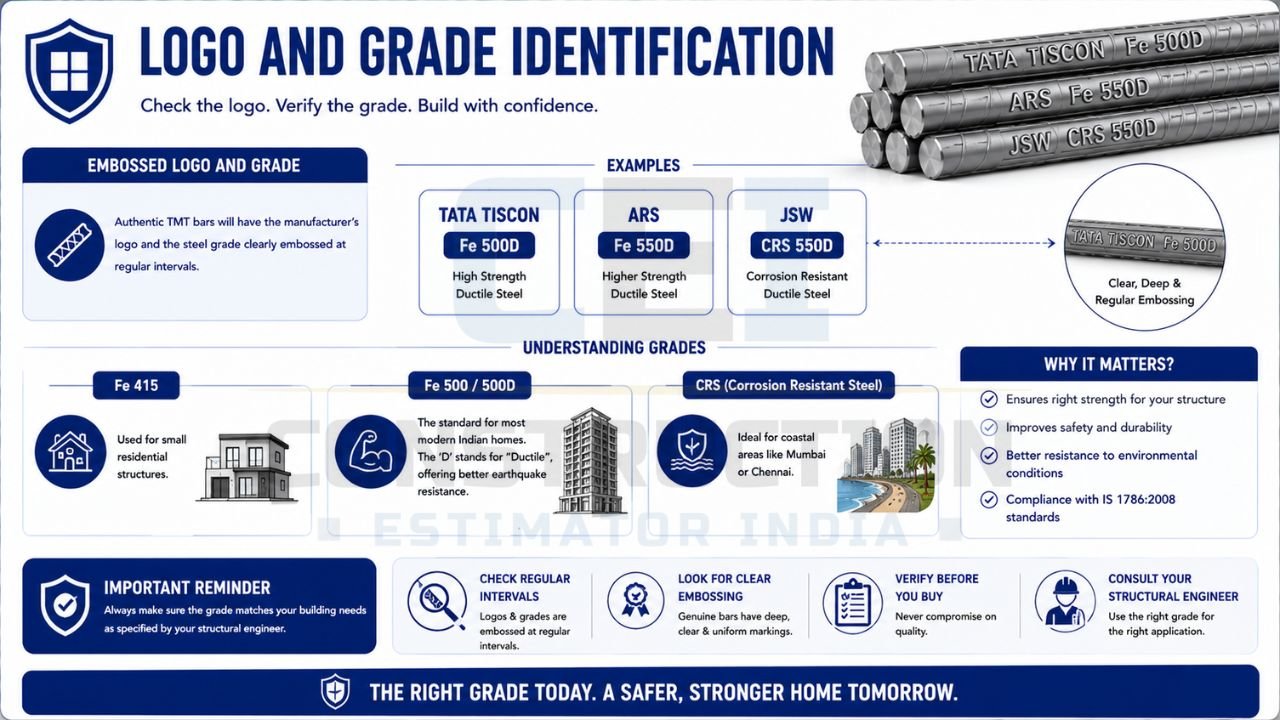
Embossed Logo and Grade
Authentic TMT bars will have the manufacturer’s logo and the steel grade clearly embossed at regular intervals. For example, you might see “TATA TISCON” or “ARS” alongside grades like Fe 500, Fe 550D, or CRS 550D.
Understanding Grades
- Fe 415: Used for small residential structures.
- Fe 500/500D: The standard for most modern Indian homes. The ‘D’ stands for “Ductile,” offering better earthquake resistance.
- CRS (Corrosion Resistant Steel): Ideal for coastal areas like Mumbai or Chennai.
Always make sure the grade matches your building needs as specified by your structural engineer. To learn more about selecting materials, check out our guide on what is TMT bar in construction.
Weight Check
Weight Verification
One of the most common ways “local” brands cheat is by reducing the weight of the bar while maintaining the outer diameter. It is absolutely necessary to weigh a sample bar and compare it with standard weight charts.
Standard Weight Formula
In India, the standard weight for a 1-meter TMT bar is calculated as D²/162, where D is the diameter in millimeters.
- 8mm: ~0.395 kg/m
- 12mm: ~0.888 kg/m
- 16mm: ~1.58 kg/m
Accurate weight shows good manufacturing and quality as per IS 1786-2008. Use a calibrated scale to ensure the weight reaches the manufacturer’s specifications. This is a key part of construction material estimation in India.
Manufacturer Information
Check Complete Details
Top-quality TMT bars will display clear and accurate details about the manufacturer, including their name and contact information. If the information is missing, incomplete, or blurry, it could mean you are looking at fake or low-quality bars. Ordinary or “secondary” bars often lack these identifiers to avoid accountability for structural failures.
Bend Test (Ductility Test)
Bend and Re-bend Test
The ductility of TMT bars—the ability to deform without breaking—is assessed using the bend and rebend test. In a formal lab setting, a sample bar is bent 180 degrees, then 135 degrees after being soaked in hot water.
On-Site Manual Test
On a construction site, you can perform a simpler version. Try to manually bend the bar; a high-quality TMT bar will flex easily without developing cracks. This test determines the material’s resistance level and soundness. If the bar snaps or shows even hairline cracks on the outer surface, it is brittle and dangerous for use in RCC (Reinforced Cement Concrete).
Weldability Test
Modern construction often requires welding steel bars together. If you plan to weld, perform a test on-site. Quality bars should weld easily without any issues and, most importantly, should not break or become brittle near the weld joint. High carbon content in poor-quality steel makes it difficult to weld and prone to snapping under stress.
Rib Pattern Check
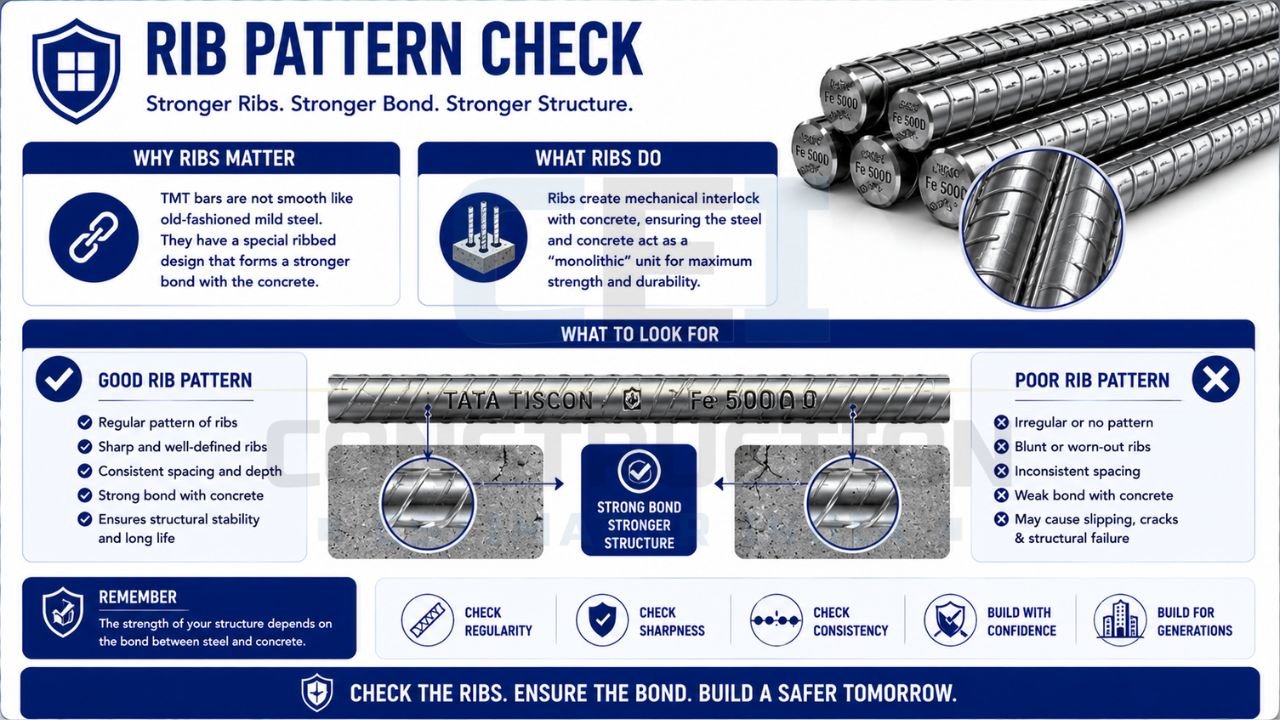
Why Ribs Matter
TMT bars are not smooth like old-fashioned mild steel. They have a special ribbed design that forms a stronger bond with the concrete.
What to Look For
Check for a regular pattern of ribs that are sharp and consistent. These ribs ensure that the steel and concrete act as a “monolithic” unit. If the ribs are blunt, worn down, or irregular, the steel may slip inside the concrete over time, leading to structural cracks.
Laboratory Tests (Professional)
For large-scale or critical projects, manual checks are not enough. You must involve a third-party steel testing laboratory in India.
Chemical Analysis Test
A chemical analysis test is essential to ascertain the exact content of carbon, sulfur, and phosphorus in the TMT bars. Excessive sulfur or phosphorus can make steel brittle and prone to “cold shortness” or “hot shortness.” Modern labs use Spectrometer Analysis, which uses light to analyze the chemical composition quickly and precisely.
Tensile Strength Test
Using a Universal Testing Machine (UTM), engineers determine the maximum force a bar can bear before breaking. This process helps determine the tensile strength, yield strength, and elasticity of the material.
Supplier Reputation
Always buy TMT bars from authorized and trustworthy suppliers to minimize the risk of receiving “seconds” or counterfeit products. A reputable supplier will provide all necessary documentation and allow for visual inspection before you make the final payment. This is a vital step in the house construction step by step process in India.
Steel Quality Check On-Site vs Before Buying
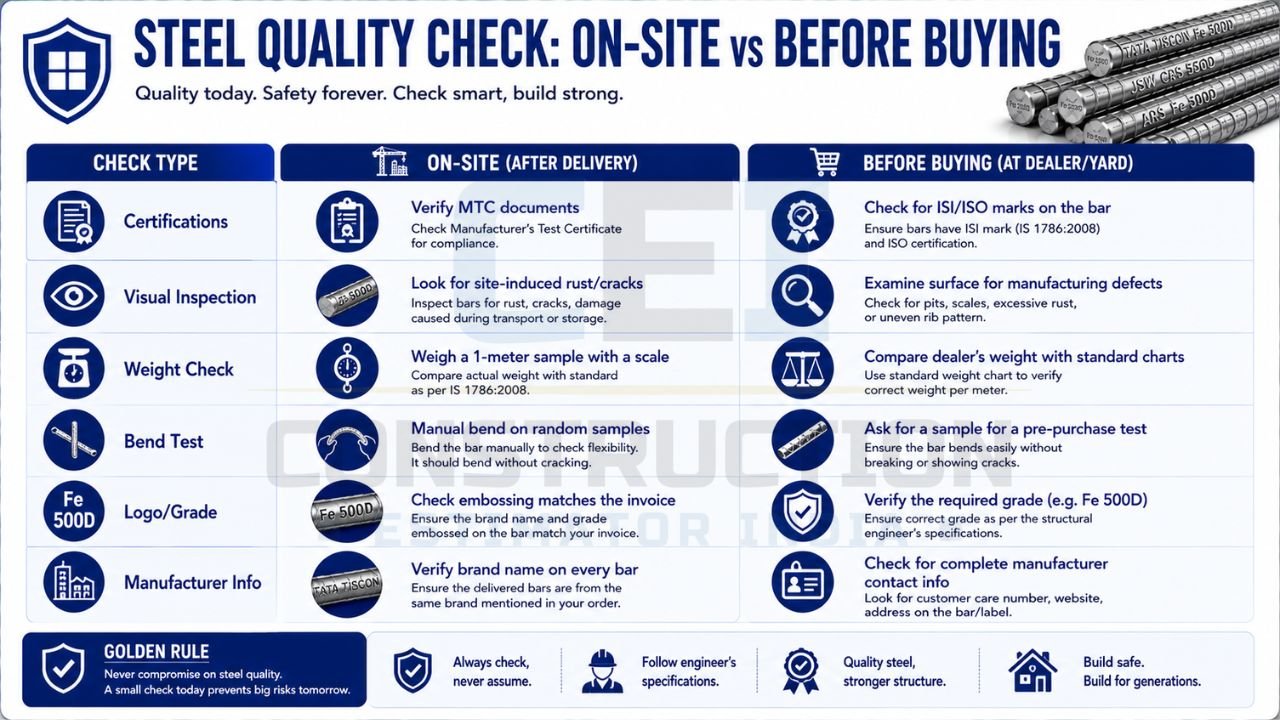
| Check Type | On-Site | Before Buying |
|---|---|---|
| Certifications | Verify MTC documents | Check for ISI/ISO marks on the bar |
| Visual Inspection | Look for site-induced rust/cracks | Examine surface for manufacturing defects |
| Weight Check | Weigh a 1-meter sample with a scale | Compare dealer’s weight with standard charts |
| Bend Test | Manual bend on random samples | Ask for a sample for a pre-purchase test |
| Logo/Grade | Check embossing matches the invoice | Verify the required grade (e.g. Fe 500D) |
| Manufacturer Info | Verify brand name on every bar | Check for complete manufacturer contact info |
Common Steel Quality Mistakes to Avoid
1. Skipping Certification Check
Never assume all steel is equal. If the bar doesn’t have the ISI mark (IS 1786:2008), it hasn’t been verified for safety. To avoid such errors, you can read more about the 7 common expensive mistakes in house construction in India.
2. Ignoring Surface Defects
Using rusted or cracked bars compromises the bond with concrete and leads to internal corrosion. Ensure the bar is clean and rust-free before use.
3. Not Doing the Bend Test
Ductility is the life-saver in seismic zones. Don’t skip the manual bend test; if it cracks, it’s brittle.
4. Buying from Unverified Suppliers
Unknown sources might offer lower prices, but they often sell substandard steel that lacks chemical purity.
5. Ignoring Weight Verification
If you pay by weight but the bars are “under-weight,” you are losing money and structural strength simultaneously.
Conclusion
Building your dream home is a once-in-a-lifetime investment. Don’t let substandard steel ruin your foundation. If you need expert guidance on steel quality verification, quantity estimation, or material procurement, contact Construction Estimator India today.
We specialize in:
- Professional Steel Quality Consultation
- Precision Steel Quantity Estimation
- Detailed what is BOQ in construction Preparation
- DPR (Detailed Project Report) Services
- Construction Planning for Residential & Commercial Projects
WhatsApp / Call: +91 8630676890
Serving homeowners and contractors India-wide.
FAQ — How to Check Quality of Steel India
How to check quality of steel India?
Verify the ISI mark, check the weight against standard charts, perform a manual bend test, and inspect the surface for rust and cracks.
What is the ISI mark for TMT bars?
The standard ISI mark for reinforcement steel in India is IS 1786:2008.
How to check TMT bar quality on site?
Look for the embossed logo/grade, perform a 180-degree bend test, and verify the weight per meter.
What is the bend test for TMT bars?
It’s a test where a bar is bent to see if it develops cracks. Quality steel flexes; poor steel snaps.
How to identify fake TMT bar?
Fake bars often have missing manufacturer info, blurred logos, irregular rib patterns, and fail the weight/bend tests.
What is IS 1786:2008 standard?
It is the Indian standard specification for high-strength deformed steel bars used for concrete reinforcement.
How to check TMT bar weight?
Use the formula D²/162 and weigh a 1-meter sample using a calibrated digital scale.
What certification should steel have in India?
It must have the ISI mark (IS 1786:2008) and preferably ISO 9001:2015 certification.
How to check steel quality before buying?
Request the Manufacturer’s Test Certificate (MTC) and visually inspect the stock for uniformity and branding.
How do I contact Construction Estimator India for steel quality consultation?
You can reach us at +91 8630676890 via WhatsApp or Call for expert guidance.