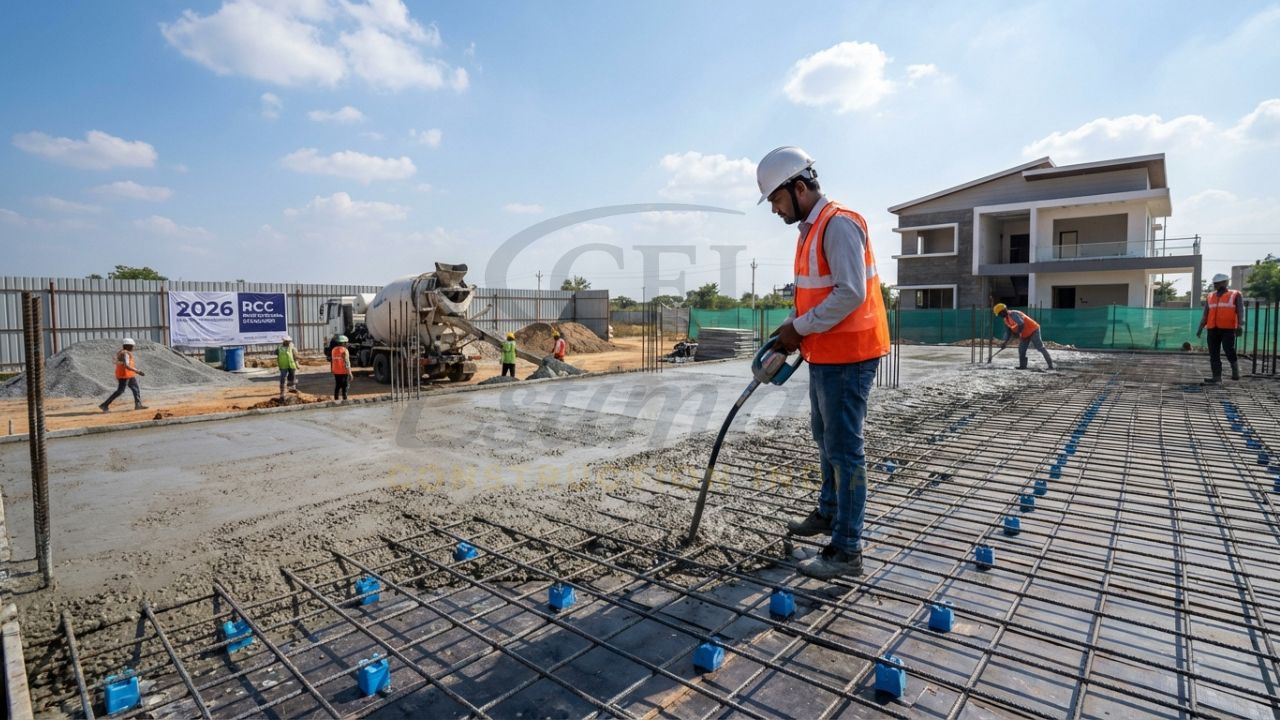
Reinforced Cement Concrete (RCC) forms the structural backbone of almost every modern building in India. Yet, even experienced contractors and site teams repeatedly make the same errors during RCC work that lead to cracks, leaks, reduced strength, and expensive repairs later. Common mistakes in RCC work are not always dramatic — they are often small lapses in mix proportion, placement, compaction, or curing that accumulate into big problems.
In 2026, with cement and steel prices remaining volatile and clients demanding faster, higher-quality construction, avoiding these mistakes has become more important than ever. A poorly executed RCC slab or column not only weakens the building but also increases maintenance costs and can delay project handover. This practical guide lists the most frequent mistakes seen on residential and commercial sites across Agra, Uttar Pradesh, Delhi NCR, and other parts of India. For each mistake, you will find clear reasons why it happens, its consequences, and simple, site-tested ways to prevent it. Whether you are a contractor, site engineer, or homeowner supervising your own house construction, these insights will help you deliver stronger and more durable RCC work.
Why RCC Work Mistakes Are So Costly in 2026?
RCC work typically accounts for 30–40% of the total cost of a building. To see how these structural costs fit into your overall budget, start by reviewing the construction cost per sq ft in India for 2026. Mistakes made during concreting are difficult and expensive to rectify once the structure is cast. In 2026, material inflation, labour shortages, and stricter quality checks by banks and authorities mean that even a 5–10% strength reduction due to poor RCC practices can turn a profitable project into a loss-making one. Common issues such as honeycombing, insufficient cover, or inadequate curing lead to corrosion, water seepage, and early structural distress. The good news is that most of these mistakes are completely preventable with basic attention to detail, proper supervision, and adherence to IS 456 guidelines.
1. Wrong Concrete Mix Ratio and Grade Selection
One of the top common mistakes in RCC work is using an incorrect mix ratio or wrong grade. Many sites still use M15 or even leaner mixes for columns and slabs because “it works faster” or “saves cement.”
Consequences:
- Lower compressive strength than designed
- Early cracking and reduced durability
- Failure during load testing or seismic events
Correct Approach (2026 practice):
- Use M20 minimum for columns and beams in normal residential buildings.
- Use M25 for slabs with longer spans or in seismic zones.
- Always prepare concrete in a mechanical mixer and verify the mix ratio by volume or by weight.
- Keep a small slump test kit on site and reject batches outside 75–150 mm slump for normal RCC.
- Before mixing, perform a precise construction material estimation in India to ensure your cement-to-aggregate ratio is perfect. For roof work, knowing how to calculate cement sand and aggregate for slab casting is vital to maintain grade consistency.
Choose Your Construction Services
Connect with verified experts for your project. We provide professional
General Contractors, Sub-contractors, Builders, and Material Suppliers.
Our network also includes specialized 3D Rendering Developers and Interior Experts.
2. Insufficient or Improper Cover to Reinforcement
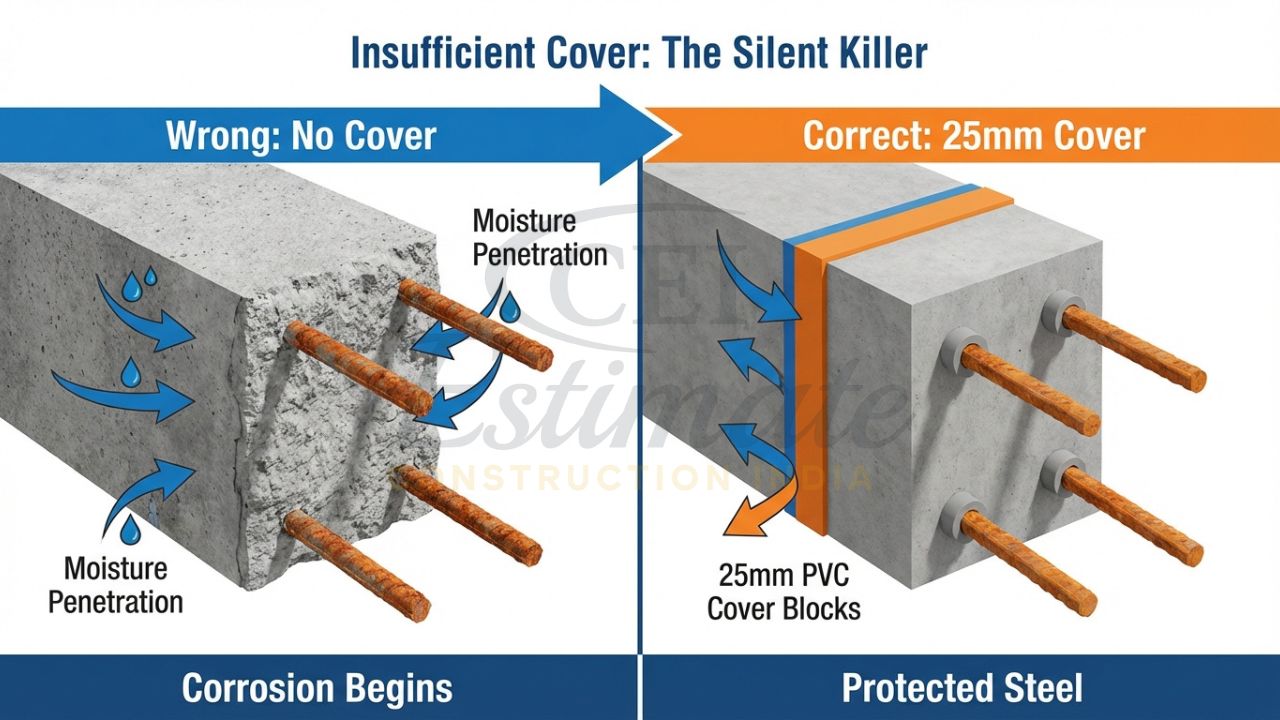
Cover is the clear distance between the outer surface of concrete and the nearest reinforcement bar. This is one of the most underestimated common mistakes in RCC work.
Typical errors:
- Using 20 mm cover where 40 mm is required
- Cover blocks shifting during concreting
- No cover at edges and corners
Correct cover as per IS 456 (2026):
- Slab: 20–25 mm (mild exposure)
- Beam: 25–30 mm
- Column: 40 mm (mild exposure)
- Foundation: 50 mm
Insufficient cover leads to early corrosion of steel, spalling of concrete, and major repair costs within 8–12 years. When casting footings in construction, maintaining a 50mm cover is non-negotiable because the foundation is in constant contact with soil moisture.
3. Poor Compaction and Honeycombing
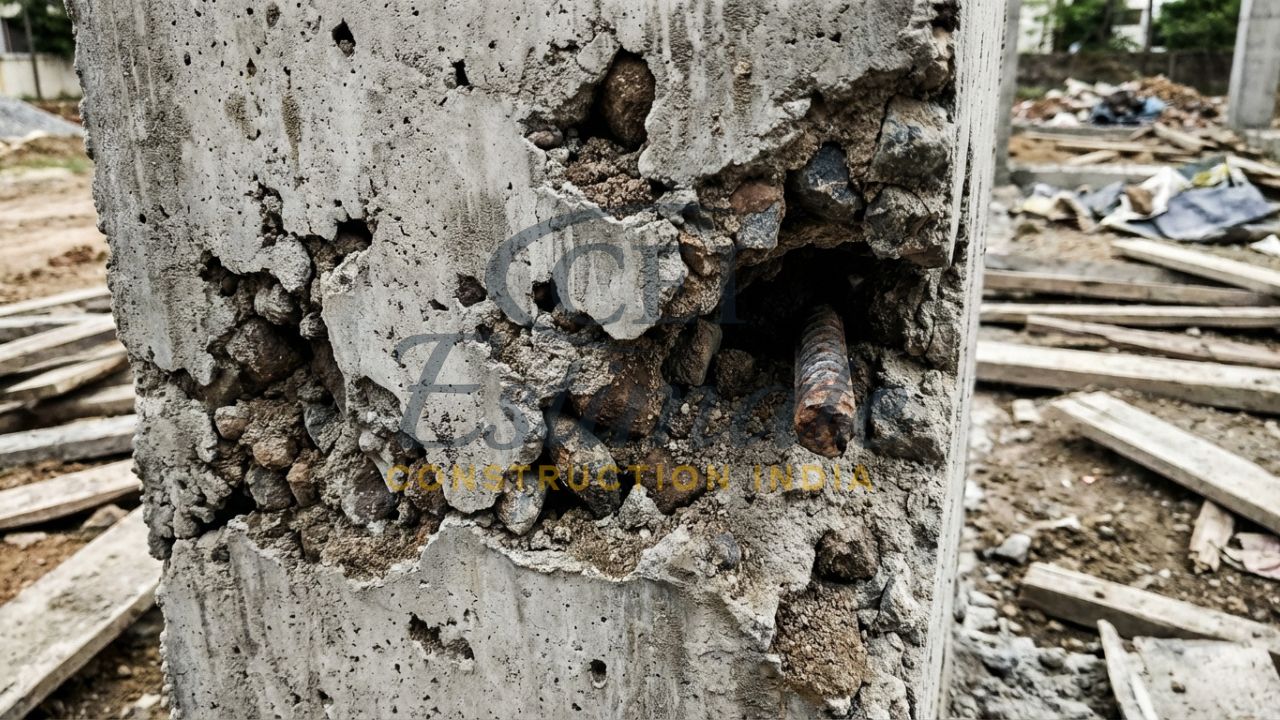
Honeycombing — visible voids and exposed aggregate on the surface — is perhaps the most visible sign of poor RCC execution. It occurs when concrete is not properly vibrated.
Main causes:
- Overly stiff mix
- Insufficient or wrong size needle vibrators
- Pouring from excessive height without chutes
Prevention:
- Use 40 mm or 60 mm needle vibrators depending on member size.
- Vibrate in layers of 300–400 mm.
- Ensure concrete flows around reinforcement without segregation.
Honeycombing reduces strength by 20–30% locally and allows water to reach the steel, causing corrosion.
4. Inadequate or Incorrect Curing Practices
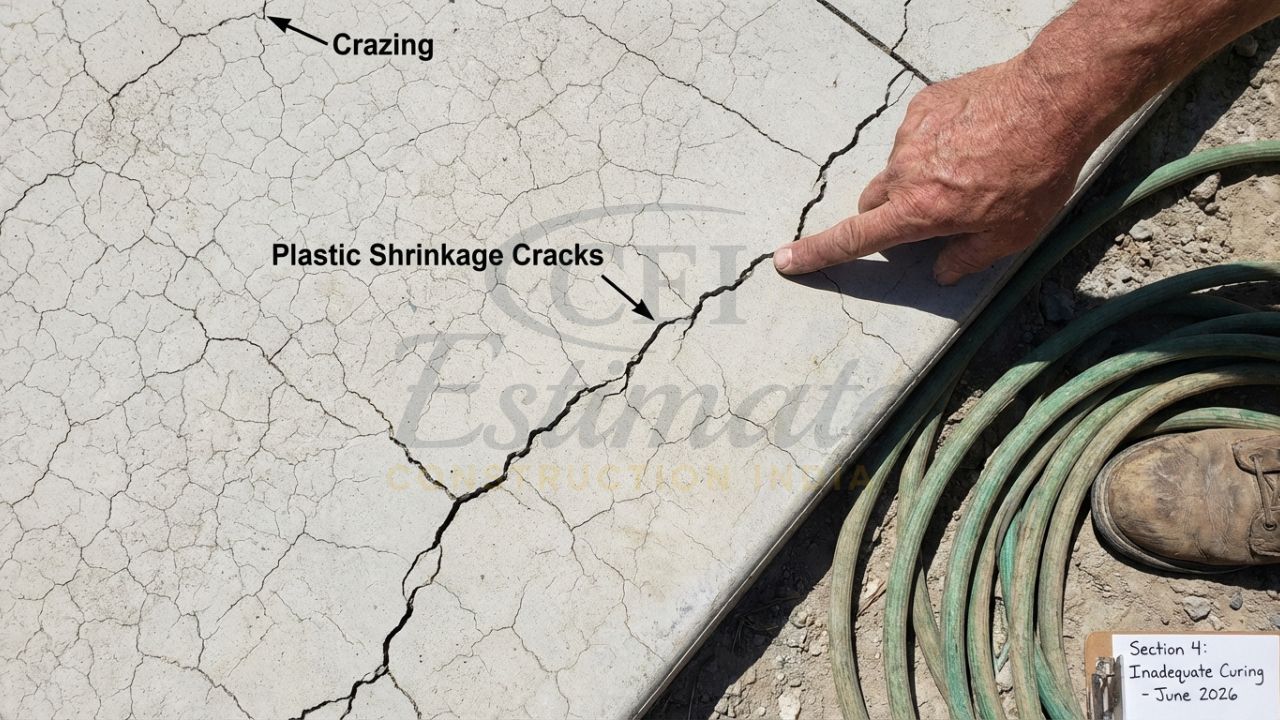
Improper curing remains one of the most frequent common mistakes in RCC work across India. Many contractors finish concreting and move on to the next activity within 2–3 days.
Recommended curing (IS 456):
- Minimum 7 days for OPC
- Minimum 10–14 days for PPC/PSC
- Continuous moisture for slabs and beams
Best methods in 2026:
- Ponding on slabs (most effective)
- Wet gunny bags/hessian for columns and beams
- Approved curing compounds when water is scarce
What is Curing in Concrete provides a detailed guide on curing methods and duration.
5. Incorrect Placement of Reinforcement (Bar Bending Schedule Errors)
Wrong spacing, insufficient laps, missing hooks, or congested reinforcement are very common errors.
Typical mistakes:
- Laps at the same location in adjacent bars
- Inadequate development length
- No stirrups at beam-column junctions
Prevention:
- Strictly follow the approved Bar Bending Schedule (BBS).
- Provide proper laps (40–50 times bar diameter).
- Use chairs and spacers to maintain cover and spacing.
6. Using Poor Quality Materials or Non-ISI Steel
Using cheap local cement, dirty sand, or non-ISI TMT bars is still widespread on smaller sites.
Consequences:
- Reduced strength and early corrosion
- Brittle failure under load
Always insist on ISI-marked materials and test certificates. In 2026, Fe500D or Fe550D TMT bars are preferred for better ductility.
7. Cold Joints and Construction Joint Mistakes
Cold joints form when concreting is stopped and restarted without proper preparation. They create weak planes that allow water leakage and reduce structural integrity.
Prevention:
- Plan pours to avoid unplanned stoppages.
- If unavoidable, roughen the old surface, clean it, and apply cement slurry before new concrete.
8. Formwork Failures and Improper Shuttering/Deshuttering
Bulging, leaking, or early removal of formwork leads to honeycombed or deformed members.
Best practices:
- Use sturdy props and bracing.
- Oil formwork before use.
- Remove formwork only after the minimum specified time (slabs 7–14 days, columns 16–24 hours).
Other Frequent Mistakes in RCC Work
- Adding excess water to improve workability (reduces strength dramatically).
- Pouring concrete from heights more than 1.5 m without chutes.
- No slump test before pouring.
- Ignoring temperature effects (hot weather concreting without precautions).
- Poor alignment and levelling of formwork.
Choose Your Construction Services
Connect with verified experts for your project. We provide professional
General Contractors, Sub-contractors, Builders, and Material Suppliers.
Our network also includes specialized 3D Rendering Developers and Interior Experts.
Best Practices Checklist to Avoid RCC Mistakes on Site
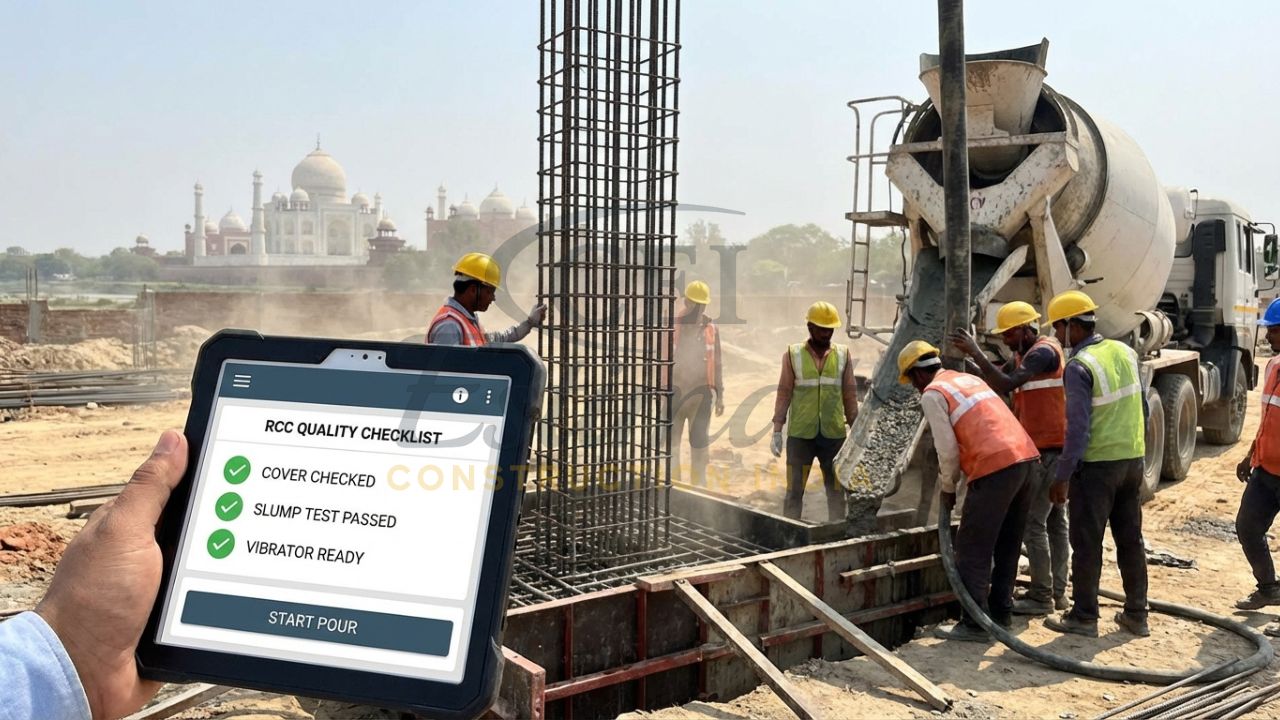
Use this practical checklist before and during every RCC pour:
- Verify mix ratio and grade from structural drawing.
- Check cover blocks and spacers are placed correctly.
- Ensure needle vibrators are working and sufficient in number.
- Plan pour sequence to avoid cold joints.
- Start curing within 24 hours and maintain continuously.
- Keep slump within 75–150 mm.
- Record temperature, slump, and cube samples.
- Follow deshuttering schedule strictly.
- Inspect finished surface for honeycombing before moving ahead.
- Maintain curing register with dates and photographs.
Conclusion
Common mistakes in RCC work are rarely dramatic but almost always expensive. Most structural problems seen in Indian buildings — cracks, water leakage, corrosion, and early deterioration — can be traced back to one or more of the issues discussed in this guide. The good news is that all of them are preventable with proper planning, supervision, correct material selection, and strict adherence to IS 456 guidelines.
In 2026, with higher client expectations and competitive pressure, contractors who eliminate these common RCC mistakes deliver better quality, finish projects faster, and build stronger reputations. Make a habit of using checklists, training your site teams, and cross-checking critical items before every pour. Combine good workmanship with accurate material estimation and professional BOQ preparation, and your RCC structures will remain strong and durable for decades. Ready to get an accurate, customised construction estimate for your project in 2026?
At Estimator Construction India our professional estimating team delivers detailed BOQ and cost reports in just 48 hours.
Construction cost estimation services start at just ₹10,000 INR only.
Contact us today:
📞 Phone / WhatsApp: +91 86306 76890
✉️ Email: info@constructionestimatorindia.com
Don’t overpay or underbid — get your precise 2026 construction cost per sq ft estimate now and win more projects with confidence!
Frequently Asked Questions (FAQs) – Common Mistakes in RCC Work
What are the most common mistakes in RCC slab casting in residential construction?
The most frequent mistakes in RCC slab casting include insufficient cover to reinforcement, poor compaction leading to honeycombing, inadequate curing, wrong mix ratio (using leaner than M20), and adding excess water for workability. These common mistakes in RCC work reduce slab strength, cause early cracking, and lead to water seepage from the roof. Proper vibration, correct cover, and 14-day continuous curing solve most problems.
How does insufficient cover in RCC lead to structural problems?
Insufficient cover allows moisture, oxygen, and chemicals to reach the steel reinforcement faster, causing corrosion. Rust expands and spalls the concrete cover, leading to visible cracks and loss of bond between steel and concrete. In 2026 Indian conditions with increasing pollution and humidity, maintaining the specified cover (25–40 mm depending on exposure) is critical for long-term durability.
What is the correct curing time for RCC work as per Indian standards?
As per IS 456:2000, OPC-based RCC should be cured for a minimum of 7 days, while PPC/PSC requires 10 days minimum (14 days is recommended). In hot and dry climates of Uttar Pradesh, extending curing to 14–21 days for slabs and beams gives significantly better strength and crack resistance. Continuous moisture is more important than the exact number of days.
How can contractors avoid honeycombing in RCC columns and beams?
Honeycombing is avoided by using the right slump (75–150 mm), adequate vibration with 40–60 mm needle vibrators, pouring in 300–400 mm layers, and ensuring concrete flows properly around reinforcement. Proper formwork oiling and avoiding pour heights above 1.5 m also help reduce this common mistake in RCC work.
Why is proper vibration important during RCC pouring?
Proper vibration removes entrapped air, ensures concrete flows into every corner and around reinforcement, and creates a dense, homogeneous mass. Without adequate vibration, voids and honeycombing form, reducing strength by 20–30% and allowing water to penetrate, which leads to corrosion. Good vibration is one of the easiest ways to improve RCC quality on site.