Imagine you are Amit, an independent civil contractor in Meerut, Uttar Pradesh. You’ve just secured a contract to build a premium 3BHK independent floor. You’ve invested your savings into raw materials—TMT bars, cement, and high-end Italian marble—all stacked neatly on-site. Suddenly, an unseasonable 2026 monsoon cloudburst hits West UP, flooding the foundation and causing a partial collapse of the newly laid shuttering. To make matters worse, a worker slips during the cleanup, sustaining a serious back injury. Amit assumes his client’s “home insurance” will cover it, only to realize standard policies exclude structures under construction. He is now personally liable for 12 Lakhs in damages and medical costs.
This nightmare is a reality for many who ignore the specific types of insurance for independent contractors. Whether you are a solo freelance site supervisor, a small-scale builder, or a sub-contractor in the Delhi-NCR region, you are essentially a one-man army. You handle labor, materials, and coordination, which means you also carry 100% of the financial risk. While massive construction firms have corporate blankets, independent operators need affordable, tailored insurance for independent contractors India to protect their livelihood from being wiped out by a single accident.
In 2026, the Indian construction landscape has shifted. Banks, RERA authorities, and even individual homeowners are now demanding proof of coverage before groundbreaking. Many small operators skip insurance to “save costs,” not realizing that a basic policy often costs less than a single pallet of premium cement. This guide will walk you through the most practical types of insurance, their 2026 costs, and how you can include these premiums in your project estimates to ensure your business remains profitable and protected.
For a broader view of all project protections, explore our complete guide on types of construction insurance in India.
Why Independent Contractors Need Insurance More Than Ever?
For a self-employed builder or independent contractor, there is no “corporate safety net.” If a fire breaks out at a site in Noida or a theft occurs in a residential colony in Ghaziabad, the loss comes directly out of your pocket. In 2026, several factors make insurance a non-negotiable requirement for small operators:
- Personal Financial Liability: As an independent contractor, your personal assets—your home, car, and savings—are often at risk if a client sues you for structural failure or if a third party is injured on your site.
- Climate Volatility: North India is witnessing increasingly erratic weather. From seismic tremors in Delhi-NCR (Zone IV and V) to localized flooding in Uttar Pradesh, the “work-in-progress” is more vulnerable than the finished building.
- Legal Compliance: The BOCW (Building and Other Construction Workers) Act and the Employees’ Compensation Act are being strictly enforced in 2026. Even if you have a team of just three workers, you are legally responsible for their medical care and compensation in case of site accidents.
- Bank and Tender Requirements: Most Indian banks now mandate a “Builders Risk” or CAR policy before releasing home construction loan tranches. If you want to win better contracts, having professional insurance is a prerequisite.
Major Types of Insurance for Independent Contractors in India
Navigating the insurance market can be confusing. To simplify your choice, here is an overview of the essential covers tailored for solo and small-team operators in 2026.
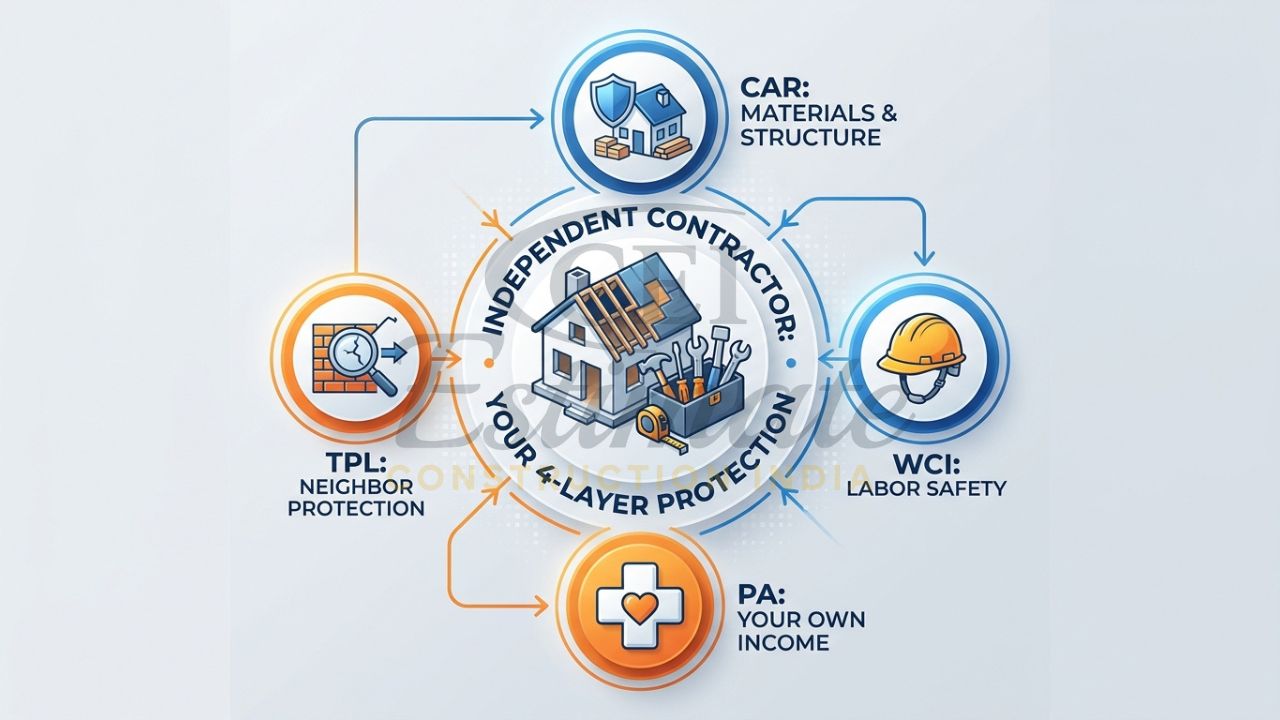
| Insurance Category | Primary Purpose | Best Suited For |
|---|---|---|
| Contractors All Risk (CAR) | Covers damage to the building, materials, and site theft. | Individual Home Builders & Civil Contractors |
| Workmen Compensation (WCI) | Covers legal liability for worker injuries or death. | Contractors managing any number of laborers |
| Personal Accident (PA) | Protects the contractor’s own income and health. | Independent supervisors and solo operators |
| Third Party Liability (TPL) | Covers damage to neighbors’ property or public injury. | Urban projects with shared walls or narrow lanes |
| Plant & Machinery (CPM) | Protects owned equipment like mixers, vibrators, and lifts. | Small contractors with their own inventory |
1. Contractors’ All Risk (CAR) Insurance
The CAR policy is the “gold standard” among the types of insurance for independent contractors. It is specifically designed to cover the project from the moment of groundbreaking until the final handover. For an independent contractor building a residential house, this policy is indispensable because it treats the construction site as a dynamic, high-risk environment.
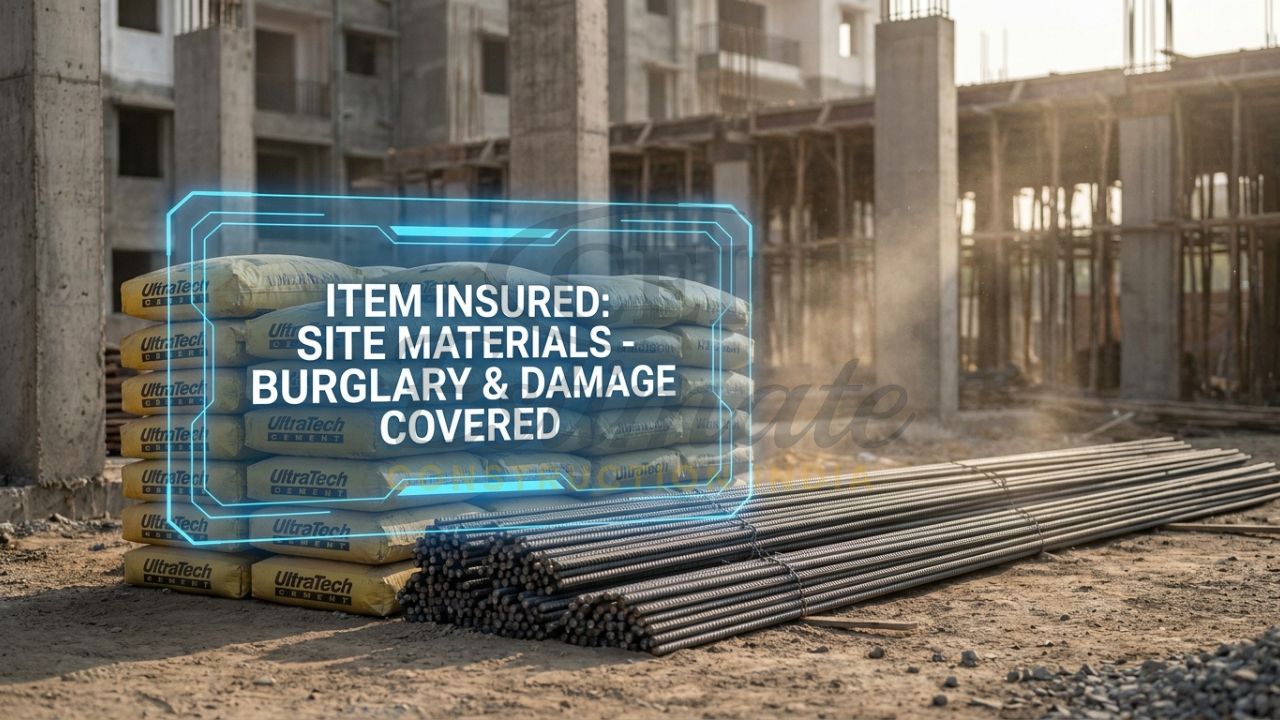
What does it cover?
- Physical Damage: Damage caused by fire, lightning, earthquake, flood, or storms.
- Theft and Burglary: Coverage for expensive materials like copper wiring, TMT steel, and sanitary fittings which are frequent targets for site theft.
- Collapse and Accidents: If a wall collapses due to faulty temporary supports or a crane mishap, the CAR policy covers the cost of reconstruction.
For small projects, you don’t need a multi-crore turnover to buy this. In 2026, insurers offer “Single Project” CAR policies with flexible minimum project values. For a typical residential project with a reconstruction cost of ₹50 Lakhs, the sum insured should ideally reflect the total contract value plus a 10% buffer for debris removal and escalation.
For detailed protection during the active building phase, read our guide on insurance for building under construction in India.
2. Workmen Compensation Insurance (WCI) or Group Personal Accident
One of the biggest mistakes small contractors in cities like Meerut and Lucknow make is assuming that “casual labor” doesn’t require insurance. Under the Employees’ Compensation Act, you are liable for any injury that occurs “during and in the course of employment.”
If a mason falls from a scaffold, the medical bills and disability compensation can run into lakhs. Workmen compensation for small contractors provides a legal shield, paying for:
- Medical Expenses: Hospitalization costs for site injuries.
- Death Benefits: A lump sum paid to the worker’s family.
- Disability: Compensation for permanent or temporary loss of earning capacity.
For very small teams (e.g., 2–4 core workers), a full WCI policy might feel expensive. In such cases, a Group Personal Accident (GPA) policy is an excellent, affordable alternative. Additionally, ensure your workers are registered under the BOCW board to tap into government welfare schemes, which can supplement your private insurance cover.
To understand worker-specific protections in depth, refer to our complete guide on insurance for construction workers in India.
3. Personal Accident Insurance & Health Cover for the Contractor Himself
As an independent contractor, you are the engine of your business. If you are injured on-site and cannot supervise work for two months, your income stops, but your project overheads continue. This is why personal accident insurance for contractors is vital.
Unlike standard health insurance, a Personal Accident (PA) policy provides a weekly “Loss of Income” benefit if you are temporarily disabled. In 2026, you should also look at government-backed low-cost options like the Pradhan Mantri Jeevan Jyoti Bima Yojana (PMJJBY) for life cover. However, for comprehensive protection, a standalone health policy that includes “Hazardous Occupation” riders is recommended for anyone frequently visiting active construction sites.
4. Third Party Liability Insurance
Construction doesn’t happen in a vacuum. If you are digging a basement for a house in a congested part of Old Delhi or Meerut, there is a high risk of causing cracks in the neighbor’s wall or damaging a public utility pipe.
Third party liability for independent contractors covers:
- Property Damage: Cost of repairing a neighbor’s structure damaged by your construction.
- Public Injury: If a passerby is hit by falling debris, the legal and medical costs are covered.
While often available as an add-on to your CAR policy, having a separate Public Liability cover is a sign of a professional, high-quality contractor that many premium clients in 2026 appreciate.
For small and growing businesses, explore our recommendations on best insurance for small construction business in India.
5. Other Useful Types of Insurance for Independent Contractors
Beyond the basics, several niche policies can protect your specific business assets:
- Contractors Plant & Machinery (CPM): If you own expensive equipment like concrete mixers, scaffolding sets, or earthmoving tools, a CPM policy protects them from site accidents and mechanical breakdowns.
- Inland Transit Insurance: If you are transporting high-value materials (like solar panels or premium tiles) from a warehouse to the site, this covers damage during transit.
- Professional Indemnity: If you provide design-build services or site supervision, this protects you if a client claims financial loss due to your professional negligence or errors in the BOQ.
- Office/Godown Insurance: If you maintain a small office or a shed to store cement and tools, a basic “Standard Fire and Special Perils” policy for the premises is a smart, low-cost investment.
When hiring specialists, proper arrangements are essential. Learn more in our guide on how to get insurance for subcontractors in India.
Comparison of Insurance Types for Independent Contractors
To help you decide which types of insurance for independent contractors to prioritize, refer to this practical comparison table for the 2026 market.
| Policy Type | Best For | Coverage Highlights | Ease of Purchase | Approx. 2026 Cost (Annual) |
|---|---|---|---|---|
| CAR Insurance | Small/Mid Projects | Fire, Flood, Theft, Collapse | High (Online) | ₹6,000 – ₹18,000 |
| Workmen Comp | Labor Safety | Legal Liability, Injury, Death | Medium | 0.5% – 1.2% of Wages |
| Personal Accident | Solo Contractor | Self-Disability, Income Loss | Very High | ₹1,500 – ₹4,000 |
| Public Liability | Urban/Tight Sites | Damage to Neighbors/Public | Medium | ₹3,000 – ₹7,000 |
| CPM Insurance | Equipment Owners | Machinery Damage/Breakdown | Medium | 1% of Machine Value |
How Much Does Insurance Cost for Independent Contractors in 2026?
A common misconception is that insurance is a “big company expense.” In reality, insurance for independent contractors India is quite affordable if purchased correctly.
For a residential project with a total construction value of ₹30 Lakhs to ₹50 Lakhs, a comprehensive CAR policy typically costs between ₹5,000 and ₹15,000 for the entire project duration (usually 12–18 months).
Factors affecting your premium include:
- Site Location: Projects in seismic Zone V (parts of Delhi-NCR) may have slightly higher premiums.
- Type of Work: High-rise residential construction carries a higher risk than a single-story renovation.
- Safety Record: Contractors who maintain clean, gated sites with proper PPE usage can often negotiate better rates.
Pro Tip for Estimators: Never absorb these costs into your profit margin. Always include “Insurance and Compliance” as a separate line item in your Bill of Quantities (BOQ). When you explain to the client that this small fee protects their dream home and your workers, 99% of clients will happily pay it.
Step-by-Step Guide for Independent Contractors to Buy Insurance
Getting insured in 2026 is faster than ever thanks to digital platforms. Follow these steps:
- Assess Project Risk: Determine the total reconstruction cost and the number of workers on-site.
- Compare Quotes: Use aggregators like Policybazaar or go directly to the portals of HDFC Ergo, ICICI Lombard, New India Assurance, or Go Digit. Look specifically for “Contractors All Risk” or “Builders Risk.”
- Check for Add-ons: Ensure you include “Debris Removal” and “Third Party Liability” in your CAR policy.
- Submit Documents: You will typically need the project address, a brief work description, your Aadhaar/PAN, and sometimes site photos or the Sanctioned Plan.
- Review Exclusions: Read the “fine print” to ensure you understand what is not covered (e.g., willful negligence or war).
Best Practices and Common Mistakes to Avoid
- Don’t Under-insure: If your project is worth ₹50 Lakhs but you insure it for ₹30 Lakhs, the “Condition of Average” applies. In a total loss, the insurer will only pay a fraction of the claim.
- Verify Subcontractors: If you hire a specialist for electrical or plumbing work, ensure your policy covers them, or mandate that they carry their own insurance.
- Maintain a Site Log: Keep records of worker attendance and safety briefings. In 2026, digital logs are often required to settle workmen compensation claims quickly.
- Renew on Time: If a project is delayed (common in India!), ensure you extend the CAR policy before it expires. An expired policy offers zero protection during the most critical finishing stages.
Conclusion
The construction industry is inherently risky, but being an independent operator shouldn’t mean gambling with your financial future. By investing in the right types of insurance for independent contractors, you transform your business from a vulnerable solo act into a professional, resilient enterprise. Whether it is a CAR policy to protect your materials or Workmen Compensation to safeguard your team, insurance is the ultimate “safety harness” for your career.
In 2026, a contractor who is “insured and assured” is the one who wins the best projects and sleeps soundly even during a monsoon. Don’t leave your hard-earned reputation to chance.
At Construction Estimator India, we specialize in helping small contractors and home builders navigate the complexities of project costing. Protect your business today by ensuring your next quotation is accurate and fully covered. For professional BOQ services that factor in every insurance and compliance cost, contact us today. Let’s build your dream project with total protection.
FAQ Section
What are the main types of insurance for independent contractors in India?
The primary types are Contractors All Risk (CAR), Workmen Compensation Insurance (WCI), Public Liability, and Personal Accident insurance for the contractor.
Do independent contractors need CAR insurance for small house construction?
Yes. CAR insurance protects against fire, theft of materials, and natural disasters, which can cause devastating losses on even the smallest residential sites.
Is Workmen Compensation Insurance mandatory for independent contractors?
Legally, yes. Under the Employees’ Compensation Act, any employer (including a small contractor) is liable for injuries to workers occurring during work.
What is the cheapest insurance option for independent contractors?
For very small teams, combining a basic CAR policy with a Group Personal Accident cover is usually the most budget-friendly way to stay protected.
How much does CAR insurance cost for independent contractors?
In 2026, for a ₹50 Lakh project, the premium typically ranges between ₹8,000 and ₹15,000, depending on the location and duration.
Can I buy insurance if I am doing my own house construction?
Yes, self-builders acting as their own contractors can purchase “Owner-Controlled Insurance Programs” or a standard CAR policy to protect their investment.
Does personal accident insurance cover the contractor himself?
Standard CAR or WCI policies cover the project and the workers, but not the contractor. You need a separate Personal Accident policy for your own protection.
How to include insurance costs in my quotation as an independent contractor?
Add a specific line item in your BOQ under “Project Overheads” or “Statutory Compliance & Insurance,” typically calculated as 1% to 1.5% of the total project cost.
What happens if I don’t have insurance and an accident occurs?
You will be personally and legally liable for all damages, medical costs, and potential lawsuits, which can lead to the freezing of your assets or project.
Which companies offer easy insurance for small contractors in India?
Top providers in 2026 include HDFC Ergo, ICICI Lombard, New India Assurance, and Go Digit, all of which offer easy online purchase for small-scale projects.
Guide Suggestions: