In the rapidly evolving landscape of Indian logistics, understanding what are the 7 types of warehouses is no longer just a technicality—it is a strategic necessity for business owners aiming for operational excellence and cost efficiency. As we move through 2026, the demand for sophisticated storage solutions has skyrocketed, driven by the e-commerce boom and India’s growing role as a global manufacturing hub. Choosing the wrong facility can lead to massive budget overruns, whereas the right choice acts as a high-performance asset for your supply chain.
Whether you are an e-commerce seller in Noida, a manufacturer in Gujarat, or a distributor in Uttarakhand, this guide will clarify the different types of warehouses available in the Indian market today. Beyond just definitions, we will look at how each type impacts your construction and fit-out budget. At Construction Estimator India, we specialize in helping you bridge the gap between selecting a warehouse category and executing a realistic, data-backed construction plan. If you are ready to move from planning to execution, you can reach our experts via WhatsApp at +91 8630676890 for a custom BOQ or cost estimate.
Why Understanding Warehouse Types Matters for Your Business
Selecting a warehouse is one of the most capital-intensive decisions a business owner will make. In 2026, relying on outdated 2024 or 2025 data is a recipe for failure. Understanding the specific kinds of warehouses for logistics allows you to:
- Optimize Capital Expenditure (CAPEX): Different warehouses have vastly different construction costs. For instance, a basic godown might cost ₹1,200/sq ft, while a cold storage facility can exceed ₹3,800/sq ft.
- Enhance Operational Speed: An e-commerce fulfillment center requires different floor tolerances and racking heights than a general workshop.
- Ensure Regulatory Compliance: Certain types, like bonded warehouses in India, require specific government approvals and structural security that others do not.
- Future-Proof Your Investment: Incorporating modern trends like solar-ready roofs or high-bay racking early in the design phase prevents expensive retrofitting later.
The 7 Main Types of Warehouses Explained
Here is a detailed breakdown of the primary warehouse classification used in the Indian market for 2026.
1. Private Warehouse
A private warehouse is owned and operated by the company that produces or owns the goods. These are common among large manufacturers, wholesalers, and retail giants who require total control over their inventory and operations.
- Key Features: High degree of control, custom layout design, and integrated technology systems.
- Advantages: Long-term cost savings, brand-specific branding/security, and operational flexibility.
- Disadvantages: High initial CAPEX and fixed costs even when inventory is low.
- Best Suited For: Large-scale manufacturers and established retail chains with consistent inventory levels.
2. Public Warehouse
Public warehouses are owned by third-party logistics (3PL) providers and leased to various businesses. They are the backbone of the types of warehouses in India for small to medium enterprises (SMEs).
- Key Features: Shared space, pay-per-use model, and professional management.
- Advantages: No capital investment in construction and flexibility to scale space up or down.
- Disadvantages: Limited control over layout and potential lack of specialized storage equipment.
- Best Suited For: Startups, seasonal businesses, and companies testing new regional markets.
3. Bonded Warehouse
A bonded warehouse is a secured facility where imported goods can be stored without paying customs duties until the goods are removed. In India, these are strictly regulated by customs authorities.
- Key Features: High security, customs-supervised, and duty-deferment capability.
- Advantages: Improves cash flow for importers by delaying tax payments and allows for value-added services like packaging within the facility.
- Disadvantages: Strict regulatory compliance and higher administrative overhead.
- Best Suited For: Importers, exporters, and international trading houses.
4. Cold Storage Warehouse
Specifically designed for temperature-sensitive products, cold storage warehouses are critical for the pharmaceutical and food industries. In 2026, these facilities often feature PUF panel insulation to reduce HVAC costs by up to 40%.
- Key Features: Precise temperature control, humidity regulation, and specialized flooring.
- Advantages: Prevents spoilage and meets rigorous hygiene standards for pharma-grade products.
- Disadvantages: High construction cost (₹2,800 – ₹3,700/sq ft) and high electricity consumption.
- Best Suited For: Pharma companies, food processors, and grocery distributors.
5. Distribution / Fulfillment Warehouse
These are high-velocity hubs designed for quick movement rather than long-term storage. They are the engines behind giants like Amazon and Flipkart.
- Key Features: Multiple loading docks, cross-docking capabilities, and high-velocity layouts.
- Advantages: Minimal transit time and optimized for “last-mile” delivery.
- Disadvantages: Requires expensive high-tolerance flooring (M40 Trimix) for heavy racking and forklift traffic.
- Best Suited For: E-commerce companies and FMCG distributors.
6. Smart / Automated Warehouse
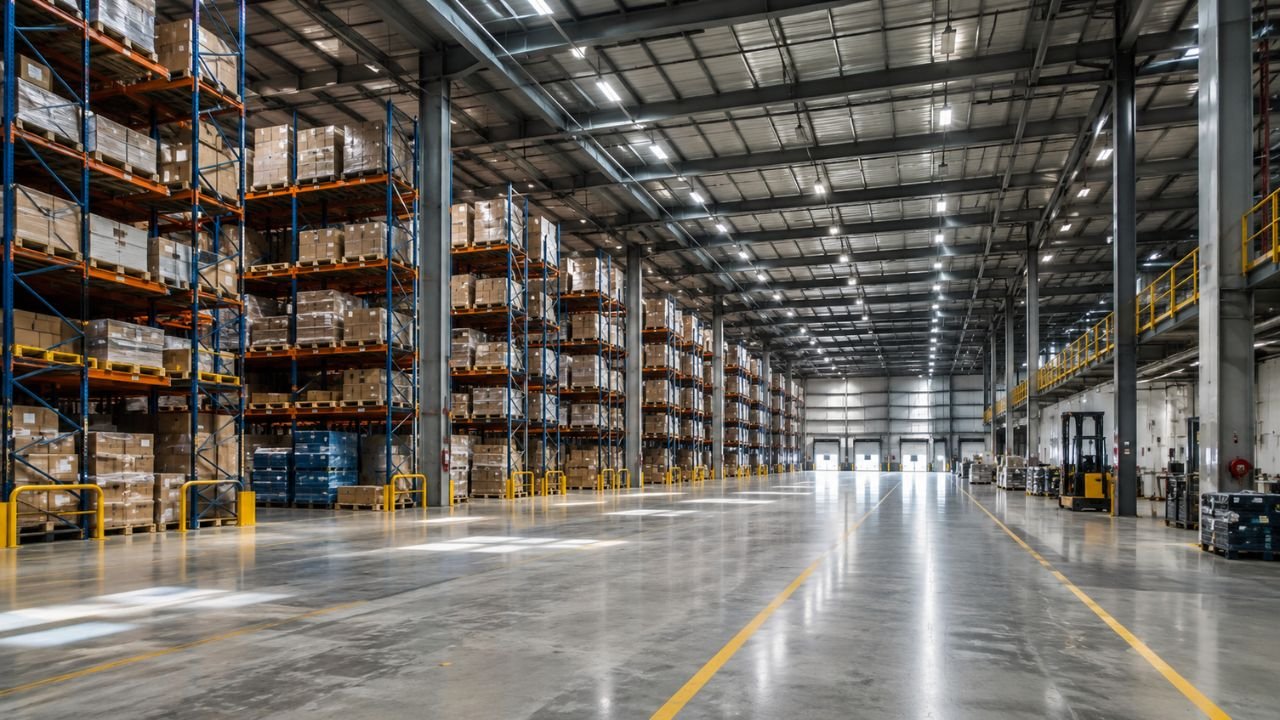
In 2026, automation-readiness is a core requirement for MNC tenants. These facilities use AI, robotics, and high-bay racking systems (up to 40 ft).
- Key Features: High clear heights, Autonomous Mobile Robot (AMR) compatibility, and integrated Warehouse Management Systems (WMS).
- Advantages: Extreme efficiency, reduced labor costs, and maximized vertical space utilization.
- Disadvantages: Highest initial setup cost and complex structural engineering requirements.
- Best Suited For: Tech-driven logistics firms and high-volume fulfillment operations.
7. Cooperative or Shared Warehouse
These are owned and managed by cooperative societies, often in the agricultural sector, where multiple small producers share the cost of a high-quality facility.
- Key Features: Shared ownership, low-cost access for members, and community-driven management.
- Advantages: Affordable for small players and often supported by government incentives.
- Disadvantages: Decision-making can be slow due to the cooperative structure.
- Best Suited For: Farmers’ cooperatives and small-scale artisanal manufacturers.
Warehouse Comparison Table: Quick Reference 2026
| Warehouse Type | Best For | Key Advantage |
|---|---|---|
| Private | Large Manufacturers | Total Operational Control |
| Public | SMEs & Startups | Zero Capital Investment |
| Bonded | Importers/Exporters | Duty Deferment & Cash Flow |
| Cold Storage | Pharma & Food | Temperature Integrity |
| Distribution | E-commerce | Speed & Throughput |
| Smart | High-Tech Logistics | Max Vertical ROI |
| Cooperative | Agri-Sectors | Cost Sharing for Members |
How to Choose the Right Type of Warehouse for Your Business
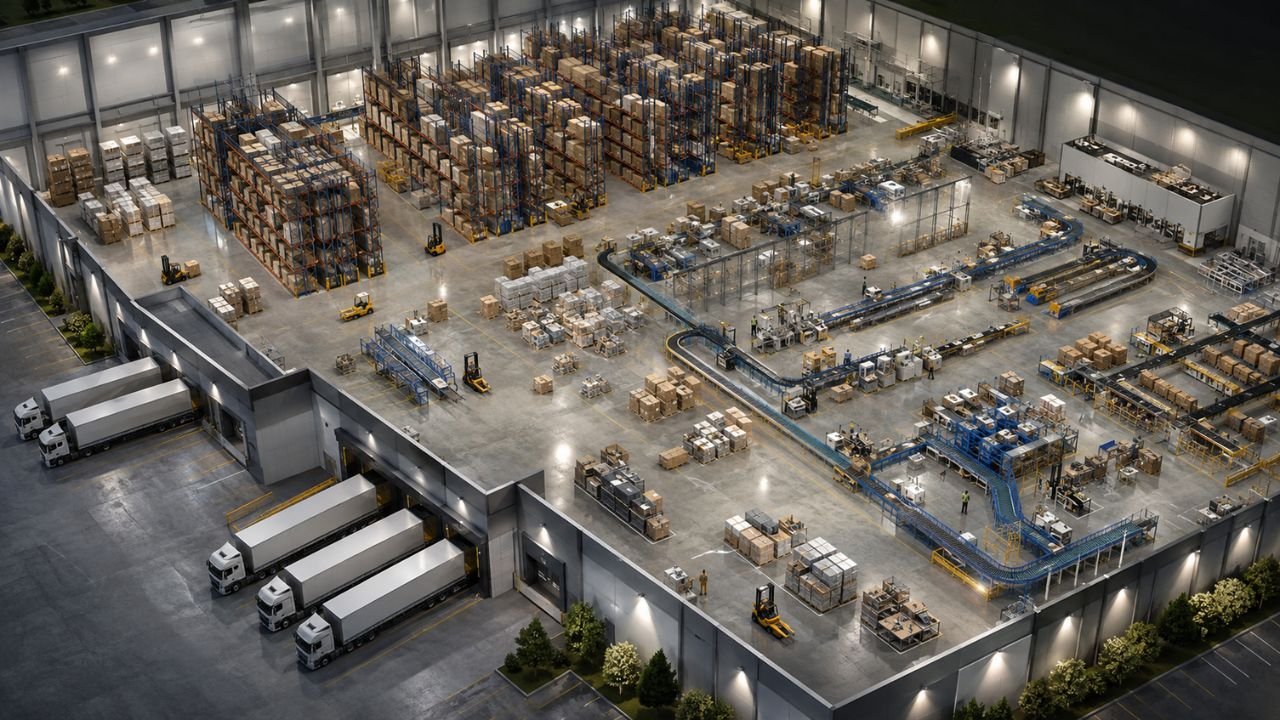
Selecting from the 7 types of warehouses explained above requires a balanced analysis of your current operations and future growth. Consider these four pillars:
- Product Nature: Does your product require temperature control (Cold Storage) or is it a high-turnover item (Distribution)?
- Budget Strategy: Do you have the capital for a high-ROI asset (Private/Smart) or do you need low-risk flexibility (Public)?
- Location & Logistics: Proximity to hubs like Delhi-NCR or Gujarat can significantly impact transit costs and labor availability.
- Duration of Storage: If goods stay for months, Private or Public works well. If they move in 24 hours, a Fulfillment Center is mandatory.
Key Design & Construction Considerations for Different Warehouse Types
Building a warehouse in 2026 is no longer about four walls and a roof. Technical specifications now define the asset’s value.
- Clear Height: Increasing height from 20 ft to 40 ft increases steel consumption by 10-15% but doubles storage capacity.
- Flooring (M40 Trimix): Essential for distribution and smart warehouses to support heavy racking and VNA trucks.
- PEB vs. RCC: Pre-Engineered Buildings (PEB) are 30-50% faster to build and 30% lighter than conventional structures, offering better ROI.
- MEP & Fire Safety: Compliance with NBC 2016 standards is critical. Retrofitting sprinklers later can be prohibitively expensive.
Warehouse Construction & Fit-Out Cost Factors in India 2026
Based on 2026 data, here is how your budget is typically distributed for a standard logistics facility:
- Primary Structure (Columns/Rafters): 35% – 40% of budget (₹550 – ₹850/sq ft).
- Roofing & Cladding: 15% – 18% of budget (₹250 – ₹450/sq ft).
- Flooring: 12% – 15% of budget (₹300 – ₹500/sq ft).
- MEP & Fire Safety: 8% – 10% of budget (₹200 – ₹400/sq ft).
Regional variations also play a role. For example, costs in Uttarakhand are often 10-15% higher than in Gujarat due to material transportation challenges.
How Construction Estimator India Helps You Select & Budget the Right Warehouse
At Construction Estimator India, we don’t just give you a number; we provide a roadmap. With over 10 years of experience and 500+ successful projects, we bridge the gap between your vision and a cost-effective reality.
- Custom BOQ Generation: We provide detailed Bill of Quantities to prevent the “hidden charges” trap, saving owners up to 12% on material costs.
- 3D Industrial Design: Visualize your warehouse flow—including racking and mezzanine floors—before you break ground.
- Technical Vetting: We ensure your design meets IS codes and seismic requirements for your specific region, whether it is the high-wind zones of Gujarat or the hills of Dehradun.
Get Expert Advice on Warehouse Type + Accurate Cost Estimate
Stop guessing your construction costs. Whether you are planning a 10,000 sq ft regional godown or a 100,000 sq ft smart fulfillment center, precision is your best investment.
Follow our simple 3-step process:
- Identify your business type and storage needs.
- Share your site location and requirements.
- WhatsApp us at +91 8630676890 to get a realistic cost estimate and guidance on the right warehouse type within 24–48 hours.
FAQ Section
Q1: Which type of warehouse is most cost-effective to build?
A basic PEB godown or industrial shed is the most cost-effective, typically starting at ₹1,200/sq ft, excluding land and taxes.
Q2: Is a PEB structure better for a distribution center?
Yes. PEB offers massive “clear-span” space (up to 100m+) without internal columns, which is essential for forklift maneuverability and efficient racking.
Q3: How much does height affect my construction cost?
For every 5 feet of additional height, your steel consumption—and thus your cost—increases by approximately 10-15%.
Q4: Do I need a special floor for a smart warehouse?
Absolutely. Smart warehouses with robots require high-tolerance, level flooring (M40 grade) to ensure machine accuracy and safety.
Q5: What are the benefits of a bonded warehouse in India?
It allows for duty deferment, which significantly improves cash flow for businesses involved in high-volume importing and exporting.
Q6: Can I add a mezzanine floor to any warehouse type?
Only if the original foundation and PEB structure were designed to handle the extra load. Always consult your structural drawings first.
Q7: How long does it take to construct a 20,000 sq ft PEB warehouse?
Typically, it takes 5 to 8 months from the design phase to handover, provided all government approvals are in place.
Q8: Why should I get a professional BOQ before starting?
A professional BOQ catches discrepancies in steel tonnage and plate thickness, preventing contractors from overcharging and reducing wastage by up to 12%.
Conclusion
Choosing from the 7 types of warehouses is a foundational decision that dictates your business’s agility and profitability in the competitive 2026 market. From the high-control environment of private warehouses to the tech-driven efficiency of smart warehouses, each category serves a specific strategic purpose.
Don’t let vague “lump sum” quotes lead to 40% budget overruns. Ensure your investment is backed by data, expert design, and accurate estimation.
Ready to start your warehouse project?
Get your custom BOQ and 3D design plan today.
WhatsApp/Call Construction Estimator India: +91 8630676890