Building a house in India is an emotional and financial milestone. However, enthusiasm can quickly turn into anxiety when costs begin to spiral out of control. For homeowners and small contractors, the single best tool to keep a project on budget and transparent is a meticulously prepared Bill of Quantities. In this comprehensive guide, we will break down how to structure a civil BOQ with rates, understand the crucial components of labor and kitchen costs, and utilize Excel templates to manage your residential project like a professional.
Introduction: Why a “Civil BOQ with Rates” Is Critical for House Construction in India
When you ask a contractor, “How much will my house cost?”, you will often receive a lump-sum, square-foot figure. While this sounds convenient, it is highly dangerous. A lump-sum quote hides the exact specifications of the materials being used and the specific scope of work, leading to inevitable disputes midway through the project.
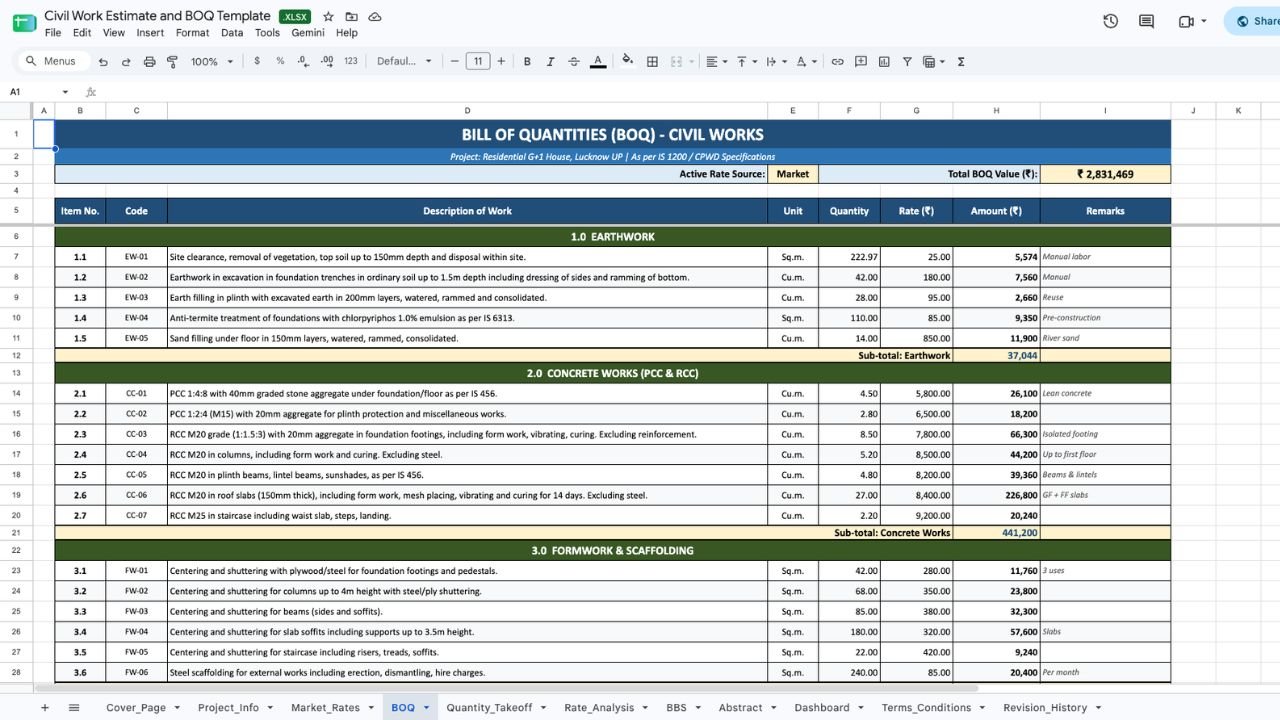
The professional alternative is an itemized Bill of Quantities. A BOQ lists every single construction task required to build your home. When you take this list and attach a specific price to each item, it becomes a civil BOQ with rates. This document is the ultimate financial blueprint. It ensures that both the homeowner and the contractor know exactly what is included (e.g., M25 grade concrete, standard 200mm brickwork) and what the financial consequences are if changes are made later.
BOQ of Civil Work: How Your House Is Broken Down into Items
A professional BOQ does not just list items randomly; it follows the chronological sequence of actual site construction. Understanding this structure helps you track the physical progress of your house against your budget.
A standard BOQ of civil work for an Indian residential project is typically divided into the following sections:
-
Substructure: Earthwork (excavation and backfilling), anti-termite treatment, PCC (Plain Cement Concrete) bed, and RCC foundations.
-
Superstructure: RCC columns, plinth beams, roof slabs, and staircases.
-
Masonry: Brickwork or blockwork for external and internal walls.
-
Plastering & Finishes: Internal smooth plaster, external weatherproof plaster, flooring, and wall putty.
-
External Works: Compound walls, underground water tanks, and drainage systems.
Each of these items is assigned a standard unit of measurement (like cubic meters for concrete or square meters for plastering), a calculated quantity, and a specific rate.
Labour Cost and Its Impact on Your Civil BOQ with Rates
One of the largest variables in any construction budget is the human element. In the Indian market, contractors either quote on a “turnkey” basis (where the rate includes both material and labor) or a “labor-only” basis (where the homeowner buys the materials).
Even in a turnkey BOQ, the labor component dictates a massive portion of the rate. Tasks like intricate bar-bending, complex shuttering for curved staircases, or laying large-format floor tiles are highly labor-intensive and will drive the item rate up. If you are managing the material procurement yourself, having a clear understanding of the labour cost for house construction in India—whether quoted per square foot for the whole structure or per day for specific masonry tasks—is essential to ensuring your overall project estimate remains accurate.
Kitchen Construction Cost: A Special Case Inside Your House BOQ
In modern Indian homes, the kitchen is no longer just a utilitarian space; it is a high-investment zone. When preparing your BOQ, the kitchen requires special attention because the civil rates differ vastly from the finishing and carpentry rates.
Within the civil BOQ, you must account for the heavy plumbing required for sinks and dishwashers, intensive wall dado tiling (which is more expensive to lay than floor tiles), and the construction of the granite or quartz counter platform. However, the modular woodwork, chimneys, and hardware are usually excluded from the basic civil quote. Because these costs can escalate rapidly, we highly recommend reviewing a dedicated breakdown of the kitchen construction cost in India to ensure you allocate a sufficient budget for this critical area before signing off on the overall house estimate.
Working with Civil Contractors (Example: Dehradun)
The rates in your BOQ are not universal; they fluctuate significantly based on geography, local material availability, and regional labor markets.
Take Uttarakhand, for example. If you are building a home in the hills or the foothills, the cost of transporting steel, sand, and heavy machinery will naturally inflate your rates. Finding reliable civil contractors in Dehradun who understand the local terrain, the specific structural requirements for seismic zones, and regional material pricing is vital. When negotiating with local builders, insist they fill out your unpriced BOQ format. This allows you to compare their specific item rates (e.g., how much they charge per cubic meter of excavation) rather than just their bottom-line number, ensuring you pick a contractor based on transparency, not just the lowest blind quote.
Using BOQ Formats and Excel Templates for Your Project
Attempting to manage hundreds of construction items, measurements, and fluctuating rates on a notepad or a basic Word document is a recipe for disaster. The Indian construction industry runs on Microsoft Excel.
Excel allows you to build templates where the formulas (multiplying quantity by rate, and calculating total GST) update automatically if you decide to change a material specification mid-project. If you want to start with a highly professional layout that covers all standard Indian residential sections, you should explore the best BOQ formats & samples in Excel for house, civil, commercial construction in India.
Alternatively, if you are a contractor looking for a more customizable, blank-slate tool that you can adapt for various types of bids, downloading a robust bill of quantities template construction Excel will save you hours of administrative work and ensure your formulas are error-free.
Practical Example: Small House Civil BOQ with Rates
To conceptualize how this looks, imagine a G+1 (Ground plus one floor) residential house of 1,200 sq ft. Your BOQ will systematically list:
-
Item 1.1: Excavation for footings (Quantity: 150 m³ | Rate: ₹X | Amount: ₹Y)
-
Item 2.1: RCC M25 for columns and beams (Quantity: 45 m³ | Rate: ₹X | Amount: ₹Y)
-
Item 3.1: 200mm Brick masonry for outer walls (Quantity: 210 m² | Rate: ₹X | Amount: ₹Y)
-
Item 4.1: Vitrified floor tiling in living areas (Quantity: 110 m² | Rate: ₹X | Amount: ₹Y)
By reviewing this breakdown, you can see exactly where your money is going. If the total exceeds your budget, you can look at the BOQ and make informed decisions—perhaps changing the M25 concrete is non-negotiable for safety, but you can swap out premium vitrified tiles for standard ceramic tiles to save money.
How to Use BOQ with Rates to Control Budget and Avoid Disputes
-
Never Accept Vague Estimates: Always insist on an item-wise BOQ with clear rates before paying an advance.
-
Compare “Apples to Apples”: When evaluating different contractors, compare their BOQs side-by-side on scope and specification. If Contractor A is cheaper, check if they omitted the terrace waterproofing or used a lower grade of cement.
-
Manage Changes (Variations): If you decide to add an extra bathroom during construction, the contractor simply refers to the pre-agreed BOQ rates for masonry and plumbing to calculate the extra cost, preventing arbitrary overcharging.
Conclusion
Building a house in India does not have to be a stressful financial gamble. By insisting on a detailed civil BOQ with rates, understanding the nuances of localized labor and kitchen finishing costs, and utilizing robust Excel templates to manage the data, you take absolute control of your project. Transparent documentation ensures that both you and your contractor are protected, paving the way for a smooth, dispute-free journey to your new home.