
Introduction: Why PCC and BOQ Matter in Civil Construction
Every successful building project in India relies on two types of foundations. The first is physical—starting with the earthwork and the crucial layer of Plain Cement Concrete (PCC) that supports the structure. The second is financial—built upon precise documentation like the Bill of Quantities (BOQ) and professional quotations.
Without a solid PCC base, a building’s footings can sink or suffer from water damage. Similarly, without a properly formatted BOQ and quotation in Excel, a construction business will struggle with budget overruns and client disputes. This article bridges the gap between the construction site and the office, explaining PCC basics, BOQ preparation, and how to manage these critical documents in Excel.
What Is PCC in Construction and Why It Matters
Before any heavy structural work begins, site engineers lay down PCC. Plain Cement Concrete is a simple mixture of cement, sand (fine aggregate), coarse aggregate, and water. Unlike Reinforced Cement Concrete (RCC), PCC does not contain any steel reinforcement bars.
Its primary purpose is to provide a rigid, level, and clean bed for the RCC foundations to rest upon. Laying PCC directly over excavated soil prevents the steel reinforcement in the footings from coming into contact with the earth, thereby preventing corrosion and moisture damage. It is also widely used for flooring base layers, plinth protection, and surface drains. To understand the specific mix ratios (like 1:4:8 or 1:3:6) and its various site applications, you can explore our detailed guide on what is PCC in construction.
From PCC on Site to PCC in Your BOQ
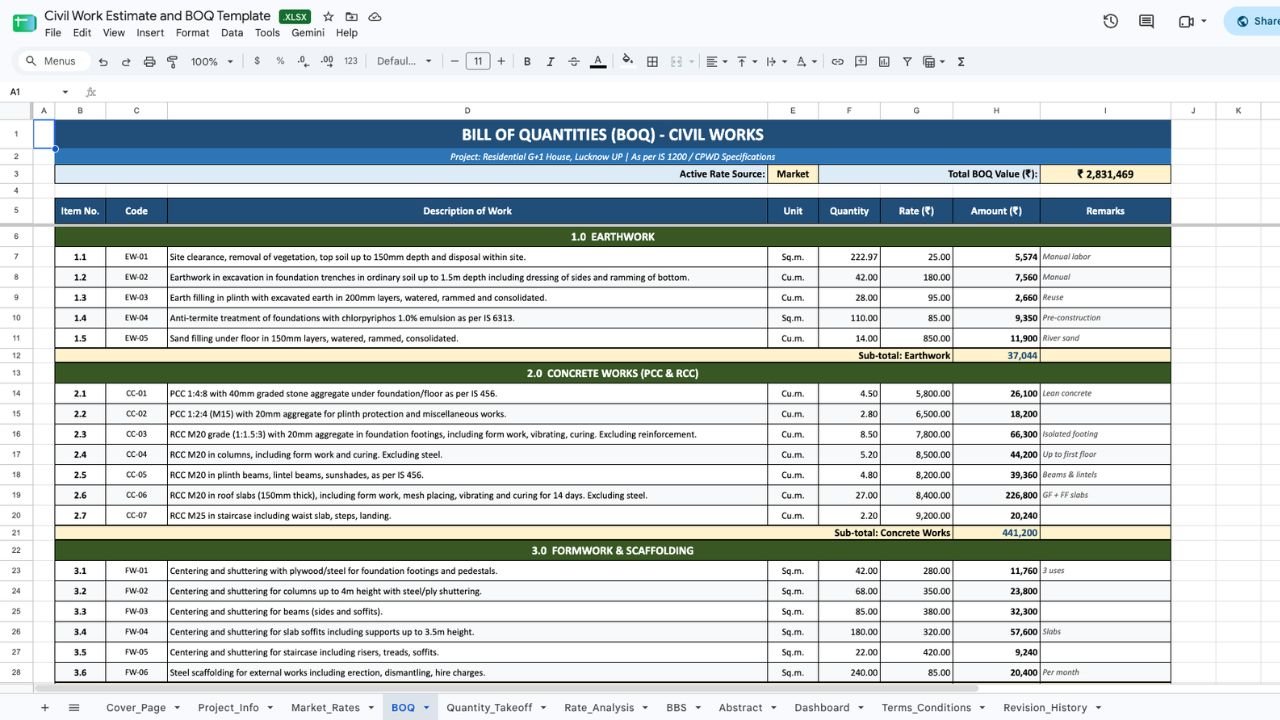
While the site execution of PCC involves mixers, laborers, and curing, the office execution involves translating this activity into a measurable BOQ item. In a standard civil estimate, construction activities must be quantified so they can be priced.
In a BOQ, PCC is typically represented like this:
-
Description: “Providing and laying PCC 1:4:8 under foundations and plinth beams, including formwork and curing.”
-
Unit: Cubic Meters (m³) or Cubic Feet (cft).
-
Quantity: Derived from multiplying the length, breadth, and thickness of the PCC beds as per the architectural drawings.
By breaking down the entire building into these specific line items, a BOQ turns raw materials and labor into a highly trackable financial document.
BOQ Preparation of Civil Work: Big Picture
A Bill of Quantities is the master document that lists every single material and labor task required for a project. Creating this document is one of the most important skills for a quantity surveyor or contractor.
The general workflow involves studying the structural and architectural drawings, creating measurement sheets (to calculate volumes and areas), listing the items logically, and grouping them into easily readable sections. Mastering the overall BOQ preparation of civil work ensures that no hidden costs surprise the contractor during execution, safeguarding the project’s profit margins.
How to Prepare BOQ for Civil Works: Step-by-Step
If you are a fresher or a site engineer looking to draft your first estimate, follow this standard step-by-step procedure:
-
Read the Drawings Thoroughly: Analyze the foundation plans, floor plans, and structural details. Note the specifications, such as the required thickness of the PCC bed or the grade of concrete for the columns.
-
Prepare Measurement Sheets: Create a take-off sheet to calculate the exact quantities (Length × Breadth × Depth). Calculate the earthwork first, then the PCC volume, followed by the RCC, masonry, plaster, and flooring.
-
Assign Units and Group Items: Standardize your units (e.g., m³ for concrete, m² for plastering). Arrange the items in chronological order of construction: Substructure, Superstructure, Finishes, and External Works.
-
Enter Data into Excel: Transfer the finalized quantities into your BOQ format, leaving the “Rate” column blank for the tendering stage.
For a more granular look at coding items, assigning CPWD/PWD specifications, and calculating deductions, read our comprehensive tutorial on how to prepare BOQ for civil works.
Civil Work Quotation Format in Excel
It is important to understand the difference between a BOQ and a quotation. A BOQ is a technical, detailed quantity document used internally or during formal tenders. A quotation, however, is the commercial price offer you submit directly to a client or homeowner.
Clients usually do not want to read through a 20-page technical BOQ. They want a clear, summarized document showing what they are paying for. A professional quotation includes your company header, the client’s details, a summary of major cost heads (e.g., Foundation Works including PCC/RCC, Brickwork, Finishes), the total amount with applicable GST, and clear payment terms. To make a strong impression and win bids faster, contractors should use a ready-made civil work quotation format in Excel that is clean, professional, and easy for non-technical clients to read.
Using the Best BOQ Excel Sheet for Building Construction
Microsoft Excel is the undisputed industry standard for estimation in India. Why? Because it handles complex formulas automatically, allows for quick revisions if drawing dimensions change, and can be easily shared with clients and architects.
When setting up your file, you need sections that automatically multiply the Quantity by the Rate, and a summary sheet that pulls the totals from different tabs to calculate the final project cost. Instead of spending hours building these interlinked formulas from scratch and risking mathematical errors, smart estimators download the best BOQ Excel sheet for building construction. A standardized template comes pre-loaded with the correct column structures, automated formulas, and professional formatting.

Practical Tips: Connecting PCC, BOQ, and Quotations
To ensure your estimating workflow is seamless, keep these practical tips in mind:
-
Be Specific in Descriptions: Always mention the exact mix ratio (like 1:4:8 or 1:5:10) and the thickness of the PCC in your BOQ. Vague descriptions lead to contractor-client disputes over material quality.
-
Rely on Measurement Sheets: Never guess quantities. A small error in calculating the PCC area for a large raft foundation will completely skew your cement and aggregate budget.
-
Match Quantities: Ensure that the quantities listed in your technical BOQ perfectly match the commercial quotation you hand to the client.
-
Lock Your Formulas: In Excel, protect the cells containing formulas (
=SUM,=PRODUCT) so you don’t accidentally overwrite them when typing in new rates.
👉 Click Here to Purchase the Civil Work BOQ Template for ₹249
Conclusion: From Plain Concrete to Professional Documents
Just as Plain Cement Concrete provides a leveled, secure base for a building’s heavy RCC structure, your BOQs and quotations provide a secure financial base for your construction business.
By understanding the technical purpose of materials like PCC, mastering the step-by-step preparation of quantities, and utilizing standardized Excel templates, you elevate the professionalism of your contracting firm. Embrace these documentation practices, and you will find it much easier to estimate accurately, win client trust, and deliver profitable civil construction projects across India.