The exterior of your home is much more than just a wall; it is the visual narrative of your lifestyle and the primary factor in establishing a lasting first impression. In the rapidly evolving landscape of Indian residential architecture, a well-thought-out house elevation design serves as a bridge between your personal aesthetic and the practical constraints of urban living. Many homeowners today spend countless hours scrolling through digital galleries, saving hundreds of beautiful images, yet they often find themselves at a crossroads when it comes to implementation, struggling to decide what is realistic for their specific plot and budget.
👉 Design a House Elevation That Reflects Your Style and Vision.
This guide provides a practical decision-making framework to help you navigate these choices. Whether you are building an independent villa or a compact city home, understanding the logic behind façade composition is essential. Construction Estimator India helps homeowners bridge this gap by providing precise cost evaluations and quantity takeoffs for various elevation styles. If you want to understand the financial impact of your design ideas before laying the first brick, contact Construction Estimator India on WhatsApp / Call +91 8630676890 for professional guidance.
Elevation Design Starts With Plot and House Type
How Plot Width, Height, and Surroundings Shape Elevation?
The physical dimensions of your plot are the most significant factors in determining your house elevation design. In many Indian cities, plots are often deep but narrow, with frontages ranging from 15 to 25 feet, requiring a focus on verticality and clean lines to prevent the house from looking cramped. Conversely, wider plots allow for horizontal expansion, where you can play with multiple projections and a mix of materials. The width of the road also dictates how your house is viewed; a house on a narrow internal lane requires a different strategy than one on a wide main road where upper floors are visible from a distance.
Height is another critical variable. A single-floor house needs a design that adds perceived volume, perhaps through a decorative parapet or a prominent porch. For double-floor structures, the challenge is creating a cohesive rhythm between levels so they don’t look like separate boxes pasted together. Balancing “solid” parts like walls with “voids” like windows and balconies is the key to a professional-looking façade.
Three Short Elevation Examples
To illustrate these principles, consider these mini-scenarios commonly found in Indian neighborhoods. A single-floor elevation on a narrow 20-foot frontage might use a “box-style” frame around the main window and a vertical groove pattern on the staircase wall to draw the eye upward. This minimalist approach ensures the small front remains neat and modern without feeling cluttered.
A double-floor elevation on a typical 30×40 or 30×50 plot offers more room for drama. Here, the first floor can feature a cantilevered balcony that overhangs the car parking area, creating depth and providing shade. This interplay of materials—like glass railings paired with a solid, textured wall—helps define the levels while maintaining a single architectural language. Finally, a corner plot elevation requires a balanced “L-shaped” look, ensuring the design flows seamlessly from the front to the side rather than ending abruptly at the corner.
The following table provides a high-level comparison of common architectural styles used for Indian homes to help you identify which direction suits your plot and personality.
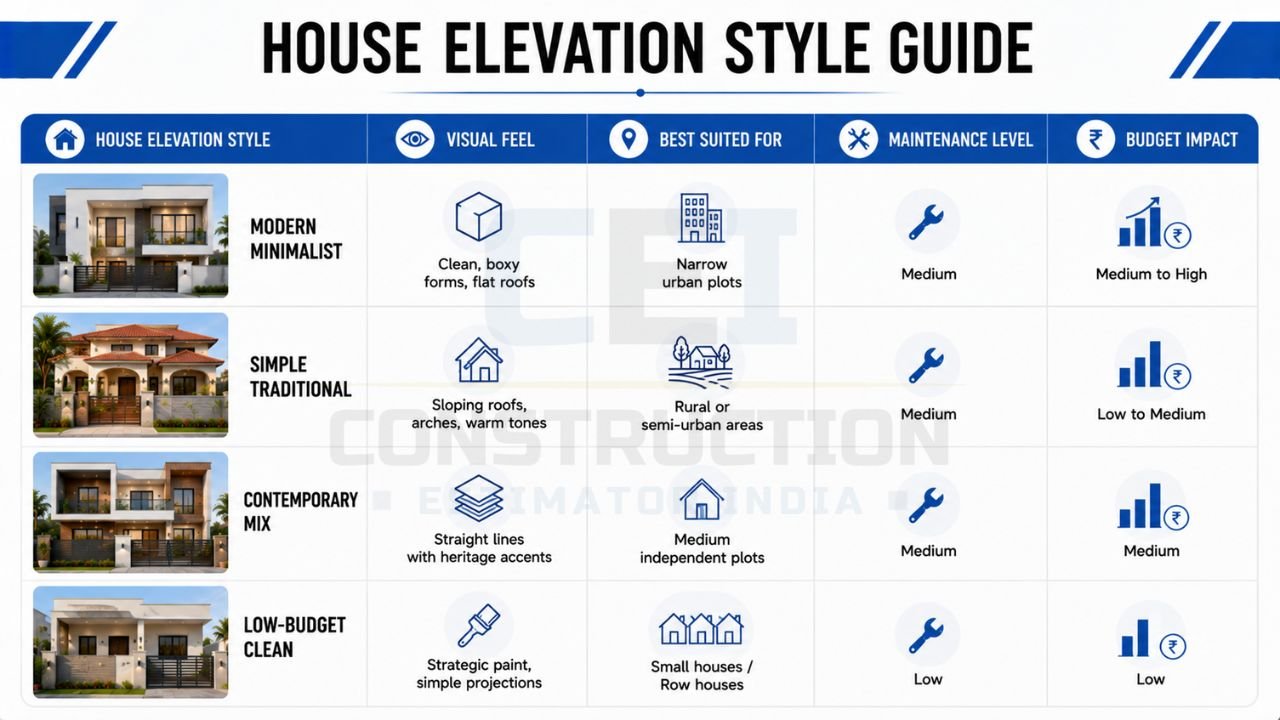
| House Elevation Style | Visual Feel | Best Suited For | Maintenance Level | Budget Impact |
|---|---|---|---|---|
| Modern Minimalist | Clean, boxy forms, flat roofs | Narrow urban plots | Medium | Medium to High |
| Simple Traditional | Sloping roofs, arches, warm tones | Rural or semi-urban areas | Medium | Low to Medium |
| Contemporary Mix | Straight lines with heritage accents | Medium independent plots | Medium | Medium |
| Low-Budget Clean | Strategic paint, simple projections | Small houses / Row houses | Low | Low |
This table serves as a starting point for your research. Once you have identified a style that resonates with you, you can delve deeper into specific materials and compositional elements to refine the look.
👉 Get a Custom House Elevation Designed for Your Dream Home.
Major Elevation Style Families in Indian Homes
Modern Minimalist Elevation
The modern house elevation design often follows a “box” philosophy, treating the exterior as a collection of interlocking rectangular frames. Currently popular in cities like Bangalore, Pune, and Delhi NCR, it emphasizes horizontal and vertical lines, often using a “frame-within-a-frame” aesthetic. Large floor-to-ceiling windows with sleek aluminum frames are staples of this look. To prevent the design from looking too industrial, warmth is frequently added using “wood-look” tiles or high-pressure laminate (HPL) panels on balcony undersides.
Simple Traditional-Influenced Elevation
Not every homeowner wants a futuristic glass-and-metal look; many prefer a simple house elevation that feels grounded and familiar. This style relies on time-tested elements like modest balcony projections and simple MS (Mild Steel) railings with clean vertical bars. Instead of expensive cladding, this look uses smart plastering techniques, such as grooves or niche details, to create visual interest. A small sloping roof section or a tiled sunshade (chajja) provides traditional charm while protecting the home from heavy Indian monsoons.
Contemporary Mix Elevation
The contemporary mix is often the “middle path” for multi-generational Indian families. It combines a modern, straight-lined structure with heritage details, such as a grand arched main entrance or a traditional stone-cladded pillar on the veranda. This fusion allows for modern materials like toughened glass for balconies while maintaining a traditional terracotta color palette for the walls. It feels fresh and new without being disconnected from the cultural context of an Indian neighborhood.
Low-Budget Clean Elevation
You can achieve a stunning look on a modest budget by prioritizing proportion and alignment over expensive materials. A low-budget house elevation design in India can look neat by using high-quality exterior paint in a smart color combination and picking just one highlight feature—perhaps a beautiful main door or a single vertical panel of stone-look tiles. Alignment of windows and a neat railing design can do 90% of the work in making a house look architect-designed without the cost of extensive cladding.
Openings, Balconies, and Structural Logic
Aligning Doors and Windows With Elevation Design
The “rhythm” of a house elevation design is created by the placement and sizing of openings. A common mistake in self-designed homes is the random placement of windows based solely on internal room layout without considering exterior balance. A professional façade ensures windows on different floors align vertically or follow a deliberate pattern. The main door should always be a focal point, larger and more ornate than other openings, perhaps framed with a stone border. In a small house elevation in India, keeping window sizes consistent helps the house look wider and more organized.
Balconies, Projections, and Shadow Depth
Balconies are major visual anchors of the elevation. Glass railings offer a premium, modern feel and allow for an unobstructed view but require frequent cleaning in dusty environments. Metal railings, particularly powder-coated MS, are durable and allow for creative laser-cut patterns (CNC designs) that add an artistic touch. The depth of the balcony matters; a deep balcony creates a strong shadow line, adding depth to the façade and making it look more three-dimensional.
Linking Elevation Features to Structural Elements
The staircase is often the tallest part of the house and usually sits at the front. Instead of hiding it, a smart house elevation design turns the staircase block into a feature using a vertical strip of glass windows or a tall panel of stone cladding. Vertical elements like these help make a narrow house appear taller. Similarly, “framing” an entire section of the house—like a living room and the bedroom above it—with a contrasting color helps group different parts into a single, cohesive unit. Construction Estimator India can help you check the quantity and cost of structural changes required to achieve these features.
The table below links common material combinations with their expected visual effect and financial impact.
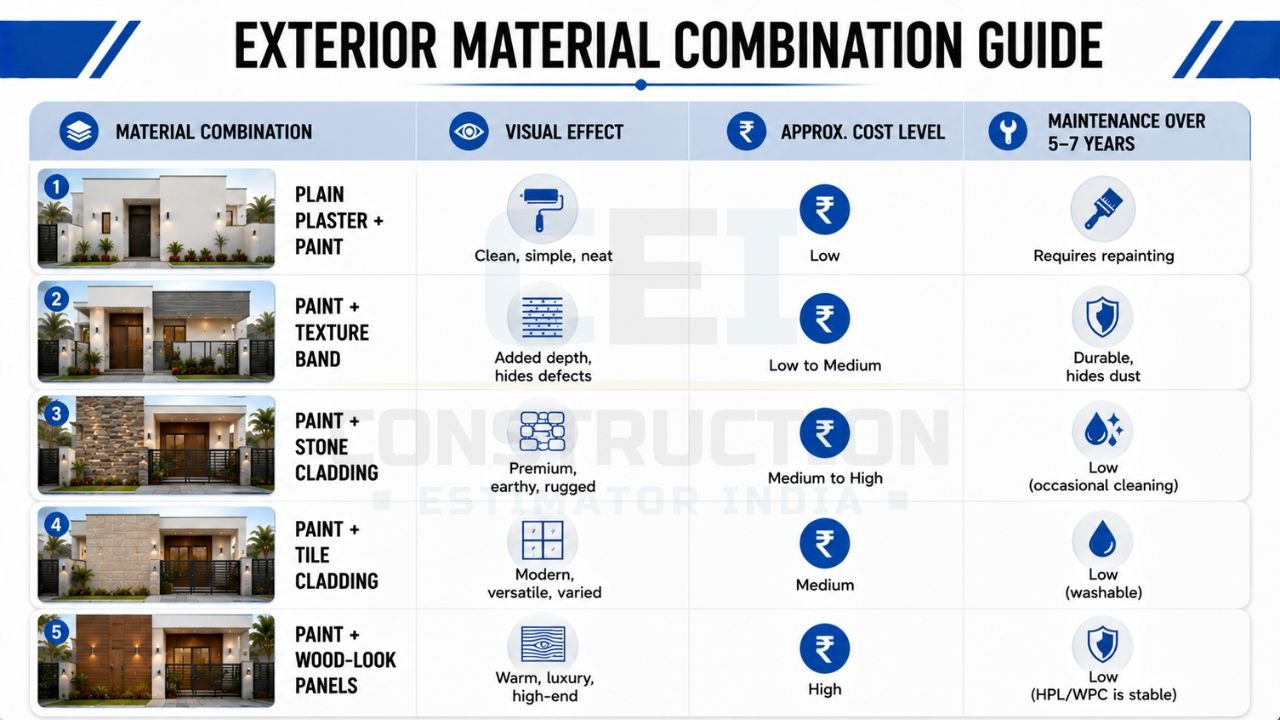
| Material Combination | Visual Effect | Approx. Cost Level | Maintenance Over 5–7 Years |
|---|---|---|---|
| Plain Plaster + Paint | Clean, simple, neat | Low | Requires repainting |
| Paint + Texture Band | Added depth, hides defects | Low to Medium | Durable, hides dust |
| Paint + Stone Cladding | Premium, earthy, rugged | Medium to High | Low (occasional cleaning) |
| Paint + Tile Cladding | Modern, versatile, varied | Medium | Low (washable) |
| Paint + Wood-look Panels | Warm, luxury, high-end | High | Low (HPL/WPC is stable) |
Use this comparison to decide where to splurge and where to save. For instance, choosing a high-quality paint for the base and a small area of expensive cladding can provide a luxury look without the luxury price tag.
👉 Build a Stunning Home Exterior with Professional Elevation Design.
Materials, Colours, and Climate-Specific Elevation Choices
Choosing Material Combinations for the Façade
The choice of finish is where many homeowners face budget shock. A plain paint finish is economical, but texture paint, with its grainy finish, is a great middle-ground as it hides minor plastering defects and lasts longer in the sun. For a premium look, cladding involves pasting materials like natural stone, ceramic tiles, or HPL panels onto specific parts of the wall. Because cladding materials vary wildly in price, Construction Estimator India helps homeowners by estimating the cost difference between these options before they make a commitment.
Colour Strategy for Different House Sizes
Color strategy significantly impacts perceived scale. Small houses usually benefit from lighter base colors like off-white, cream, or light grey, which make the building appear broader and more open. Controlled accents in darker tones can highlight specific features like a porch or a window frame. Larger double floor elevation designs can experiment with slightly stronger contrasts, using darker shades on recessed areas to create a sense of depth without looking noisy.
Responding to Dust, Rain, and Sun
In most Indian cities, a high-quality exterior paint lasts about 5 to 7 years, but this varies with climate. Houses on dusty roads may find that glass railings or dark, smooth tiles show dirt quickly, requiring frequent washing. In heavy-rain regions, sloping roof sections and adequate sunshades (chajjas) are functional necessities that protect the façade. Construction Estimator India can assist in estimating the long-term repainting and maintenance costs for different finishes so you can choose a durable option.
Elevation Design for Different Plot Types and Storeys
Single-Floor Elevation Design on Narrow Plots
For a single-floor house on a narrow frontage, the design must add volume so it doesn’t get lost among taller neighbors. This is achieved through vertical emphasis—using vertical grooves or a tall parapet wall—and a well-defined porch. Focusing on consistent window proportions is key to making a single-story home look modern and premium.
Double-Floor Elevation Design for Common City Plots
A double floor house front design is particularly important because it defines how the ground and first floor interact visually. A well-planned 2 floor house front elevation should be a direct reflection of interior spaces. For example, a large window often indicates a living room behind it. Using cantilevered balconies or vertical cladding panels helps bridge the two floors, making them feel like one cohesive composition.
Corner Houses, Row Houses, and Apartment Fronts
Corner plots must have a design that flows across both visible sides. Row houses benefit from unique frames or focal points that distinguish them from neighbors while maintaining a sense of identity. For these complex scenarios, Construction Estimator India provides support by helping you estimate realistic construction costs and quantities for your specific project.
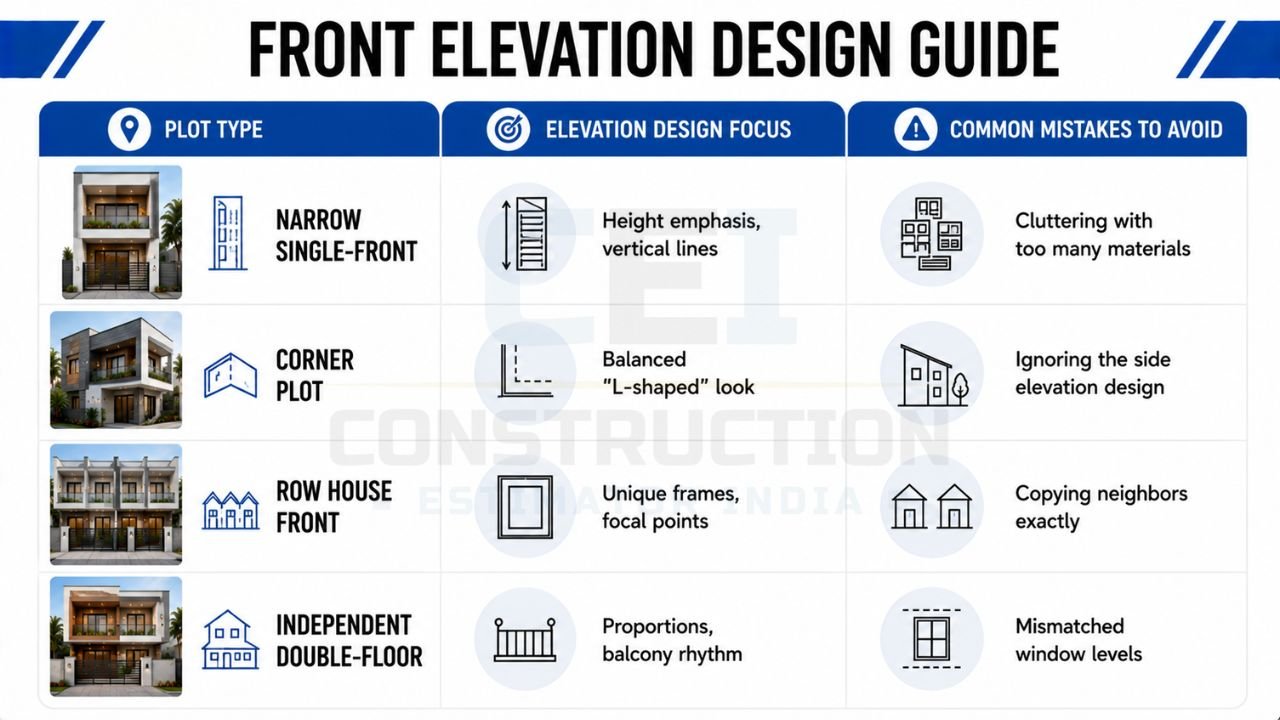
| Plot Type | Elevation Design Focus | Common Mistakes to Avoid |
|---|---|---|
| Narrow Single-Front | Height emphasis, vertical lines | Cluttering with too many materials |
| Corner Plot | Balanced “L-shaped” look | Ignoring the side elevation design |
| Row House Front | Unique frames, focal points | Copying neighbors exactly |
| Independent Double-Floor | Proportions, balcony rhythm | Mismatched window levels |
This table helps you focus on what matters most for your land configuration. If you are building a corner house, for example, ensure the “design” doesn’t end abruptly at the corner.
👉 Turn Your House Elevation Ideas into Reality with Expert Guidance.
Cost and Practical Planning for Elevation Design
Which Elevation Features Add the Most Cost
The most significant cost drivers in house elevation design are specialized materials and complex structural projections. Deep cantilevered balconies requiring extra steel reinforcement, large expanses of toughened glass, and extensive natural stone cladding push budgets upward. Façade lighting, while effective, also adds to electrical and hardware costs. By identifying these “premium” features early, you can decide where to splurge and where to save.
Designing a Good Elevation Within a Normal Budget
Achieving a modern look on a modest budget is possible by prioritizing proportion over expensive finishes. Use high-quality exterior paint and pick just one highlight element, such as a beautiful main door or a single vertical panel of stone-look tiles. This creates a focused, high-end appearance without the cost of cladding the entire house. Construction Estimator India helps you align these design decisions with your total budget.
How Construction Estimator India Helps with Elevation Costing?
At Construction Estimator India, we believe transparency is key to a stress-free building process. We prepare detailed quantity and cost estimates for different house elevation design options. Whether you want to know the price difference between glass and metal railings, or the quantity of paint required for a textured finish, our reports provide clarity. Knowing these numbers before construction starts helps you avoid running out of funds halfway through the project.
Frequent Mistakes and How to Avoid Them
Copying Reference Images Without Checking Plot and Climate
The “Pinterest Trap” can lead to poor proportions. Homeowners often try to squeeze features from a massive bungalow onto a 20-foot wide plot, resulting in a cramped look. Furthermore, a design with huge glass windows meant for a cold climate will turn an Indian living room into a furnace. Always adapt the “vibe” of an inspiration image to your specific plot and climate.
Mixing Too Many Materials and Colours
In an attempt to look “luxurious,” some owners include every trend: arches, box-frames, stone cladding, and colorful lights all on the same small façade. This results in a messy look that feels dated quickly. Successful house elevation design is about restraint; pick a style and stick to it, limiting the palette to two or three materials for a sophisticated look.
Forgetting Future Additions and Services
An elevation might look great on paper but fail in daily life. Many forget to plan for air conditioning outdoor units, which eventually get “pasted” onto beautiful front walls with dangling pipes. Similarly, not planning for water tanks or solar panels can spoil the roofline. If you plan to add a floor later, your current ground-floor design must be “expandable” so the addition doesn’t look like an awkward afterthought.
👉 Bring Your Dream Home to Life with a Customized Elevation Design.
FAQs: House Elevation Design for Indian Homes
Which elevation style is safest for small plots?
For small plots like 20×40 or 25×50, a modern house elevation design with vertical emphasis is the safest choice. It uses clean lines and minimal ornamentation to prevent a cluttered look. A “box-style” frame around the main balcony can add character without requiring much width.
Whether modern minimalist or mixed style works better for family houses?
The choice depends on neighborhood context and taste. If surrounding houses are modern, a contemporary look fits well. However, for multi-generational homes, a “contemporary mix” using modern shapes with warm, traditional colors and a small sloping roof section is often the best compromise.
How much elevation design typically contributes to overall construction cost?
Typically, “extra” costs for elevation features—like cladding, premium railings, and lighting—range from 5% to 12% of the total building expenditure. However, this varies greatly based on material choices. Contact Construction Estimator India for a precise estimate based on your specific design preferences.
How often elevation finishes need repainting or maintenance?
In most Indian cities, high-quality exterior paint lasts about 5 to 7 years. Texture paints can last slightly longer. Cladded surfaces like tiles or stone require less maintenance but should be checked every few years for loose adhesive. Regular washing of glass railings and gates is necessary to maintain the “new” look.
When to involve Construction Estimator India for elevation costing and quantity checks?
The best time to involve us is after your architect provides a “Draft Plan” but before you finalize structural drawings. This allows you to adjust the design if estimated costs exceed your budget. Knowing material quantities early gives you better control over contractor quotes.
Conclusion: Choose a House Elevation Design That Fits Your Plot, Climate, and Budget
Designing your home’s exterior is a journey of balancing aesthetic dreams with practical realities. The best house elevation design is not about the most expensive materials; it is about achieving perfect proportions, smart alignment, and a cohesive palette that respects your plot size and climate. Whether you prefer the sleek lines of a modern box-style home or the warmth of a traditional blend, your choice should enhance your daily life and provide a sense of pride.
Do not leave your construction budget to chance. Early planning and professional estimation are the keys to a stress-free building experience. Whether you are building a small house elevation or a grand double-floor villa, knowing your material quantities and expected costs is essential. Construction Estimator India is dedicated to helping homeowners navigate these choices with clarity and confidence.
Before you finalize your house elevation design drawings, reach out to the experts who can help you see the full financial picture. Contact Construction Estimator India on WhatsApp / Call +91 8630676890 today to ensure your dream home is built on a solid foundation of planning and budget awareness.