Choosing between an independent house vs flat which is better India is no longer just a financial decision; it is a lifestyle and legacy choice that will define your next 30 years. In 2026, the Indian real estate landscape has shifted dramatically. While metro cities like Delhi, Mumbai, and Bangalore continue to witness a vertical surge in luxury apartments, the post-pandemic craving for privacy and “plot ownership” has made independent houses a high-demand asset in Tier-2 and Tier-3 cities.
👉 Confused Between an Independent House and a Flat? – 📲 Contact Our Experts Today
At Construction Estimator India, we have helped over 500+ families navigate this dilemma by providing accurate professional house construction estimation services. Whether you are looking for the security of a gated community or the absolute freedom of building your own sanctuary, this guide breaks down every technical, financial, and Vastu-related detail you need.
The Quick Verdict:
- Choose an Independent House if you prioritize customization, long-term land appreciation, and Vastu perfection. It is the best option for multi-generational families.
- Choose a Flat/Apartment if you want a ready-to-move-in lifestyle, premium amenities (gym, pool), and 24/7 security with minimal personal effort in maintenance.
For accurate independent house vs flat cost estimation, custom BOQ, professional 3D plans or independent house construction service across India, WhatsApp or call us today at +91 8630676890.
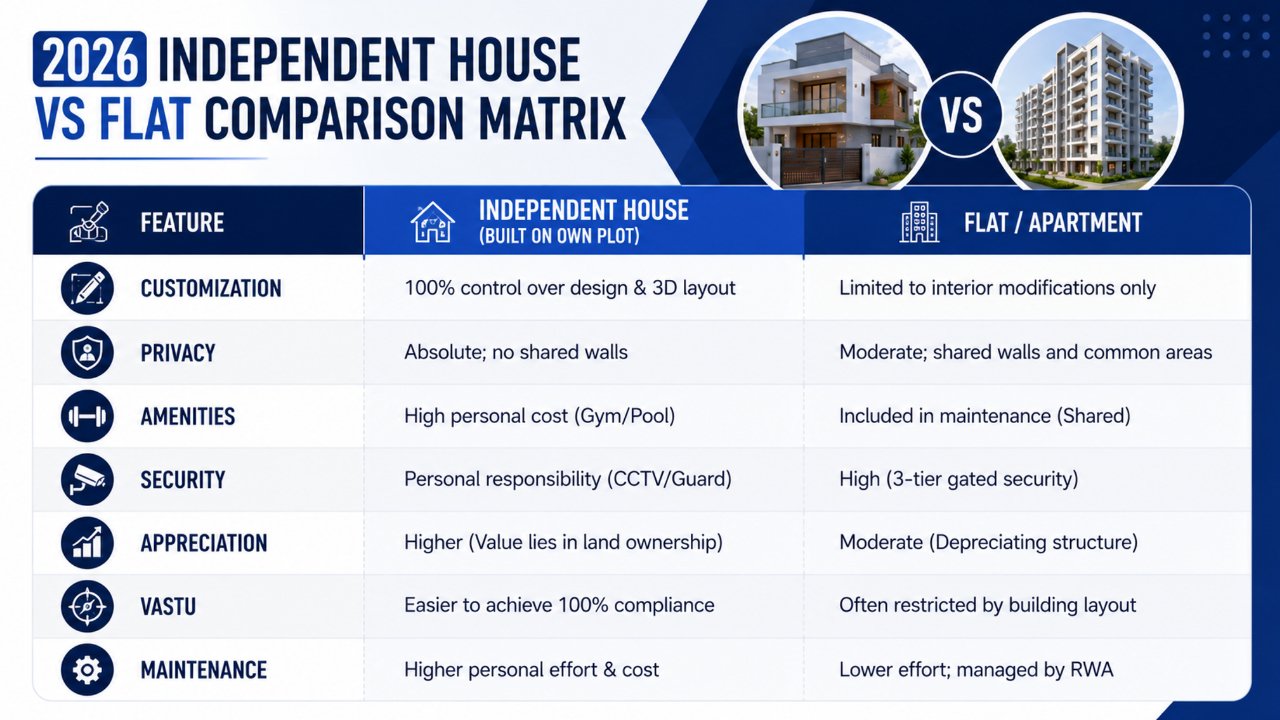
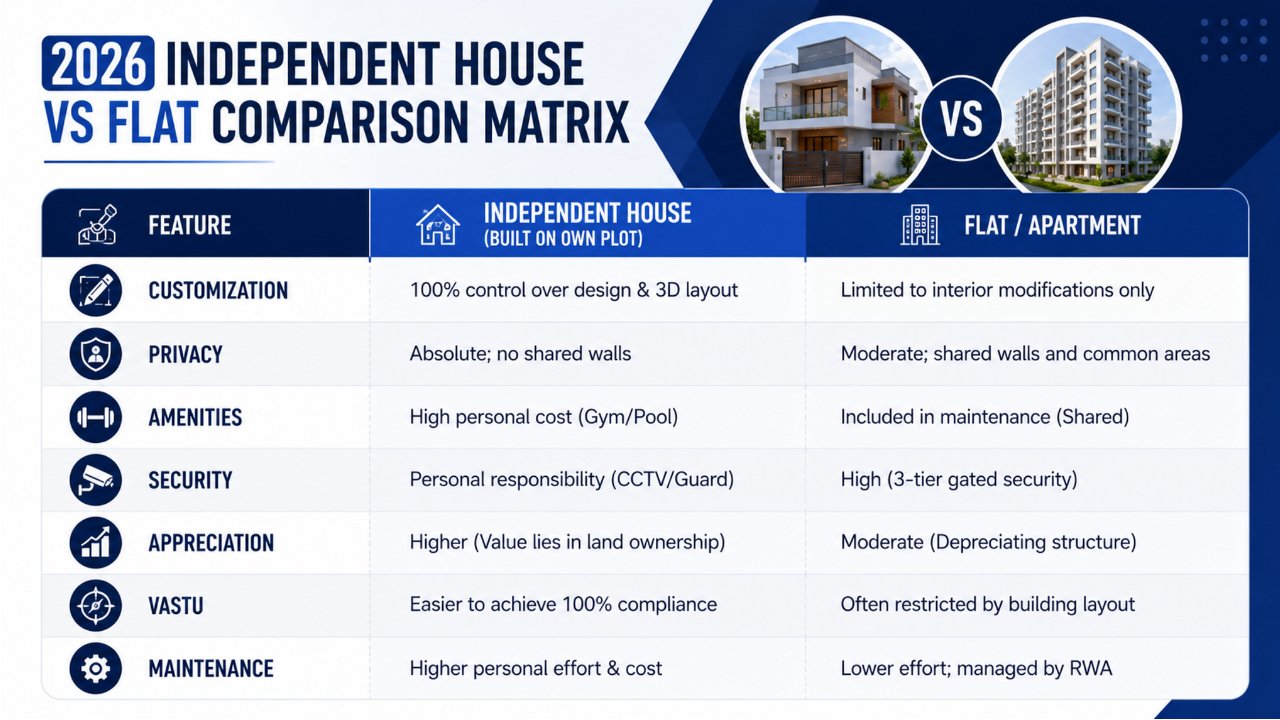
2026 Independent House vs Flat Comparison Matrix
👉 Get Expert Guidance to Choose the Right Home for Your Budget & Lifestyle – 📲 WhatsApp Now
| Feature | Independent House (Built on Own Plot) | Flat / Apartment |
|---|---|---|
| Customization | 100% control over design & 3D layout | Limited to interior modifications only |
| Privacy | Absolute; no shared walls | Moderate; shared walls and common areas |
| Amenities | High personal cost (Gym/Pool) | Included in maintenance (Shared) |
| Security | Personal responsibility (CCTV/Guard) | High (3-tier gated security) |
| Appreciation | Higher (Value lies in land ownership) | Moderate (Depreciating structure) |
| Vastu | Easier to achieve 100% compliance | Often restricted by building layout |
| Maintenance | Higher personal effort & cost | Lower effort; managed by RWA |
👉 Need Accurate House Construction Cost Estimates Before You Decide? – 📲 Start Chat Today
Pros and Cons of Independent House in 2026
Building an independent house remains the ultimate “Indian Dream.” With our 10+ years of construction estimating expertise, we’ve seen that the primary driver for houses is Control.
The Pros:
- Design Freedom: You can work with us to create professional 3D house plans & renderings that match your exact vision. From a double-height living room to a private terrace garden, the sky is the limit.
- Expansion Potential: Unlike a flat, a house allows you to add floors (G+1, G+2) as your family grows, provided you follow local FSI/FAR rules.
- Higher ROI on Land: In India, land appreciates much faster than the concrete structure. When you own an independent house, you own the asset that never depreciates: the earth beneath it.
- Modern Features: In 2026, houses are being built with EV charging points, solar provisions, and smart home automation integrated during the RCC framework stage.
The Cons:
- High Initial Effort: From getting DDA/MCD or local municipal approvals to finding a reliable contractor, the process is intensive.
- Security Costs: You must invest in your own safety systems.
- Maintenance: You are the “Manager” for everything from roof waterproofing to plumbing leaks.
Pros and Cons of Flats/Apartments in 2026
The shift towards flats is driven by the modern “work-life-amenity” balance.
The Pros:
- Community Living: Access to clubhouses, parks, and play areas for children.
- Ease of Purchase: Banks provide faster loans for RERA-registered apartment projects compared to self-construction loans.
- Location Advantage: Often, apartments are situated closer to IT hubs and commercial centers where buying land is impossible.
- Safety: 24/7 security is a major plus for nuclear families and seniors.
The Cons:
- High Monthly Maintenance: In 2026, maintenance charges in Tier-1 cities can range from ₹5,000 to ₹25,000 per month.
- Lack of Privacy: You are constantly surrounded by neighbors, and noise transfer through walls is a common complaint.
- No Expansion: You are stuck with the square footage you bought.
Detailed Cost Comparison: Construction vs Purchase
The debate of independent house vs flat cost usually depends on the location. In Delhi NCR, for example, an economy build starts at ₹1,800/sq. ft., while luxury builds can exceed ₹18,000/sq. ft..
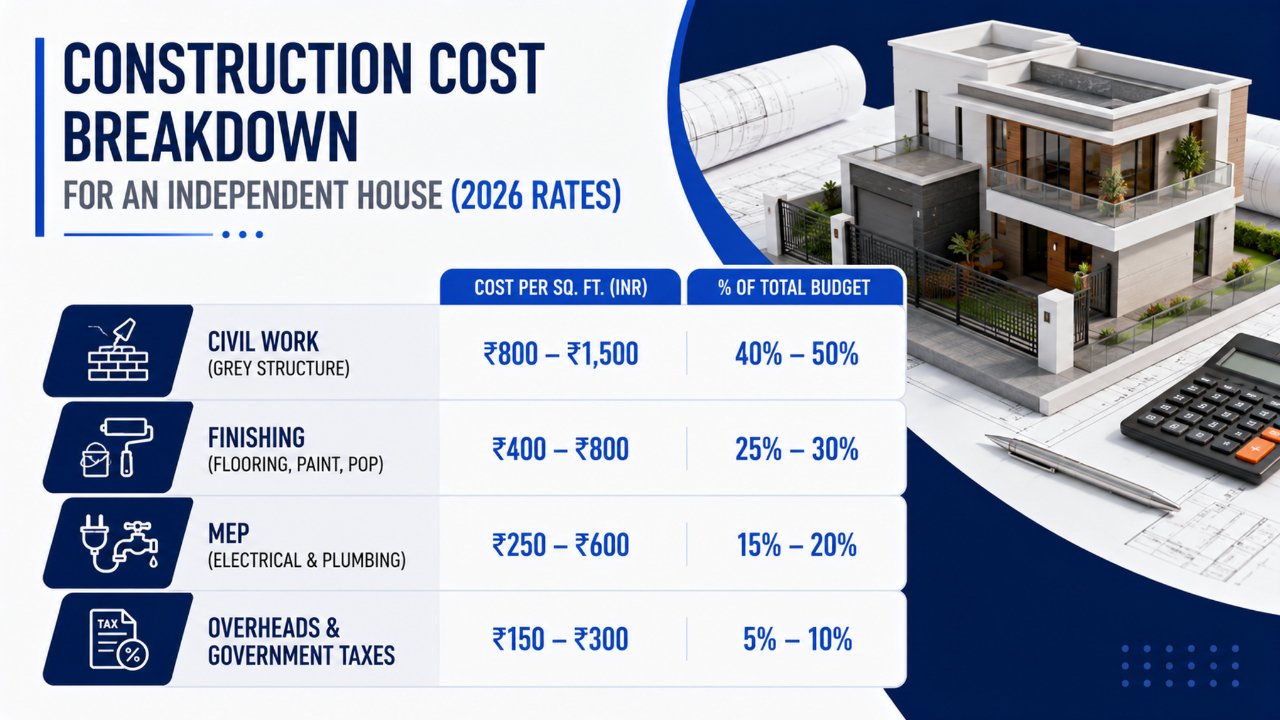
Construction Cost Breakdown for an Independent House (2026 Rates)
Based on official 2026 house construction cost trends in India, here is what you should expect when building:
👉 Compare Construction Costs, ROI & Vastu with Expert Advice – 📲 Talk to Our Team Today
| Component | Cost per Sq. Ft. (INR) | % of Total Budget |
|---|---|---|
| Civil Work (Grey Structure) | ₹800 – ₹1,500 | 40% – 50% |
| Finishing (Flooring, Paint, POP) | ₹400 – ₹800 | 25% – 30% |
| MEP (Electrical & Plumbing) | ₹250 – ₹600 | 15% – 20% |
| Overheads & Government Taxes | ₹150 – ₹300 | 5% – 10% |
Total Estimate (Standard Quality): ₹1,800 – ₹2,500 per sq. ft..
Flat/Apartment Purchase Costs
When buying a flat, you aren’t just paying for the area; you are paying for:
- Super Built-up Area: You pay for corridors and elevators you don’t live in.
- Preferential Location Charges (PLC): Extra for park-facing or higher floors.
- GST: 5% for non-affordable housing (without ITC).
For a precise house construction cost estimation services report that covers city-specific material rates, call us at +91 8630676890.
Vastu Considerations for Independent House vs Flat
Following Vastu Shastra guidelines for independent house vs flat in India 2026 is a priority for 80% of Indian home buyers.
- Independent House: You have 100% control. You can ensure the kitchen is in the Southeast (Agni), the Master Bedroom is in the Southwest (Nairutya), and the main entrance faces the auspicious North or East.
- Flats: You are often forced to compromise. While the flat interior might be Vastu-compliant, the overall building shape or the placement of lifts and staircases might create “Vastu Doshas” that are hard to fix.
Vastu Independent House vs Flat Tip: Always check the “Mukhya Dwar” (Main Door) and the placement of the toilet before finalizing a flat. In a house, we can plan these perfectly in our 3D renderings.
👉 Avoid Costly Home Buying & Construction Mistakes with Accurate Planning – 📲 Chat With Us Now
Investment & Resale Value Analysis
If you are looking at independent house vs flat which is better India from an investment lens, consider these latest 2026 independent house vs flat trends and prices in India:
- Rental Yield: Flats generally offer better rental yields (2.5% – 4%) because they are easier for tenants to manage and usually located near offices.
- Appreciation: Independent houses win here. The land value in cities like Gurgaon, Pune, or Bangalore has seen 15–20% YoY growth, whereas flat prices often stagnate after the first 10 years as the building ages.
- Liquidity: Flats are easier to sell. Selling a house takes time as you need to find a buyer who appreciates your specific design and has the budget for a larger land-based asset.
Lifestyle & Security: The Gated Community Debate
In 2026, lifestyle is the biggest differentiator.
👉 Make a Smart Investment with Expert House Construction & Budget Planning – 📲 Get Started Today
- The “Flat” Lifestyle: Imagine waking up and walking to a clubhouse gym, having your Amazon packages safely stored at a digital locker, and knowing your kids are playing in a vehicle-free zone. This is why many young professionals choose apartments.
- The “House” Lifestyle: Imagine a private garden where you grow your organic vegetables, a rooftop deck for parties, and the silence of not having a neighbor’s toddler running on the floor above you. This is the luxury of an independent house.
How to Decide Based on Your Needs?
We recommend a simple 3-step framework:
- Budget: If your budget is under ₹70 Lakhs in a Metro, a flat is more realistic. If you have ₹1.5 Cr+ or already own a plot, an independent house is far superior.
- Family Size: For joint families, an independent house is a necessity to provide everyone with their own “zone.”
- Management Capacity: If you are a busy professional who travels often, buy a flat. If you enjoy managing projects and want a “legacy home,” build a house.
Common Mistakes Home Buyers Make
- Ignoring Maintenance Charges: People buy luxury flats but forget that the ₹15,000/month maintenance fee will increase every year.
- Underestimating Construction Costs: Homeowners often think a house will cost ₹1,500/sq. ft., forgetting that premium finishes and MEP systems can push it to ₹3,500+.
- Not Using a BOQ: Many hire contractors on a “per sq. ft.” basis without a detailed Bill of Quantities, leading to massive overruns.
- Skipping 3D Design: Building without seeing a 3D rendering leads to “architectural regret” once the slab is cast.
Avoid these mistakes! Get a ₹99 BOQ template or a custom estimate from Construction Estimator India. WhatsApp us +91 8630676890.
FAQs: Independent House vs Flat Which is Better India
Q1: Which is cheaper to maintain, a house or a flat?
A: Initially, a flat is cheaper because the costs are shared. However, long-term, high-rise maintenance fees (elevators, fire safety) can become more expensive than maintaining a simple independent house.
Q2: Can I get a bank loan for constructing a house in India?
A: Yes, banks offer “Composite Loans” for land purchase + construction or “Construction Loans” if you already own the plot. You will need a professional BOQ and approved plans.
Q3: Is Vastu more important in a house or a flat?
A: It is important in both, but much easier to fix in an independent house. In a flat, you are often stuck with structural Vastu defects.
Q4: What is the average construction cost for a 1000 sq. ft. house in 2026?
A: It ranges from ₹18 Lakhs (standard) to ₹35 Lakhs+ (premium), excluding land costs.
Q5: Are builder floors better than flats?
A: Builder floors are a middle ground—offering more privacy than a flat but better security than a standalone house. They are very popular in New Delhi.
Q6: What are the current steel and cement rates in India?
A: As of 2026, cement is roughly ₹380–420 per bag and TMT steel is ₹65–78 per kg.