
Choosing the right masonry material is one of the most critical decisions in construction. Material selection directly affects structural strength, thermal performance, cost, construction speed, and long-term durability. Homeowners, builders, contractors, civil engineers, property developers, and anyone planning house construction in India often face the question: Red Bricks vs Fly Ash Bricks vs AAC Blocks — Which Is Better for Construction? Red bricks are traditional clay bricks, fly ash bricks are machine-pressed eco-friendly bricks, and AAC blocks are lightweight precast concrete blocks. Each material has distinct advantages, and the best choice depends on construction type, budget, thermal requirements, and long-term goals.
👉 Confused Between Red Bricks, Fly Ash Bricks & AAC Blocks? – 📲 Contact Our Experts Today
This detailed comparison guide examines Red Bricks vs Fly Ash Bricks vs AAC Blocks across composition, manufacturing process, compressive strength, cost, thermal insulation, sound insulation, water absorption, durability, environmental impact, and suitability for specific construction applications (foundations, load-bearing walls, partition walls, multi-storey buildings) in India.
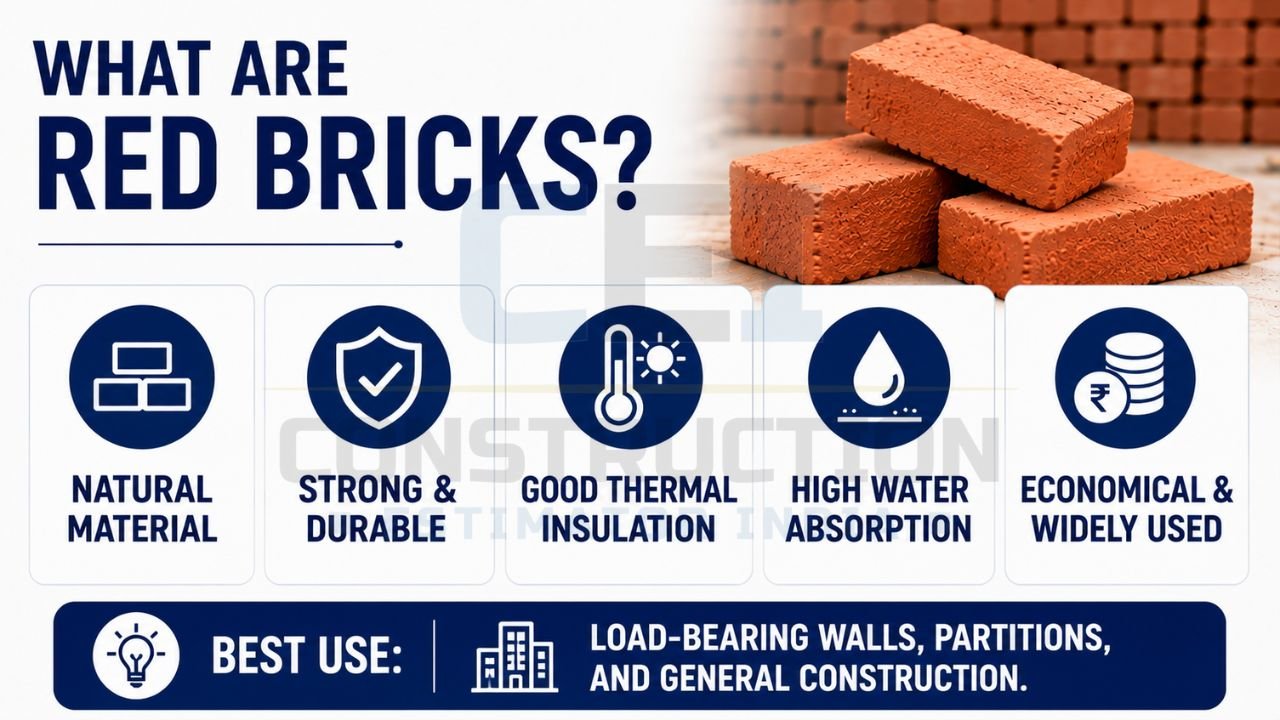
What Are Red Bricks?
Red bricks are the most traditional building material used in India for centuries. They are made from clay soil, molded into shape, and baked in kilns at high temperatures.
👉 Confused Between Red Bricks, Fly Ash Bricks & AAC Blocks? – 📲 Contact Our Experts Today
Manufacturing Process of Red Bricks
Clay is extracted from topsoil, mixed with water, molded into brick shape, dried in the sun, and then fired in kilns at 1,000–1,200°C. The high-temperature firing gives red bricks their characteristic color and strength. Standard size is 9″ x 4″ x 3″ (230mm x 115mm x 76mm).
Advantages of Red Bricks
- High compressive strength for load-bearing walls (3–4 MPa for Class A and B bricks).
- Excellent fire resistance (up to 4 hours).
- Good thermal insulation in thick walls.
- Readily available across India.
- Traditional aesthetic appeal.
Disadvantages of Red Bricks
- Heavy weight increases structural load and foundation costs.
- High water absorption (20–25%), leading to dampness issues.
- Inconsistent size and shape, requiring more mortar and plaster.
- Environmental concerns (topsoil depletion, kiln emissions, deforestation).
- More mortar required for joints, increasing construction cost.
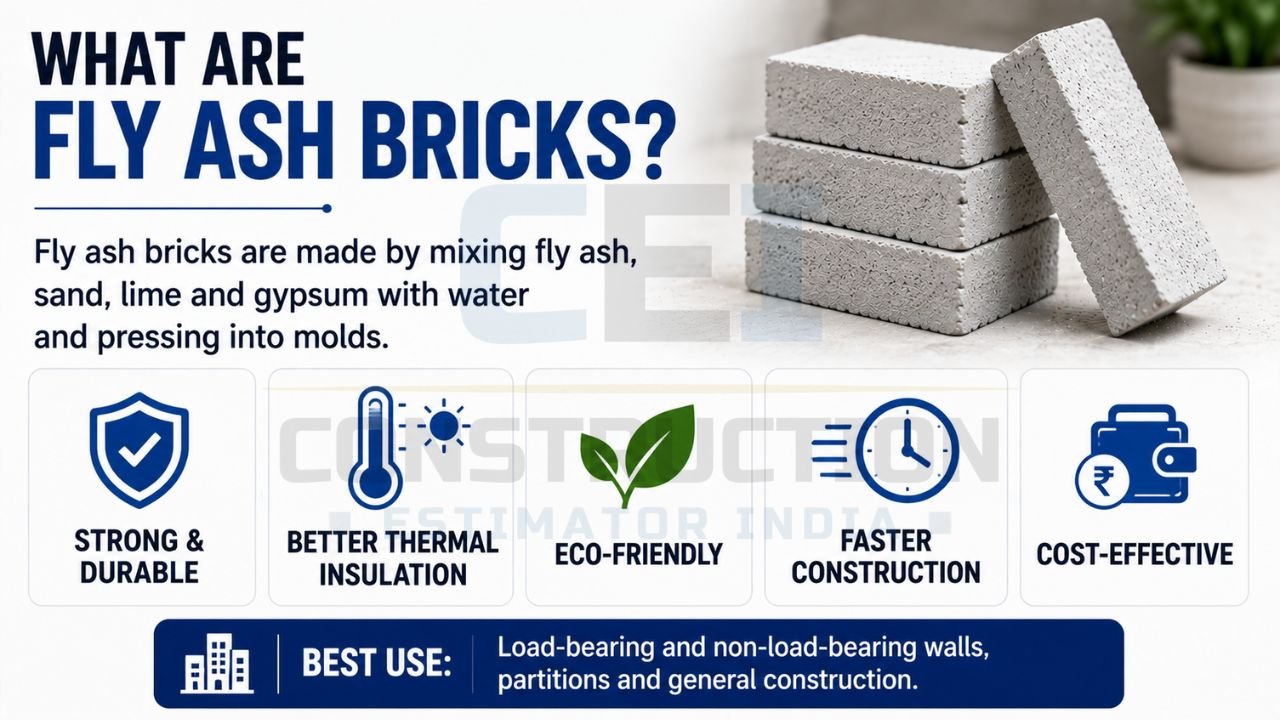
What Are Fly Ash Bricks?
Fly ash bricks are machine-pressed bricks made from fly ash (thermal power plant waste), lime, gypsum, and sand. They are an eco-friendly alternative to red bricks.
👉 Choose the Right Building Material for Stronger Construction – 📲 WhatsApp Now
Manufacturing Process of Fly Ash Bricks
Fly ash, lime, gypsum, and sand are mixed in precise proportions, pressed under high pressure in hydraulic machines, and cured with steam or water. The process is faster and more controlled than red brick production. Standard size is similar to red bricks (9″ x 4″ x 3″).
Advantages of Fly Ash Bricks
- Higher compressive strength (7–10 MPa) than red bricks.
- Uniform size and smooth finish (less plaster required).
- Lower water absorption (10–15%).
- Eco-friendly (uses industrial waste fly ash).
- Cost-effective (₹6–12 per brick).
- Better dimensional accuracy and less wastage.
Disadvantages of Fly Ash Bricks
- Lower fire resistance compared to red bricks.
- Not suitable for foundations or load-bearing walls in high-rise buildings.
- Requires skilled masons for proper laying.
- Limited availability in rural areas.
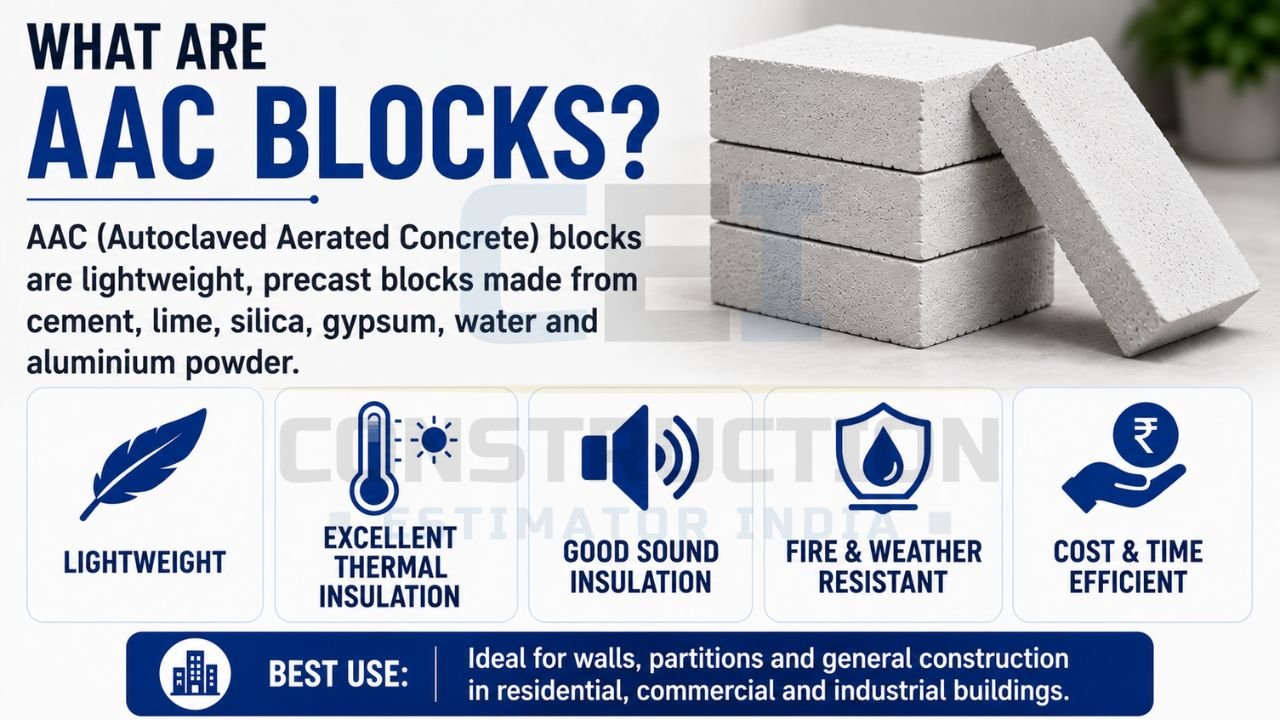
What Are AAC Blocks?
AAC (Autoclaved Aerated Concrete) blocks are lightweight precast concrete blocks made from cement, lime, quartz sand, water, and aluminum powder. They are cured in autoclaves under high pressure and temperature.
👉 Get Professional Material Planning & Cost Estimates – 📲 Message Us Now
Manufacturing Process of AAC Blocks
Cement, lime, sand, and water are mixed with aluminum powder to create a foam-like mixture. The mixture is poured into molds, allowed to rise, cut into blocks, and cured in autoclaves at high pressure and temperature. Common size is 24″ x 8″ x 8″ (600mm x 200mm x varying thickness).
Advantages of AAC Blocks
- Very lightweight (3 times lighter than red bricks).
- Excellent thermal insulation (reduces AC/heating costs).
- High sound insulation.
- Fire resistant (up to 4 hours).
- Low water absorption (5–10%).
- Less mortar required (thin joints).
- Faster construction (larger blocks).
Disadvantages of AAC Blocks
- Higher material cost (₹40–80 per block).
- Requires specialized adhesives for laying.
- Brittle and prone to cracks if not handled properly.
- Not suitable for load-bearing walls in high-rise buildings.
- Limited availability in some regions.
👉 Build Smarter with the Right Masonry Material for Your Project – 📲 Talk to Our Team Today
Red Bricks vs Fly Ash Bricks vs AAC Blocks — Key Differences
Here is a clear comparison table for quick understanding:
| Feature | Red Bricks | Fly Ash Bricks | AAC Blocks |
| Composition | Clay soil | Fly ash, lime, cement, sand | Cement, lime, quartz sand, aluminum powder |
| Compressive Strength | 3–4 MPa | 7–10 MPa | 3–6 MPa |
| Weight | Heavy (1,800 kg/m³) | Medium (1,600 kg/m³) | Light (600–800 kg/m³) |
| Water Absorption | 20–25% | 10–15% | 5–10% |
| Thermal Insulation | Moderate | Moderate | High |
| Sound Insulation | Moderate | Moderate | High |
| Fire Resistance | High | High | Very High (4 hours) |
| Cost (Approx) | ₹8–14 per brick | ₹6–12 per brick | ₹40–80 per block |
| Environmental Impact | High (kiln emissions) | Low (uses waste fly ash) | Moderate |
| Best For | Foundations, load-bearing walls | Internal walls, partition walls | Multi-storey, thermal insulation |
Cost Comparison: Red Bricks vs Fly Ash Bricks vs AAC Blocks
Red bricks typically cost ₹55–75 per sq.ft. (material + labour + plaster). Fly ash bricks cost ₹50–70 per sq.ft. AAC blocks cost ₹60–80 per sq.ft. AAC blocks may have higher material cost but save on labour, plaster, and structural load due to their lightweight nature. When planning your project budget, consider total wall cost including material, labour, mortar, and plaster.
For accurate cost planning: What is Estimation in Construction and What is Quantity Takeoff in Construction.
Strength and Durability Comparison
Fly Ash Bricks have the highest compressive strength (7–10 MPa), making them suitable for internal walls and partition walls. Red bricks (3–4 MPa) are traditional for load-bearing walls. AAC blocks (3–6 MPa) are lightweight but have good strength for non-load-bearing applications. Long-term durability is highest in Fly Ash Bricks due to low water absorption and chemical resistance. Red Bricks are durable but require thick walls. AAC blocks offer good durability with proper handling.
👉 Better Materials Mean Better Strength, Comfort & Savings – 📲 Contact Us Now
Thermal and Sound Insulation
AAC Blocks provide the best thermal insulation, reducing air conditioning costs by up to 30% in hot Indian summers. Fly Ash Bricks and Red Bricks offer moderate insulation. AAC blocks also provide excellent sound insulation, making them ideal for urban residential projects. Red Bricks require thick walls for good insulation, increasing overall cost.
Water Absorption and Moisture Resistance
AAC Blocks have the lowest water absorption (5–10%), making them best for moisture-prone areas. Fly Ash Bricks (10–15%) are better than red bricks (20–25%). Low water absorption reduces efflorescence, dampness, and structural damage in monsoon-prone regions of India.
Environmental Impact and Sustainability
Fly Ash Bricks are the most eco-friendly as they use industrial waste (fly ash) from thermal power plants. AAC Blocks have moderate impact due to cement production emissions. Red Bricks have the highest environmental impact due to topsoil depletion, kiln emissions, and deforestation. Many government projects now prefer Fly Ash Bricks and AAC Blocks for sustainability.
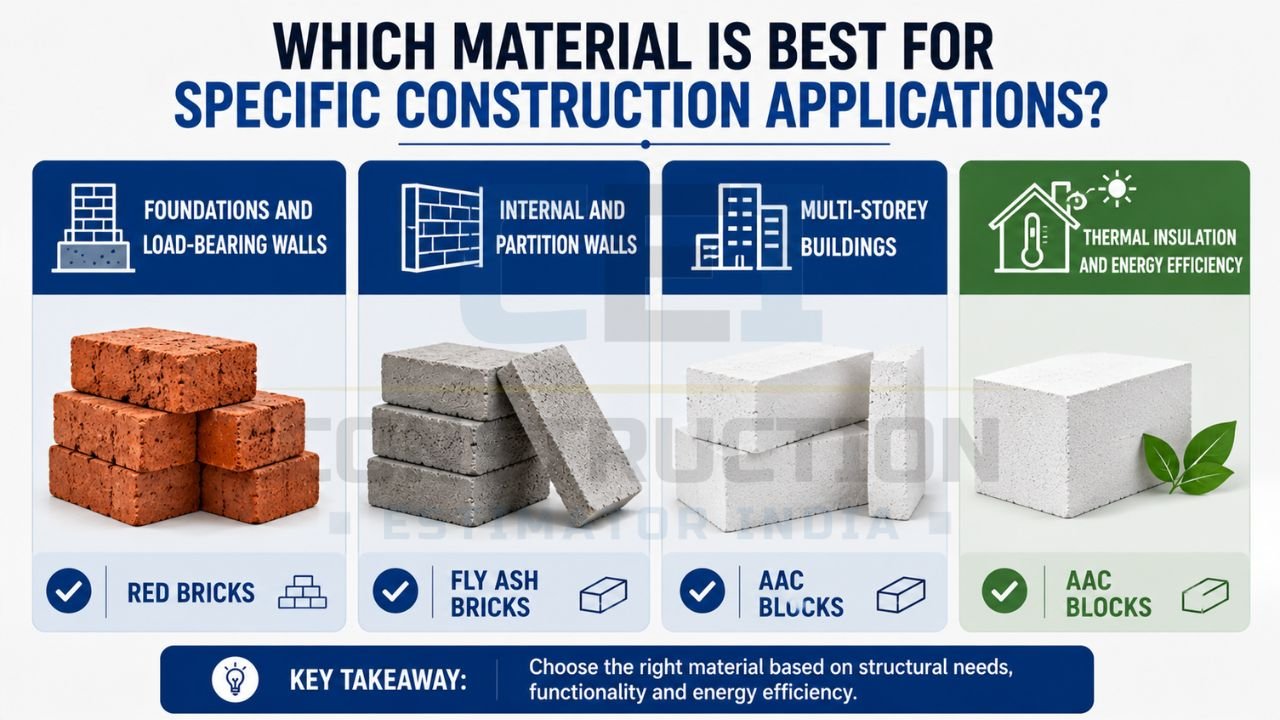
Which Material Is Best for Specific Construction Applications?
👉 Better Materials Mean Better Strength, Comfort & Savings – 📲 Contact Us Now
Foundations and Load-Bearing Walls
Red Bricks are the traditional choice for foundations and load-bearing walls due to high compressive strength. Fly Ash Bricks are suitable for low-rise load-bearing walls. AAC Blocks are not recommended for foundations.
Internal and Partition Walls
Fly Ash Bricks are best for internal walls due to smooth finish and less plaster requirement. AAC Blocks are lightweight with excellent sound insulation.
Multi-Storey Buildings
AAC Blocks are best for high-rise buildings as they reduce structural load. Fly Ash Bricks are suitable for mid-rise structures.
Thermal Insulation and Energy Efficiency
AAC Blocks are the best choice for thermal insulation, significantly reducing AC and heating costs in Indian climate conditions.
Construction Time and Labour Requirements
AAC Blocks enable faster construction due to larger size and thin joints. Fly Ash Bricks offer moderate speed with uniform size. Red Bricks require more time due to smaller size and more joints. Labour costs are lower for AAC Blocks and Fly Ash Bricks due to faster laying.
For timeline expectations: How Long Does It Take to Build a House in India.
Cement and Sand Compatibility
Fly Ash Bricks require less cement mortar due to smooth surface. AAC Blocks require special adhesives or thin joint mortar. Red Bricks require more cement mortar due to rough surface. Sand quality affects mortar strength — M Sand is preferred for modern construction.
For sand guidance: River Sand vs M Sand.
For cement guidance: PPC vs OPC Cement Which Is Better in India.
👉 Get Accurate BOQ, Quantity Takeoff & Material Estimates – 📲 Chat With Us Now
Common Mistakes to Avoid When Choosing Masonry Materials
Homeowners often make these mistakes:
- Using AAC blocks for foundations.
- Choosing cheap, low-quality bricks.
- Ignoring thermal and sound insulation needs.
- Not calculating total wall cost (material + labour + plaster).
- Using red bricks in high-rise buildings (increases structural load).
Avoiding these mistakes saves money and prevents structural issues.
For common expensive mistakes: 7 Common Expensive Mistakes in House Construction in India.
Why Construction Projects Fail: Masonry Material Matters
Poor masonry material selection contributes to project failure through weak walls, cracks in plaster, structural durability issues, and increased rework costs. Proper material choice, combined with quality cement, sand, and professional estimation, ensures durable and cost-effective construction.
For reasons why projects fail: 5 Reasons Why Construction Projects Fail in India.
Why Construction Estimator India?
Construction Estimator India is a trusted advisor for construction material selection and cost planning. We provide expert guidance on brick and block selection, transparent cost estimates, material quality verification, professional estimation and quantity takeoff, and end-to-end construction support to help you build stronger, more economical, and sustainable projects in India.
Conclusion
Red Bricks vs Fly Ash Bricks vs AAC Blocks depends on construction type, budget, and long-term goals. Fly ash bricks offer best strength and cost efficiency, AAC blocks provide best thermal insulation and lightweight construction, and red bricks remain suitable for traditional load-bearing walls. Proper material selection, combined with quality cement, sand, and professional estimation, ensures durable and cost-effective construction.
Are you unsure whether to use Red Bricks, Fly Ash Bricks, or AAC Blocks for your house construction, renovation, or commercial project in India? As a trusted construction cost planning and material selection partner, Construction Estimator India helps homeowners and builders choose the right masonry material for strength, durability, and cost efficiency. From material guidance to detailed estimation and quantity takeoff, we provide end-to-end solutions to protect your investment.
Contact us today for a free consultation and detailed construction material & cost plan!
📞 Call / WhatsApp: +91 8630676890
🌐 Visit Us: Construction Estimator India
📍 Serving: Across India – Dehradun, Roorkee, Haridwar, Rishikesh, Delhi, Mumbai, Bangalore, and more
FAQ Section
Which is better: fly ash bricks or AAC blocks?
Fly ash bricks offer higher compressive strength and cost efficiency for internal walls. AAC blocks provide superior thermal insulation and lightweight construction for multi-storey buildings.
Can I use AAC blocks for load-bearing walls?
AAC blocks are not recommended for load-bearing walls in high-rise buildings due to lower compressive strength. They are best for non-load-bearing partition walls.
Why are fly ash bricks stronger than red bricks?
Fly ash bricks have higher compressive strength (7–10 MPa) due to machine pressing and controlled manufacturing, compared to red bricks (3–4 MPa).
How much does AAC block construction cost per sq.ft.?
AAC block construction costs ₹60–80 per sq.ft. (material + labour + plaster), which is competitive when considering faster construction and reduced structural load.
Are red bricks obsolete in modern construction?
Red bricks are still used for foundations and low-rise load-bearing walls but are increasingly replaced by fly ash bricks and AAC blocks due to environmental and cost concerns.
Which material is best for thermal insulation?
AAC blocks are the best for thermal insulation, significantly reducing air conditioning costs in Indian climate conditions.
Do AAC blocks require special adhesives?
Yes. AAC blocks require special thin joint mortar or adhesives for laying due to their smooth surface and precise dimensions.