
The mutation certificate is an essential document for property ownership transfer in India. It is also known as “Dakhil-Kharij” in Hindi and refers to the change or transfer of property ownership from one person to another in the land revenue department records. Buyers must check sale deeds, encumbrance certificates, land records, mutation entries, and litigation status to ensure clear and marketable title. Understanding What is Mutation Certificate helps property buyers, owners, and investors avoid legal complications and ensure smooth ownership transfer.
👉 Get a Complete Mutation & Property Documentation Checklist – 📲 Message Us Now
This comprehensive guide is designed for homebuyers, property investors, land purchasers, legal advisors, and anyone buying or inheriting property in India. It covers title verification, land records, encumbrance certificates, mutation records, 7/12 extracts, Patta/Khata/RTC, online portals, CERSAI checks, litigation searches, and legal due diligence steps.
Why Title Verification Matters?
Proper verification of land ownership and title prevents buying disputed or encumbered property that could lead to prolonged legal battles. It avoids legal disputes and litigation that can tie up your investment for years. It ensures loan eligibility, as banks and financial institutions reject properties with unclear titles for home loans. Legal verification protects against fraud and fake sellers who may not have clear ownership rights. It guarantees future saleability and market value of the property. Compliance with local municipal laws ensures you are not liable for penalties or legal action. In India, where title disputes are common, thorough due diligence is essential for safe property transactions.
For home loan guidance on under-construction properties: Home Loan for Under-Construction Property India.
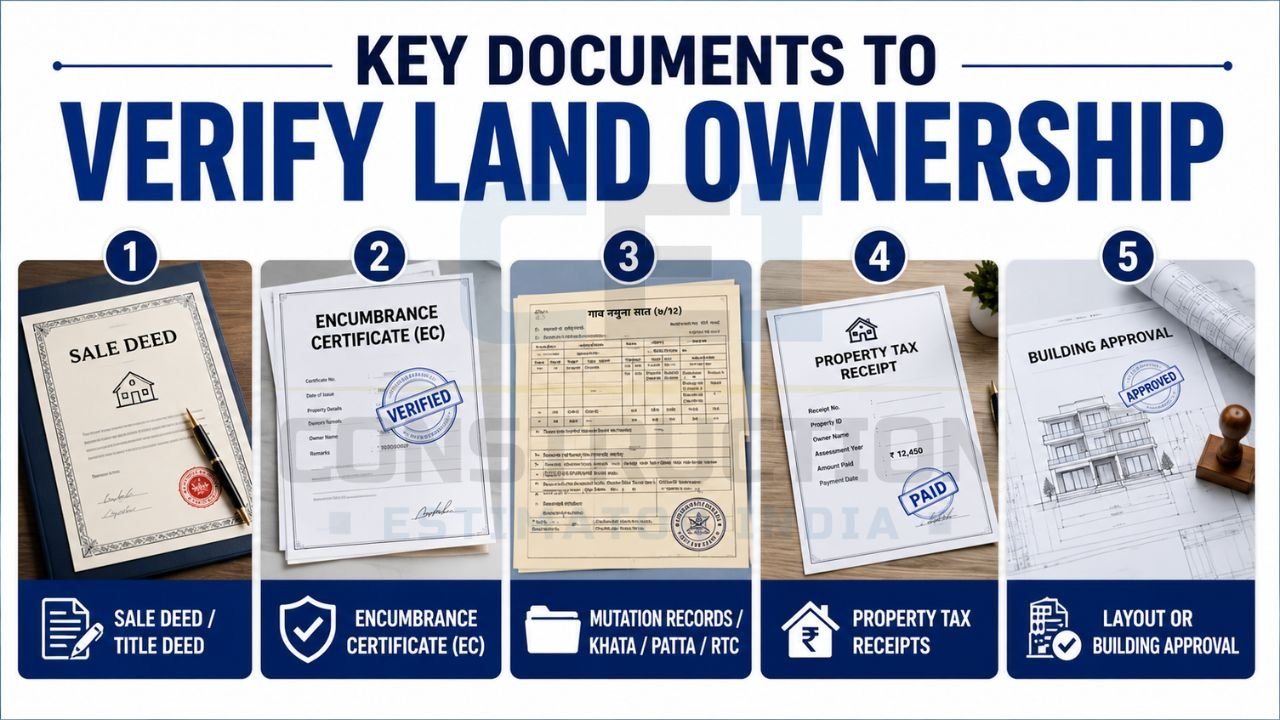
Key Documents to Verify Land Ownership
Several key documents must be examined to confirm clear ownership.
👉 Avoid Future Property Disputes with Proper Mutation Records – 📲 Contact Us Now
Sale Deed / Title Deed
The sale deed is the primary proof of ownership transfer. It must be registered at the Sub-Registrar’s office. Verify the continuous chain of ownership through the Mother Deed and subsequent sale deeds. Check that names, survey numbers, property description, and boundaries match exactly. Any mismatch or missing links in the ownership chain is a major red flag.
Encumbrance Certificate (EC)
The Encumbrance Certificate shows all financial and legal liabilities on the property. It should be obtained from the Sub-Registrar’s office and cover at least 13–30 years of property history. Verify no mortgages, loans, liens, or legal burdens exist on the property. A clear EC is mandatory for safe property purchase.
Mutation Records / Khata / Patta / RTC
These are land revenue records showing ownership. In Maharashtra and Gujarat, check the 7/12 Extract. In Karnataka, verify the RTC Pahani. In Tamil Nadu, check Patta Chitta. In Telangana and Andhra Pradesh, verify Khata records. The seller’s name must be recorded as the current owner in revenue records. Any mismatch requires clarification and correction.
Property Tax Receipts
Latest property tax payment receipts confirm active ownership and possession. Verify the name matches the seller and check for any unpaid taxes or dues that could create encumbrances.
👉 Buying Property? Don’t Forget the Mutation Process – 📲 Contact Our Experts
Layout or Building Approval
For plots and buildings, approval from local authorities is mandatory. Verify the approved layout plan from the municipal corporation and building plan approval from the relevant development authority (MDDA, BDA, BBMP, GHMC, etc.). Ensure the actual construction matches the approved plan.
For building plan guidance: Building Plan Approval India and How to Get Construction Permit India.
Step-by-Step: How to Verify the Ownership and Title of the Land
Follow this systematic verification process before buying or investing in any property.
Step 1: Check Current Ownership via Land Records
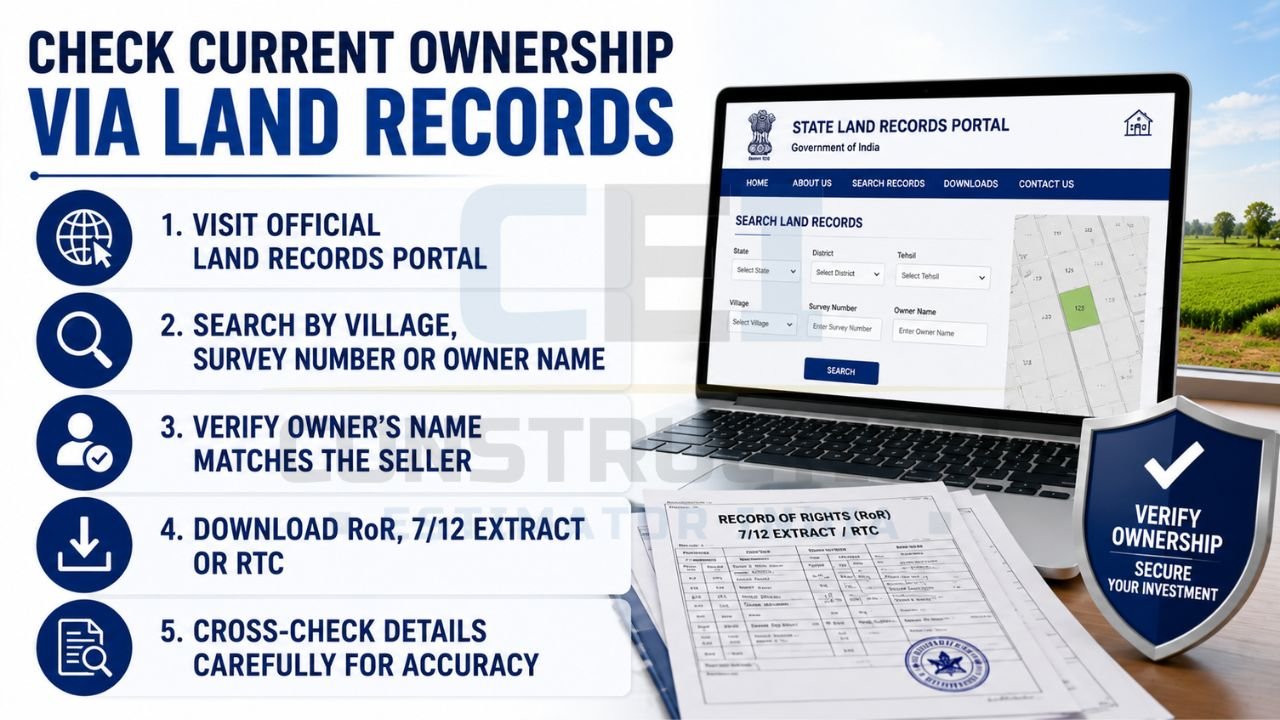
Most states have digitized land records online. Visit your state’s official land records portal. Search by village, survey number, or owner name. Verify the current owner’s name matches the seller. Download Record of Rights (RoR), 7/12 extract, or RTC. Cross-check the details carefully for accuracy.
👉 Expert Support for Property Verification & Legal Compliance – 📲 Message Us Today
Step 2: Verify Mutation Register
Mutation records show changes in ownership over time. Check the Form VI or Register of Mutation. Records transfers, loans, and property changes. Cross-check with revenue office records to ensure the seller is the recorded owner.
Step 3: Obtain Encumbrance Certificate (EC)
Apply for the Encumbrance Certificate from the Sub-Registrar’s office. Request a Nil Encumbrance Certificate covering 13–30 years. Verify no mortgages, loans, or legal liabilities exist on the property.
Step 4: Check CERSAI for Bank Loans
CERSAI maintains a database of assets pledged with banks. Visit the CERSAI portal (cersai.org.in). Search by property address or owner name. Verify no bank loans or mortgages are pending.
Step 5: Inspect Registrar’s Office Records
Physical verification at the Sub-Registrar’s office is essential. Check Book No. 1, Index 1, and Index 2. Verify all registered documents (sale deeds, mortgages, gifts). Cross-check with online records for consistency.
Step 6: Verify Physical Possession
Factual possession must be confirmed. Visit the property physically. Verify boundaries, access, and possession. Check for encroachments or disputes. Physical possession should match the records.
👉 From Mutation Certificates to Building Approvals, We Help You Every Step – 📲 WhatsApp Our Team Now
Step 7: Check Court Litigation Status
Search the e-Courts portal (ecourts.gov.in) using the property address or owner name. Verify no civil or criminal litigation is pending. Check local court records for any property disputes or ongoing cases.
Step 8: Verify Land Use and Zoning
Land use classification must match the construction purpose. Check land records for zoning (residential, commercial, agricultural). Verify conversion approval if agricultural land is used for construction. Ensure no land use violations exist.
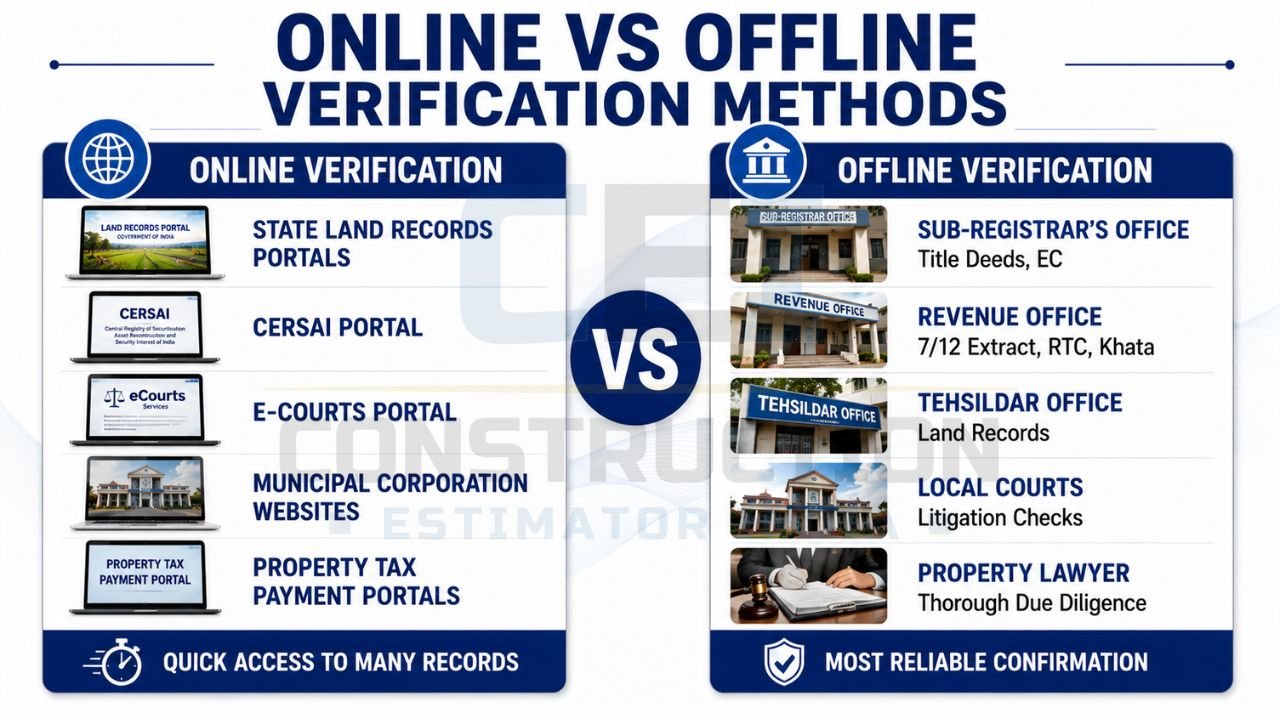
Online vs Offline Verification Methods
👉 Your Trusted Partner for Property Verification & Mutation Services – 📲 Contact Now
Online Verification
Use state land records portals, CERSAI portal, e-Courts portal, municipal corporation websites, and property tax payment portals. These provide quick access to many records.
Offline Verification
Visit the Sub-Registrar’s office for title deeds and EC, revenue office for 7/12 extract, RTC, Khata, Tehsildar office for land records, local courts for litigation checks, and consult a property lawyer for thorough due diligence. Offline verification provides the most reliable confirmation.
State-Wise Land Records Portals
Major state portals for land records include:
- Tamil Nadu: Patta Chitta, A-Register, FMB (eservices.tn.gov.in)
- Maharashtra: 7/12 Extract, Form VIII A (mahabhulekh.gov.in)
- Karnataka: RTC Pahani, Mutation (landrecords.karnataka.gov.in)
- Telangana: Dharani Portal (dharani.telangana.gov.in)
- Andhra Pradesh: Meebhoomi (meebhoomi.ap.gov.in)
- Uttar Pradesh: Bhulekh (upbhulekh.gov.in)
- Madhya Pradesh: MP Bhulekh (mpbhulekh.gov.in)
- Gujarat: e-Dhara (edhara.gujarat.gov.in)
- Haryana: Jamabandi (jamabandi.nic.in)
- Rajasthan: Apna Khata (apnakhata.raj.nic.in)
Red Flags: Warning Signs of Unclear Title
Watch for these warning signs:
- Seller refuses to show original documents.
- Gaps in ownership chain (Mother Deed missing).
- Mismatched names or survey numbers.
- Encumbrance Certificate shows mortgages or loans.
- Property is under litigation.
- Mutation records don’t match seller’s name.
- Banks refuse to approve loans.
- Physical possession differs from records.
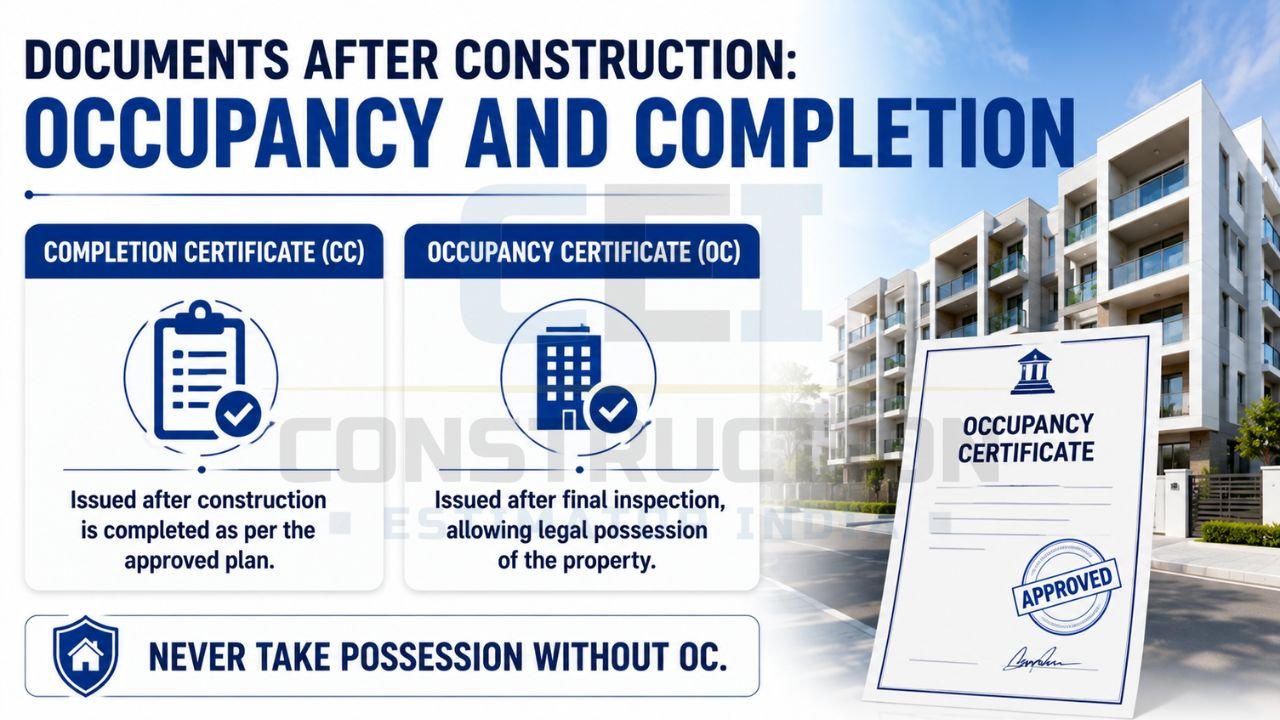
Documents After Construction: Occupancy and Completion
👉 Secure Your Investment with Proper Property Documentation – 📲 Talk to Us Today
After construction is complete, buyers and owners must verify occupancy and completion certificates for legal possession. Completion Certificate (CC) is issued after construction is completed as per the approved plan. Occupancy Certificate (OC) is issued after final inspection, allowing legal possession. Never take possession without OC.
For detailed guidance: Occupancy Certificate India Guide and Completion Certificate Guide India.
Things to Know Before Building a House in India
Legal verification is crucial before starting construction. Understand land title verification, building plan approval process, construction permits and licenses, occupancy and completion certificates, and tax and legal compliance.
For complete guidance: Things to Know Before Building a House in India.
Hiring Contractors and Builders: What to Check
After verifying land title, selecting the right contractor is equally important. Check contractor experience and past projects, written agreements and payment terms, quality of materials and workmanship, and timeline commitments and delivery track record.
For contractor guidance: What to Check Before Hiring a Contractor in India.
Why Construction Estimator India?
Construction Estimator India is a trusted partner for property verification and legal due diligence. We provide expert guidance on land title verification, documentation and compliance support, encumbrance certificate and land records assistance, end-to-end property advisory and legal checks to help you buy or build with confidence.
Conclusion
Knowing What is Mutation Certificate is essential for every property buyer and owner in India. While the mutation certificate is not a legal proof of ownership, it is crucial for property tax payment, utility connections, future property transactions, and loan approvals. Proper mutation ensures smooth property ownership transfer and legal compliance.
Are you planning to buy property, land, or a house in India and unsure about the mutation process? As a trusted property advisory and construction partner, Construction Estimator India helps buyers verify property documents, apply for mutation certificates, and ensure legal compliance. From mutation to building plan approval, occupancy certificates, and construction permits, we provide end-to-end solutions to protect your investment.
Contact us today for a free consultation and detailed property documentation & mutation checklist!
📞 Call / WhatsApp: +91 8630676890
🌐 Visit Us: Construction Estimator India
📍 Serving: Across India – Dehradun, Roorkee, Haridwar, Rishikesh, Delhi, Mumbai, Bangalore, and more
FAQ Section
Is mutation certificate mandatory for property purchase?
It is not mandatory for ownership transfer but highly recommended for property tax, utility connections, and future sales. Without mutation, the property tax continues in the previous owner’s name.
What is the difference between mutation and sale deed?
The sale deed is a legal document proving ownership transfer. The mutation certificate is a revenue record that updates the ownership in government land records for tax purposes.
How long does it take to get a mutation certificate?
It typically takes 15–30 days after submission of the application and verification by authorities. Delays can occur if documents are incomplete or disputed.
Can I apply for mutation online?
Yes. Many states now offer online mutation services through land records portals. Check your state’s official portal for online application facilities.
What documents are required for mutation?
Registered sale deed, property tax receipts, identity proof, application form, and supporting documents like death certificate or succession certificate for inheritance cases.
Is mutation required for agricultural land?
Yes. Mutation is mandatory for ownership transfer of agricultural land to claim ownership, government compensation, or subsidies.
Does mutation affect property tax?
Yes. After mutation, property tax is assessed and billed in the new owner’s name. Without mutation, tax notices continue to arrive in the previous owner’s name.