Verifying a building’s legal approval is one of the most critical steps before buying property or starting construction in India. Unapproved or illegal buildings can lead to demolition, legal disputes, loan rejections, heavy penalties, and significant financial loss. Buyers must check RERA registration, building plan approval, land titles, encumbrance certificates, occupancy certificates, and GST compliance to ensure legal compliance. Knowing How to Check if a Building Is Legally Approved in India protects your investment and gives you peace of mind in a complex real estate market.
This comprehensive guide is designed for homebuyers, property investors, homeowners planning construction, real estate buyers, and anyone verifying property legality in India. It covers RERA registration, building plan approval, land title verification, encumbrance certificates, occupancy certificates, completion certificates, GST compliance, and legal due diligence steps.
Why Checking Legal Approval Matters?
Proper verification of legal approval prevents buying illegal or unapproved properties that could be demolished or sealed by authorities. It ensures loan eligibility, as banks and financial institutions reject unapproved buildings for home loans. Legal verification protects against future disputes, litigation, and financial losses. It guarantees future saleability and market value of the property. Compliance with local municipal laws ensures you are not liable for penalties or legal action. In India, where unauthorized construction is common in many cities, thorough due diligence is essential for safe property transactions.
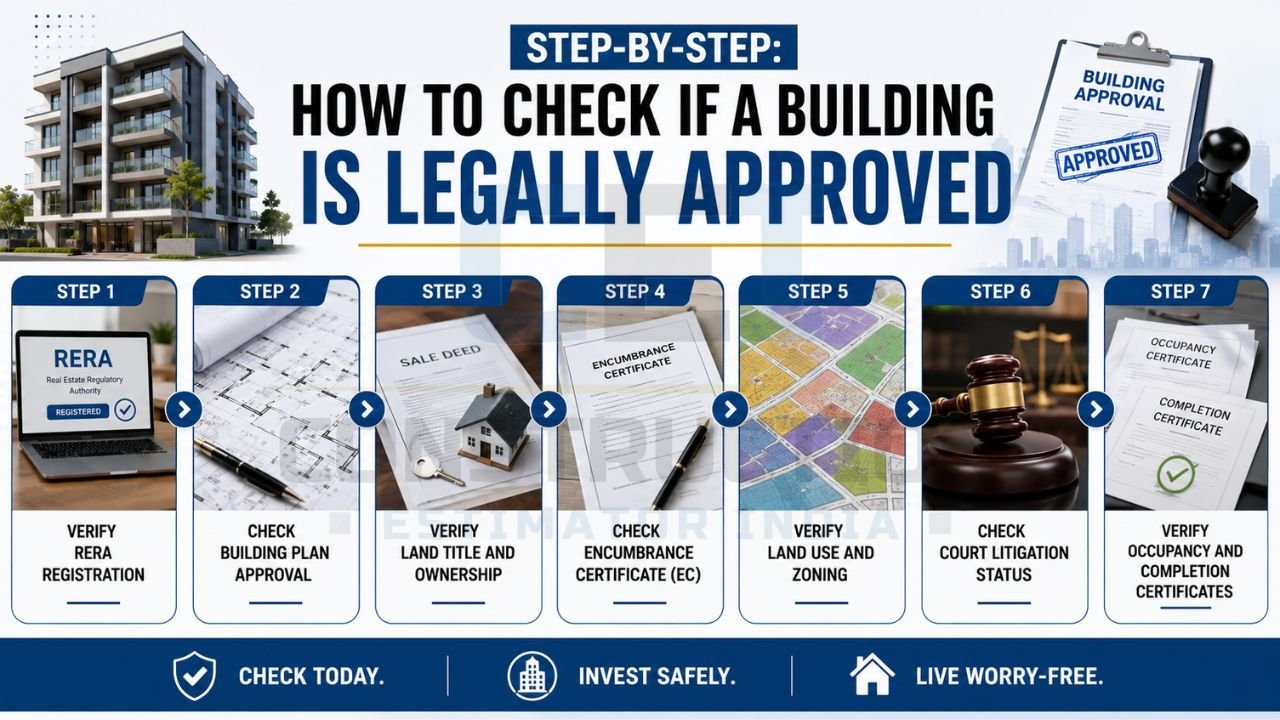
Step-by-Step: How to Check if a Building Is Legally Approved
Follow this systematic verification process before buying or investing in any property.
👉 Check RERA, OC, CC & Building Approvals with Confidence – 📲 WhatsApp Now
Step 1: Verify RERA Registration
All real estate projects must be registered with the state RERA authority. Visit your state’s official RERA portal (e.g., UP-RERA, Maharashtra RERA, etc.). Search the project by name, registration number, or developer name. Verify registration status, approvals, completion timeline, and any complaints or legal issues against the project. A valid RERA registration is a strong indicator of legal compliance.
For detailed RERA guidance: What is RERA in Construction India.
Step 2: Check Building Plan Approval
All buildings must have approved plans from local municipal authorities. Request a copy of the approved building plan from the builder or seller. Verify approval from the local municipal body (MDDA in Dehradun, BBMP in Bangalore, GHMC in Hyderabad, etc.). Cross-check the approved layout, number of floors, and construction area against the actual building. Ensure the construction matches the approved plan exactly.
For building plan guidance: Building Plan Approval India and How to Get Construction Permit India.
👉 Avoid Legal Risks & Property Fraud Before Investing – 📲 Start Chat Today
Step 3: Verify Land Title and Ownership
Clear land titles are the foundation of legal property. Check the title deed for clear ownership. Verify the land is not disputed or under litigation. Ensure the builder or seller has legal ownership or authorized rights to sell. Consult a property lawyer for thorough title verification.
Step 4: Check Encumbrance Certificate (EC)
The Encumbrance Certificate shows if the property has any mortgages, loans, or legal liabilities. Obtain the EC from the Sub-Registrar’s office. It should cover at least 30 years of property history. Verify no pending loans, liens, or encumbrances exist on the property.
Step 5: Verify Land Use and Zoning
Land use classification must match the construction purpose. Check the 7/12 extract (Maharashtra), RTC Pahani (Karnataka), or Jamabandi (North India). Verify the land is classified as residential, commercial, or industrial as per the construction type. Ensure no agricultural land is used without proper conversion.
Step 6: Check Court Litigation Status
Search the e-Courts portal (ecourts.gov.in) using the property address or owner name. Verify no civil or criminal litigation is pending against the property. Check local court records for any property disputes or ongoing cases.
👉 Need a Complete Property Verification Checklist? – 📲 Message Us Now
Step 7: Verify Occupancy and Completion Certificates
Occupancy and completion certificates are mandatory for legal possession. Completion Certificate (CC) is issued after construction is completed as per the approved plan. Occupancy Certificate (OC) is issued after final inspection, allowing legal possession. Never take possession without OC.
For detailed guidance: Occupancy Certificate India Guide and Completion Certificate Guide India.
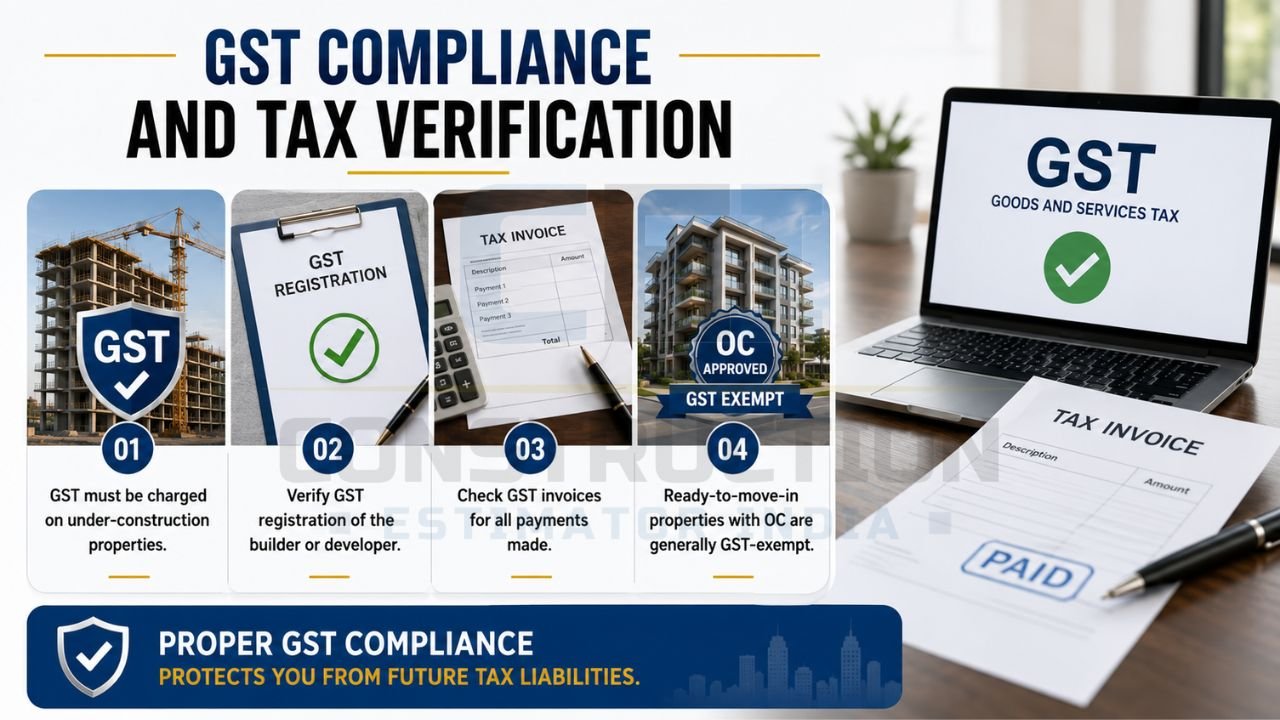
GST Compliance and Tax Verification
GST must be charged on under-construction properties. Verify GST registration of the builder or developer. Check GST invoices for all payments made. Ready-to-move-in properties with OC are generally GST-exempt. Proper GST compliance protects you from future tax liabilities.
👉 Verify Land Titles, Building Plans & Legal Documents – 📲 Talk to Our Team Today
For GST guidance: GST on Construction India.
Home Loan and Bank Approval Verification?
Banks conduct their own legal checks before approving loans. They verify RERA registration, building plan approval, and title documents. Loan rejection often indicates legal issues. Prefer properties already approved by multiple banks for faster loan processing.
For home loan guidance: Home Loan for Under-Construction Property India.
Online vs Offline Verification Methods
Online Verification
Use state RERA portals, e-Courts portal, municipal corporation websites, land records portals (7/12, RTC, Jamabandi), and property tax payment portals.
Offline Verification
Visit the Sub-Registrar’s office for title deeds and EC, municipal office for building plan approval and property tax records, Tehsildar/Revenue office for land records, local courts for litigation checks, and consult a property lawyer for thorough due diligence.
👉 Buy Only Legally Approved Properties in India – 📲 Contact Us Now
Red Flags: Signs of an Unapproved Building
Watch for these warning signs:
- Builder refuses to show RERA registration or building plan approval.
- No approved building plan available.
- Property tax receipts are unavailable or inconsistent.
- Banks refuse to approve loans for the property.
- Construction exceeds approved floors or built-up area.
- No occupancy or completion certificate.
- Disputed land or unclear titles.
- Property is under litigation or has pending court cases.
Things to Know Before Building a House in India
Legal verification is crucial before starting construction. Understand land title verification, building plan approval process, RERA compliance for developers, construction permits and licenses, occupancy and completion certificates, and GST/tax compliance.
For complete guidance: Things to Know Before Building a House in India.
Why Construction Estimator India?
Construction Estimator India is a trusted partner for property verification and construction compliance. We provide expert guidance on legal property verification, transparent cost estimates, documentation and compliance support, RERA and building plan approval assistance, and end-to-end construction and property advisory to help you build or buy with confidence.
Conclusion
Knowing How to Check if a Building Is Legally Approved in India is essential for protecting your investment, avoiding legal disputes, and ensuring long-term property value. Proper verification of RERA registration, building plan approval, land titles, encumbrance certificates, occupancy certificates, and GST compliance is critical for safe property transactions and construction projects across India.
Are you planning to buy a house, apartment, or commercial property in India and unsure if the building is legally approved? As a trusted construction and property advisory partner, Construction Estimator India helps buyers verify RERA registration, building plan approval, land titles, and legal compliance before purchase. From property due diligence to construction permits and occupancy certificates, we provide end-to-end solutions to protect your investment.
Contact us today for a free consultation and detailed property verification & legal compliance checklist!
📞 Call / WhatsApp: +91 8630676890
🌐 Visit Us: Construction Estimator India
📍 Serving: Across India – Dehradun, Roorkee, Haridwar, Rishikesh, Delhi, Mumbai, Bangalore, and more
FAQ Section
How can I check if a building has RERA approval?
Visit your state’s official RERA portal and search the project by name or registration number. Verify registration status, approvals, and any complaints.
What is building plan approval in India?
It is the official approval of architectural and structural drawings by the local municipal authority before construction can begin.
Why is occupancy certificate important?
It confirms the building is safe for occupation and constructed as per approved plans. Banks and authorities require it for legal possession.
How do I check if land titles are clear?
Verify the title deed, encumbrance certificate, and land records (7/12, RTC, Jamabandi). Consult a property lawyer for thorough title search.
What is an encumbrance certificate?
It is a document that shows all transactions, mortgages, and liabilities on a property over a specific period (usually 30 years).
Can I buy property without OC?
It is highly risky and not recommended. Many banks reject loans for properties without OC. Legal possession may also be challenged.
Do banks check legal approval before home loans?
Yes. Banks conduct thorough legal due diligence, including RERA, building plan approval, and title verification before sanctioning loans.