GST, or Goods and Services Tax, has had a significant impact on various sectors in India, including real estate. Managed at the federal level by authorities like the Central Board of Indirect Taxes and Customs (CBIC), it is a comprehensive indirect tax levied on the supply of goods and services across the country. By replacing multiple indirect taxes like VAT, service tax, and excise duty, GST aimed to simplify the tax structure, increase transparency, and reduce the tax cascading effects that previously plagued the industry.
In the context of constructing residential houses, GST applies to both the supply of construction services and the supply of goods like cement, steel, and tiles used in the construction process. Understanding how GST applies at different stages of construction is an essential part of how to plan home construction in India. For instance, while GST on services is charged on the bill of the contractor, the GST on materials is already included in the purchase price of those goods.
👉 Need Clarity on GST for Construction Projects? Get Expert Guidance Today.
Navigating these complexities requires expert guidance. At Construction Estimator India, we specialize in helping builders and homeowners decipher these regulations. We offer free GST consultation for construction and construction cost estimation with GST included to ensure your project remains within budget. If you have questions regarding tax compliance, feel free to contact us at WhatsApp/Call: +91 8630676890.
GST Rates on Construction Services in India 2026
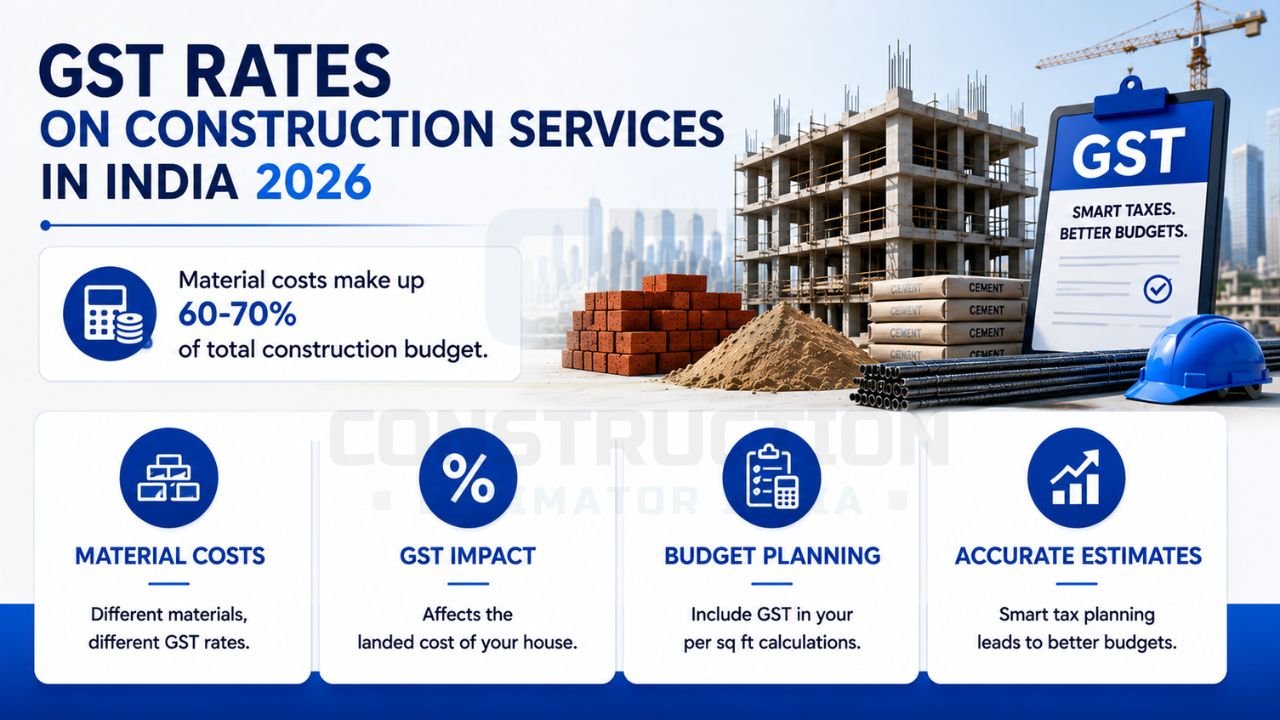
The cost of materials often accounts for 60-70% of the total construction budget. Under GST, different materials fall under different tax brackets, which directly impacts the “landed cost” of your house. Factoring these taxes into your baseline house construction per sq ft rate is critical for accurate budgeting.
Affordable Housing GST Rate
Affordable housing projects are taxed at a reduced rate of 1% without Input Tax Credit (ITC). This rate applies to housing units with a carpet area up to 60 sq m (645 sq ft) in non-metropolitan cities and 45 sq m (484 sq ft) in metropolitan cities (like Delhi, Mumbai, Kolkata, Chennai, Bengaluru, and Hyderabad). To qualify, the price of the unit must also be up to ₹45 lakh. This 1% rate is a significant relief for lower-income home buyers, though builders cannot claim credit for the taxes paid on raw materials.
Other Residential Housing (Non-Affordable)
For residential projects that do not fall under the “affordable” category, the GST rate is 5% without ITC. This includes any house or apartment where the carpet area exceeds the metropolitan limits or the price is above ₹45 lakh. Similar to the affordable category, builders are not allowed to claim Input Tax Credit on the materials used, which is why the effective tax rate is kept relatively low compared to commercial sectors.
Commercial Construction GST Rate
The GST rate for commercial construction services is generally 18%. This rate applies to the construction of shops, offices, malls, hotels, and commercial complexes. Unlike residential projects, commercial construction allows for Input Tax Credit (ITC). This means the contractor or builder can claim a refund for the GST paid on inputs like cement, steel, and labor, which often reduces the net tax liability significantly.
Government and Public Construction
Construction services provided for government projects—such as roads, bridges, and public infrastructure—are typically taxed at 18%. Contractors working on these projects are eligible for ITC, allowing them to offset the taxes paid on materials and sub-contracts against their final tax bill.
GST Rate Comparison Table
| Project Type | GST Rate | ITC Available |
|---|---|---|
| Affordable Housing | 1% | No |
| Other Residential | 5% | No |
| Commercial | 18% | Yes |
| Government/Public | 18% | Yes |
👉 Understand Construction GST and Plan Your Project Costs with Confidence.
GST on Construction Materials: Complete Rate List
The cost of materials often accounts for 60-70% of the total construction budget. Under GST, different materials fall under different tax brackets, which directly impacts the “landed cost” of your house.
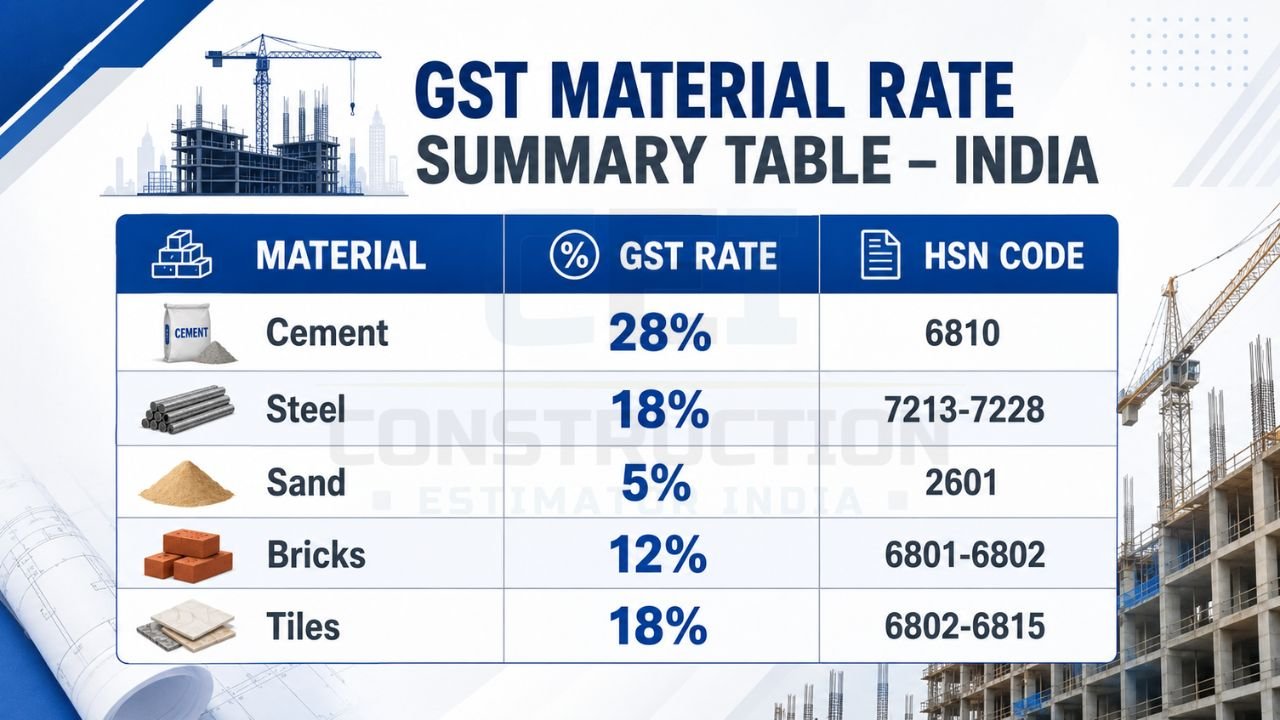
GST on Cement (28%)
Cement is currently taxed at the highest bracket of 28% (HSN Code: 6810). As a major cost component in any building, this high rate significantly inflates the initial budget. For example, if you purchase cement worth ₹50,000 from brands like UltraTech Cement, the GST component alone is ₹14,000. Knowing exactly which grade cement is best for plastering in India ensures you don’t overspend on higher grades unnecessarily.
GST on Steel (18%)
Steel and iron used for reinforcement attract an 18% GST (HSN Code: 7213-7228). A solid understanding of what is RCC construction highlights the massive volume of steel required for modern foundations and framing. This 18% charge is a critical factor in financial planning for homeowners.
GST on Sand, Bricks, and Tiles
- Sand: Essential for mortar and concrete, sand is taxed at 5% (HSN Code: 2601).
- Bricks: Wall construction materials like fly-ash bricks or clay bricks attract a 12% GST (HSN Code: 6801-6802).
- Tiles: Flooring and wall finishing materials such as ceramic or vitrified tiles are taxed at 18% (HSN Code: 6802-6815).
Calculating the overall plaster cost per square foot with material in India helps you see exactly how these 5% to 12% material taxes stack up.
GST Material Rate Summary Table
| Material | GST Rate | HSN Code |
|---|---|---|
| Cement | 28% | 6810 |
| Steel | 18% | 7213-7228 |
| Sand | 5% | 2601 |
| Bricks | 12% | 6801-6802 |
| Tiles | 18% | 6802-6815 |
👉 Get Expert Insights on GST Rates, Compliance, and Construction Costs.
GST on Works Contract: Tax Rules for Construction Industry
A “Works Contract” in GST is defined as a contract for building, construction, fabrication, completion, erection, installation, fitting out, improvement, modification, repair, maintenance, renovation, alteration, or commissioning of any immovable property.
What is Works Contract?
In the construction industry, when a contractor agrees to build a structure using their own materials and labor, it is treated as a supply of service. GST Law mentions that input tax credit is not available for works contract services when supplied for construction of immovable property for one’s own account.
GST Rate and Application
The standard rate for a works contract is 18%. This applies to turnkey construction projects where the owner pays the contractor a lump sum to handle the entire project. However, if the owner buys the materials separately and only hires labor, the tax treatment changes. Construction Estimator India can help you decide which model (Material + Labor or Labor Only) is more tax-efficient for your specific project. Call us at +91 8630676890 for free tax compliance help.
Input Tax Credit (ITC): What Homeowners and Contractors Can Claim
Input Tax Credit (ITC) allows a taxpayer to reduce the tax they have already paid on inputs from the tax they have to pay on their final output.
ITC for Residential vs. Commercial
For residential housing (the 1% and 5% rates), no ITC is available. The government provided these lower rates on the condition that builders would not claim credit for the taxes paid on cement, steel, etc. This is why residential construction costs can feel higher upfront.
In contrast, for commercial construction (18%), ITC is fully available. If a builder pays ₹18 lakh in GST on a commercial project but has already paid ₹10 lakh in GST on materials, their net payable GST to the government is only ₹8 lakh. This makes commercial development more “tax-neutral” for the builder compared to residential housing.
GST Calculation Examples: Real Cost Impact on Construction
To understand the actual cost, let’s look at real-world scenarios for a construction cost of ₹50 lakh.
Example 1: Affordable Housing (1% GST)
- Construction Cost: ₹50,00,000
- GST Payable (1%): ₹50,000
- Total Cost: ₹50,50,000
Example 2: Other Residential Housing (5% GST)
- Construction Cost: ₹50,00,000
- GST Payable (5%): ₹2,50,000
- Total Cost: ₹52,50,000
Example 3: Commercial Construction (18% GST)
- Construction Cost: ₹1,00,00,000
- GST Payable (18%): ₹18,00,000
- Total Cost: ₹1,18,00,000
- Note: The builder can claim ITC on materials, potentially recovering several lakhs.
GST Compliance: Registration, Filing & Documentation
For contractors and builders, compliance is mandatory to avoid penalties. Filing accurately through the official GST Portal keeps your business in good legal standing.
- Registration: Mandatory if annual turnover exceeds ₹40 lakh for goods or ₹20 lakh for services.
- Invoices: Must clearly display the GSTIN, HSN codes for materials, and separate lines for SGST/CGST or IGST.
- Filing: Builders usually file monthly (GSTR-1 and GSTR-3B) or quarterly under the QRMP scheme if their turnover is below ₹5 crore.
GST Exemptions on Construction
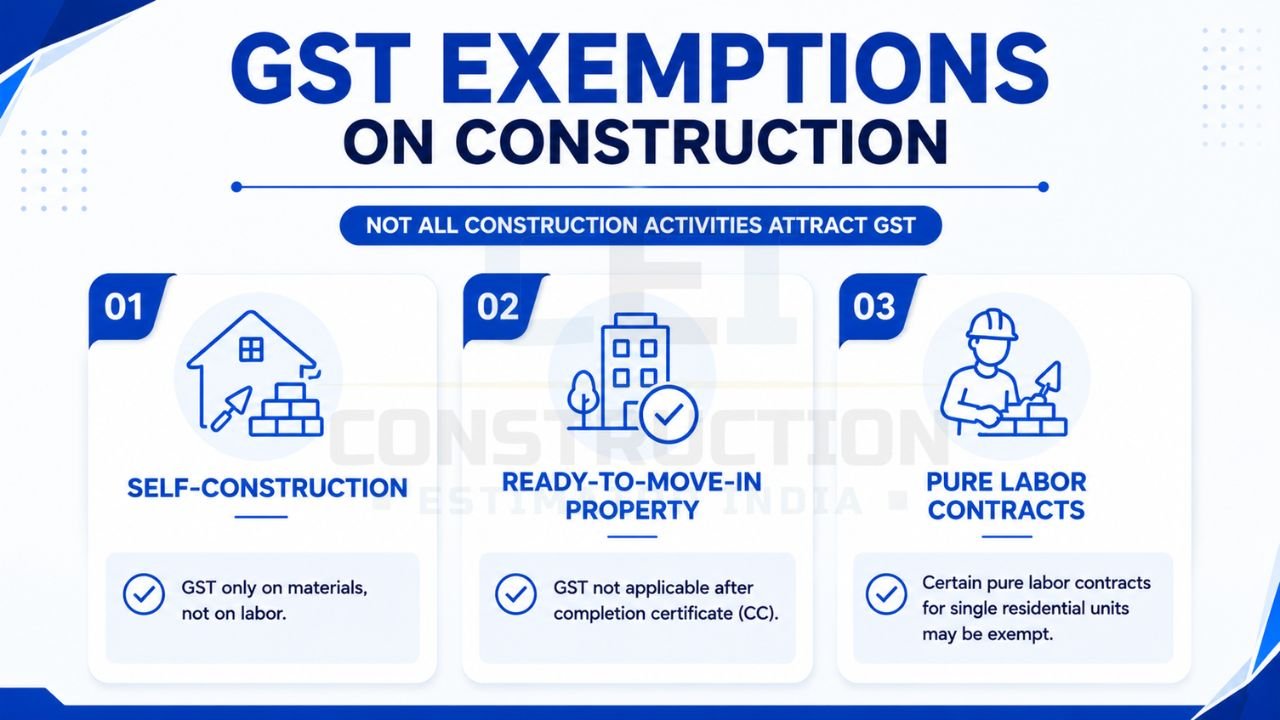
Not all construction activities attract GST. Key exemptions include:
- Self-Construction: If a homeowner buys materials and hires local labor directly (and the labor’s turnover is under the threshold), GST is only paid on materials, not on the labor service itself.
- Ready-to-Move-In Property: GST is not applicable to the sale of a house or flat after the issuance of a completion certificate (CC).
- Pure Labor Contracts: Certain pure labor contracts for single residential units (otherwise than as part of a residential complex) may be exempt.
Pros and Cons of GST on Construction
Pros:
- Simplified Structure: Replaced a dozen different taxes with one unified system.
- Transparency: Reduced the “black money” component as every transaction must be recorded to claim credit.
- Lower Rates: The 1% and 5% rates are lower than the effective pre-GST tax rates.
Cons:
- Increased Initial Costs: Paying 28% on cement upfront can strain the cash flow of a self-building homeowner.
- Compliance Burden: Smaller contractors often struggle with the rigorous documentation required.
👉 Planning a Construction Project? Understand the GST Impact Before You Start.
When to Contact Construction Estimator India for GST Help
Navigating GST on the construction of residential houses requires a clear understanding of applicable rates and compliance requirements. You should contact Construction Estimator India if:
- You are confused about whether your project qualifies as “Affordable Housing.”
- You need an accurate cost estimation that includes all material GST.
- You are a contractor looking for help with GST-compliant invoicing.
We provide free GST consultation for construction and free tax compliance help. Reach out to us at WhatsApp/Call: +91 8630676890.
FAQs
Q1: What is the GST rate for residential house construction in India?
It is either 1% (Affordable) or 5% (Non-affordable) without ITC.
Q2: What is the GST rate for commercial construction?
The rate is 18% with Input Tax Credit available.
Q3: What is the GST rate on cement for construction?
Cement attracts the highest rate of 28%.
Q4: Do I need to pay GST if I build my own house?
You pay GST on the materials you buy. If you hire top architects and architecture firms or a contractor for a “Turnkey” project, you pay GST on their total service bill.
Q5: How do I contact Construction Estimator India for GST help?
You can call or WhatsApp us at +91 8630676890.
Conclusion: Understand GST to Manage Construction Costs Effectively
GST has fundamentally changed how construction costs are calculated in India. While the system is more transparent, the high rates on materials like cement and the lack of ITC for residential projects mean that homeowners must plan their budgets with precision. Understanding how GST applies at different stages—from the first bag of cement to the final coat of paint—is the only way to avoid cost overruns.
At Construction Estimator India, we are committed to making your home-building journey smooth and transparent. Our experts are always available for a free consultation to help you manage your construction taxes and costs effectively.
Contact Construction Estimator India today:
- WhatsApp/Call: +91 8630676890
- Services: Free GST consultation, cost estimation, Tax compliance help.