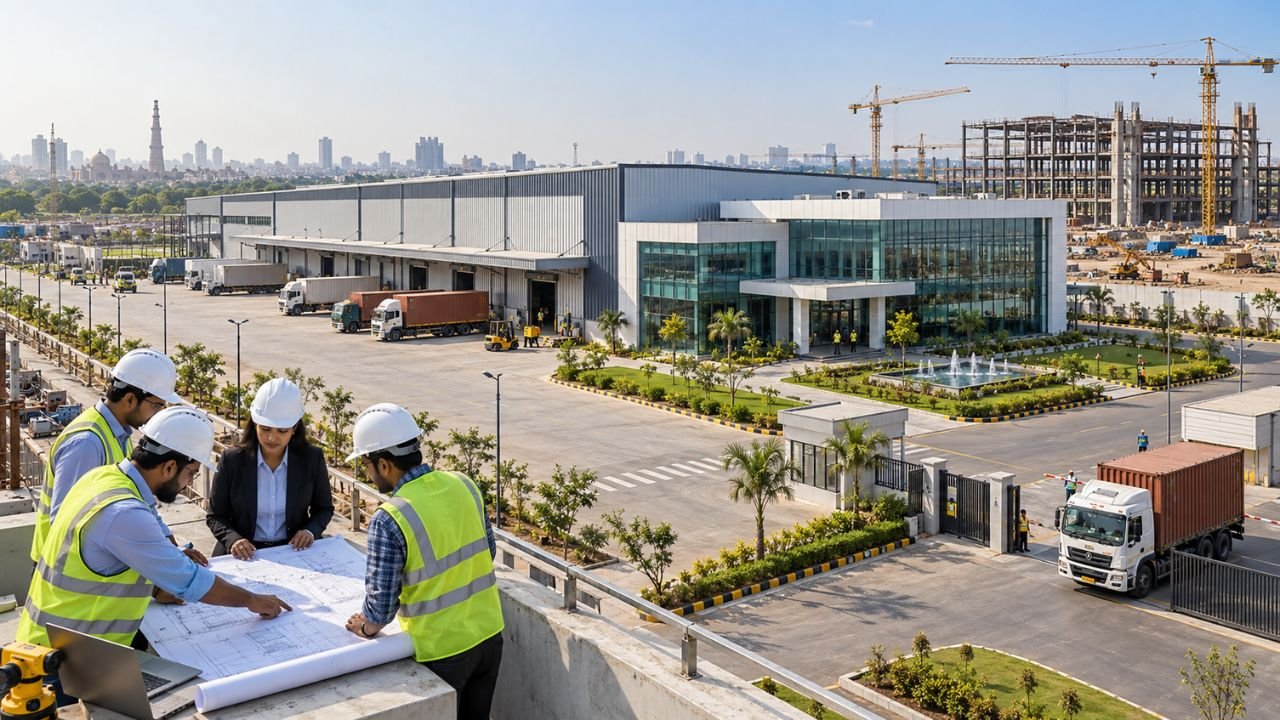
If you’re planning to construct a house, commercial building, or any real estate in India, getting building approval is a mandatory legal requirement. Building approval is more than just a permit; it is the official legal acknowledgment that your home or commercial asset is safe, compliant, and structurally sound. To truly understand how to plan home construction in India, you must start with this critical legal step. Construction projects in India require various permissions and approvals from different authorities before they can commence. This process is governed by the Real Estate (Regulation and Development) Act (RERA) and local municipal bylaws, which ensure that every structure built contributes to a planned, safe, and sustainable urban environment.
Without a valid construction permit, your project faces significant risks. It may be categorized as illegal construction, leading to potential demolition orders or total loss of property value. You will also be unable to obtain an Occupancy Certificate (OC), which is required to make the building legally fit for habitation. Furthermore, without a permit, you cannot secure official utility connections for water and electricity, and your application for a bank home loan will likely be rejected. In essence, building without approval is a gamble that puts your financial investment and your family’s safety at risk.
👉 Need a Construction Permit? Get Expert Guidance for a Smooth Approval Process.
On the other hand, obtaining a permit ensures your construction is 100% legal. It facilitates easier bank loan approval, ensures access to municipal utilities, and guarantees that the building follows seismic and safety codes. The typical process timeline ranges from 15 to 90 days, depending on the city and the complexity of the building type. Today, most major cities in India have transitioned to online building plan approval systems, making the procedure faster and more transparent than ever before.
Navigating this bureaucracy can be complex, involving multiple departments and technical paperwork. This is where professional expertise becomes invaluable. Construction Estimator India offers expert legal and technical oversight to ensure your construction journey is compliant from day one. Whether you are a local homeowner or an NRI looking to invest in India, Construction Estimator India provides Free permit application assistance, Free document verification, and construction cost estimation to help you build with peace of mind. For personalized guidance, you can contact Construction Estimator India at WhatsApp/Call: +91 8630676890.
Before Applying: 5 Pre-Check Requirements for Construction Permit
Legal Land Ownership
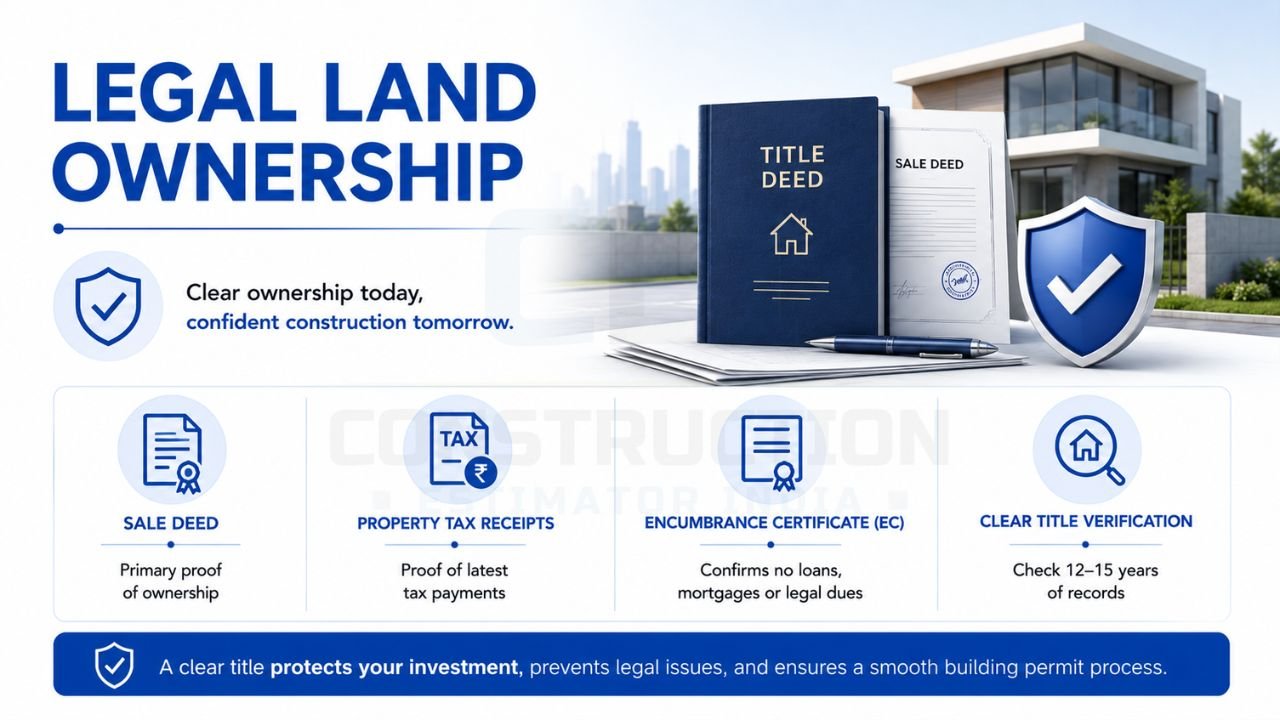
Before you can apply for a building permit, you must prove that you own the land legally. The foundation of any construction project is a clear and undisputed land title. You must submit the title deed or sale deed of the land to the municipal authorities. This document acts as the primary evidence of your ownership rights.
In addition to the sale deed, you must provide the latest property tax receipts and an Encumbrance Certificate (EC). It is highly recommended to verify the latest 12–15 years of encumbrance records to ensure there are no existing loans, mortgages, or legal disputes associated with the property. Construction Estimator India provides Free document verification at +91 8630676890 to help you confirm your land’s legality before you invest in architectural plans.
Land Type Conversion (NA Status)
In India, land is often classified as agricultural or non-agricultural. You cannot build a house or commercial building on agricultural land without converting its status. You must ensure the land is in a non-agricultural (NA) or residential zone before proceeding. This conversion process is managed by the state’s revenue department.
The process of obtaining NA (Non-Agricultural) conversion involves applying to the local Collector or the relevant revenue authority. The cost for this conversion can vary significantly by state, typically ranging from ₹50,000 to ₹5,00,000, and the timeline for approval usually spans 30 to 90 days. Without this conversion, your building plan will be rejected by the municipal corporation.
👉 Ensure Your Project Meets All Permit and Compliance Requirements.
Zoning Clearance
Zoning and Land Use Clearances are essential pre-checks. Before you start preparing your building plan, verify that your property’s land use is zoned for residential or commercial purposes according to the city’s Master Plan. Zonal clearance ensures that your proposed construction matches the designated use for that specific area.
After you finish the necessary paperwork for getting the land title and clearance from local authorities, the revenue department will give you ownership under the provision of the local body act. You should consult the local municipal zoning map to confirm that your project doesn’t conflict with industrial zones, green belts, or future highway projects.
FSI/FAR Compliance
The Floor Space Index (FSI) or Floor Area Ratio (FAR) determines how much you can build on your plot. You must check the maximum permissible FSI for your specific plot size and road width. For example, if you have a 1,000 sq ft plot and the local FSI is 1.5, your maximum total built-up area across all floors cannot exceed 1,500 sq ft. Assessing the baseline house construction per sq ft rate helps you determine if maximizing your FSI fits your budget.
Calculating your proposed construction area accurately is vital. If your design exceeds the permissible FSI, the municipality will reject the plan or require expensive modifications. Construction Estimator India offers construction cost estimation and FSI calculations at +91 8630676890 to ensure your design is both financially and legally feasible.
Building Bylaw Compliance
Your plans are reviewed for compliance with local building bylaws, which include regulations on setbacks, height limits, and safety standards conforming to the National Building Code (NBC) published by BIS. Every state and city has unique bylaws that dictate how far your building must be from the plot boundaries (setbacks). For instance, a common requirement might include a front setback of 3m, a rear setback of 2m, and side setbacks of 1.5m each.
These bylaws also cover road width requirements, ventilation standards, and structural safety codes. Failing to adhere to these minute details is a leading cause of permit rejection. Professional architects and architecture firms, such as those partnering with Construction Estimator India, ensure that every drawing matches these local mandates perfectly.
Step-by-Step Process to Get Construction Permit in India
Step 1: Visit Local Municipality Office
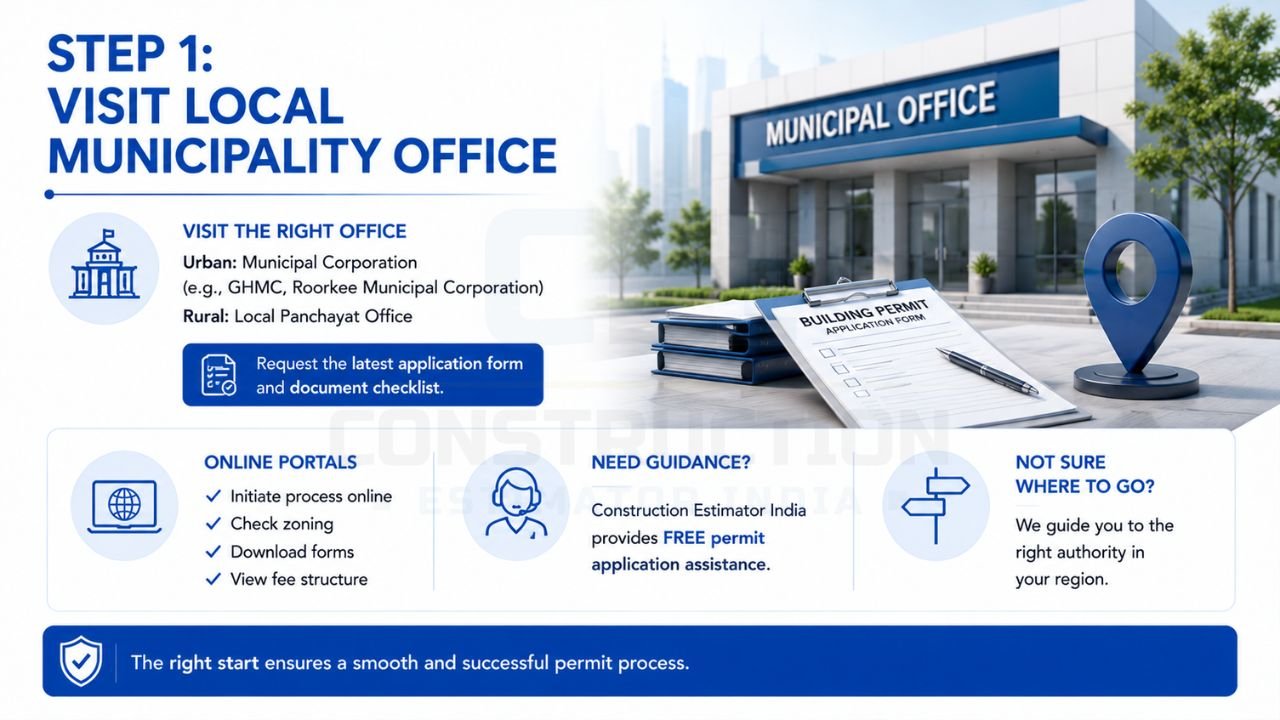
The first step in obtaining a building construction permit is to visit your local municipality office. For urban areas, this is usually the Municipal Corporation (e.g., GHMC in Hyderabad or Roorkee Municipal Corporation), while in rural areas, you must apply to the local Panchayat office. You should request the latest application form and a specific document checklist for your building type.
Alternatively, many cities now have robust online portals where you can initiate the process without physical visits. These portals allow homeowners to check zoning, download forms, and understand the fee structure. If you are unsure which office to visit, Construction Estimator India provides Free permit application assistance and can guide you to the right authority in your region.
Step 2: Prepare Building Plan with Licensed Architect
Your building plan must be prepared and signed by a licensed architect or structural engineer. Your licensed architect or engineer, often appointed through a reputable construction company like Construction Estimator India, prepares detailed drawings that comply with local bylaws. These drawings are the technical heart of your application.
The required drawings include:
- Site Plan: Showing the plot boundaries and surroundings.
- Floor Plans: Detailed layout for every floor.
- Elevation Drawings: Showing the front, rear, and side views.
- Section Drawings: Vertical cuts showing internal heights and structural members.
- Structural Drawings: Details of foundation types, beams, and columns based on RCC construction principles.
- Area Statement: Detailed FSI/FAR calculations.
Preparation costs typically range from ₹10,000 to ₹1,00,000 depending on the project size. Construction Estimator India specializes in providing construction-ready GFC (Good for Construction) drawings to ensure error-free execution.
👉 Get Professional Help with Documentation, Approvals, and Regulatory Compliance.
Step 3: Gather All Required Documents
Once your plans are ready, you must gather all supporting legal and technical documents. You will need to submit the building plan along with the Land Title Deed, latest Property Tax Receipts, and an Encumbrance Certificate. Other documents include survey sketches, soil test reports (for larger buildings), and copies of the architect’s license.
A complete application in the prescribed format is essential to avoid delays. Missing even a single tax receipt can lead to the application being returned. Construction Estimator India offers Free document verification at +91 8630676890 to double-check your folder before you submit it to the authorities.
Step 4: Submit Application Online or Offline
You can now apply for online or offline approval. Most major cities in India now support online building plan approval systems (OBPS) supported by the Ministry of Housing and Urban Affairs. This portal is used for getting a building or development permit through an efficient digital interface, such as service no. 12 on many state portals.
Online submission involves uploading scanned copies of all documents and drawings, followed by the payment of scrutiny fees. Architects and engineers can seek permission for construction through these hassle-free online procedures. If your city doesn’t have an online system, you must submit physical copies (often in triplicate) at the municipality’s single-window clearance cell.
Step 5: Obtain NOCs from Relevant Departments
Before your final permit is issued, you must obtain No Objection Certificates (NOCs) from various relevant departments. Numerous permits such as land title, land clearance, zonal clearance, highway permit, forest permit, and so on must be acquired before beginning any construction.
The specific NOCs required depend on your building’s height and location. For example, commercial buildings or those taller than 15 meters usually require a Fire Department NOC. Construction Estimator India handles NOC coordination as part of their turnkey services, ensuring you don’t have to navigate multiple government offices yourself.
Step 6: Pay Applicable Fees
After the initial scrutiny of your application, you will be required to pay the applicable fees. These typically include:
- Building plan scrutiny fees.
- Betterment and development charges.
- Labour welfare cess.
- Shelter fund (required in certain cities for larger projects).
The fee depends on the total built-up area and the type of building (residential vs. commercial). Typical costs for a standard house range from ₹10,000 to ₹2,00,000. Construction Estimator India provides a construction cost estimation that includes a breakdown of these government fees, so you can budget accurately from the start.
Step 7: Scrutiny and Site Inspection
Once the fees are paid, a municipal officer will scrutinise the application. This involves a technical review of the drawings to ensure they match the local bylaws. The officer may also inspect the site to verify land boundaries, existing road width, and the surroundings to ensure they match the submitted survey sketch.
This review process typically takes 7 to 30 days. During this time, the officer checks the authenticity of the documents and site compliance. If there are any discrepancies, you will be asked to submit modifications. Construction Estimator India provides site supervision to ensure your plot is prepared for these inspections.
Step 8: Receive Building Permit/Approval
If your application is approved, the municipality will issue a building construction permit. This document includes a unique permit number and is usually valid for 3 to 5 years. Once approved, you can begin construction legally.
In some states like Kerala, building permission should be granted or rejected within a strict 15-day window. If there are violations, the plan may be sent for modification or rejected entirely. Upon receiving the permit, you must display the permit number at the construction site as per legal requirements.
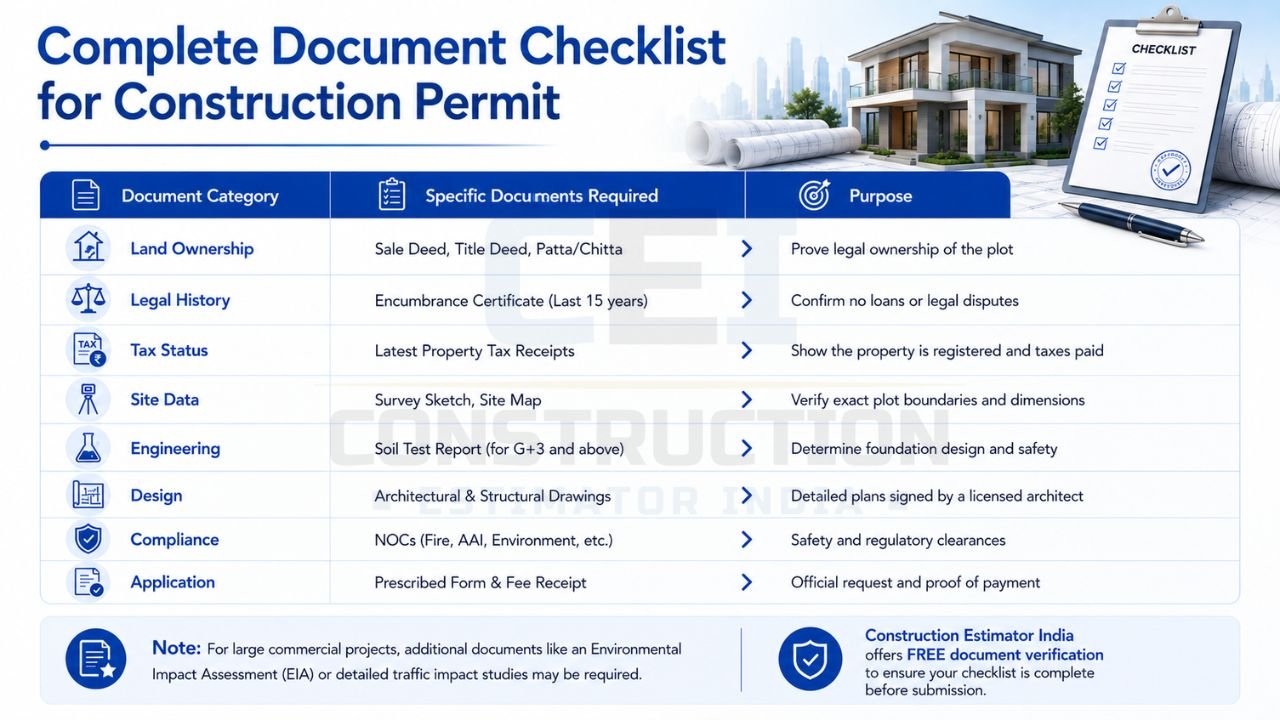
Complete Document Checklist for Construction Permit
| Document Category | Specific Documents Required | Purpose |
|---|---|---|
| Land Ownership | Sale Deed, Title Deed, Patta/Chitta | Prove legal ownership of the plot |
| Legal History | Encumbrance Certificate (Last 15 years) | Confirm no loans or legal disputes |
| Tax Status | Latest Property Tax Receipts | Show the property is registered and taxes paid |
| Site Data | Survey Sketch, Site Map | Verify exact plot boundaries and dimensions |
| Engineering | Soil Test Report (for G+3 and above) | Determine foundation design and safety |
| Design | Architectural & Structural Drawings | Detailed plans signed by a licensed architect |
| Compliance | NOCs (Fire, AAI, Environment, etc.) | Safety and regulatory clearances |
| Application | Prescribed Form & Fee Receipt | Official request and proof of payment |
Note: For large commercial projects, additional documents like an Environmental Impact Assessment (EIA) or detailed traffic impact studies may be required. Construction Estimator India offers Free document verification to ensure your checklist is complete before submission.
Required NOCs for Construction Permit
- Fire Department NOC: Mandatory for buildings taller than 15 meters (approx. G+4) or commercial spaces larger than 500 sq m. You must submit a fire safety plan showing escape routes and sprinkler systems.
- Airport Authority of India (AAI) NOC: Required if your property is within 10–15 km of an airport to ensure the building height doesn’t interfere with flight paths.
- Environment/Forest Department NOC: Necessary for very large projects (>20,000 sq m) or those located near protected forest areas.
- Electricity & Water Board NOC: To confirm that the local utility grid can support your new building’s consumption.
- Highway/Rail Authority NOC: Required if your plot is adjacent to a national highway or railway track to ensure construction doesn’t encroach on protected buffers.
- Land Clearance NOC: Often required from the pollution control board to show the land is environmentally suitable for its intended use.
👉 Start Your Construction Project with Confidence and Proper Permits.
Online Construction Permit Systems by State/City
| State/City | Online Portal | Estimated Timeline |
|---|---|---|
| Delhi | DDA Online Building Permit | 30–45 Days |
| Mumbai | BMC Building Proposal (ICBAS) | 20–30 Days |
| Bangalore | BBMP/BDA Plan Approval | 30–60 Days |
| Hyderabad | GHMC/HMDA DPMS Portal | 25–40 Days |
| Kerala | [LSGD Sanketham Portal]([suspicious link removed]) | 15 Days |
| Uttarakhand | Uttarakhand Housing & Urban Dev | 30–60 Days |
Construction Permit Fees: Cost Breakdown by Building Type
The fee depends on the built-up area and type of building. If you are handling complex works like a major house renovation, fees vary. Below is a typical breakdown for new builds:
Residential Building Fees
- Small House (<1,000 sq ft): ₹10,000 – ₹50,000
- Medium House (1,000 – 2,000 sq ft): ₹50,000 – ₹1,00,000
- Large House (2,000+ sq ft): ₹1,00,000 – ₹2,00,000
Commercial Building Fees
- Small Shop/Office: ₹50,000 – ₹1,50,000
- Medium Commercial: ₹1,50,000 – ₹3,00,000
- Large Commercial: ₹3,00,000 – ₹10,00,000+
Components of these fees usually include plan scrutiny fees, betterment charges, development charges, and labour welfare cess. Construction Estimator India provides a construction cost estimation at +91 8630676890 that includes a precise breakdown of these regulatory costs.
Timeline: How Long Does Construction Permit Take?
The duration of the approval process depends on several factors:
- City Scale: Metro cities like Mumbai often have faster digital systems (20-30 days), while smaller towns may take 45-60 days.
- Kerala Model: Kerala is known for the fastest processing, often granting permits within 15 days.
- Document Completeness: Any missing document can reset the timeline by weeks.
- Building Size: Larger commercial complexes require more NOCs, extending the timeline to 90 days.
To speed up the process, always use the online portal, ensure your documents are verified by experts like Construction Estimator India, and address any municipal queries within 24–48 hours.
What Happens After Permit Approval: Next Steps
Once approved, you can begin construction legally. It is crucial to follow the approved plan exactly; any deviation can lead to penalties or rejection of the Occupancy Certificate later. During construction, municipal officers may inspect the site at the foundation, plinth, and roof levels to ensure compliance. Hiring expert civil engineers general contractors mitigates deviation risks.
After construction is complete, you must apply for a Building Completion Certificate (CC). This involves a final inspection where officers verify that the building matches the approved drawings. The final step is obtaining the Occupancy Certificate (OC). Only after receiving the OC is the building legally fit for occupation, utility connection regularisation, and bank loan closure.
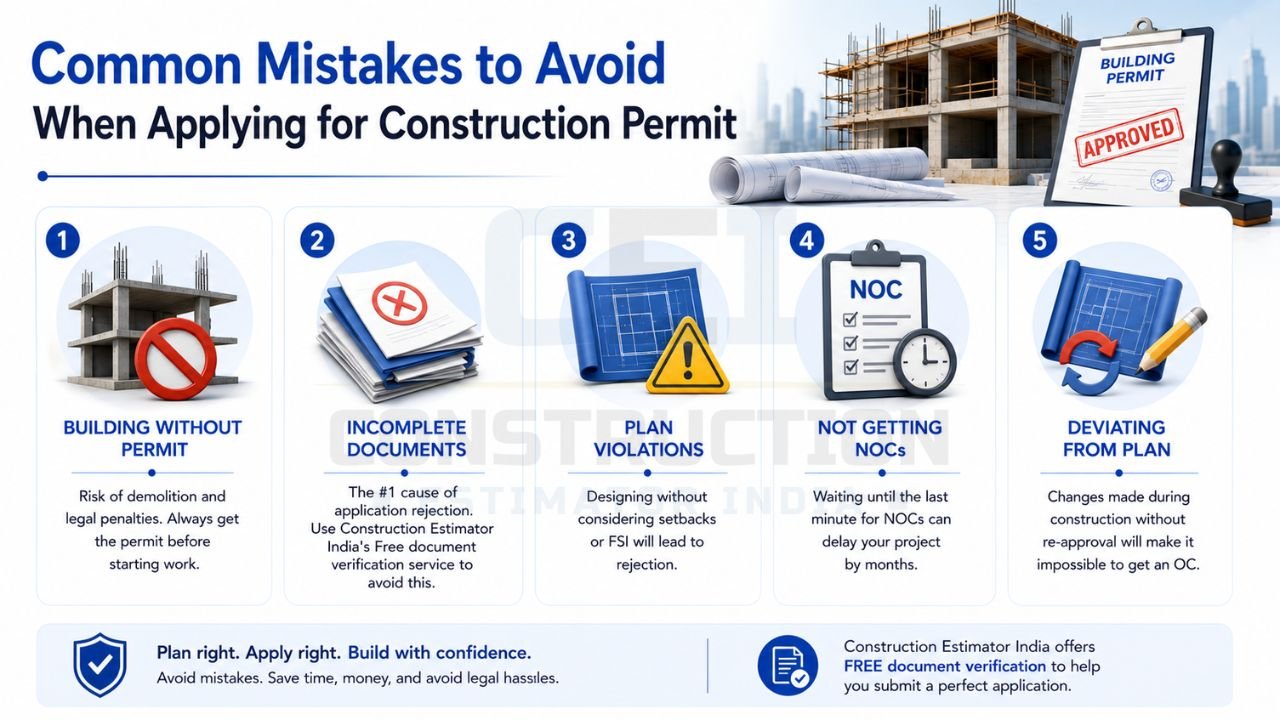
Common Mistakes to Avoid When Applying for Construction Permit
- Building Without Permit: Risk of demolition and legal penalties. Always get the permit before starting work.
- Incomplete Documents: The #1 cause of application rejection. Use Construction Estimator India’s Free document verification service to avoid this.
- Plan Violations: Designing without considering setbacks or FSI will lead to rejection.
- Not Getting NOCs: Waiting until the last minute for NOCs can delay your project by months.
- Deviating from Plan: Changes made during construction without re-approval will make it impossible to get an OC.
👉 Planning to Build? Consult Our Experts Before Applying for Permits.
When to Contact Construction Estimator India for Permit Help
If the bureaucracy seems overwhelming or you are worried about technical errors, Construction Estimator India is your trusted partner. We assist homeowners and developers across India, specializing in:
- Permit Application Assistance: We handle the digital and physical paperwork for you.
- Document Verification: We ensure your land title and tax records are permit-ready.
- Technical Estimation: We provide high-precision cost breakdowns to prevent budget shocks.
Contact Construction Estimator India today for Free permit application assistance, Free document verification, and construction cost estimation at WhatsApp/Call: +91 8630676890.
FAQs
Q1: Is construction permit mandatory for all buildings in India?
Yes, getting building approval is a mandatory legal requirement for any house or commercial structure.
Q2: How long does it take to get a construction permit?
It typically takes 15 to 90 days, depending on the city and building scale.
Q3: What is the cost of construction permit in India?
Fees usually range from ₹10,000 to ₹2,00,000 for residential homes, based on the built-up area.
Q4: Can I apply for construction permit online?
Yes, most major Indian cities now use Online Building Plan Approval Systems (OBPS).
Q5: What documents are needed for construction permit?
Key documents include the sale deed, EC, property tax receipts, and architect-signed building plans.
Q6: When do I need Fire NOC for construction?
Usually for buildings taller than 15 meters or large commercial spaces.
Q7: How long is building permit valid?
Most permits are valid for 3 to 5 years from the date of issue.
Q8: What happens if I build without permit?
You face demolition risks, heavy legal penalties, and will be unable to get an Occupancy Certificate.
Q9: Can I modify my building after permit approval?
Yes, but you must submit a revised plan and get it approved before making changes on-site.
Q10: What is the difference between building permit and occupancy certificate?
A permit allows you to start construction; an OC confirms the building is finished as per the plan and is safe to live in.
Q11: Do I need permit for renovation work?
Minor repairs don’t need permits, but any structural change or extension (adding a floor/room) requires approval.
Q12: How do I contact Construction Estimator India for permit help?
You can reach us at WhatsApp/Call: +91 8630676890 for free initial assistance.
Contact Construction Estimator India for Construction Services
Building your dream project shouldn’t be a bureaucratic nightmare. Construction Estimator India brings 15+ years of experience in the Indian construction sector to your doorstep. We bridge the gap between complex municipal bylaws and your vision for a perfect building.
Our Core Services Include:
- Free Permit Application Assistance: Navigating the OBPS portals for you.
- Free Document Verification: Auditing sale deeds and ECs for permit compliance.
- Turnkey Construction: From “soils to shingles” management.
Company: Construction Estimator India
WhatsApp/Call: +91 8630676890
Email:
Conclusion: Get Construction Permit for Legal, Safe Building
Getting building approval is a mandatory legal requirement for all construction in India. The journey toward a legal home or commercial space begins with paperwork, not bricks. By following this comprehensive guide—from verifying your land’s NA status to obtaining the final Occupancy Certificate—you protect your investment and your family’s future.
While the approval process involves multiple steps like architectural design, NOC coordination, and fee payment, the transparency of modern online systems has made it more accessible. Remember, a building permit is your shield against demolition and legal disputes. Construction Estimator India is here to help you every step of the way with professional advice and Free permit assistance at +91 8630676890. Build smart, build legal, and build with confidence.