The journey of building a home in India often feels like a marathon, and the Completion Certificate (CC) is the finish line. A Building Completion Certificate (BCC) is an official document issued by the local municipal authority once construction is finished. As the name suggests, it is a certificate issued to you when the construction is completed and the property is ready to move in. It serves as a legal confirmation that the structure has been built in strict compliance with the approved architectural plans and local building bylaws.
👉 Need a Completion Certificate? Get Expert Guidance for a Smooth Approval Process.
For homeowners, the CC is more than just a piece of paper; it is the final legal acknowledgment that your home is safe, compliant, and structurally sound. It signifies the conclusion of construction and the readiness for occupancy of the building. Without this document, your property is essentially in a legal “no-man’s-land.” You cannot legally reside in the building, register the property in your name at the sub-registrar’s office, or secure permanent utility connections like water and electricity.
Furthermore, if you have taken a home loan, most banks will require the CC to provide final approval and close the loan account. Knowing how to plan home construction in India means looking ahead to this phase to prevent your build from being deemed “unauthorized,” which can lead to severe penalties or even demolition orders from local authorities. Construction Estimator India offers free completion certificate assistance and a free construction compliance check at +91 8630676890 to ensure your hard-earned investment is legally protected.
What Is Completion Certificate: Definition & Purpose?
Definition of Completion Certificate
A Completion Certificate (CC) is a legal document issued by a local governing authority—such as a municipal corporation, development authority, or panchayat—certifying that the construction of a building is finished. It verifies that the construction was completed according to approved plans and meets all regional safety and urban planning standards. In simple terms, it is the government’s official confirmation that your house is built correctly and is safe to live in.
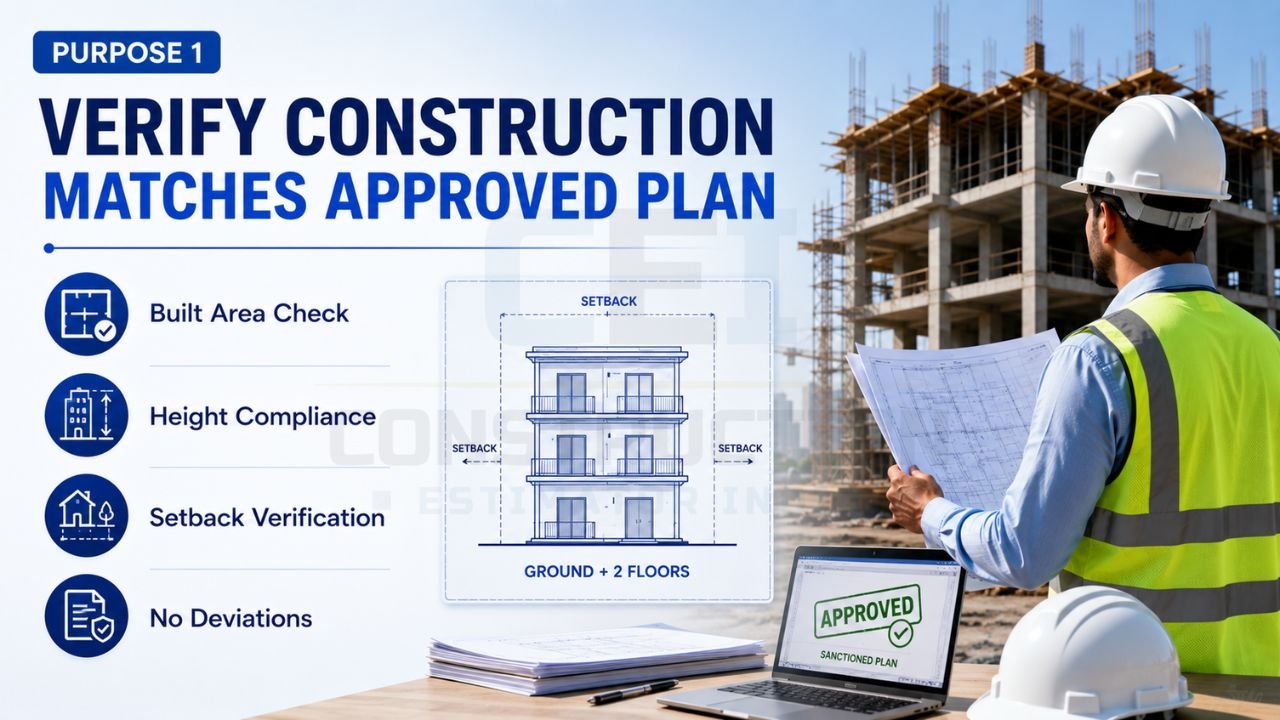
Purpose 1: Verify Construction Matches Approved Plan
The primary goal of the CC is to ensure that the actual construction matches the blueprint that was originally sanctioned. Municipal engineers check if the built area, building height, and “setbacks” (the open spaces required around your building for light and air) are exactly as permitted. For example, if your plan was approved for a Ground + 2 floor structure, you cannot build a G+3 floor without obtaining new approvals. Any major deviation at this stage can result in the rejection of your CC.
Purpose 2: Ensure Structural Safety
Before issuing a CC, authorities must verify that the property is fit for moving in. This includes checking that the structural execution meets load standards and follows seismic and fire safety norms. If your building features high-durability RCC construction, a structural stability certificate signed by your engineer is required to prove that the building can safely support its intended occupants. This technical oversight prevents foundation failures and structural collapses in the future.
Purpose 3: Certification of Completed Works
The CC confirms that all necessary works—including plumbing, electrical systems, and finishing—have been completed according to the design plan and municipal directions. This ensures that the drainage systems are properly connected to the city’s underground network and that the electrical wiring is safe for usage. It acts as a comprehensive “quality check” by the state to protect the homeowner.
👉 Avoid Delays and Documentation Issues with Professional Support.
Who Issues Completion Certificate
The certificate is issued by the local development authority or Municipal Corporation of your city. For instance, in Delhi, it is handled by the DDA or MCD; in Bangalore, by the BBMP; and in Mumbai, by the BMC. You can typically obtain it from the Chief Zonal Officer or through the online building plan approval portal of your respective city.
Difference Between Completion Certificate & Occupancy Certificate
While often used interchangeably, there is a subtle difference. The Completion Certificate (CC) confirms the building is constructed as per the sanctioned plan. The Occupancy Certificate (OC) confirms the building is safe for people to live in and meets all utility standards. In many Indian cities, once you receive the CC, the OC is either issued simultaneously or follows shortly after. However, some authorities require the CC first, followed by a separate application for the OC once utilities are ready.
Why Completion Certificate Is Important for House Owners?
Importance 1: Mandatory for Property Registration
In India, a Completion Certificate is mandatory for property registration. If you intend to get the property title registered in your name or transfer it to another person, the sub-registrar’s office will demand the CC. Without it, you do not have absolute legal ownership of the built structure, leaving your investment vulnerable to legal disputes.
Importance 2: Required for Utility Connections
To live comfortably, you need water, electricity, and sanitation. Municipal authorities usually refuse to provide permanent utility connections without a CC. While you might have temporary “construction-phase” connections, these are expensive and often disconnected once construction ends if a CC isn’t produced. Securing a CC is the only way to regularize these essential services at standard domestic rates.
Importance 3: Required for Housing Loans
Financial institutions and banks view a building without a CC as a high-risk asset. Banks require the CC for processing utility connections and for the final disbursement of housing loans. If you have an active construction loan, the bank may withhold the final installment until the CC is submitted. Similarly, future buyers will find it impossible to get a loan for your property if it lacks this certificate.
Importance 4: Legal Compliance
Obtaining a CC ensures that you have constructed the building as per the approved plan without any major deviations or violations. This legal shield protects you from future municipal raids, demolition notices, and heavy fines. If you are building a property meant for real estate transition, ensuring adherence to the guidelines of your state RERA portal makes your house a certified “legal construction.”
Importance 5: Property Sale Value
A property with a Completion Certificate holds a much higher market value than an uncertified one. Savvy buyers and real estate agents will always check for the CC during the due diligence process. Without it, you may be forced to sell your property at a significant discount, as the new owner will inherit the legal risks associated with “unauthorized” construction.
Importance 6: Safety for Occupants
The CC signifies that the building has reached its final stage of construction and is safe for occupancy. It confirms that the property is fit for moving in, meaning fire exits are clear, structural stability is verified, and the environment is habitable. For a homeowner, this is the ultimate assurance that your family is moving into a home that meets the National Building Code (NBC) standards managed by BIS.
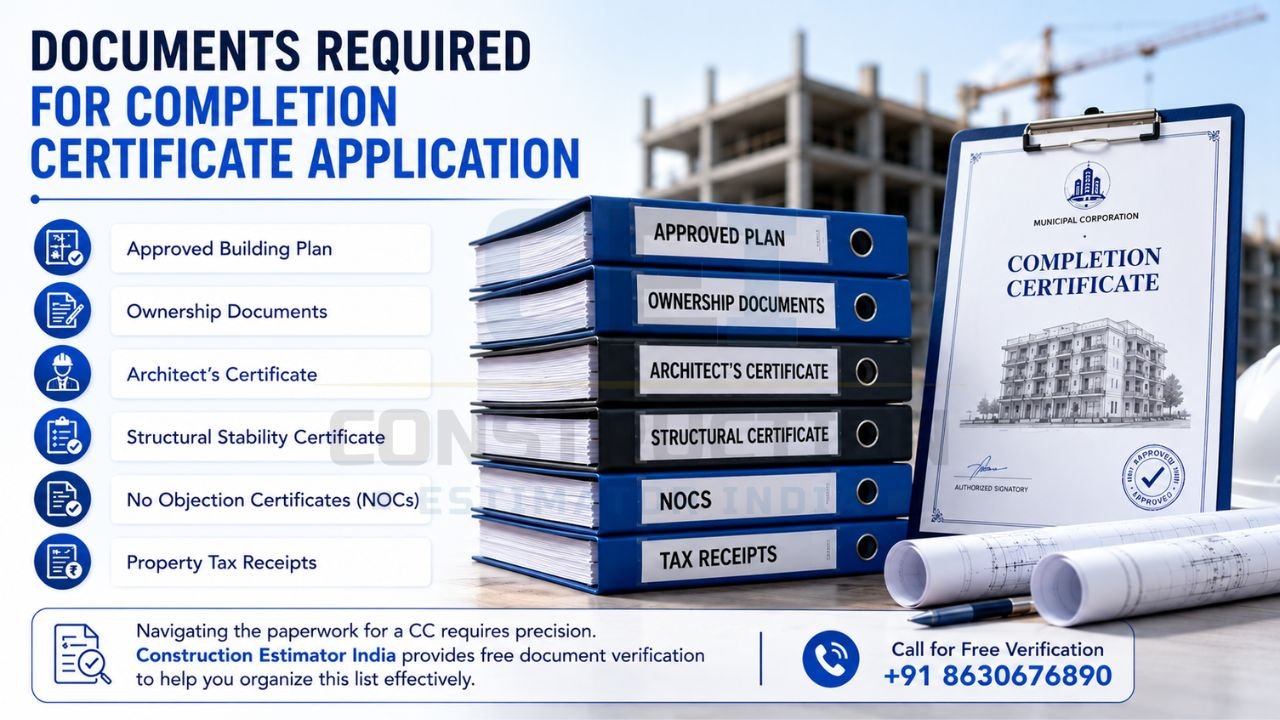
Documents Required for Completion Certificate Application
Navigating the paperwork for a CC requires precision. Construction Estimator India provides free document verification at +91 8630676890 to help you organize this list effectively.
Document 1: Copy of Sale Deed/Lease Deed
You must provide a copy of the Sale Deed or Lease Deed registered at the sub-registrar’s office. This document is the primary proof of your legal ownership of the plot. It ensures the municipal authority that the applicant has the legal right to apply for a certificate for the structure built on that specific land.
Document 2: Approved Building Plan
A copy of the originally approved building plan and the permission letter (plan sanction) must be submitted. This allows the municipal engineers to compare the “as-built” structure with what was legally permitted at the start of the project.
👉 Get Professional Guidance on Construction Compliance and Final Approvals.
Document 3: Building Plan Drawings (As Built)
Homeowners must provide building plans drawn to a scale of 1:100, showing all existing details as actually built. This typically requires two blueprints along with a tracing. These drawings must reflect every floor, elevation, and section of the completed house, highlighting any minor changes made during construction.
Document 4: Property Tax Receipts
You must submit photocopies of up-to-date property tax receipts. The municipality will not issue a CC if there are any pending taxes or dues on the land or the structure. This proves that you are a law-abiding taxpayer and the property is correctly registered in the revenue books.
Document 5: Water Tax Receipts
Similar to property tax, receipts for water tax paid up-to-date are mandatory. This confirms that your water connection (if already applied for during construction) is in good standing and all usage fees have been cleared.
Document 6: UGD Connection Charges Receipt
A photocopy of the receipt for Underground Drainage (UGD) connection charges is required. This proves that your building’s waste management system is officially integrated into the city’s sewage network, preventing environmental hazards and public health issues.
Document 7: Electricity & Road Cutting Receipts
You must provide receipts for electricity cable charges and road cutting charges paid. These are fees paid to the municipality to repair the road surface after laying utility lines. This ensures that your construction did not permanently damage public infrastructure.
Document 8: Bore Well Permission (If Applicable)
If you have installed a bore well on your property, a photocopy of the receipt for bore well permission fees must be submitted. In many Indian cities, extracting groundwater without permission is illegal and can lead to the rejection of your CC.
Document 9: Affidavit on Stamp Paper
An affidavit on a ₹10 non-judicial stamp paper is required, which must be attested by a Notary Public or Metropolitan Magistrate. This affidavit declares your ownership, provides details of the architect/engineer engaged, and confirms that construction followed all local bylaws.
Document 10: Certificate from Empanelled Architect
A formal “Building Completion Certificate” issued and signed by an empanelled architect or construction engineer is mandatory. This professional certifies that they supervised the work and it matches the sanctioned design.
Document 11: Photographs of Completed Building
Recent photographs of the completed building, including all sides and interiors, must be submitted. These photos must be duly attested by your empanelled architect to serve as visual proof of the project’s completion.
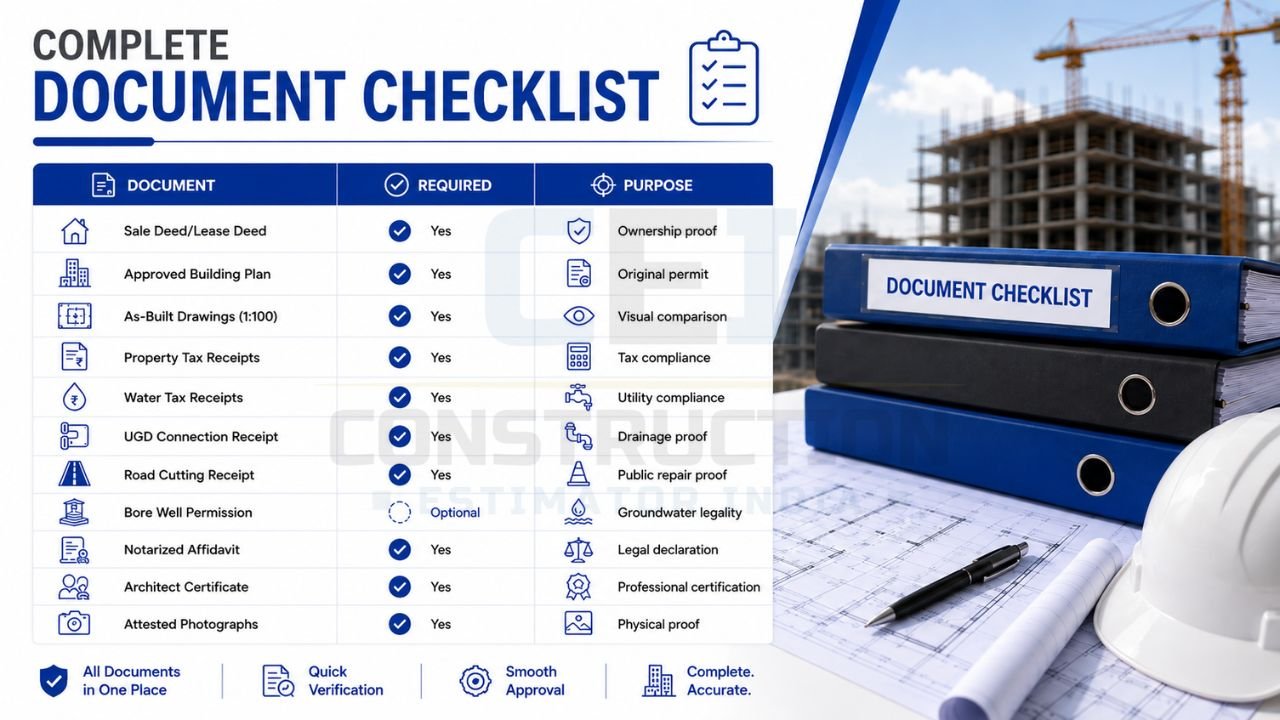
Complete Document Checklist Table
| Document | Required | Purpose |
|---|---|---|
| Sale Deed/Lease Deed | Yes | Ownership proof |
| Approved Building Plan | Yes | Original permit |
| As-Built Drawings (1:100) | Yes | Visual comparison |
| Property Tax Receipts | Yes | Tax compliance |
| Water Tax Receipts | Yes | Utility compliance |
| UGD Connection Receipt | Yes | Drainage proof |
| Road Cutting Receipt | Yes | Public repair proof |
| Bore Well Permission | Optional | Groundwater legality |
| Notarized Affidavit | Yes | Legal declaration |
| Architect Certificate | Yes | Professional certification |
| Attested Photographs | Yes | Physical proof |
👉 Need Help with Property Documentation? Consult Our Experts Today.
Step-by-Step Process to Get Completion Certificate
Step 1: Complete Construction Fully
The first step is to ensure that 100% of the construction work is finished. This includes all structural elements, plumbing, electrical wiring, and exterior painting. The house must be “move-in ready” before you even think of applying. Construction Estimator India can provide a free construction compliance check to ensure you haven’t missed any vital details.
Step 2: Hire Empanelled Architect for Certification
In most Indian cities, you cannot apply for a CC on your own. You must hire an architect who is “empanelled” or registered with the local municipal authority. The architect will visit your site, measure the rooms and setbacks, and compare them to the sanctioned plan. Once satisfied, they will issue the necessary professional certificate. The fee for this service typically ranges from ₹5,000 to ₹20,000.
Step 3: Prepare All Required Documents
Collect all 11 documents mentioned in the previous section. Ensure that all tax receipts are current and that your as-built drawings are prepared to the correct scale of 1:100. Organizing these in a professional folder will speed up the review process.
Step 4: Submit Application to Municipal Authority
Your architect will typically handle the submission through the city’s Online Building Plan Approval System (OBPAS). However, you can also submit it at the office of the Chief Zonal Officer of the local development authority. The application must be accompanied by a nominal fee, which is often around ₹20 in many jurisdictions.
Step 5: Pay Application Fee & Processing Costs
While the base application fee is low, the total cost including architect fees, stamp paper, and document preparation can range from ₹10,000 to ₹30,000. Ensure you get a receipt for every payment made to the municipality.
Step 6: Joint Inspection by Authority
Once the application is filed, the municipal engineers will schedule a joint inspection. They will visit your property accompanied by your architect to verify if the house is built as per the sanctioned design plan. They will check the FAR (Floor Area Ratio), setbacks, and overall structural integrity.
Step 7: Compliance (If Required)
If the inspectors find any minor deviations (e.g., a balcony built slightly larger than permitted), they will issue an order to comply. You will be required to rectify these issues or pay a regularization penalty. Once you submit proof of compliance, the process continues.
Step 8: Receive Completion Certificate
If everything is in order and all specifications are followed, the completion certificate is issued within 3 to 4 weeks. It will be duly signed and stamped by the authority, signaling that your home is now 100% legal and ready for life.
Completion Certificate Timeline & Fees
Timeline for CC Issuance
A standard, error-free application typically takes 3 to 4 weeks (21–30 days) to result in a CC after the site inspection is completed. Some efficient municipal authorities, like those in Kerala or parts of Karnataka, aim to issue it within 15 working days if all documents are perfect. However, if compliance is required or deviations are found, the timeline can stretch to 6 to 8 weeks.
Fee Structure
The total cost of obtaining a CC varies by city and house size, but for a standard individual residential house (1,000–2,000 sq. ft.), homeowners should budget for:
- Application Fee: ₹20–₹500.
- Architect Certification: ₹5,000–₹20,000.
- Notarization & Stamp Paper: ₹500–₹1,000.
- Document Preparation: ₹1,000–₹3,000.
- Total Estimated Cost: ₹10,000–₹30,000.
Penalties for Delayed CC
It is critical to note that construction must typically be completed and the CC applied for within 3 years of the initial building plan approval. If no intimation of completion is received within this period, the original construction permission may be automatically revoked. Renewing an expired permit can be a costly and time-consuming process.
Completion Certificate by City: Municipal Authority Contact
Delhi: DDA/MCD
In the capital, the owner must intimate the Delhi Development Authority (DDA) or the Municipal Corporation of Delhi (MCD) through an architect after completing construction. This must happen within the 3-year validity of the original plan.
Bangalore: BBMP
The Bruhat Bengaluru Mahanagara Palike (BBMP) handles CC/OC applications. Homeowners can apply online through the BBMP One portal. Given the focus on “e-Khatha” in 2026, having a CC is vital for property record updates.
Mumbai: BMC
The Brihanmumbai Municipal Corporation (BMC) uses the ICBAS/AutoDCR system. The process is strictly digital, and inspections are scheduled within a week of document upload.
Chennai: GCMC
The Greater Chennai Municipal Corporation offers a streamlined online application process. Homeowners in Chennai should ensure their rainwater harvesting systems are fully functional, as this is a major focus during CC inspections.
Common Issues When Applying for Completion Certificate
👉 Complete Your Project the Right Way with Professional Approval Support.
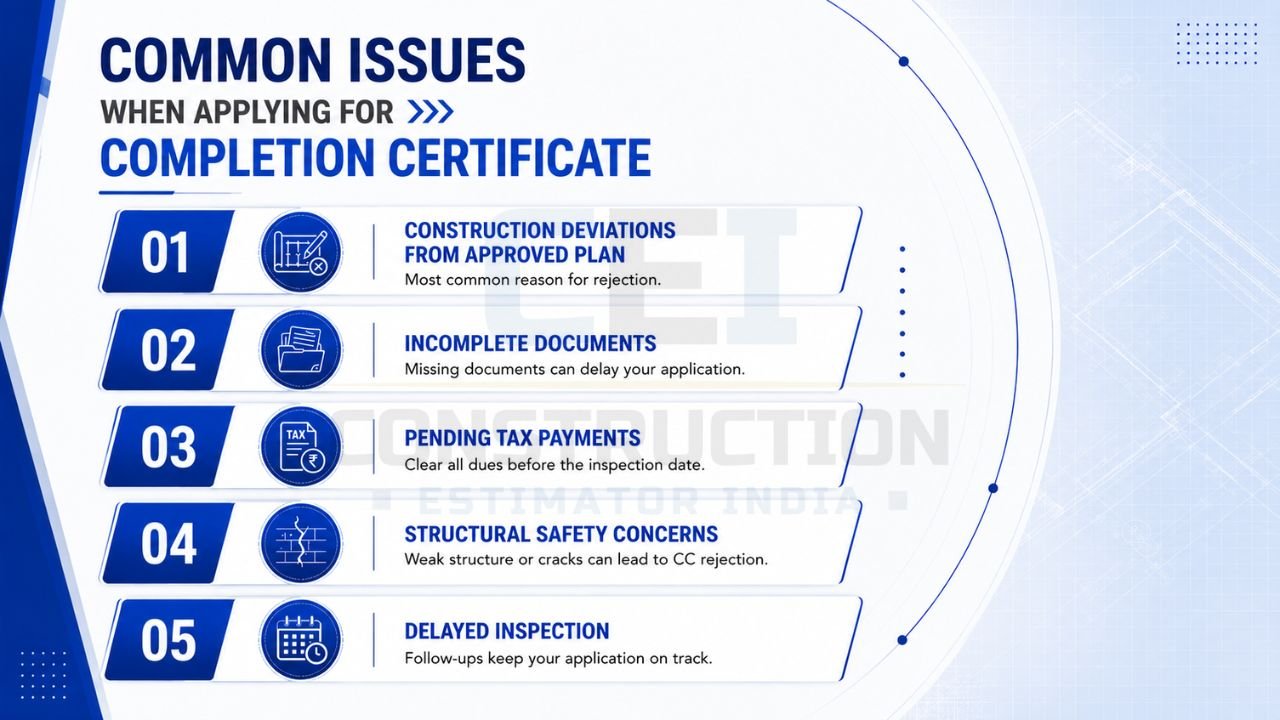
Issue 1: Construction Deviations from Approved Plan
This is the most common reason for rejection. If you built a room where the plan showed a setback, the authority will demand its removal or a heavy fine. Ensuring your team utilizes professional building contractors keeps executions aligned with original drawings.
Issue 2: Incomplete Documents
Missing property tax receipts or outdated sale deeds can reset your application timeline by weeks. Always use a comprehensive checklist (see Section 5) before submission.
Issue 3: Pending Tax Payments
Unpaid water or property taxes are immediate red flags. Ensure every single rupee owed to the municipality is cleared before the inspection date.
Issue 4: Structural Safety Concerns
If the building shows visible cracks or doesn’t meet the baseline requirements, the engineer will deny the CC. In such cases, checking your foundation types for house construction in India and structural integrity is mandatory.
Issue 5: Delayed Inspection
Sometimes municipal officers are overburdened, leading to delays. Regular follow-ups by your empanelled architect are essential to keep the file moving.
What to Do After Getting Completion Certificate?
Action 1: Property Registration
Take your CC to the sub-registrar’s office immediately to complete your property registration. This ensures you have a “clear title” for the built structure, not just the land.
Action 2: Utility Connections
Apply for permanent domestic electricity and water connections using the CC as your primary document. This will significantly reduce your monthly utility bills compared to construction-phase rates.
Action 3: Occupancy Certificate (If Separate)
If your city mandates a separate Occupancy Certificate (OC), use the CC as the basis for that application. Remember, the OC is the final “green light” to move in.
Action 4: Home Loan Final Approval
Submit the CC to your bank to regularize your home loan. This will ensure that your interest rates are locked in at domestic levels and that you are eligible for any insurance benefits associated with the loan.
When to Contact Construction Estimator India for CC Help?
Obtaining a CC can be a bureaucratic maze. If you are implementing a localized build or updating an existing asset through an extensive house renovation, coordinating technicalities requires precise engineering guidance. Construction Estimator India acts as your personal representative to ensure your paperwork is flawless. Contact us at +91 8630676890 if:
- You are unsure if your construction matches the approved plan.
- You need help finding an empanelled architect for certification.
- You want a thorough document audit before submitting to the municipality.
- You face delays or queries from the municipal corporation.
We offer:
- Free Completion Certificate Assistance
- Free Document Verification
- Free Construction Compliance Check
FAQs
Q1: What is completion certificate for house?
A: It is an official document issued by the local authority certifying that construction is completed according to the approved plans and bylaws.
Q2: Why is completion certificate important?
A: It is mandatory for property registration, permanent utility connections, and housing loans.
Q3: Who issues completion certificate in India?
A: The local Municipal Corporation or Development Authority (e.g., DDA, BBMP, BMC).
Q4: Is completion certificate mandatory for property registration?
A: Yes, it is a legal requirement for registering a built property in India.
Q5: What documents are required for completion certificate?
A: Key documents include the Sale Deed, Approved Plan, As-Built drawings, tax receipts, and an architect’s certificate.
Q6: How long does it take to get completion certificate?
A: Typically 3 to 4 weeks (21–30 days) after the site inspection.
Q7: What is the cost of completion certificate in India?
A: The total cost, including architect fees and taxes, ranges from ₹10,000 to ₹30,000 for a standard house. Knowing your comprehensive regional house construction per sq ft rate helps you allocate these costs smoothly.
Q8: Can I get utilities without completion certificate?
A: No, municipal authorities usually require a CC for permanent water and electricity connections.
Q9: What happens if construction is not completed within 3 years?
A: The building plan approval may be revoked, and you might need to apply for a fresh permit.
Q10: Difference between completion certificate and occupancy certificate?
A: CC confirms the building matches the plan; OC confirms the building is safe and fit for human habitation.
Q11: What if construction doesn’t match approved plan?
A: You must rectify the deviations or pay a penalty for regularization before the CC is granted.
Q12: How do I contact Construction Estimator India for CC help?
A: You can reach us via WhatsApp or Call at +91 8630676890 for a free consultation.
Contact Construction Estimator India for Construction Services
Don’t let red tape delay your homecoming. Construction Estimator India provides expert legal and technical oversight to ensure your construction journey is 100% compliant from day one.
Company: Construction Estimator India
WhatsApp/Call: +91 8630676890
Services:
- Free Completion Certificate Assistance
- Free Document Verification
- Free Construction Compliance Check
Conclusion: Get Completion Certificate for Legal, Safe House
A Completion Certificate is more than just a permit; it is the official legal acknowledgment that your home is safe, compliant, and structurally sound. As we have explored, the journey toward a legal home ends with this document, not just the last coat of paint. By following this step-by-step guide—from land verification to the final inspection—you protect your family’s future and your financial investment.
Remember, building without a CC is a risk that can lead to demolition or a total loss of property value. While the cost for an individual house approval can range from ₹10,000 to ₹30,000, it is a small price for total peace of mind. Construction Estimator India is here to help with free completion certificate assistance at +91 8630676890. Build smart, build legal, and enjoy your new home with confidence.