Building or renovating a home in India is a significant investment, often representing a lifetime of savings. However, the Indian monsoon—stretching from June to September—presents a formidable challenge to structural integrity. Heavy downpours, high humidity, and regional variations like the intense rains of the Western Ghats or the humid Northeast can transform a dream home into a maintenance nightmare if proper precautions aren’t taken. Understanding how to plan home construction in India from the very beginning is the most effective way to safeguard against these seasonal threats.
Common issues such as wall dampness, ceiling seepage, and efflorescence (salpeter) are not just aesthetic problems; they are indicators of structural decay. Water ingress can lead to the corrosion of steel reinforcement (spalling), the growth of toxic mold, and a significant reduction in property value. In fact, ignoring monsoon-proofing during the construction phase can lead to future repair costs ranging from ₹50,000 to over ₹500,000.
👉 Protect Your Home from Monsoon Damage with Expert Construction Guidance.
At Construction Estimator India, we believe that prevention is far more cost-effective than a cure. This comprehensive guide provides actionable, engineering-backed strategies to ensure your home remains dry and resilient for 50+ years. For expert assistance, Construction Estimator India offers a Free Waterproofing Consultation and Free Monsoon-Proofing Site Inspection. Contact us today at +91 8630676890 (WhatsApp/Call).
Before Construction: Site Preparation for Monsoon
Preparation begins before the first brick is laid. Proper site grading and soil understanding are the foundations of a monsoon-resistant home.
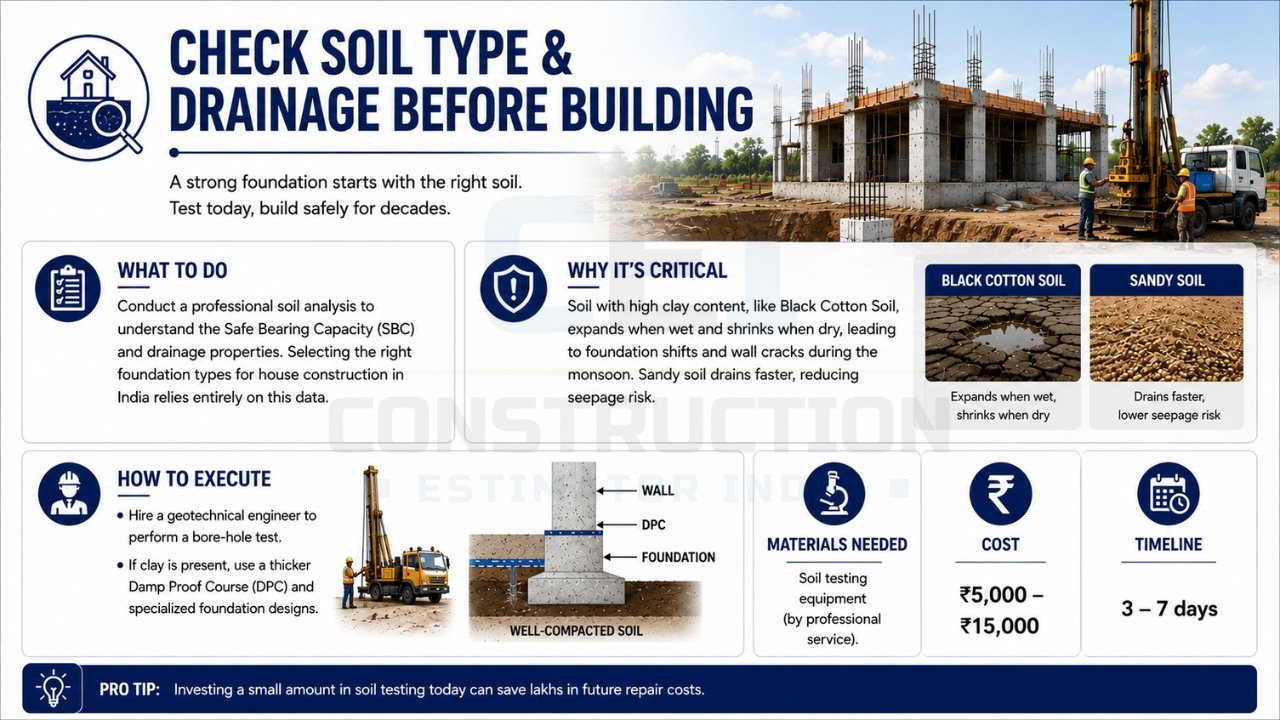
Check Soil Type & Drainage Before Building
What to do: Conduct a professional soil analysis to understand the Safe Bearing Capacity (SBC) and drainage properties. Selecting the right foundation types for house construction in India relies entirely on this data.
Why it’s critical: Soil with high clay content, like Black Cotton Soil, expands when wet and shrinks when dry, leading to foundation shifts and wall cracks during the monsoon. Sandy soil drains faster, reducing seepage risk.
How to execute: Hire a geotechnical engineer to perform a bore-hole test. If clay is present, use a thicker Damp Proof Course (DPC) and specialized foundation designs.
Materials Needed: Soil testing equipment (by professional service).
Cost: ₹5,000–₹15,000.
Timeline: 3–7 days.
Raise Plinth Level Above Road Level
What to do: Ensure the ground floor (plinth level) is significantly higher than the surrounding road and historical flood levels.
Why it’s critical: This prevents rainwater from the road or yard from entering your home during heavy flooding.
How to execute: Set the plinth at least 300mm (12 inches) above the road level, though 2–3 feet is recommended for heavy rainfall zones.
Materials Needed: Compacted earth, soling, and M20/M25 concrete.
Cost: ₹10,000–₹50,000 (varies by plot size).
👉 Planning Construction Before the Rainy Season? Consult Our Experts Today.
Create Around-Plot Drainage (Peripheral Drain)
What to do: Build a U-shaped or V-shaped concrete drain around the entire perimeter of the plot.
Why it’s critical: It captures surface runoff and prevents it from pooling near the foundation, which can cause settlement issues.
How to execute: Excavate a channel, line it with bricks or concrete, and ensure it connects to the municipal storm water outlet.
Materials Needed: Bricks, cement, sand, and 4-inch PVC pipes for connections.
Cost: ₹20,000–₹100,000.
Timeline: 5–10 days.
Slope Ground Away From Building
What to do: Grade the surrounding landscape so it slopes away from the structure.
Why it’s critical: This ensures water flows toward the peripheral drains rather than soaking the soil adjacent to your foundation.
How to execute: Maintain a minimum gradient of 1:50 (2-3% slope) using compacted earth and a concrete apron (plinth protection).
Materials Needed: Fill soil, compaction tools, and concrete for the apron.
Cost: ₹15,000–₹75,000.
Foundation Waterproofing: Prevent Seepage at Base
The foundation is the most vulnerable part of the house during the monsoon as it remains in constant contact with moist soil.
Apply Damp Proof Course (DPC) on Foundation
What to do: Lay a 40mm thick horizontal barrier of concrete at the plinth level.
Why it’s critical: The DPC stops “rising damp”—moisture traveling up the walls via capillary action—which can destroy interior paint and plaster.
How to execute: Use a 1:2:4 concrete mix integrated with a liquid waterproofing compound. Ensure the layer is continuous with no gaps.
Materials Needed: Cement, sand, aggregate, and waterproofing compounds (e.g., Dr. Fixit LW+).
Cost: ₹15,000–₹60,000.
Timeline: 1–2 days.
Use Waterproofing Compound in Foundation Concrete
What to do: Mix integral waterproofing chemicals into all foundation concrete work.
Why it’s critical: These chemicals block the micro-pores in concrete, making it denser and less permeable to groundwater.
How to execute: Add the compound (usually 200ml per bag of cement) to the mixing water before adding it to the dry mix.
Materials Needed: Products like Sassol, Dr. Fixit, or Kryton.
Cost: ₹5,000–₹20,000 per house.
Apply Cement Mortar Waterproofing on Foundation Walls
What to do: Plaster the vertical surfaces of the foundation walls before backfilling soil.
Why it’s critical: It provides a primary barrier against lateral moisture penetration from the wet earth.
How to execute: Apply a 15–20mm thick coat of 1:4 cement mortar mixed with a waterproofing additive.
Materials Needed: Cement, fine sand, and waterproofing liquid.
Cost: ₹20,000–₹80,000.
Install Bitumen Membrane on Foundation (Heavy Rain Areas)
What to do: Apply a torch-on or self-adhesive bitumen membrane to the foundation.
Why it’s critical: In coastal areas like Kerala or Mumbai, standard plaster isn’t enough; a physical membrane is required for 100% protection.
How to execute: Clean the surface, apply a primer, and then wrap the foundation with the 2mm thick bitumen sheet.
Materials Needed: Bitumen primer and 2mm membrane sheets.
Cost: ₹40,000–₹150,000.
Timeline: 2–3 days.
Wall Waterproofing: Prevent Dampness & Leaks
External walls bear the brunt of horizontal, wind-driven rain. Construction Estimator India recommends a multi-layered defense strategy.
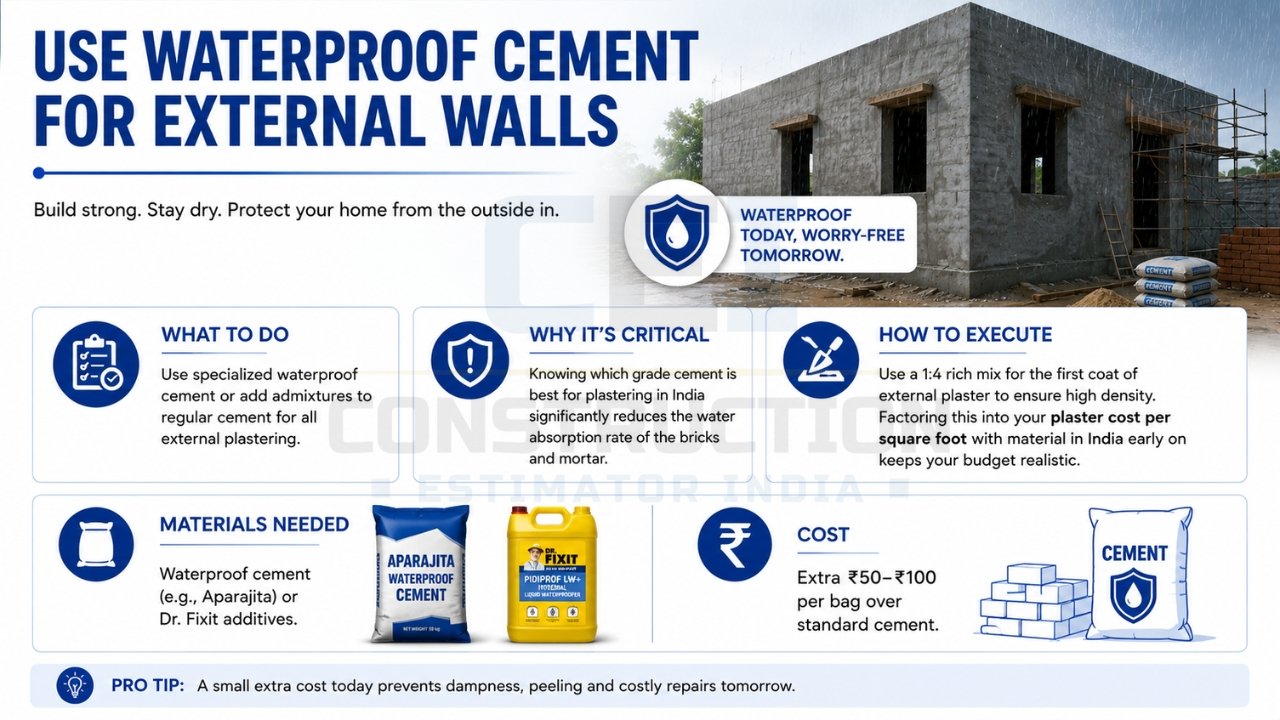
Use Waterproof Cement for External Walls
What to do: Use specialized waterproof cement or add admixtures to regular cement for all external plastering.
Why it’s critical: Knowing which grade cement is best for plastering in India significantly reduces the water absorption rate of the bricks and mortar.
How to execute: Use a 1:4 rich mix for the first coat of external plaster to ensure high density. Factoring this into your plaster cost per square foot with material in India early on keeps your budget realistic.
Materials Needed: Waterproof cement (e.g., Aparajita) or Dr. Fixit additives.
Cost: Extra ₹50–₹100 per bag over standard cement.
Apply Waterproof Putty on External Walls
What to do: Use white-cement-based or acrylic waterproof putty before painting. Mastering how to use white cement for waterproofing in India ensures maximum protection.
Why it’s critical: Standard putty can absorb moisture; waterproof putty seals micro-cracks and provides a smooth, water-resistant base.
How to execute: Apply in two layers (2–3mm total) after the plaster has cured for at least 14–21 days.
Materials Needed: Asian Paints or Berger waterproof putty.
Cost: ₹30–₹50 per sq ft.
👉 Build a Monsoon-Ready Home with Smart Construction and Waterproofing Solutions.
Use Waterproof External Paint
What to do: Finish your home with elastomeric, high-performance waterproof paint.
Why it’s critical: These paints act like a rubber skin, stretching to cover hairline cracks that develop during seasonal temperature changes.
How to execute: Apply one coat of primer followed by two coats of the topcoat. Ensure the surface is bone-dry before application.
Materials Needed: Elastomeric paints (e.g., Asian Paints Apex Ultima Protek).
Cost: ₹40–₹80 per sq ft.
Install Drip Line Grooves (Khacha)
What to do: Create horizontal grooves on the underside of projections (Chajjas) and above the plinth.
Why it’s critical: Drip grooves break the surface tension of water, forcing it to drop to the ground instead of crawling back toward the wall or window frame.
How to execute: Cut a 10mm x 10mm groove during the plastering phase.
Materials Needed: Standard plastering tools or plastic U-strips.
Cost: ₹10,000–₹40,000.
Seal Wall Cracks with Waterproof Epoxy
What to do: Inspect and fill all structural and hairline cracks before the monsoon.
Why it’s critical: Even a 1mm crack can allow liters of water to seep in during a heavy storm, leading to interior dampness.
How to execute: V-groove the crack, clean it, and fill it with a non-shrink epoxy or polyurethane filler.
Materials Needed: Dr. Fixit CrackX or similar epoxy fillers.
Cost: ₹500–₹2,000 per crack.
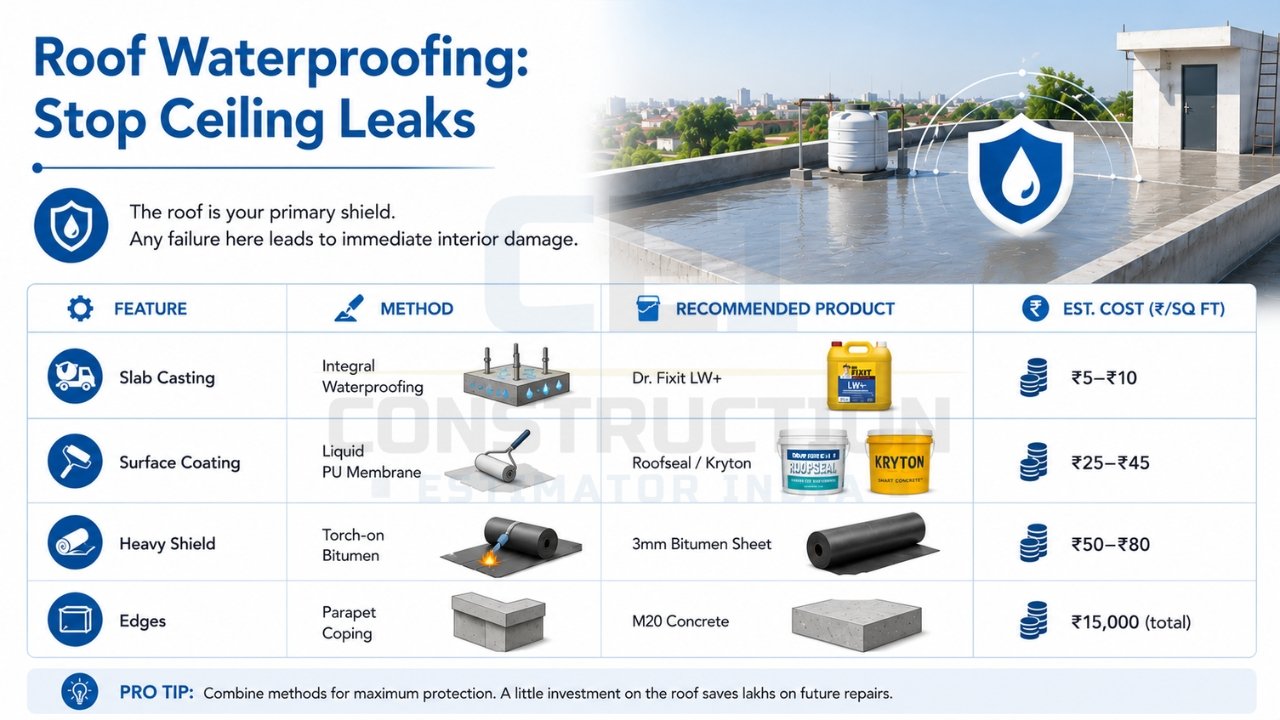
Roof Waterproofing: Stop Ceiling Leaks
The roof is your primary shield. Any failure here leads to immediate interior damage.
| Feature | Method | Recommended Product | Est. Cost (₹/sq ft) |
|---|---|---|---|
| Slab Casting | Integral Waterproofing | Dr. Fixit LW+ | ₹5–₹10 |
| Surface Coating | Liquid PU Membrane | Roofseal / Kryton | ₹25–₹45 |
| Heavy Shield | Torch-on Bitumen | 3mm Bitumen Sheet | ₹50–₹80 |
| Edges | Parapet Coping | M20 Concrete | ₹15,000 (total) |
Apply DPC on Roof Before Slab Casting
What to do: Integrate a waterproofing layer into the final screed of the roof slab.
Why it’s critical: It provides a second line of defense if the top coating fails.
How to execute: Apply a 40mm thick concrete layer with waterproofing compound at a 1:2:4 ratio.
Cost: ₹20,000–₹80,000.
👉 Get Professional Advice on Monsoon-Proof Construction Techniques.
Use Waterproof Concrete for Roof Slab
What to do: Ensure the main RCC slab is cast using high-density waterproof concrete. A firm grasp of what is RCC construction guarantees these pours are structurally sound.
Why it’s critical: Prevents “honeycombing” and reduces overall permeability.
How to execute: Use a 1:2:4 or 1:1.5:3 ratio and ensure proper mechanical vibration during pouring.
Cost: ₹5,000–₹20,000 (compound cost).
Tip 16: Apply Liquid Waterproofing on Roof Surface
What to do: Coat the cured roof with a seamless liquid membrane.
Why it’s critical: Liquid membranes are joint-free, which is where traditional methods usually fail.
How to execute: Apply 2–3 coats using a brush or roller to achieve a 1.5–2mm thickness.
Materials Needed: Acrylic or PU-based liquid (e.g., Dr. Fixit Roofseal).
Timeline: 2–3 days.
Drainage System: Prevent Water Logging
Efficient water removal is as important as blocking water ingress. All drainage materials should conform to the standards set by the Bureau of Indian Standards (BIS).
Install Proper Roof Drainage (Gutters & Downspouts)
What to do: Install a robust system of gutters and downspouts to collect roof water.
Why it’s critical: It prevents water from cascading down the walls, which can wear away paint and saturate the foundation.
How to execute: Use 110mm (4-inch) pipes for every 500 sq. ft. of roof area. Install “Dome” gratings to prevent leaf clogs.
Materials Needed: PVC or GI pipes and gutters.
Cost: ₹30,000–₹120,000.
Slope Roof for Water Flow
What to do: Ensure the roof slab or screed has a definitive slope toward the drainage points.
Why it’s critical: “Ponding” water is the #1 cause of roof leaks. Water standing for >24 hours will eventually seep through.
How to execute: Maintain a minimum slope of 1:100 (1cm drop per meter).
Materials Needed: Cement mortar for screeding.
Cost: ₹20,000–₹80,000.
Monsoon Construction: Do’s & Don’ts
Building during the rain is possible but requires strict discipline. Utilizing resources like the India Meteorological Department (IMD) to track weather patterns helps you schedule high-risk tasks. For specialized guidance, contact Construction Estimator India at +91 8630676890.
- DO: Mix Concrete in Small Batches: Sudden rain can ruin a large batch of fresh concrete. Mix only what can be poured and covered quickly.
- DO: Protect Fresh Concrete with Tarpaulin: Keep heavy-duty (200μ) plastic sheets ready to cover fresh work the moment rain starts to prevent cement from washing away.
- DON’T: Pour Concrete if Rain is Expected within 4 Hours: The first 4 hours of setting are critical. Check weather forecasts daily.
-
DON’T: Lay Bricks During Heavy Rain: Rainwater can wash out the mortar from the joints, leading to a weak wall structure. Knowing the difference between RCC and brick construction in India highlights why brickwork is particularly vulnerable to washouts before setting.
FAQs: Expert Advice from Construction Estimator India
Q1: Can I build during the monsoon season?
Yes, but focus on interior work. Avoid major excavation or external plastering during heavy rain days.
Q2: What is DPC and why is it important?
Damp Proof Course (DPC) is a horizontal barrier at the plinth level that stops groundwater from rising into your walls through capillary action.
Q3: Which waterproofing compound is best?
For Indian conditions, integral waterproofing (in the mix) combined with PU-based liquid membranes is highly effective.
Q4: How do I fix wall dampness after construction?
Identify the source (leaky pipe or rising damp). You may need chemical injection or a new DPC. Call Construction Estimator India at +91 8630676890 for a Free Site Inspection.
Contact Construction Estimator India
Don’t let the monsoon damage your dream home. Construction Estimator India provides professional civil engineering and architectural consultancy tailored for the Indian climate.
- WhatsApp / Call: +91 8630676890
- Free Services:
- Free Waterproofing Consultation
- Free Monsoon-Proofing Site Inspection
Conclusion
Monsoon-proof construction is not an “optional extra”; it is a foundational requirement for any building in India. By implementing strategies like the DPC, integral waterproofing, and proper drainage systems, you protect your home from depreciation and your family from the health risks of dampness.
Start your monsoon-proofing journey today with Construction Estimator India. Our expert team is ready to help you build a resilient, beautiful, and dry home that stands the test of time. Reach out to us at +91 8630676890 for your free estimate and consultation.