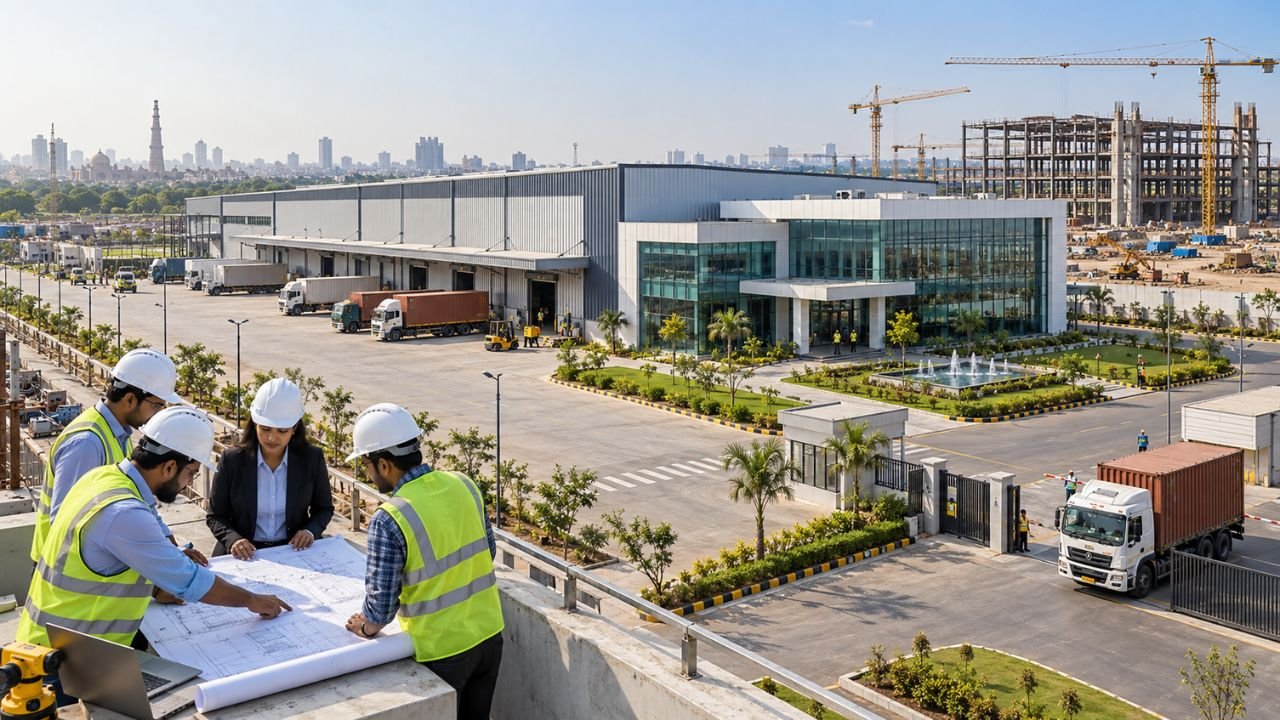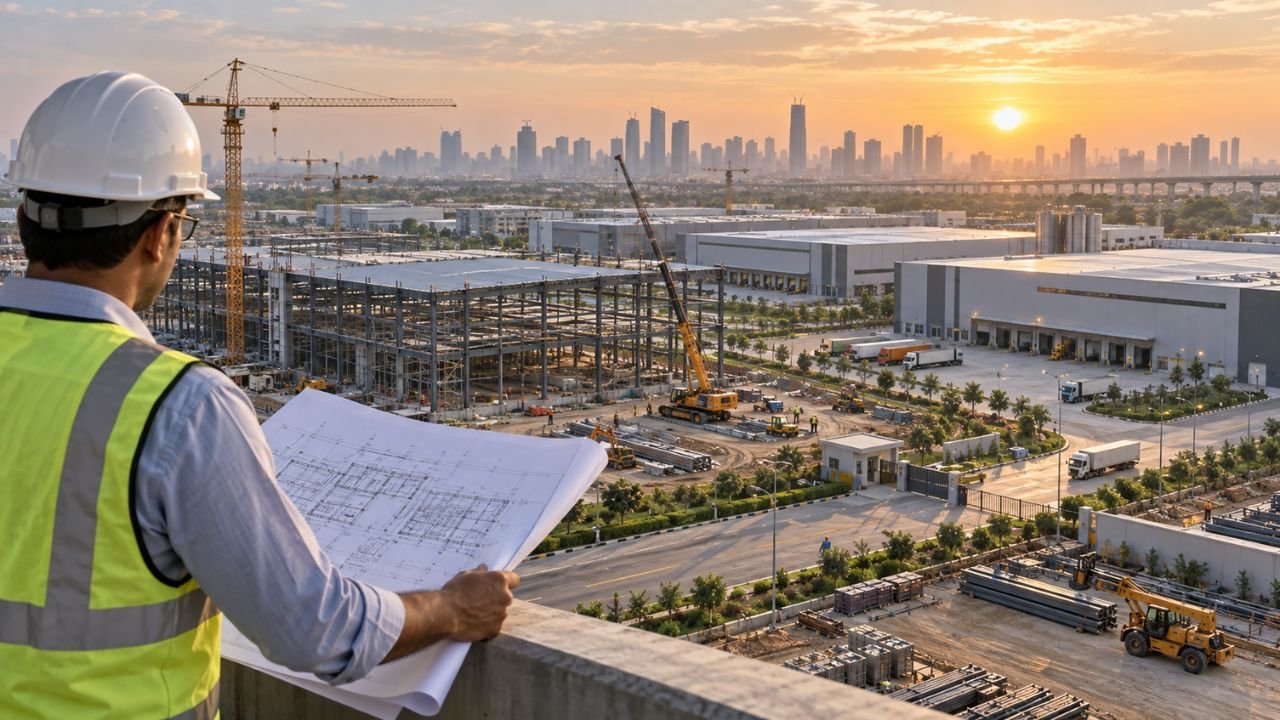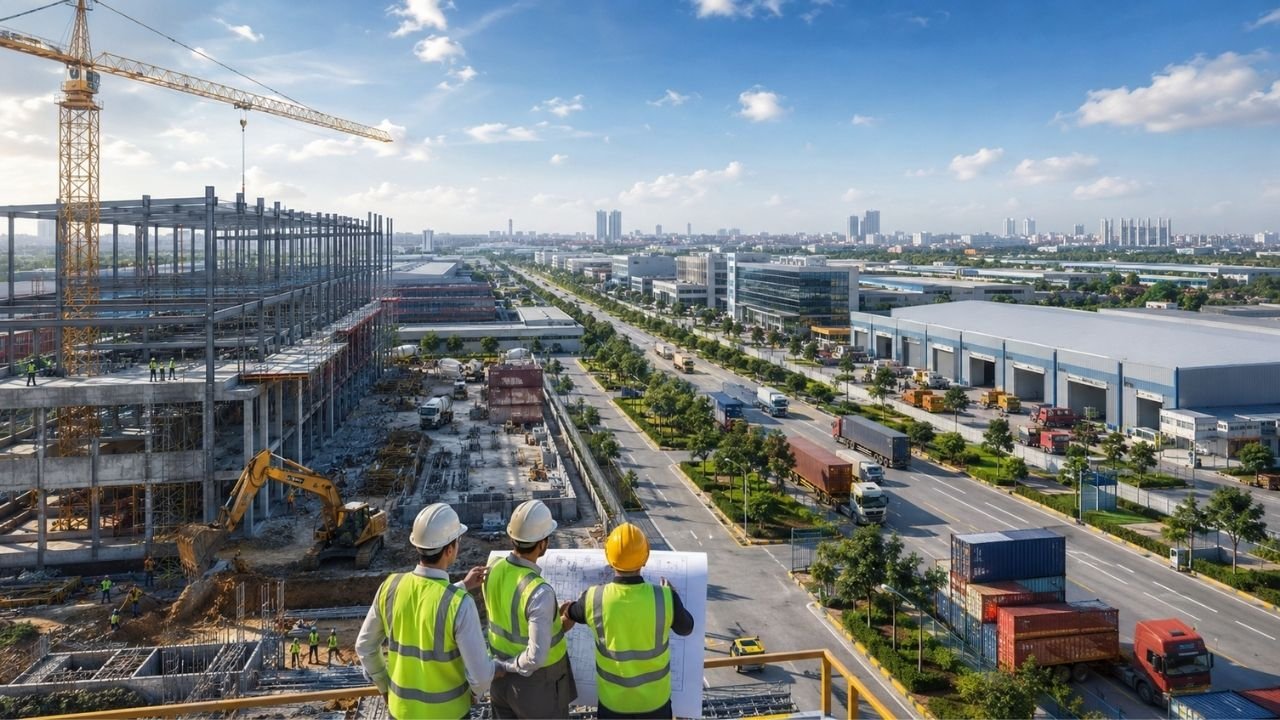
For many, a house is a dream for a common man, representing a lifetime of hard work, savings, and emotional aspirations. Thoroughly understanding how to plan home construction in India is arguably the most significant investment of time you will ever make, yet it is also one of the most complex. In the diverse landscape of Indian construction, many first-time builders face daunting problems due to a lack of technical and procedural knowledge. While constructing a house, if you are not aware of basic information, there is a great chance to lose money, time, and quality in construction. This loss can manifest in budget overruns of 30-50%, legal notices from municipal authorities, or structural failures like cracks and leaks.
As an expert home construction consultant with over 15 years of experience, I have seen that you should have basic knowledge so that you can save money, time, and material. This guide is designed by Construction Estimator India to serve as your definitive roadmap. We provide 50 critical factors to consider when building your dream home, including 10 must-know tips before you even break ground. From navigating the step-by-step house construction process in India to mastering material selection, this guide ensures you stay in control.
At Construction Estimator India, we understand the anxieties of first-time builders. Whether you are building in Delhi NCR, Uttar Pradesh, or Rajasthan, our mission is to empower you with professional-grade insights. We offer a Free Consultation and Budget Estimate to help you start on the right foot. If you feel overwhelmed, remember that expert help is just a message away. You can reach us for Project Planning Assistance at WhatsApp/Call: +91 8630676890.
10 Must-Know Tips Before Starting Construction
Tip 1: Set Clear Goals for Your Home
Before you move a single bucket of soil, you must define exactly what you want from your home. First-time builders often make the mistake of starting with vague ideas, which leads to “scope creep” and massive budget hikes. Start by listing your absolute requirements: the number of bedrooms, bathrooms, and types of living areas. Consider your family’s specific lifestyle—do you need a dedicated home office, a prayer room, or an elderly-friendly ground floor bedroom?
Furthermore, plan for future expansion if needed. If you are building a G+1 duplex now but might want a second floor in five years, your foundation and structural design must be built to support that future load today. Writing down these requirements clearly helps your architect design a space that fits you like a glove, rather than a generic structure that requires expensive modifications later.
Tip 2: Define Your Budget and Stick to It
Financial discipline is the difference between a completed home and a stalled project. Define your budget and stick to it from day one. To do this effectively, assess per square foot construction expenses based on your specific location in India. For example, in 2026, costs in North India range from ₹1900 to ₹3200 per sq ft depending on quality. Getting a localized estimate, like checking the house construction per sq ft rate roorkee (or your specific city), gives you a baseline.
You must seek advice from a civil engineer about construction costs to get a realistic picture that includes land costs, design fees, utilities, and furnishings. A critical tip: always add a 10-15% contingency buffer for unexpected price hikes in steel or cement. For a professional, itemized budget, Construction Estimator India provides detailed BOQ services. Contact us at +91 8630676890 for a preliminary estimate.
Tip 3: Choose the Right Location
Location is critical for both your quality of life and long-term property value. Beyond just the neighborhood, you must double-check plot boundaries and get them marked clearly by a licensed surveyor using GPS pillars to prevent future disputes with neighbors. Verify the connectivity to schools, hospitals, and amenities, but also look deeper into the site’s physical health.
Check for soil quality (alluvial vs. rocky) and water availability, as these significantly impact foundation costs. In North India, you must also verify if the plot falls in a flood risk zone or a high seismic zone (like Zone IV in Dehradun or Delhi). Ensure all legal clearances, such as mutation certificates and non-agricultural (NA) conversion, are in order before proceeding.

Tip 4: Hire a Reputable Architect
Hire a reputable architect who understands your vision and has a portfolio of completed residential projects. An architect is not just a draftsman; they are the visionary who balances aesthetics with functionality and local building bylaws. Finding top-tier professionals, such as the top architects in roorkee or in your district, ensures you get AutoCAD/BIM plans that include detailed elevations, sections, and even 3D models.
A good architect will also ensure your home is compliant with Vastu Shastra if you follow it, and more importantly, with the National Building Code (NBC). They will help you maximize natural light and ventilation, which reduces long-term electricity bills. Ensure they are COA-licensed to avoid issues with building plan sanctions later.
👉 Start your home-building journey the right way with expert insights from industry professionals.
Tip 5: Hire an Experienced Local Contractor
The best designs in the world are useless if the execution is poor. Choosing the right person to build your dream house is a high-stakes decision. You must verify a contractor’s experience by visiting at least 2-3 of their completed projects to inspect the finishing quality. Talk directly to previous clients about their behavior, transparency, and whether they stayed within the quoted timeline.
In 2026, ensure the contractor has a valid GST registration and a clear, written agreement. A common mistake is hiring the “cheapest” quote, which often leads to the use of inferior materials or hidden “extra” costs later. Construction Estimator India can help you perform a contractor bid analysis to ensure you are getting a fair deal. Call us at +91 8630676890 for guidance.
Tip 6: Get Proper Building Approvals
Never start construction without a formal building plan sanction from your local authority (MCD, Noida Authority, or Gram Panchayat). Starting without a permit can lead to demolition orders or massive penalties. The process usually takes 30-90 days and requires architectural and structural drawings.
In 2026, many states have moved to digital single-window portals for faster approvals. Ensure you also have the necessary NOCs for fire safety, electricity, and water connections. If your plot is larger than 500 sqm, check if RERA registration is mandatory for your specific project type to avoid legal complications.
Tip 7: Conduct Soil Testing
This is perhaps the most overlooked step by first-time builders. Conduct soil testing to ensure a stable foundation. Exploring the different foundation types for house construction in India highlights why testing is vital. The National Building Code (NBC-2016) strongly recommends completing both soil testing and surveying before starting construction. A geotechnical report tells you the Safe Bearing Capacity (SBC) of your land.
If you have “black cotton soil” or loose alluvial soil common in the Gangetic plains, you might need a pile foundation rather than a standard footing. Skipping a ₹15,000 soil test could result in a ₹10 lakh foundation failure later. Expert labs like TUV SUD or IIT affiliates are recommended for accurate testing.
Tip 8: Plan for Natural Lighting & Ventilation
An energy-efficient home is a comfortable home. Proper planning for natural lighting and ventilation reduces your reliance on artificial lights and air conditioning, saving you thousands in utility bills over the years. Your architect should position windows and openings to take advantage of the prevailing wind direction and the sun’s path.
Consider features like skylights, internal courtyards (angan), or cross-ventilation strategies. In the hot Indian climate, south and west-facing walls should have fewer or shaded openings to prevent heat gain. Proper ventilation also prevents moisture buildup, which protects your paint and structure from dampness.
Tip 9: Create Detailed Floor Plans
Detailed floor plans are the “DNA” of your house. They should include not just the walls and doors, but also furniture layouts, electrical points, and plumbing routes. Having these finalized before construction begins prevents “on-site changes” which are the primary cause of delays and budget overruns.
Ensure the floor plan accounts for modern lifestyle needs, such as a modular kitchen layout, adequate storage/wardrobe space, and ergonomic bathroom designs. Review the plans multiple times with your family to ensure the “flow” of the house works for your daily routine. Construction Estimator India can review your plans to ensure they are optimized for cost and space.
Tip 10: Factor in Future Expansion
Many homeowners build a ground floor today with the intention of adding a first or second floor later. If this is your plan, you must communicate this clearly to your structural engineer. The columns, beams, and foundation must be designed with “starter bars” and the structural strength to carry the additional load of future floors.
Failing to do this means you will either never be able to expand, or you will have to undergo extremely expensive structural retrofitting later. Even if you don’t build the upper floors now, planning the staircase and utility lines (water/sewerage) to extend upwards will save you massive headaches in the future.
Step-by-Step House Construction Process in India
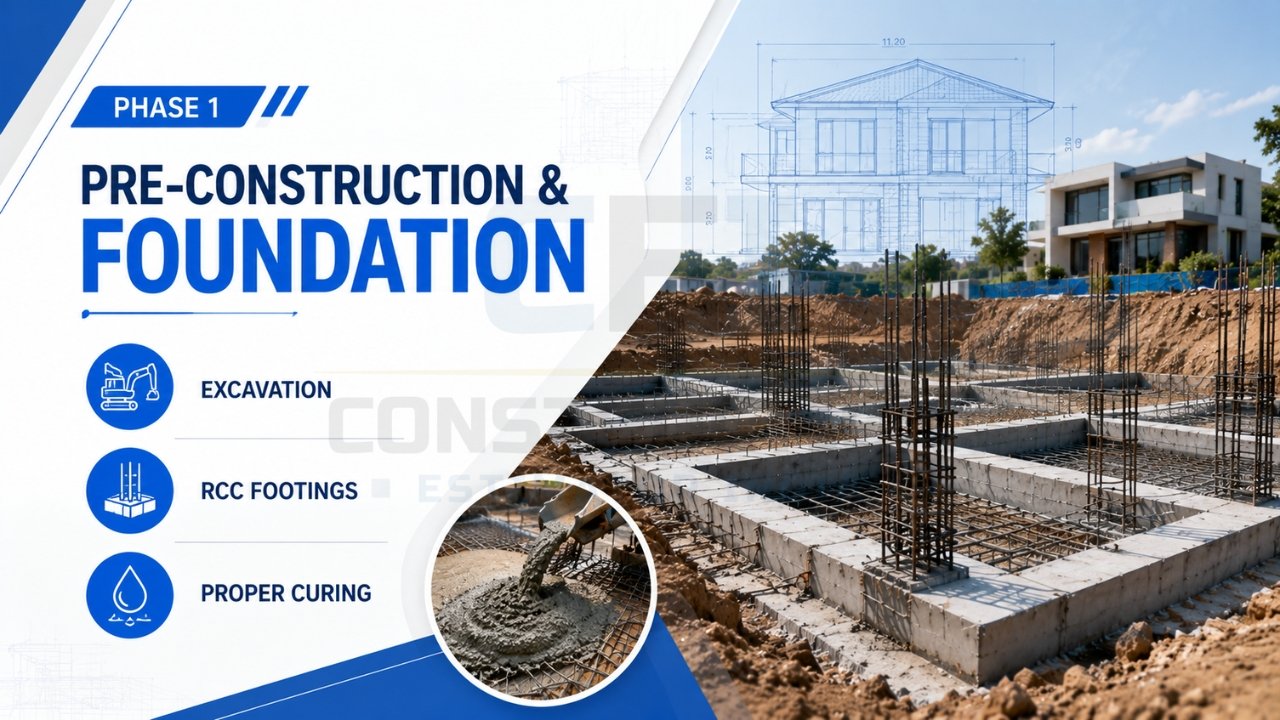
Phase 1: Pre-Construction & Foundation
The journey from plot to house completion begins with site preparation. Once your land is acquired and cleared, the very first physical step is excavation. Based on your soil report, the foundation is laid—this is the most critical structural component. In India, this typically involves Lean PCC (Plain Cement Concrete) followed by RCC footings.
For a standard 1500 sq ft home, the foundation stage takes about 15-35 days and consumes roughly 15% of your total budget. It is vital to ensure proper curing (watering) of the concrete for at least 7-14 days to achieve maximum strength. Construction Estimator India recommends site visits during this phase to ensure the steel reinforcement matches the structural drawings.
Phase 2: Structure & RCC Work
Once the foundation is set, the “skeleton” of the house—the RCC (Reinforced Cement Concrete) structure—begins to rise. Understanding precisely what is RCC construction reveals why this includes columns, beams, and the roof slab. This is the most “steel and cement-heavy” phase, often taking the longest time and nearly 26% of your budget per floor.
In 2026, ensure you are using TMT steel of at least Fe500D grade and 53-grade OPC cement for structural members. The shuttering (formwork) must be level and sturdy to prevent honeycombing in the concrete. Each slab needs dedicated curing time. This phase transforms your plan into a physical reality, and quality control here is non-negotiable for safety.
👉 Get personalized guidance for designing, planning, and building your first home in India.
Phase 3: Brickwork & Finishing
With the skeleton complete, the “skin” of the house—the brickwork—starts. Knowing the difference between RCC and brick construction in india helps you appreciate this transition. This involves building the internal and external walls using red bricks, AAC blocks, or fly ash bricks. Once masonry is done, electrical conduits and plumbing pipes are concealed within the walls before plastering begins.
Plastering provides a smooth base for paint and protects the bricks from the elements. This is followed by flooring (tiles, marble, or granite) and the installation of doors and windows. Finishing work is where your aesthetic vision comes to life, but it also requires meticulous supervision to ensure levels are correct and joints are seamless.
50 Critical Factors to Consider When Building Your Home
Building a house involves hundreds of moving parts. To keep you organized, we have categorized 50 critical factors every first-time builder must check:
Planning & Structure
- Seismic Resistance: Ensure design complies with IS 1893:2026 for earthquake safety.
- SBC Value: Never build without knowing your soil’s safe bearing capacity.
- Plinth Level: Elevate the plinth 2-3 feet above the road level to prevent flooding.
- Curing: Maintain a strict 14-day curing schedule for all RCC members.
- Concrete Mix: Use the correct grade (M20/M25) as specified by the engineer.
Utilities & Finishes
- Waterproofing: Apply high-quality waterproofing to terraces and bathrooms.
- Concealed Wiring: Use fire-retardant (FR) wires and branded conduits.
- Plumbing Slopes: Ensure proper slopes in floor traps and sewerage lines to prevent clogs.
- Wall Putty: Use water-resistant putty for exterior walls to prevent paint peeling.
- Termite Treatment: Conduct anti-termite treatment at the foundation and plinth levels.
For a full list of all 50 factors tailored to your specific project, WhatsApp Construction Estimator India at +91 8630676890.
Material Selection Tips for Quality Construction
Cement and Steel Quality
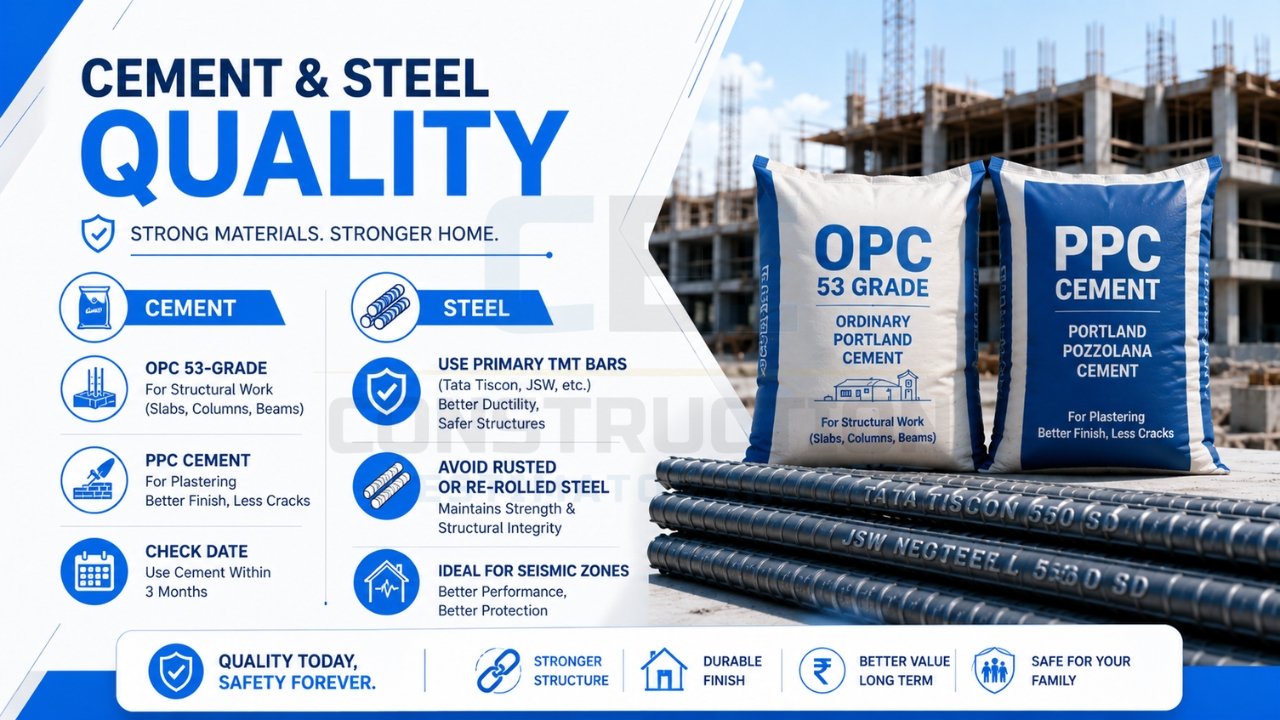
Cement is the glue of your house. For structural work like slabs and columns, use OPC (Ordinary Portland Cement) 53-grade, and for plastering, PPC (Portland Pozzolana Cement) is often preferred for its better finish and crack resistance. Knowing exactly which grade cement is best for plastering in india will save you from future aesthetic issues. Always check the manufacturing date; cement older than 3 months loses strength.
For steel, use primary TMT bars (like Tata Tiscon or JSW) that offer better ductility, especially in seismic zones. Avoid using rusted or re-rolled steel, as it compromises the structural integrity of your home.
Bricks and Waterproofing
Red bricks are traditional, but AAC (Autoclaved Aerated Concrete) blocks are becoming popular in 2026 for their thermal insulation and light weight. If using red bricks, ensure they are well-burnt and produce a metallic ringing sound when struck.
Waterproofing is where many first-time builders cut corners, only to regret it during the first monsoon. Use specialized chemical waterproofing (like Dr. Fixit or Fosroc) for the terrace, sunken slabs of toilets, and basement walls. This small investment prevents lakhs in future repair costs.
👉 Build smarter, save money, and ensure quality with expert construction support.
Common Mistakes to Avoid in House Construction
Skipping Technical Prerequisites
The most expensive mistake is skipping the soil test or the structural design. Builders often think “the neighbor didn’t do it, so I don’t need to,” but soil conditions can change within a few meters. Another common error is poor curing of concrete. If the concrete is not kept wet, it develops micro-cracks that allow water to reach the steel, leading to rusting and “spalling” (concrete falling off) years later.
Inadequate Financial Planning
Many homeowners start construction without a detailed BOQ (Bill of Quantities). They rely on a contractor’s rough estimate, which almost always ignores “extras” like boundary walls, gates, or interior finishes. This leads to the project stopping halfway due to a lack of funds. Always have a professional estimation done by Construction Estimator India to know your true costs upfront.
Budget Estimation & Cost Control Tips
In 2026, inflation in material costs is a reality. To control your budget, understanding the baseline plaster cost per square foot with material in india (and other sub-tasks) is vital.
- Get a Professional BOQ: A Bill of Quantities lists every kg of steel and bag of cement required. It allows you to buy materials in bulk and prevent theft or wastage.
- Compare Quotes: Never settle for the first contractor quote. Get 3-5 bids based on your BOQ and compare them line-by-line.
- Track Stages: Release payments to the contractor only after specific milestones (e.g., foundation complete, slab cast) are verified.
Construction Estimator India specializes in helping homeowners save up to 20% by identifying overcharges in contractor quotes. WhatsApp us at +91 8630676890 to get started.
Legal Approvals & Permits Required in India
The legal checklist for 2026 includes:
- Title Deed & Mutation: Confirming you are the legal owner on government records (Bhulekh/Apna Khata).
- Building Sanction Plan: Approved layout from the local development authority.
- Commencement Certificate: Permission to start physical work after the foundation layout is verified.
- RERA Registration: Necessary if you are building on a plot larger than 500 sqm or plan to sell units.
- Occupancy Certificate (OC): Issued after completion to prove the house is fit for living and follows all laws.
When to Contact Construction Estimator India for Help?
If you are building for the first time, you don’t have to do it alone. Construction Estimator India acts as your personal “Owner’s Representative.” You should contact us if:
- You have a plot but don’t know where to start.
- You need an accurate, unbiased construction cost estimate for a bank loan.
- You want to verify if your contractor’s quote is fair or inflated.
- You need a project timeline to ensure your house is finished on time.
We provide Project Planning Assistance and a Budget Estimate. Our goal is to ensure that your dream of a home doesn’t turn into a financial nightmare.
Detailed FAQs for First-Time Builders
- How long does it typically take to build a house in India in 2026?
For a standard G+1 (1500-2000 sq ft) house, the timeline is usually 14-22 months. This includes pre-construction approvals (3-4 months) and actual construction (10-18 months). Factors like monsoon, labor availability, and your cash flow can influence this. - Is a soil test really mandatory for a small 2-story house?
Yes. Even for a G+1 structure, the NBC-2016 recommends it. It ensures your foundation is designed correctly for your specific ground conditions, preventing structural cracks or sinking later. - What is the current average cost of construction per square foot in North India?
As of 2026, basic construction costs range from ₹1900 to ₹2200 per sq ft. Premium construction with high-end finishes can go up to ₹3200 per sq ft. - How much advance payment should I give to the contractor?
Ideally, never give more than 10-15% as an initial mobilization advance. Future payments should be strictly linked to work progress milestones. - Can I build a house without an architect?
While possible for very small rural structures, it is highly discouraged. An architect ensures your house is legal, safe, ventilated, and aesthetically pleasing, which increases its resale value. - What is a BOQ and why do I need one?
A Bill of Quantities is a detailed list of all materials and labor tasks. It is the most powerful tool for cost control, ensuring your contractor doesn’t overcharge you for materials. - Should I buy materials myself or let the contractor handle it?
A “Labor Contract” (where you buy materials) gives you more control over quality but requires more time. A “With-Material Contract” is more convenient but requires a very trustworthy contractor and a detailed agreement. - How do I prevent dampness in my new house?
Ensure proper waterproofing of the terrace and bathrooms, use a DPC (Damp Proof Course) at the plinth level, and choose high-quality external paint. - Is Vastu Shastra compliance expensive?
Not if planned at the architectural stage. It mainly involves the placement of rooms and entrances, which doesn’t necessarily increase construction costs. - What grade of steel is best for residential buildings?
Fe500D or Fe550D TMT bars are recommended for their strength and flexibility, especially in earthquake-prone areas of India. - Do I need RERA registration for my own house?
In most states, if your plot is less than 500 sqm and you are building for self-use, RERA is not required. However, always check your specific state’s 2026 updates. - How can Construction Estimator India help me save money?
We provide independent quantity takeoffs and bid analysis. By knowing the exact amount of material needed, you can prevent wastage and spot 15-20% hidden margins in contractor quotes.
Contact Construction Estimator India
Ready to build your dream home with confidence? Get the expert guidance you deserve.
- Company Name: Construction Estimator India
- WhatsApp/Call: +91 8630676890
- Services Offered: Consultation, Budget Estimates, Professional BOQ Preparation, Project Planning, Contractor Quote Analysis.
Don’t start your construction journey blindly. Reach out to us at +91 8630676890 and let’s build your dream together.
Conclusion
Building your first home in India is a journey of a thousand steps, but with the right preparation, it can be a rewarding and joyful experience. As we have seen, a house is a dream for a common man, and protecting that dream requires basic knowledge and professional planning. By following this complete checklist—from conducting mandatory soil tests to hiring the right architect and contractor—you can avoid the common pitfalls that lead to lost time and money.
Remember, you should have basic knowledge so that you can save money, time, and material. Use tools like a professional BOQ and structural designs to keep your project on track. If at any point the process feels overwhelming, Construction Estimator India is here to support you with expert advice and precise estimation services. Call us today at +91 8630676890 for your project planning assistance and start building your future on a rock-solid foundation.