Choosing the right material is the most critical decision for any homeowner building in India today. When comparing fly ash bricks vs red bricks India, fly ash bricks are generally better for most modern construction projects due to their superior strength, consistent uniformity, better thermal insulation, and lower overall cost. While traditional red clay bricks have been the industry standard for centuries, fly ash bricks offer a sustainable and high-performance alternative that is ideally suited for the extreme Indian climate, especially in hot regions like Rajasthan and Gujarat.
If you need professional guidance on brick selection, material procurement, or an accurate BOQ for your project, contact Construction Estimator India at WhatsApp / Call: +91 8630676890.
Fly Ash Bricks vs Red Bricks India (Quick Answer)
In the current construction landscape of 2026, fly ash bricks vs red bricks India: Fly ash bricks are better for most modern construction because they solve the modern builder’s three biggest challenges: cost, speed, and energy efficiency.
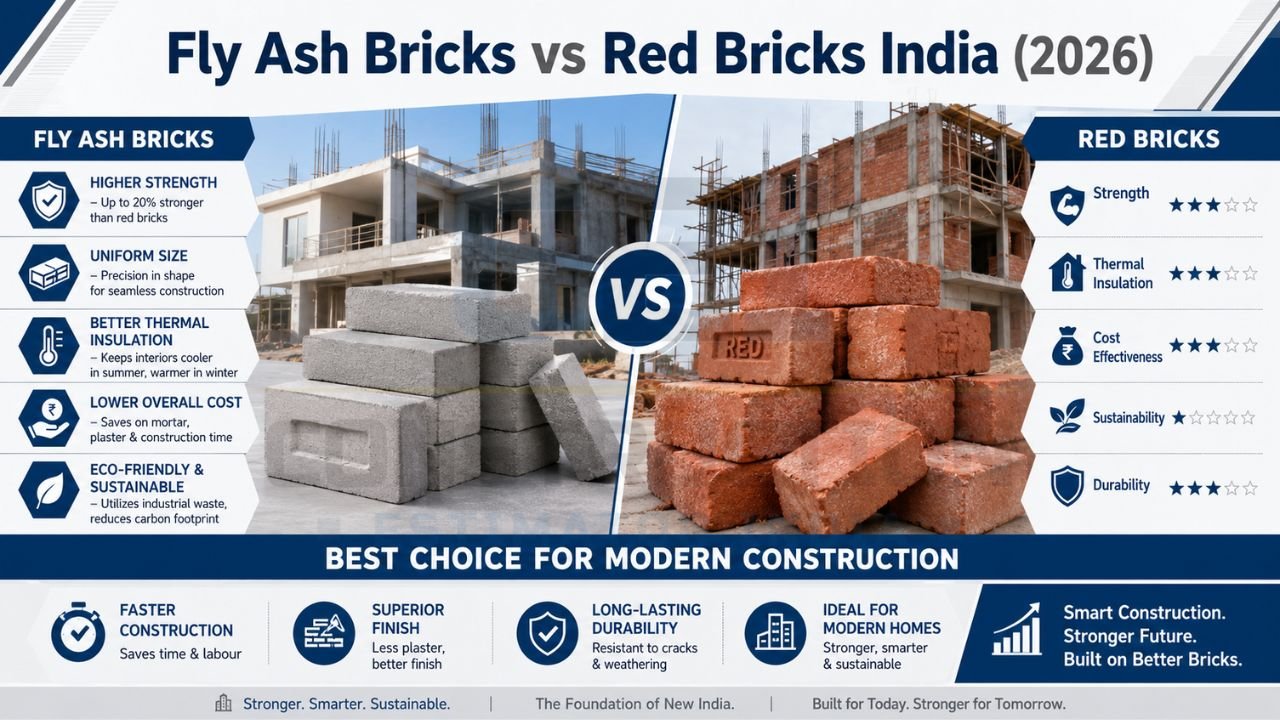
Definition and Composition
- Fly ash bricks are manufactured using fly ash (a by-product from thermal power plants), cement, lime, gypsum, and sometimes sand.
- They are eco-friendly as they repurpose waste materials, reducing landfill deposits.
- Moulded using high-pressure machines before being cured with steam or water, resulting in a very dense and strong product.
- Usually greyish-white in colour and have a smooth finish that often requires less plaster.
- Red bricks are made from natural clay and are better for traditional structures where a rustic look is desired.
- Red bricks, as the name suggests, are made of clay and are usually reddish-brown in colour.
- Produced by moulding clay and baking it at high temperatures in a kiln, a process that emits significant greenhouse gases.
Key Differences at a Glance
Modern urban projects across India are rapidly shifting toward fly ash technology.
- Fly ash bricks offer better strength and uniformity than Red Bricks.
- The cost of fly ash bricks is generally lower than that of red bricks.
- Fly ash bricks are lighter and larger in size than red bricks, which reduces the “dead load” on the building’s foundation.
- Fly ash bricks have better insulation properties than red bricks, keeping homes cooler in summer.
- Red bricks are cheaper and more accessible in rural areas where transport costs for fly ash bricks might be high.
- Use fly ash bricks for urban, sustainable builds, and red bricks for rural or load-bearing walls in single-story homes.
Fly Ash Bricks vs Red Bricks: Complete Comparison Table
Understanding the technical nuances helps you make a choice that lasts for decades. Here is how they stack up in 2026:
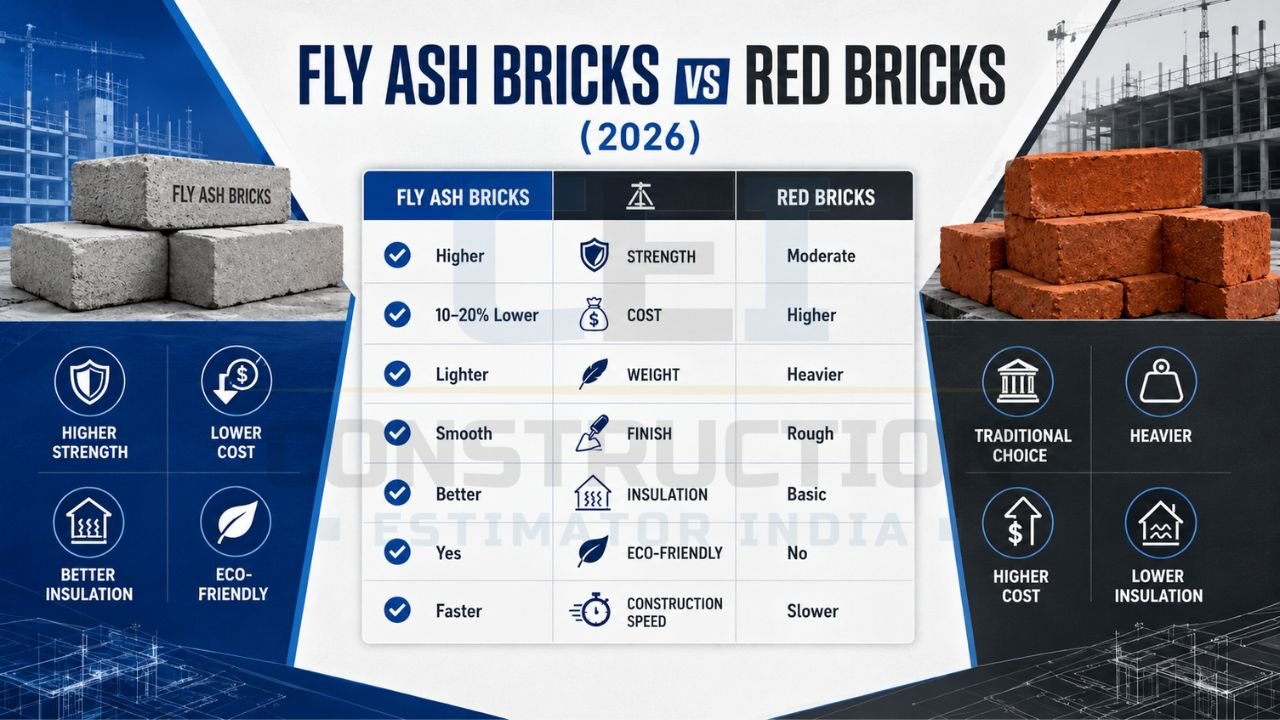
| Feature | Fly Ash Bricks | Red Bricks |
|---|---|---|
| Material | Fly ash (industrial waste), cement, lime, gypsum | Natural clay |
| Color | Greyish-white | Reddish-brown |
| Finish | Smooth, uniform | Rough, uneven |
| Compressive Strength | Higher (Consistent 7.5 to 10 N/mm²) | Moderate (Variable 3.5 to 7.5 N/mm²) |
| Durability | High; better moisture/chemical resistance | Moderate; prone to efflorescence (salt buildup) |
| Weight | Lighter | Heavier |
| Size | Larger, covers more area per unit | Smaller |
| Cost | Generally 10-20% lower | Higher |
| Thermal Insulation | Excellent (lower conductivity) | Poor (absorbs and radiates heat) |
| Best For Climate | Hot regions (Rajasthan, Gujarat, Delhi NCR) | Colder regions (Himalayan belt) |
| Environment | Eco-friendly; repurposes waste | High carbon footprint |
| Construction Speed | Faster; uniform size reduces mortar use | Slower; requires manual sorting for quality |
| Availability | High in urban areas | High in rural areas |
| Best Use | Modern buildings, high-rises, load-bearing | Traditional houses, boundary walls, fireplaces |
Strength Comparison: Fly Ash Bricks vs Red Bricks
Strength is the backbone of your home. In the battle of fly ash brick strength vs red brick, the machine-made precision of fly ash technology wins.
Fly Ash Bricks Strength
- Fly ash bricks offer better strength and uniformity than Red Bricks.
- Fly ash bricks have a higher compressive strength compared to red bricks, which means they can withstand more pressure and weight.
- Fly ash bricks are much stronger. They can handle more load and pressure, which makes them ideal for modern buildings that may go up to G+4 or higher.
- Yes, fly ash bricks have higher and more consistent compressive strength than red bricks. Their controlled manufacturing process provides uniform load-bearing across the entire wall.
Red Bricks Strength
- Red bricks have moderate strength. Their quality depends entirely on the type of clay used and how well they were baked in the local kiln. This often leads to variations where some bricks in a batch are strong while others are brittle.
Verdict: Fly ash bricks are much stronger and ideal for modern buildings.
Cost Comparison: Fly Ash Bricks vs Red Bricks
Budgeting is often the deciding factor. When analyzing fly ash brick cost vs red brick India, you must look beyond the price per piece.
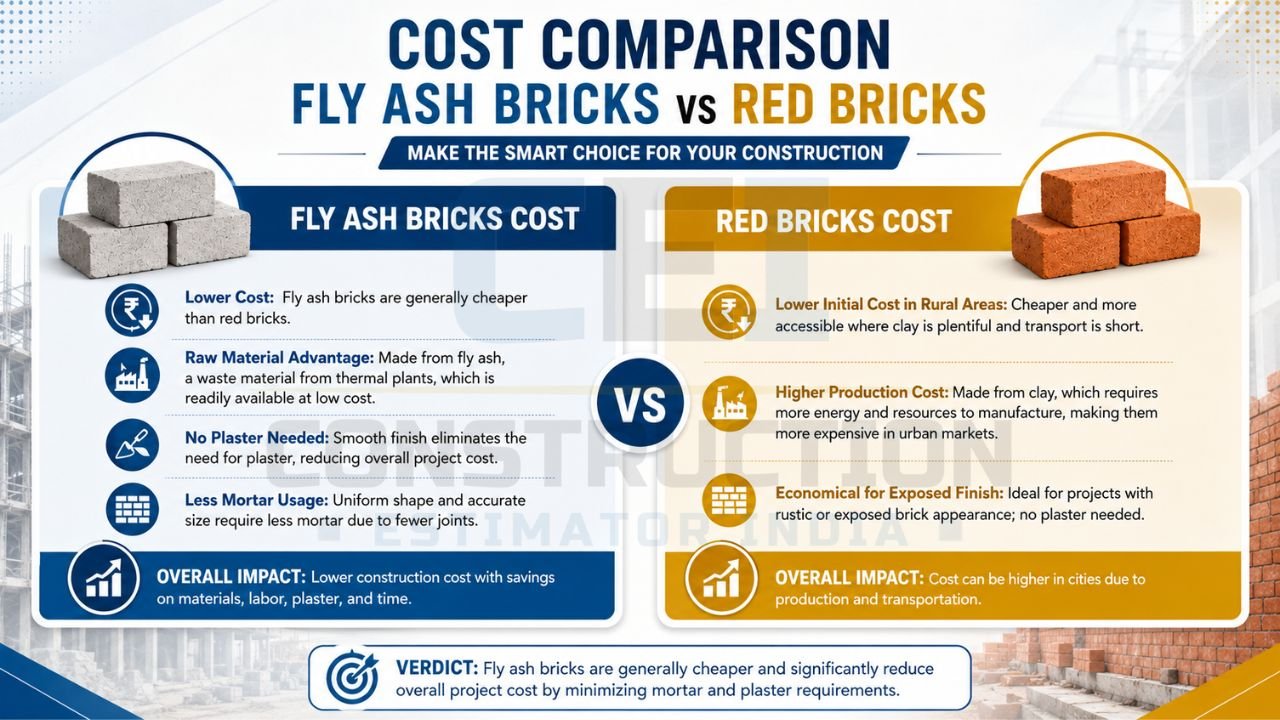
Fly Ash Bricks Cost
- The cost of fly ash bricks is generally lower than that of red bricks.
- Fly ash bricks are generally cheaper than red bricks.
- This is because fly ash is a waste material from thermal plants, and is readily available at cheap prices, which reduces the production cost of fly ash bricks.
- Apart from that, fly ash bricks eliminate the need for further finishing operations like plaster, to achieve a smooth surface, thereby reducing the overall cost of the project. They also require less mortar due to their uniform shape and fewer joints.
Red Bricks Cost
- Red bricks are cheaper and more accessible in rural areas where clay is plentiful and transport is short.
- On the other hand, red bricks are made from clay, which requires more energy and resources to manufacture, making them more expensive in many urban markets.
- However, red bricks will be economical if a rustic appearance is desirable, as you may choose to leave them exposed without plastering.
Verdict: Fly ash bricks are generally cheaper and significantly reduce overall project cost by minimizing mortar and plaster requirements.
Thermal Insulation: Fly Ash Bricks vs Red Bricks
In India, where summers are brutal, insulation is a health and financial necessity.
Fly Ash Bricks Thermal Insulation
- Fly ash bricks have better insulation properties than red bricks.
- The thermal conductivity of fly ash bricks is lower than that of red bricks, which means they are better at retaining heat and preventing it from entering your home.
- This makes fly ash bricks an excellent choice for buildings located in areas with extreme temperatures, such as India.
- One of the key advantages of fly ash AAC blocks and bricks is their excellent thermal insulation. With lower thermal conductivity, these blocks slow down the transfer of heat from the outside to the inside.
- During a blazing summer day, less heat gets inside the home, reducing your reliance on air conditioning.
- Fly ash bricks absorb much less heat during the day.
- When temperatures drop after sunset, they release whatever heat they have slowly and gradually. This keeps the interiors from cooling down too quickly at night, maintaining a balanced temperature.
Red Bricks Thermal Properties
- In contrast, red bricks—though solid and time-tested—tend to absorb heat throughout the day and radiate it indoors, even after sunset.
- Red bricks, on the other hand, absorb and retain large amounts of heat during the day.
- While fly ash bricks provide insulation against heat, red bricks absorb the heat readily. This can turn your home into a “heat trap” in cities like Jaipur or Ahmedabad.
Climate Recommendations
- As a result, fly ash bricks are preferable for hot regions, while red bricks are preferable for colder regions where you actually want the bricks to absorb and store solar heat.
Verdict: Fly ash bricks are preferable for hot regions like Rajasthan and Gujarat.
Environmental Impact: Fly Ash Bricks vs Red Bricks
Sustainable construction is no longer a choice; it’s a responsibility.
- Fly ash bricks are eco-friendly as they repurpose waste materials.
- Fly ash bricks are made from fly ash, which is a byproduct of thermal power plants.
- Using this fly ash to make bricks, reduces the amount of waste deposited in landfills, reducing the overall environmental impact.
- Red brick production involves the burning of clay at high temperatures, which results in the emission of greenhouse gases. Furthermore, red brick manufacturing often consumes fertile topsoil, which is damaging to agriculture.
Verdict: Fly ash bricks are more environmentally friendly and significantly reduce landfill waste and carbon emissions.
When to Use Fly Ash Bricks vs Red Bricks?
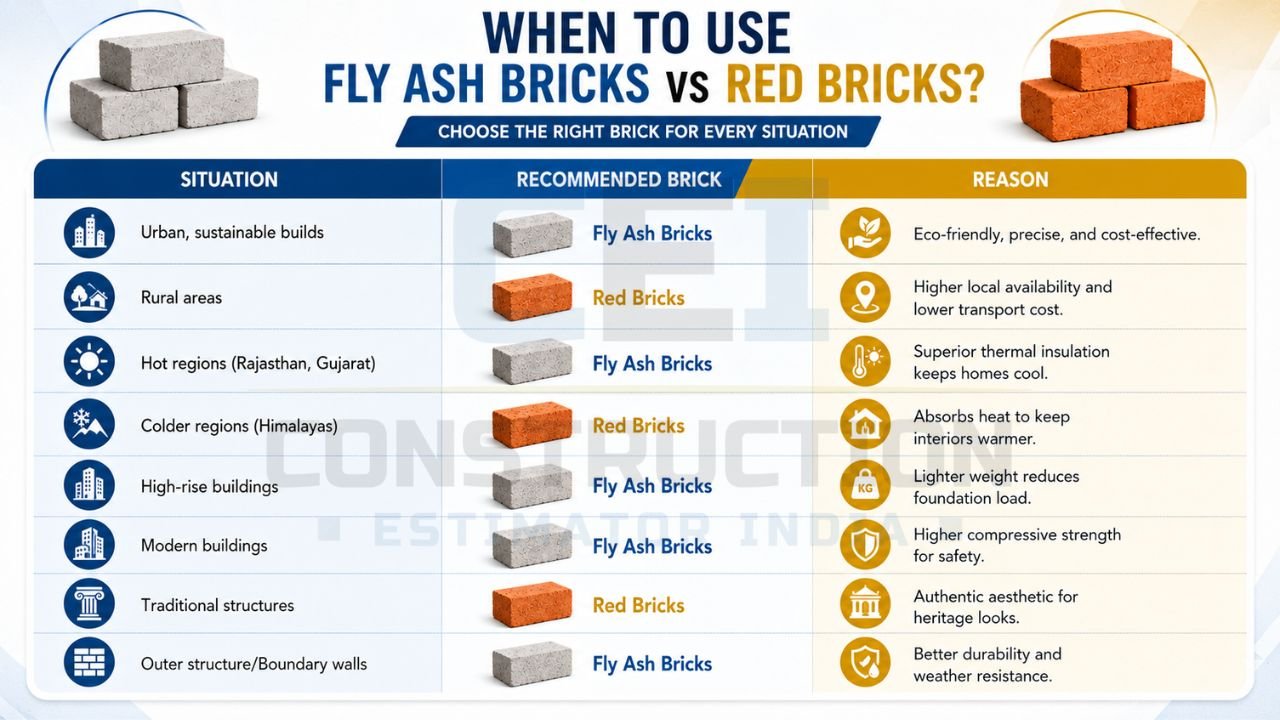
| Situation | Recommended Brick | Reason |
|---|---|---|
| Urban, sustainable builds | Fly Ash Bricks | Eco-friendly, precise, and cost-effective. |
| Rural areas | Red Bricks | Higher local availability and lower transport cost. |
| Hot regions (Rajasthan, Gujarat) | Fly Ash Bricks | Superior thermal insulation keeps homes cool. |
| Colder regions (Himalayas) | Red Bricks | Absorbs heat to keep interiors warmer. |
| High-rise buildings | Fly Ash Bricks | Lighter weight reduces foundation load. |
| Modern buildings | Fly Ash Bricks | Higher compressive strength for safety. |
| Traditional structures | Red Bricks | Authentic aesthetic for heritage looks. |
| Outer structure/Boundary walls | Fly Ash Bricks | Better durability and weather resistance. |
Fly Ash Bricks Advantages and Disadvantages
Advantages of Fly Ash Bricks
- ✅ Higher compressive strength (more consistent than clay)
- ✅ Better uniformity (perfect rectangular shape)
- ✅ Lighter weight (reduces building’s dead weight)
- ✅ Larger size (requires fewer bricks and mortar)
- ✅ Smooth, uniform finish (often eliminates the need for base plaster)
- ✅ Better thermal insulation (energy efficient)
- ✅ Lower cost (due to industrial waste usage)
- ✅ Eco-friendly (recycles power plant waste)
Disadvantages of Fly Ash Bricks
- ❌ Brittle Nature: More prone to breakage during transport if handled roughly.
- ❌ Availability: Can be difficult to find in remote rural regions.
Red Bricks Advantages and Disadvantages
Advantages of Red Bricks
- ✅ Cheaper in rural areas: No high shipping costs.
- ✅ More accessible: Available in almost every part of India.
- ✅ Better for traditional structures: Excellent for rustic or heritage themes.
- ✅ Thermal Storage: Good for cold climates where warmth is needed.
Disadvantages of Red Bricks
- ❌ Lower compressive strength: Highly variable quality.
- ❌ Rough, uneven finish: Requires thick plaster to level walls.
- ❌ Heavier: Adds significant load to the structural frame.
- ❌ Absorbs heat: Acts as a heat sink in hot summers.
- ❌ Environmental impact: High CO2 emissions and soil depletion.
Common Brick Mistakes to Avoid
Whether you are building a villa or an apartment, avoiding these common errors can save you lakhs.
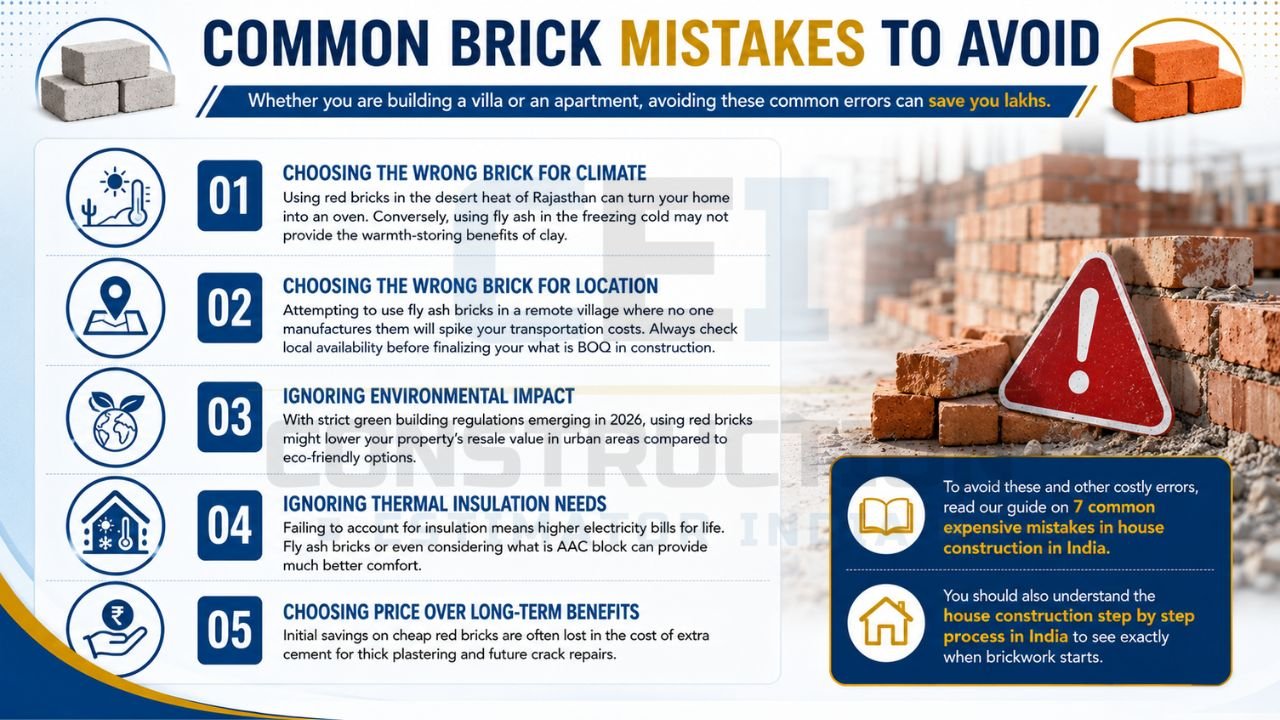
1. Choosing the Wrong Brick for Climate
Using red bricks in the desert heat of Rajasthan can turn your home into an oven. Conversely, using fly ash in the freezing cold may not provide the warmth-storing benefits of clay.
2. Choosing the Wrong Brick for Location
Attempting to use fly ash bricks in a remote village where no one manufactures them will spike your transportation costs. Always check local availability before finalizing your what is BOQ in construction.
3. Ignoring Environmental Impact
With strict green building regulations emerging in 2026, using red bricks might lower your property’s resale value in urban areas compared to eco-friendly options.
4. Ignoring Thermal Insulation Needs
Failing to account for insulation means higher electricity bills for life. Fly ash bricks or even considering what is AAC block can provide much better comfort.
5. Choosing Price Over Long-Term Benefits
Initial savings on cheap red bricks are often lost in the cost of extra cement for thick plastering and future crack repairs.
To avoid these and other costly errors, read our guide on 7 common expensive mistakes in house construction in India. You should also understand the house construction step by step process in India to see exactly when brickwork starts.
Conclusion
If you’re planning house construction in India and need expert guidance on brick selection, quantity estimation, and material procurement, contact Construction Estimator India. We don’t just guess; we use engineering data to help you build safer and cheaper.
We help with:
- Professional brick selection consultation
- Detailed construction material estimation in India
- Accurate brick quantity estimation
- Professional BOQ (Bill of Quantities) and DPR (Detailed Project Report)
- Construction planning for residential and commercial projects
WhatsApp / Call: +91 8630676890
Building Excellence Across India.
FAQ — Fly Ash Bricks vs Red Bricks India
Q: Fly ash bricks vs red bricks India: which is better?
A: For 90% of modern Indian urban construction, fly ash bricks are better due to higher strength, better insulation, and lower costs.
Q: Are fly ash bricks stronger than red bricks?
A: Yes, fly ash bricks have a much more consistent and higher compressive strength than standard clay bricks.
Q: Is fly ash brick cheaper than red brick in India?
A: Generally, yes. The raw material is cheaper, and you save on mortar and plastering labor.
Q: Which brick is better for hot regions in India?
A: Fly ash bricks are superior for hot regions like Rajasthan or Gujarat because they have lower thermal conductivity.
Q: Which brick is more environmentally friendly?
A: Fly ash bricks are the clear winner as they repurpose industrial waste and reduce soil erosion.
Q: Do fly ash bricks need plastering?
A: They have a very smooth finish, so they often require only a thin coat of plaster or can sometimes be directly painted after a primer coat.
Q: Which brick is better for high-rise buildings?
A: Fly ash bricks are better because they are lighter, which reduces the load on the building’s columns and beams.
Q: How do I contact Construction Estimator India for brick selection guidance?
A: You can reach us at WhatsApp / Call: +91 8630676890.