
Choosing the right building material is the foundation of a safe home. If you are wondering which cement is best for house construction India, the answer typically depends on your specific location, local climate, and the structural component you are building. For the majority of residential projects, PPC (Portland Pozzolana Cement) is recommended as the best cement for house construction because it offers better long-term durability, a smoother finish, and is more cost-effective than other types. Top-tier brands like UltraTech, Ambuja, and ACC lead the market in 2026, providing consistent quality across India. At Construction Estimator India, we specialize in helping homeowners and contractors navigate these choices with precision. For expert material consultation, contact us at +91 8630676890.
Which Cement Is Best for House Construction India? (Quick Answer)
For most Indian homeowners, the decision boils down to durability and cost. For most residential projects, PPC cement is recommended as the best cement for house construction due to its numerous advantages, including low heat of hydration which significantly reduces the risk of shrinkage cracks.
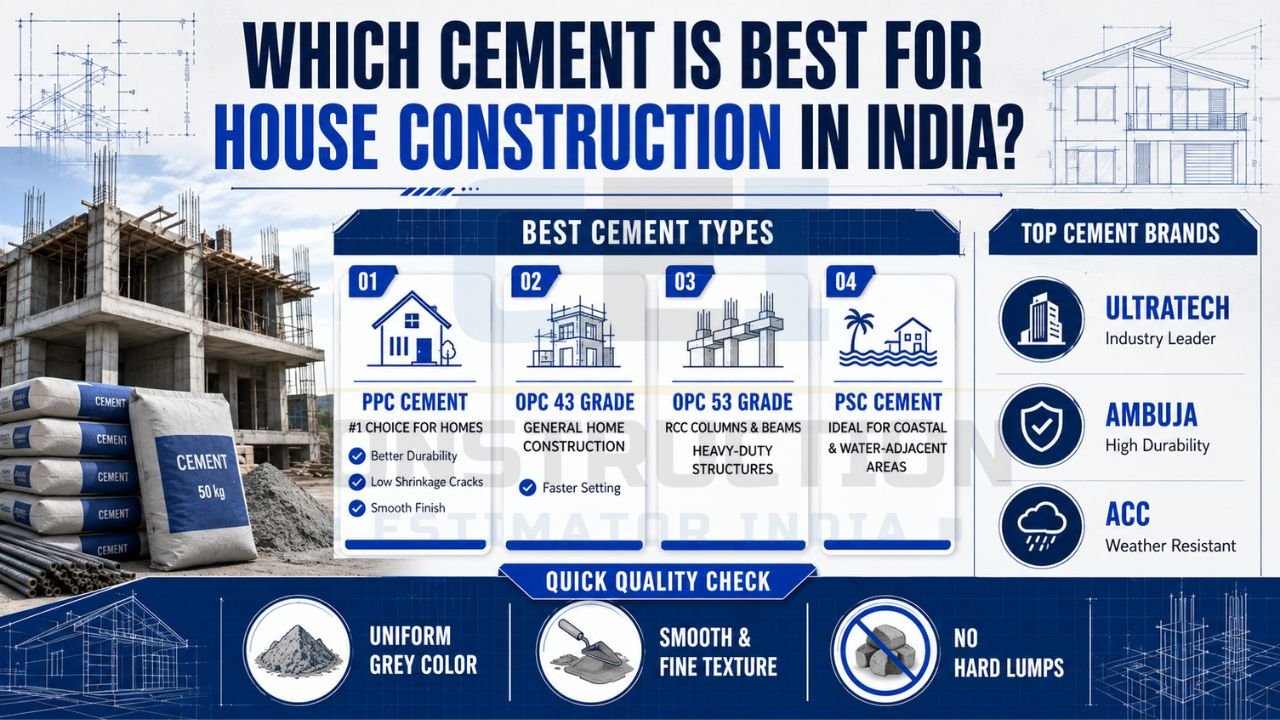
Best Cement Type for House Construction
- PPC (Portland Pozzolana Cement): The #1 choice for most residential projects. It is known for better durability, lower environmental impact, and a superior, mirror-smooth finish.
- OPC 43-grade: Works well for general home construction needs where faster setting might be required.
- OPC 53-grade: Best reserved for heavy-duty RCC (Reinforced Cement Concrete) structures like high-rise columns and beams.
- PSC (Portland Slag Cement): The go-to choice if the building is being built in coastal areas or near water bodies.
Best Cement Brands in India
- UltraTech Cement: The undisputed No. 1 brand in India and the largest manufacturer by capacity.
- Ambuja Cement: A standout choice if your priority is durability and high performance.
- ACC Cement: Known for reliable performance and weather-resistant variants like Gold Water Shield.
Quality Check Tips
Before you buy, remember that strong cement means strong construction. Ensure the cement is a uniform grey color, feels smooth and fine when rubbed between fingers, and flows freely without any hard lumps.
Top 6 Cement Types for House Construction in India
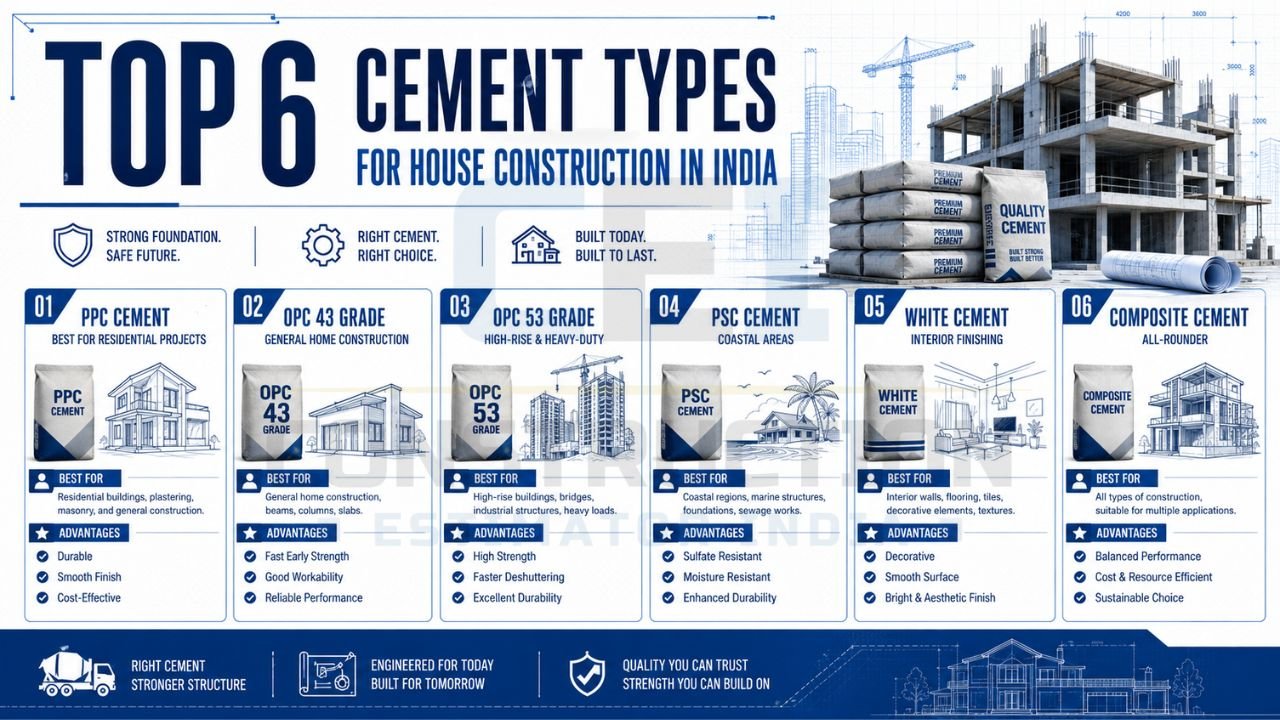
| Cement Type | Best For | Advantages | When to Use |
|---|---|---|---|
| PPC | Most residential projects | Better durability, smooth finish, cost-effective | Normal residential construction in plain areas |
| OPC 43-grade | General home construction | Faster early strength, good for most needs | General masonry and structural work |
| OPC 53-grade | Heavy-duty, high-rise | High early strength, faster deshuttering | Extreme climates and high-load structures |
| PSC | Coastal areas | High sulfate and moisture resistance | Buildings near water bodies or saline soil |
| White Cement | Interior finishing | Aesthetic finish, smooth surface | Joining tiles and decorative works |
| Composite | All-rounder | Balanced properties, sustainable | General residential building projects |
Top 6 Cement Brands for House Construction in India
1. UltraTech Cement
UltraTech is the undisputed No. 1 cement in India. As the largest manufacturer in the country, they offer the most consistent quality and a wide distribution network, making them the top choice for everything from foundations to finishing.
2. Ambuja Cement
If your priority is durability and high performance, Ambuja Cement is a standout choice. Their specialized products, such as Ambuja Plus and Ambuja Kawach, provide tailored solutions for water resistance and high-strength requirements.
3. ACC Cement
ACC is a legacy brand that remains highly reliable and widely used across India. Their “Gold Water Shield” is particularly popular for roofing and plastering in moisture-prone areas.
4. Shree Cement / Bangur Cement
Highly popular in North and East India, Shree Cement offers good quality at competitive prices. It is often praised for its compressive strength and suitability for load-bearing slabs.
5. Dalmia Cement
Dalmia is a dominant player, especially in South and East India. It is a popular choice for sustainable construction and regions with high groundwater issues due to its excellent PSC variants.
6. JK Cement
Known for reliable quality and a strong presence in the white cement market, JK Cement is also a top contender for grey cement in residential builds, offering consistent strength and fine texture.
PPC vs OPC Cement: Which Is Better for House Construction?
Understanding the difference between PCC and RCC in construction often starts with choosing the right cement type.
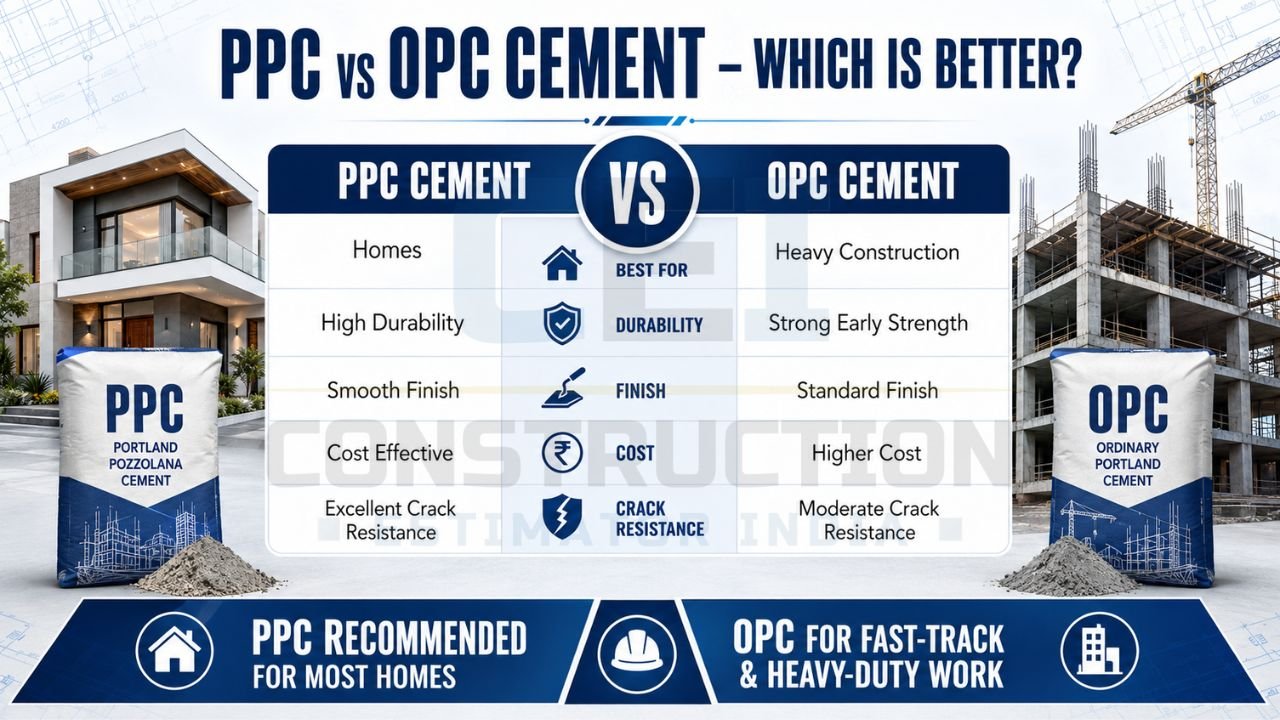
| Feature | PPC (Portland Pozzolana Cement) | OPC (Ordinary Portland Cement) |
|---|---|---|
| Best For | Most residential projects | Heavy-duty, fast-paced construction |
| Durability | Superior long-term durability | Standard durability |
| Finish | Smoother finish | Standard finish |
| Early Strength | Slower initial strength gain | Faster early strength |
| Cost | More cost-effective | Slightly more expensive |
| Sustainability | High (uses fly ash) | Moderate |
| Crack Resistance | Excellent (lower heat) | Lower (higher heat risk) |
Verdict: For most home construction needs, what is PPC cement makes it the recommended “best cement” choice because it resists cracks and provides a lasting finish. However, if you are casting heavy lintels or need to remove formwork quickly, you might want to learn what is OPC cement to understand its early strength benefits.
OPC 43-Grade vs OPC 53-Grade: Which to Choose?
| Feature | OPC 43-Grade | OPC 53-Grade |
|---|---|---|
| Strength (28 Days) | 43 MPa | 53 MPa |
| Best For | General masonry & light RCC | Heavy-duty slabs & beams |
| When to Use | Normal residential builds | Extreme climates or high-rises |
| Cost | Affordable | Premium pricing |
Recommendation: OPC 43-grade works well for most home construction needs. Use OPC 53-grade only when the structural design specifically demands high early strength or if construction is happening in extreme climates with very hot or very cold temperatures.
Cement Selection Based on Location and Climate
Selecting the right cement isn’t just about the brand; it’s about the environment.
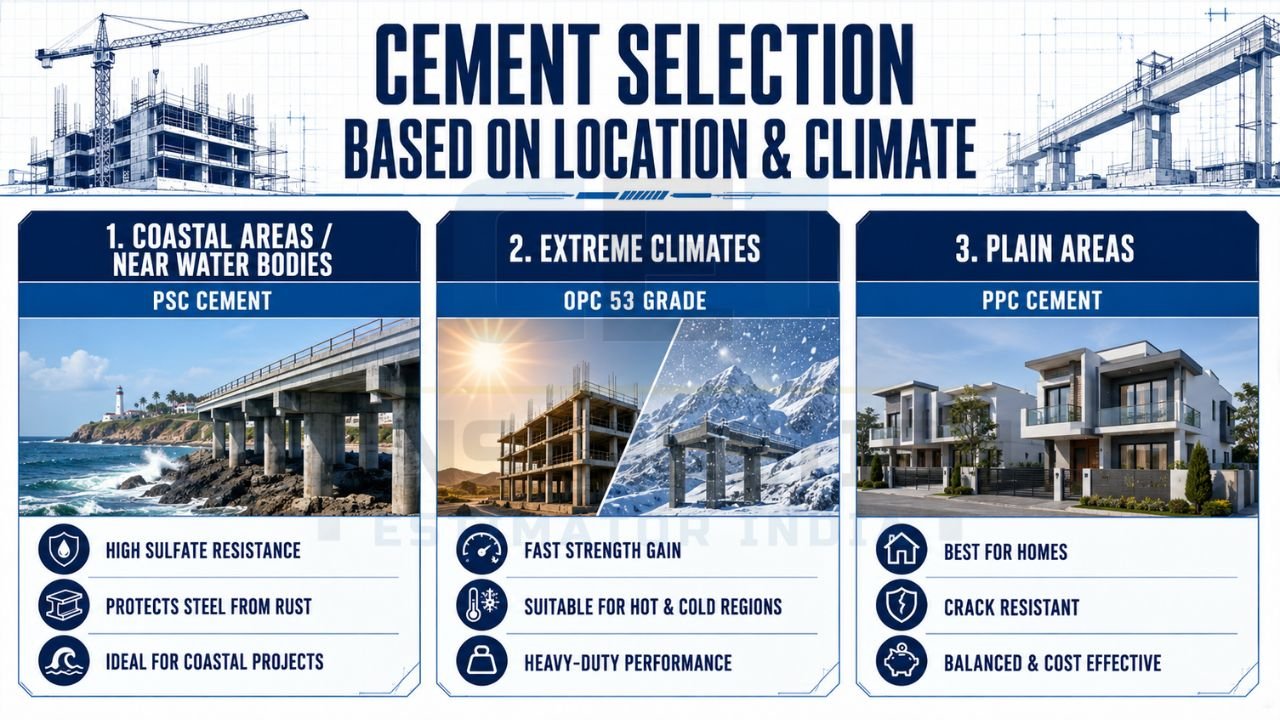
Coastal Areas or Near Water Bodies
If the building is being built in coastal areas or near water bodies, PSC cement is preferable. Portland Slag Cement (PSC) contains slag that makes it highly resistant to chloride and sulfate attacks, preventing the steel reinforcement inside your concrete from rusting.
Extreme Climates
If the building is in regions with extreme climates with very hot or very cold temperatures, OPC 53-grade cement is recommended. In very cold areas, it sets faster to prevent freezing damage, while in very hot areas, careful curing of high-grade cement ensures rapid strength gain before moisture evaporates.
Plain Areas (Normal Conditions)
For normal residential construction in plain areas, PPC cement is the best choice. It is balanced, reduces the risk of thermal cracking, and is perfectly suited for the G+1 or G+2 structures common in most Indian towns.
How to Identify Good Quality Cement?
Even the best brands can fail if the specific batch is old or poorly stored. Here is how to perform a site-level quality check:
- Visual Check: The cement color should always be uniform grey. An even color indicates proper mixing during manufacturing, while uneven shades suggest poor quality control.
- Touch Test: Good cement feels smooth and fine when rubbed between fingers. If it feels sticky or coarse, it may have started setting due to moisture.
- Lump Check: Open the bag and look for hard chunks. If lumps are binding, then the quality is low. This usually happens when the cement is more than three months old.
- Freshness Test: Do a simple hand test: If the powder flows freely when poured, the cement is fresh. Fresh cement reacts better and provides the intended strength.
Common Cement Mistakes to Avoid
Avoiding errors during procurement can save you lakhs. We recommend reviewing 7 common expensive mistakes in house construction in India to stay ahead.
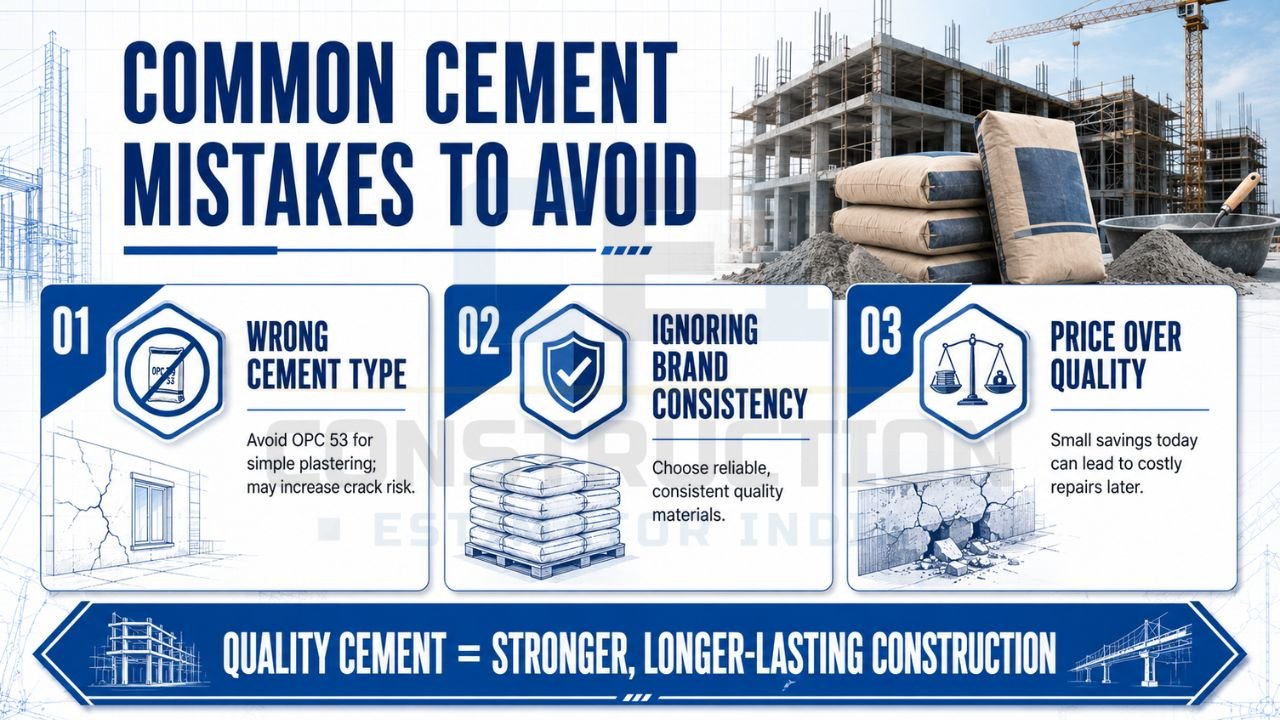
- Choosing the Wrong Type: Don’t use OPC 53 for simple plastering; it shrinks too fast and creates cracks.
- Ignoring Brand Reputation: While local brands may be cheaper, UltraTech and Ambuja offer a level of consistency that ensures your foundation remains solid for decades.
- Choosing Price Over Quality: Always tell clients: It will be slightly expensive, but quality should be best. Saving ₹20 per bag today could lead to ₹20,000 in repair costs later.
For a detailed breakdown of costs, check our guide on construction material estimation in India.
Contact Construction Estimator India
Are you planning your dream home and feeling overwhelmed by material choices? Construction Estimator India provides professional expertise to ensure your project is efficient and high-quality. We offer:
- Expert Cement Selection Consultation
- Detailed BOQ (Bill of Quantities) and DPR Preparation
- Accurate Cement and Material Quantity Estimation
- Construction Planning for Residential and Commercial Buildings
Don’t leave your home’s strength to guesswork.
WhatsApp / Call: +91 8630676890
Location: India-wide Service
FAQ — Which Cement Is Best for House Construction India
- Which cement is best for house construction India?
For most residential builds, PPC (Portland Pozzolana Cement) is the best choice due to its durability and crack resistance. - Is PPC or OPC cement better for house construction?
PPC is generally better for the longevity and finish of residential homes, while OPC is better for projects requiring very fast strength development. - What is the best cement brand in India for house construction?
UltraTech Cement is the No. 1 brand, followed closely by Ambuja and ACC. - What cement is best for coastal areas in India?
PSC (Portland Slag Cement) is highly recommended for coastal regions to prevent chemical corrosion. - How do I check if cement is good quality?
Check for a uniform grey color, smooth texture, and an absence of lumps. It should also have an ISI mark and be less than 3 months old.