
What is lintel in construction? If you are planning a residential house or a commercial building in India, the lintel is one of the most critical structural components you need to understand. A lintel is a horizontal structural beam placed over openings like doors, windows, and fireplaces to support the wall above. Its primary purpose is to carry the weight of the masonry above the opening and distribute that load to the surrounding walls, effectively preventing structural failures and unsightly cracks. At Construction Estimator India (+91 8630676890), we specialize in ensuring these small but mighty beams are designed and estimated with 100% precision to protect your investment.
👉 Need accurate construction cost estimates? Get a professional estimate for your project today.
What Is Lintel in Construction?
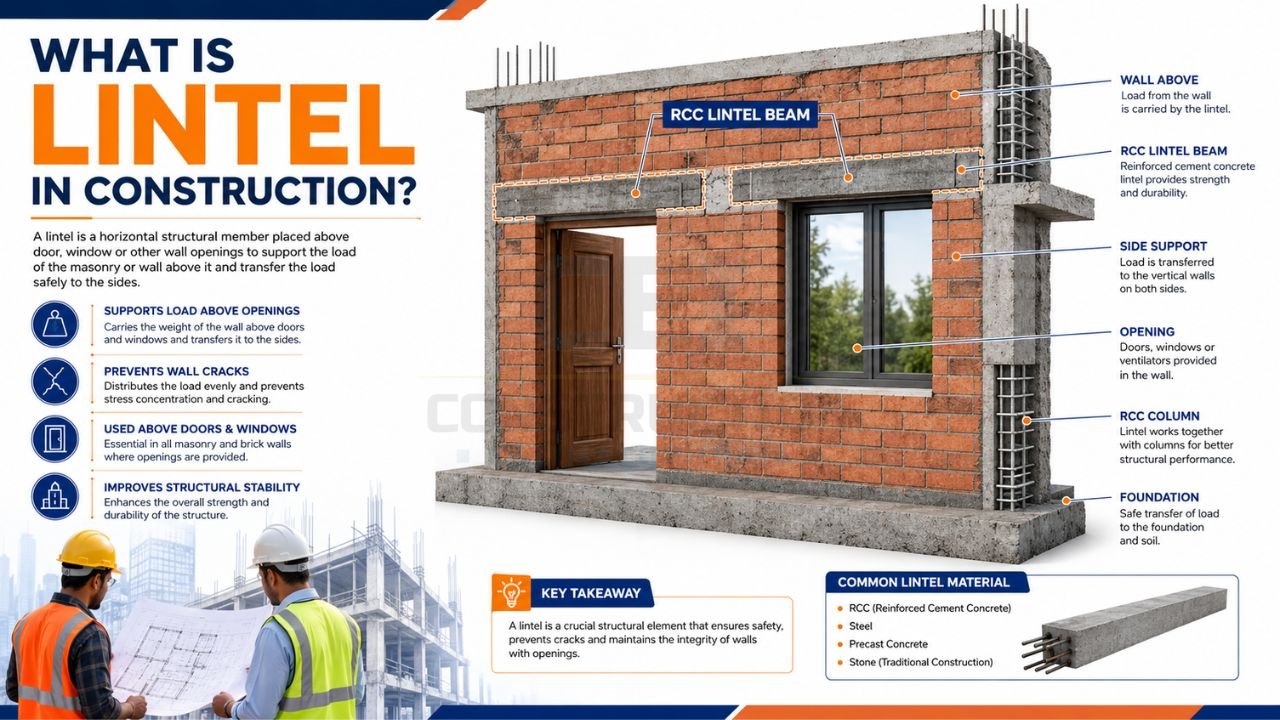
A lintel in construction is a type of beam—a horizontal structural element—that spans openings such as portals, doors, windows, and even fireplaces. It serves as a bridge, allowing for functional voids in a wall while maintaining the integrity of the structure above it.
Lintel Definition
- Support System: A lintel is a type of beam used to support the wall above it when openings like doors or windows are necessary.
- Load Distribution: In a structural system, the lintel is usually supported by the masonry walls on either side of the opening.
- Architectural History: In classical architecture, a lintel is a load-bearing member placed over an entranceway.
- Versatility: It can be a purely functional structural item, a decorative architectural element, or a combination of both.
Lintel Beam Purpose
- Wall Support: It holds up the weight of the wall or chimney directly above the opening.
- Load Transfer: It distributes vertical loads to the side masonry, ensuring the opening doesn’t buckle.
- Crack Prevention: Without a properly designed lintel, stress concentrations around doors and windows would cause severe diagonal cracking.
- Structural Stability: It provides the necessary stability to ensure the building remains secure during its lifespan.
Lintel in Post and Lintel System
The “Post and Lintel” system (also known as trabeated or trilithic) is one of the oldest building methods in human history.
- Mechanism: Strong horizontal elements (lintels) are held up by strong vertical elements (posts) with large spaces between them.
- Application: This system is commonly used to hold up a roof, creating open spaces beneath.
- Terminology: The horizontal members are called lintels, headers, or architraves, while the vertical supports are called posts, columns, or pillars.
👉 Need accurate construction cost estimates? Get a professional estimate for your project today.
Functions of Lintel in Building Construction
Understanding the lintel beam purpose is vital for any homeowner to ensure their contractor isn’t “cutting corners.”
- Load Support: Its primary job is to support the masonry or wall structure above a door or window opening.
- Load Distribution: It effectively transfers the “dead load” of the building to the side walls (jambs), preventing localized pressure on the frames.
- Crack Prevention: By providing a solid horizontal bridge, it avoids the formation of weak points that lead to cracks.
- Structural Stability: In India’s diverse seismic zones, lintels contribute significantly to the overall integrity of the structure.
- Fire Support: In traditional and some modern designs, lintels support the chimney structure above a fireplace.
- Decorative Element: Many modern architects use exposed lintels as an ornamented structural item to enhance the building’s facade.
Types of Lintel in Construction
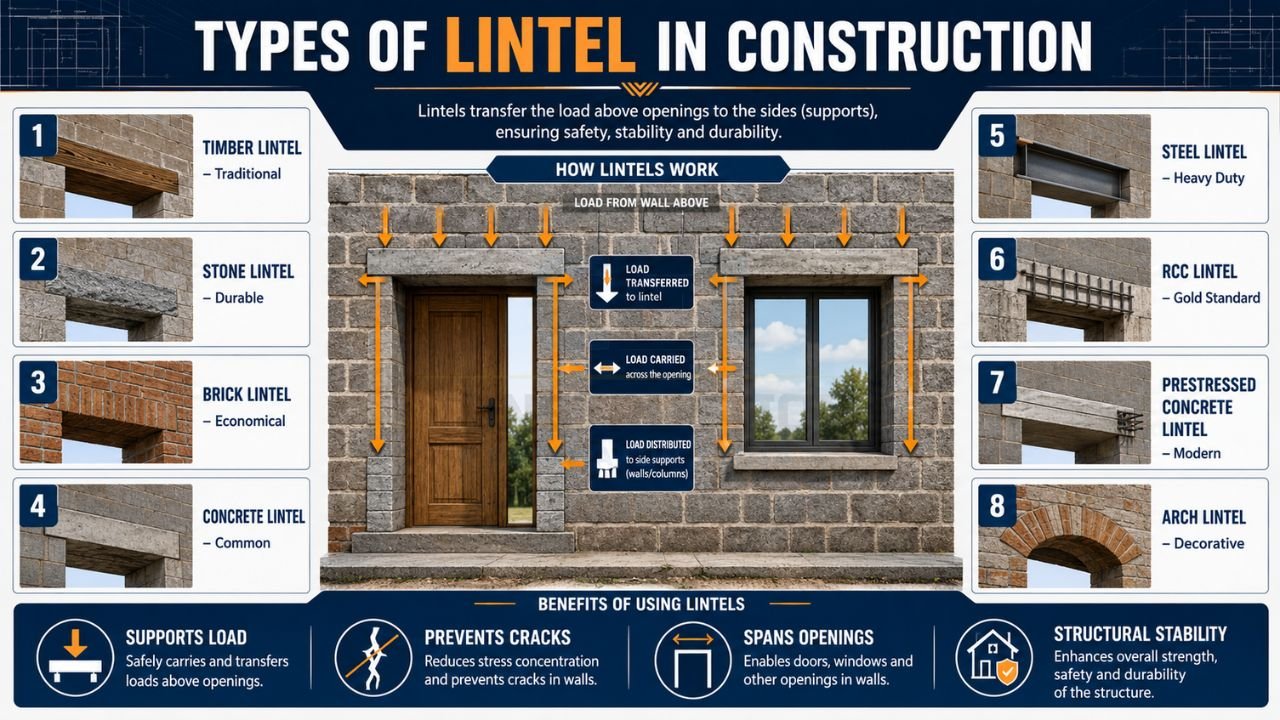
Depending on the span, budget, and load requirements, several types of lintel in construction are used across India.
1. Timber Lintel
Made from wood, this is a traditional construction method. While less common in modern Indian urban projects due to fire and termite risks, they are still found in temporary structures or heritage-style mountain cabins.
2. Stone Lintel
Common in traditional Indian architecture and historical temples, stone lintels are durable and aesthetically pleasing. However, they are heavy and require massive support pillars.
3. Brick Lintel
Constructed using bricks and mortar, these are used for very small spans or light construction. They are cost-effective but have limited load-carrying capacity.
4. Concrete Lintel
Made from reinforced concrete, these are the most common in modern buildings. They provide excellent strength and can span medium to large window openings. For more information on materials, you can check the difference between PCC and RCC in construction.
5. Steel Lintel
When spanning very large openings or supporting heavy commercial loads, steel lintels are preferred. They offer a high strength-to-weight ratio.
6. RCC Lintel (Reinforced Cement Concrete)
This is the “gold standard” for residential houses in India. It involves steel reinforcement bars embedded in concrete to handle both compression and tension. Learn more about what is RCC in construction to understand why it’s so durable.
7. Prestressed Concrete Lintel
Modern-day lintels are often manufactured in factories using prestressed concrete. These are referred to as beams in beam-and-block slabs and can even serve as components for suspended floors.
8. Arch as Curved Lintel
An arch functions technically as a curved lintel. It is used for both decorative appeal and to span very large openings using the physics of compression.
Lintel Construction Process: Step-by-Step
Following a proper lintel construction process India is essential to avoid structural sagging. For a broader overview, refer to our house construction step by step process in India.
- Step 1: Opening Preparation: Walls are built up to the required height (usually 7 feet or 2.1 meters in India).
- Step 2: Shuttering/Formwork: A wooden or steel mold is constructed to hold the concrete in place. It must be perfectly level.
- Step 3: Reinforcement Placement: For RCC lintels, steel bars are placed according to structural designs, ensuring proper “cover” so the steel doesn’t rust.
- Step 4: Concrete Pouring: High-quality concrete mix is poured and compacted to remove air bubbles.
- Step 5: Curing: This is the most ignored step. The lintel must be kept moist for at least 7 to 14 days to gain full strength.
- Step 6: Formwork Removal: Once the concrete is strong enough (typically 10-14 days), the supports are removed.
- Step 7: Completion: The wall construction continues above the lintel.
👉 Planning a building project? Get an accurate construction estimate now.
Lintel Height and Dimensions
Determining the lintel height in building India is a matter of engineering, not guesswork.
- Typical Height: Standard lintel thickness ranges from 150 mm to 300 mm depending on the span.
- Bearing Length: The lintel must extend (bear) at least 150 mm to 200 mm onto the walls on either side. Insufficient bearing is a leading cause of lintel failure.
- Factors Affecting Size: The width of the opening, the height of the wall above, and the seismic zone of the city (e.g., higher requirements for Delhi NCR) all influence the design.
Common Lintel Construction Mistakes to Avoid
To prevent structural failure, avoid these 6 common errors. You can find more details in our guide on 7 common expensive mistakes in house construction in India.
- Insufficient Bearing Length: Extending the lintel only 2 inches onto the wall will cause the masonry to crush.
- Missing Reinforcement: Using plain concrete without steel for spans over 3 feet is a recipe for disaster.
- Poor Concrete Quality: Using a weak mix results in a brittle beam that can snap under the weight of the roof.
- Inadequate Curing: Removing shuttering too early or not watering the beam leads to weak, dusty concrete.
- Wrong Type Selection: Using a timber lintel in a high-moisture area without treatment.
- Missing Lintel Altogether: Some contractors try to save money by omitting lintels for small windows, leading to immediate cracks.
Lintel vs Beam: Key Differences
While a lintel is technically a beam, there are significant differences in their application. For more on beams, read what is beam in construction.
| Feature | Lintel | Beam |
|---|---|---|
| Purpose | Spans door/window openings | Supports floors, roofs, and walls |
| Location | Only above openings | Throughout the building skeleton |
| Load | Wall load above the opening | Heavy floor/roof loads |
| Size | Smaller (150–300 mm height) | Larger (300–600+ mm height) |
| Span | Limited to opening width | Can span large room distances |
FAQ — What Is Lintel in Construction?
What is lintel in construction?
It is a horizontal structural element that spans an opening (like a window) to support the weight of the structure above.
What is the purpose of a lintel beam?
The lintel beam purpose is to support the wall above the opening, distribute loads to the sides, and prevent cracks around frames.
What are the common types of lintel in India?
The most common types are RCC (Reinforced Cement Concrete), stone, brick, and steel.
How do I determine lintel height in building India?
Height is usually set at the door level (typically 7 feet). The thickness of the beam depends on the span and load.
What is the minimum bearing length for a lintel?
It should be at least 150 mm to 200 mm on each side of the opening to ensure proper load transfer.
How can I avoid cracks around doors and windows?
By ensuring a properly designed lintel with adequate bearing and high-grade reinforcement is installed over every opening.
How do I contact Construction Estimator India for support?
You can reach us at +91 8630676890 (WhatsApp / Call) for professional structural design and cost estimation.
Conclusion
Planning your dream home or a new commercial project in India? Don’t let structural mistakes like poorly designed lintels lead to costly repairs and cracks later.
Construction Estimator India provides expert support in:
- Lintel and structural design guidance
- Detailed construction cost estimation
- Professional BOQ (Bill of Quantities) preparation
- DPR (Detailed Project Report) for bank loans
WhatsApp / Call us today at +91 8630676890 to get an accurate estimate and ensure your building stands strong for generations!