
Accurate earthwork calculation in construction is one of the most critical aspects of project estimation. A small error in excavation or backfilling quantity can lead to lakhs of rupees in losses, project delays, or disputes with clients. In 2026, with tighter margins and faster project timelines, mastering earthwork quantity calculation has become essential for contractors, site engineers, and quantity surveyors.
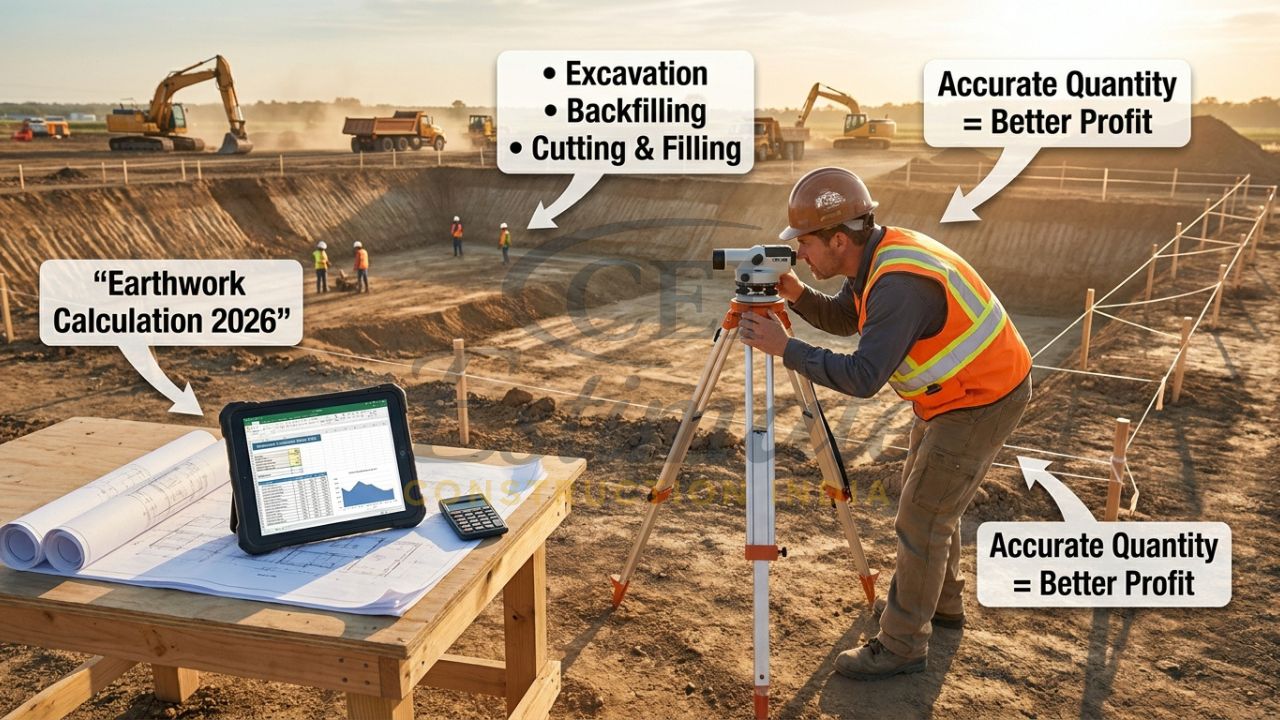
This comprehensive guide explains everything about earthwork calculation in construction — from basic methods and formulas to practical examples, modern tools, and BOQ preparation. You will learn how to calculate excavation, backfilling, cutting, and filling with confidence.
What is Earthwork in Construction?
Earthwork includes all operations involving the movement of soil or rock — excavation, cutting, filling, embankment, and backfilling. It forms the foundation for almost every civil engineering project, from residential buildings and roads to bridges and industrial plants.
Why Accurate Earthwork Calculation is Critical?
- Prevents over-excavation or shortage of fill material
- Directly impacts project cost (earthwork can be 8–15% of total cost)
- Helps in proper planning of machinery and labour
- Reduces disputes during bill certification
- Improves accuracy in tender submissions
Proper calculation strengthens your position in prequalification in construction tender in India.
Common Methods of Earthwork Calculation
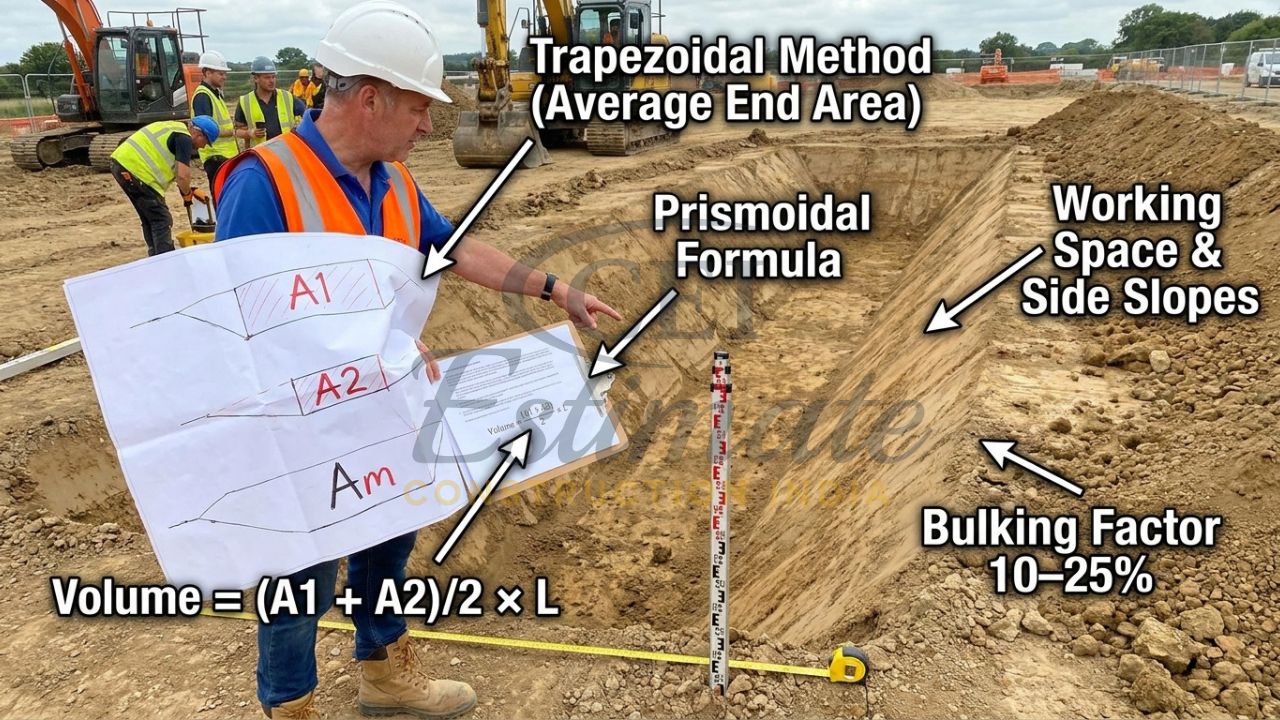
- Trapezoidal Method (Average End Area Method) — Most commonly used
- Prismoidal Formula — More accurate for large volumes
- Spot Level Method (Grid Method) — Ideal for irregular areas
- Contour Method — Used for large hilly terrains
- Mass Haul Diagram — For road and highway projects
Step-by-Step Guide to Earthwork Quantity Calculation
- Study drawing and site levels
- Decide limits of excavation
- Choose suitable method
- Take measurements (length, width, depth)
- Apply formula
- Add wastage and bulking factor (usually 5–15%)
- Calculate lead and lift charges if required
Standard Formulas for Excavation, Backfilling, Cutting & Filling
Trapezoidal Formula (Average End Area):
Volume=(A1+A2)2×L\text{Volume} = \frac{(A_1 + A_2)}{2} \times LVolume=2(A1+A2)×L
Where A1 A_1 A1 and A2 A_2 A2 are cross-sectional areas, L L L is distance.
Prismoidal Formula:
Volume=L6×(A1+4Am+A2)\text{Volume} = \frac{L}{6} \times (A_1 + 4A_m + A_2)Volume=6L×(A1+4Am+A2)
Where Am A_m Am is mid-section area.
For Trench Excavation:
Volume=Length×Average Width×Depth\text{Volume} = \text{Length} \times \text{Average Width} \times \text{Depth}Volume=Length×Average Width×Depth
Backfilling Quantity = Excavation volume – Volume of structure below ground level.
Practical Examples with Calculations
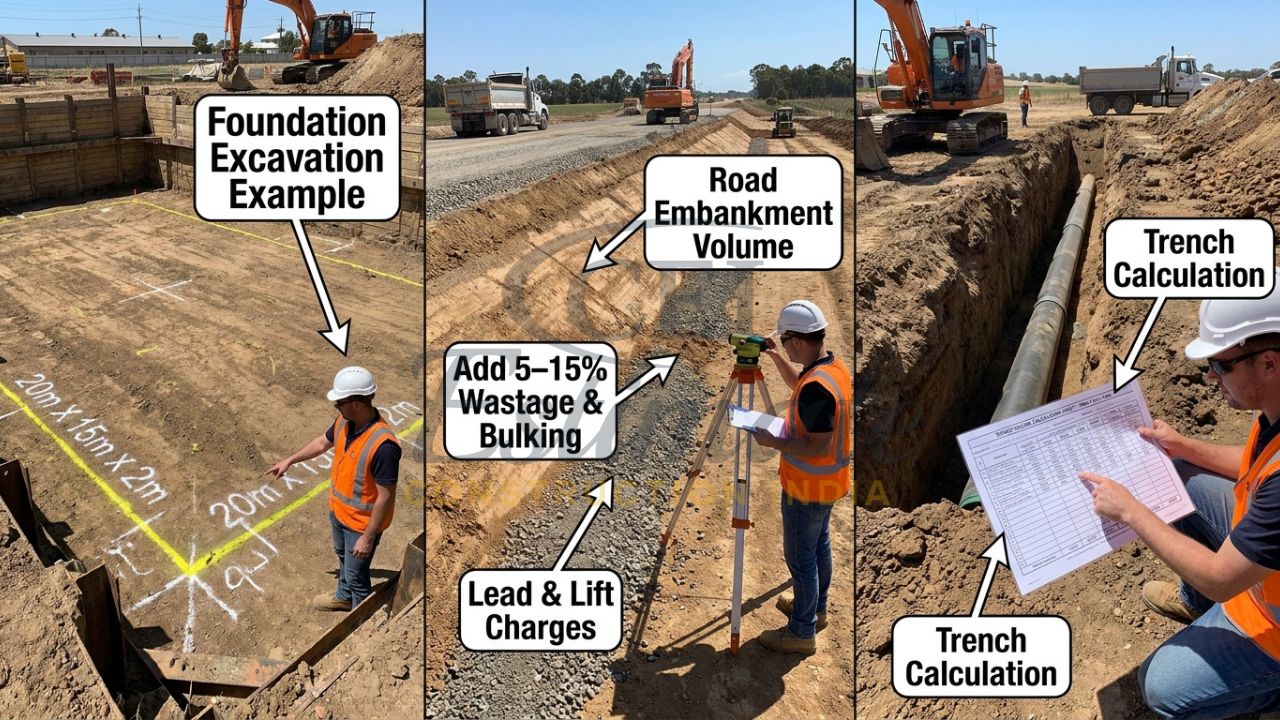
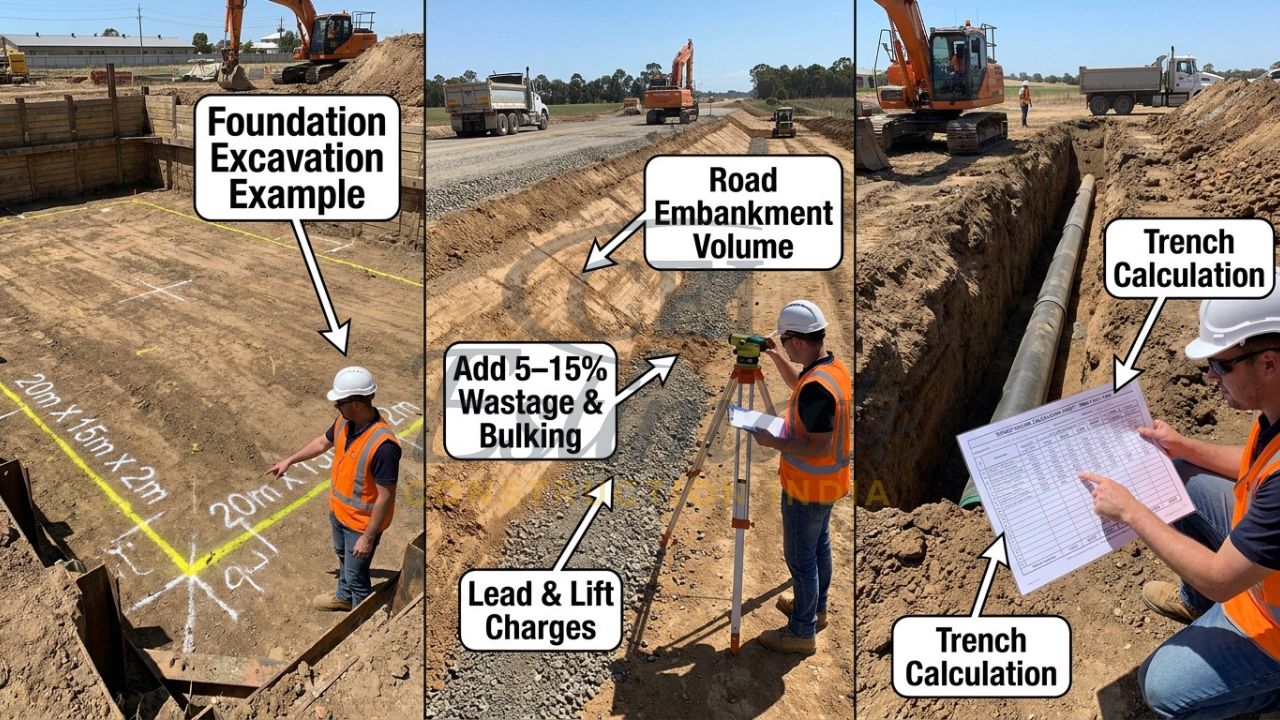
Example 1: Foundation Excavation
Plot size: 30m × 20m, Depth: 1.5m (with 0.3m working space)
Volume = 31.2m × 21.2m × 1.5m = 992.16 cum
Example 2: Road Embankment
Length 500m, Top width 10m, Bottom width 16m, Height 3m
Using Trapezoidal: Volume = 19,500 cum
Example 3: Trench for Pipeline
Length 200m, Width 0.6m, Depth 1.2m
Volume = 200 × 0.6 × 1.2 = 144 cum
Tools and Software for Earthwork Estimation in 2026
- AutoCAD Civil 3D
- Microsoft Excel (with templates)
- Global Mapper / QGIS
- Primavera & MS Project (for planning)
- Mobile apps with GPS and AR measurement
For accurate BOQ preparation, always cross-check with detailed estimate vs abstract estimate in construction.
How to Prepare Earthwork BOQ and Cost Estimation?
- Mention item description as per IS 1200
- Include lead, lift, shoring, and dewatering separately
- Add 10–20% for bulking and shrinkage
- Use current labour + machinery rates
Common Mistakes in Earthwork Calculation and How to Avoid Them?
- Ignoring working space and side slopes
- Not considering soil type and bulking factor
- Wrong units (cum vs CFT)
- Missing lead & lift charges
- Not updating levels after monsoon
Conclusion
Mastering earthwork calculation in construction is a fundamental skill that directly impacts project profitability and timely completion. Accurate quantity takeoff, proper method selection, and modern tools help contractors avoid costly overruns and win more projects with confidence.
The best construction management app is the one that fits your workflow, your project scale, and your business goals. In 2026, Indian contractors and builders need tools that improve site tracking, labour attendance, material management, billing accuracy, and documentation while keeping operations simple and efficient.
If you want expert help choosing the right software and connecting it with accurate estimation and BOQ services, contact Construction Estimator India today on WhatsApp +91 8630676890. A better digital workflow can help you reduce delays, improve cost control, and build a more profitable construction business.
FAQs
- What is the standard unit for earthwork calculation?
Cubic meter (cum) is the standard unit in India.
- What is the bulking factor for earth?
Usually 10–25% depending on soil type (sand 10–15%, clay 20–25%).
- How to calculate backfilling quantity?
Backfilling = Excavated volume – Volume occupied by foundation/structure.
- Which method is most accurate for earthwork?
Prismoidal formula is more accurate than trapezoidal for large volumes.
- How much should I add for working space in excavation?
Usually 0.3m to 0.5m on all sides.
- Does earthwork rate include transportation?
No. Lead and lift are paid separately.
- What is the difference between cutting and filling?
Cutting removes soil; filling adds soil to raise ground level.
- How to calculate earthwork for roads?
Use average end area method with cross-sections at regular intervals.
- Can I use Excel for earthwork calculation?
Yes. Many contractors successfully use Excel templates for daily estimation.
- How does accurate earthwork calculation help in tenders?
It prevents under-bidding and improves your success rate in government projects.