Cash flow is the lifeline of any construction business. Delayed or incorrect Running Bill (RA Bill) in construction submissions can create severe financial stress for contractors. In 2026, with faster digital approval systems and stricter GST compliance, understanding RA Bill in construction has become more important than ever for timely payments and healthy project cash flow.
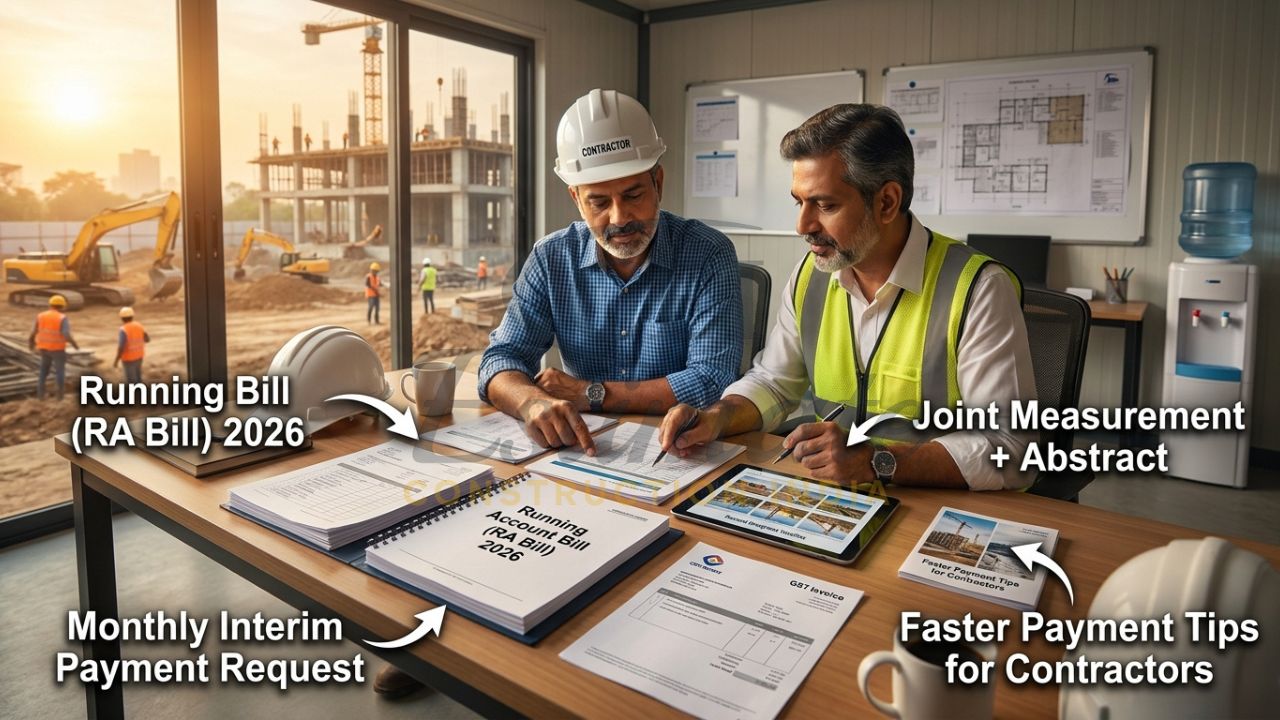
This comprehensive guide explains everything about Running Account Bill — what it is, how to prepare it, required documents, standard format, submission procedure, and expert tips to get your payments faster in the Indian construction industry.
What is a Running Bill (RA Bill) in Construction?
A Running Bill, commonly known as RA Bill, is a periodic invoice submitted by the contractor to the client or department for the work executed during a specific period (usually monthly). It is an interim payment request for the progressive work done on the project.
RA Bill helps contractors recover costs of labour, materials, and machinery on an ongoing basis instead of waiting until project completion.
Importance of RA Bill for Contractors and Clients
- Maintains positive cash flow for contractors
- Helps clients monitor project progress
- Reduces financial burden on contractors
- Creates transparent payment records
- Supports better project control and decision-making
Proper RA Bill management is a key factor during prequalification in construction tender in India.
Running Bill vs Final Bill: Key Differences
| Parameter | Running Bill (RA Bill) | Final Bill |
| Purpose | Interim payment for work done | Final settlement after completion |
| Frequency | Monthly or as per agreement | Once, after project handover |
| Measurements | Progressive | Complete and final |
| Retention Money | 5–10% usually deducted | Retention released (partially or fully) |
| Documents | Less exhaustive | All documents + completion certificate |
| Approval Time | Faster | Takes longer |
Documents Required for RA Bill Submission
- Joint measurement sheet (JMS)
- Abstract of cost (as per BOQ)
- Material consumption statement
- Labour attendance & wage register
- Photographs of progress
- Test certificates (where applicable)
- Previous RA Bill copies with payment proof
- GST invoice
- Bank details & cancelled cheque
Step-by-Step Procedure to Prepare and Submit RA Bill in 2026
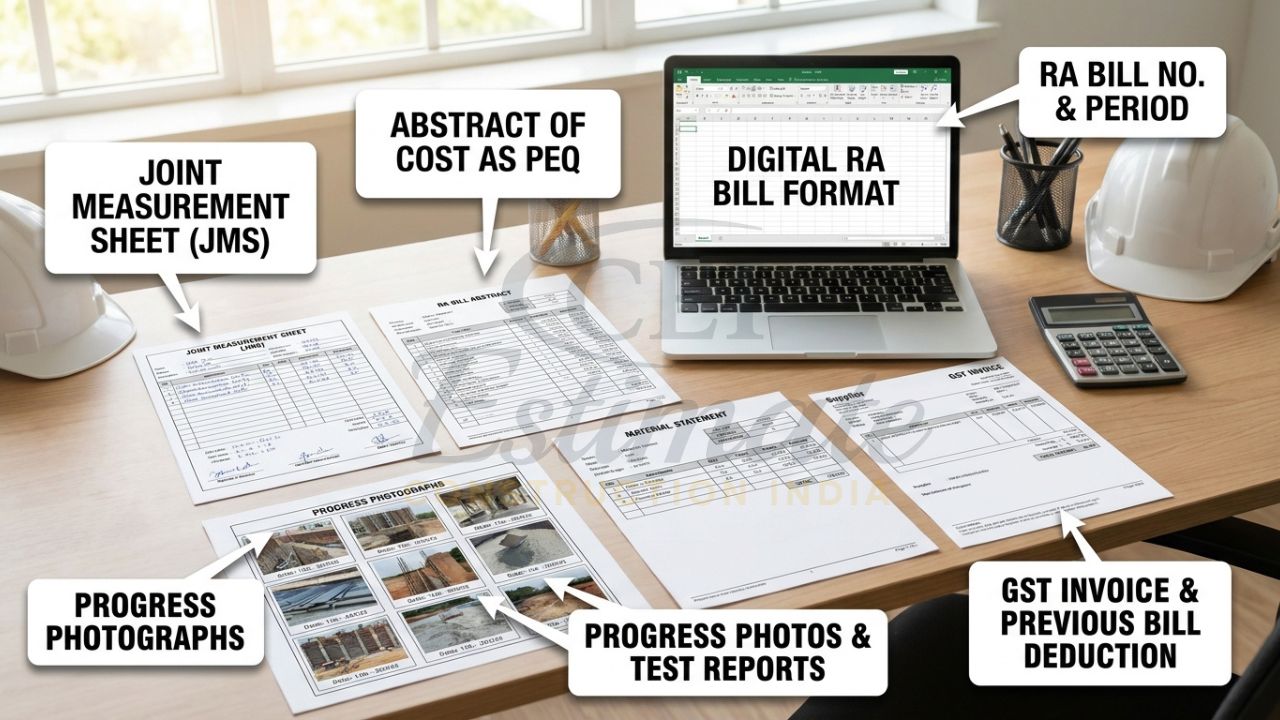
- Record Daily Progress — Maintain site records and measurements.
- Prepare Measurement Book — Get joint measurement with client’s engineer.
- Calculate Quantities — Use approved BOQ rates.
- Create Abstract — Summarize total amount.
- Deduct Retention & Previous Payments.
- Add GST (if applicable).
- Generate Invoice — In prescribed format.
- Submit — Online through portals (GEM, state e-tender) or physically.
- Follow Up — Track approval and payment status.
Standard RA Bill Format & Sample
RA Bill No: 03
Project Name: ABC Residency
Period: March 2026
| S.No | Item Description | Unit | Qty up to date | Rate (₹) | Amount (₹) |
| 1 | Earthwork in excavation | Cum | 850 | 180 | 1,53,000 |
| 2 | PCC 1:4:8 | Cum | 120 | 4,200 | 5,04,000 |
| 3 | RCC M25 with TMT | Cum | 95 | 7,800 | 7,41,000 |
| Gross Amount | 18,75,000 | ||||
| Less: Previous RA Bills | 12,50,000 | ||||
| Net Payable | 6,25,000 |
Always cross-check quantities using detailed estimate vs abstract estimate in construction.
Measurement and Certification Process
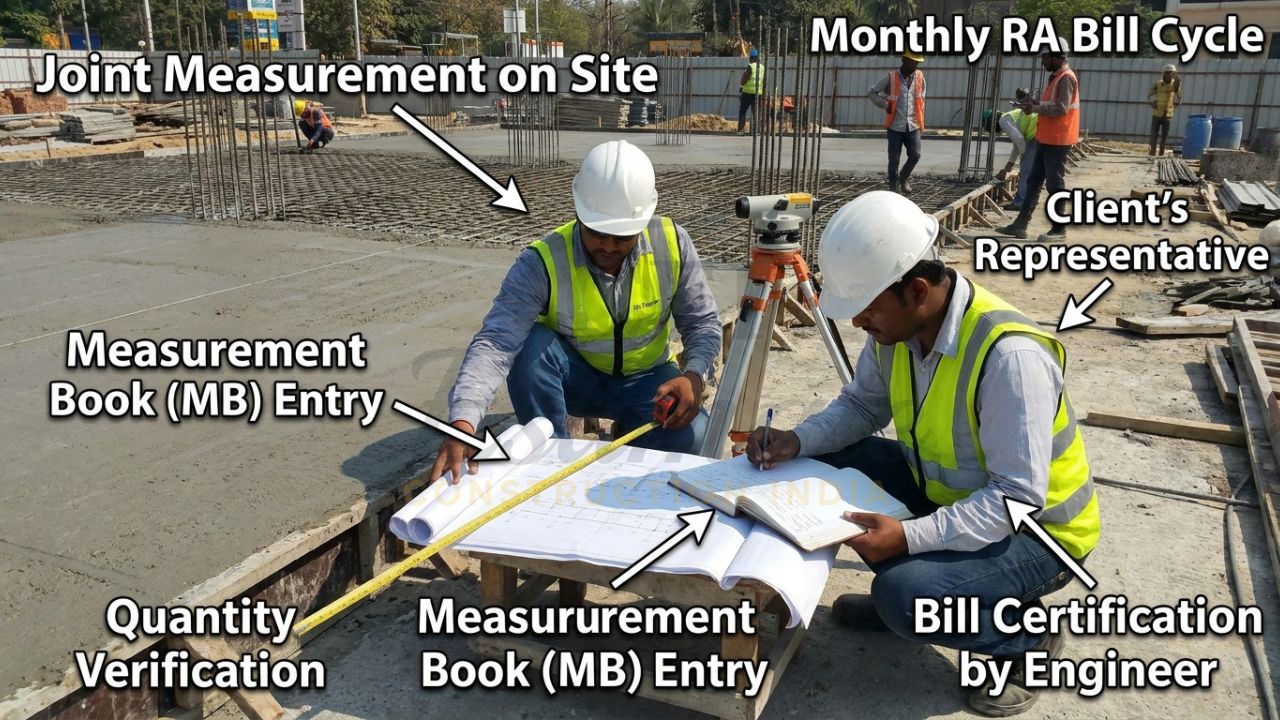
- Contractor submits measurement sheets
- Client’s engineer verifies on site
- Engineer issues Measurement Book (MB) entry
- Bill is certified by competent authority
- Finance department processes payment
In 2026, many government departments use fully digital platforms for RA Bill approval.
Common Mistakes in RA Bill Preparation and How to Avoid Them
- Incorrect or incomplete measurements
- Missing supporting documents and photos
- Calculation errors in abstract
- Not deducting previous payments
- Wrong GST rate or missing invoice
- Late submission
Tips to Get RA Bill Payments Faster
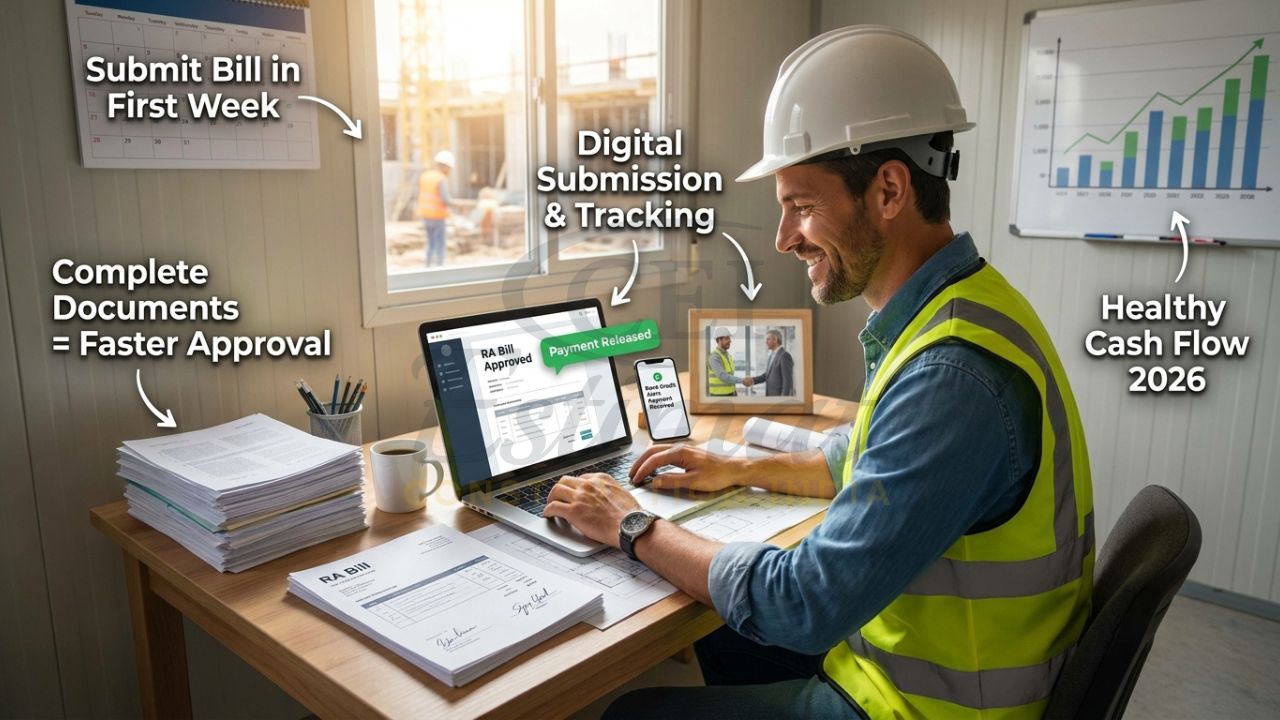
- Submit bills on the 1st week of every month
- Maintain excellent site records and photos
- Build good relationships with client’s engineers
- Use digital tools for faster documentation
- Follow up politely but consistently
- Ensure all statutory compliances (GST, labour license)
For interior and finishing works, use best BOQ templates for interior works in India to speed up billing.
Legal Aspects, GST, and TDS on Running Bills
- GST @18% on works contract (reduced in some cases)
- TDS @1% or 2% as per Income Tax rules
- Retention money usually 5–10%
- Legal remedy available under MSME Act for delayed payments
Understanding the difference between a builder and a contractor helps clarify payment responsibilities.
Conclusion
Mastering the Running Bill (RA Bill) in construction process is essential for maintaining healthy cash flow and running a successful construction business in 2026. Timely and accurate RA bill submission ensures steady payments, better project control, and stronger relationships with clients.
The best construction management app is the one that fits your workflow, your project scale, and your business goals. In 2026, Indian contractors and builders need tools that improve site tracking, labour attendance, material management, billing accuracy, and documentation while keeping operations simple and efficient.
If you want expert help choosing the right software and connecting it with accurate estimation and BOQ services, contact Construction Estimator India today on WhatsApp +91 8630676890. A better digital workflow can help you reduce delays, improve cost control, and build a more profitable construction business.
FAQs
- What is the full form of RA Bill?
Running Account Bill.
- How often should RA Bill be submitted?
Usually monthly or as mentioned in the contract.
- What is the difference between RA Bill and Final Bill?
RA Bill is interim; Final Bill is after complete work and defect liability period.
- Is GST applicable on RA Bill?
Yes, generally 18% on works contracts.
- How much retention is deducted in RA Bill?
Usually 5% to 10% depending on contract terms.
- Can RA Bill be submitted online?
Yes, most government and large private projects use online portals in 2026.
- What if client delays RA Bill payment?
Contractor can charge interest as per contract or MSME Act.
- Is joint measurement mandatory?
Yes, for government and most private projects.
- What documents are most important for RA Bill?
Joint measurement sheet and GST-compliant invoice.
- How to speed up RA Bill approval?
Submit complete documents with proper photos and follow up regularly.