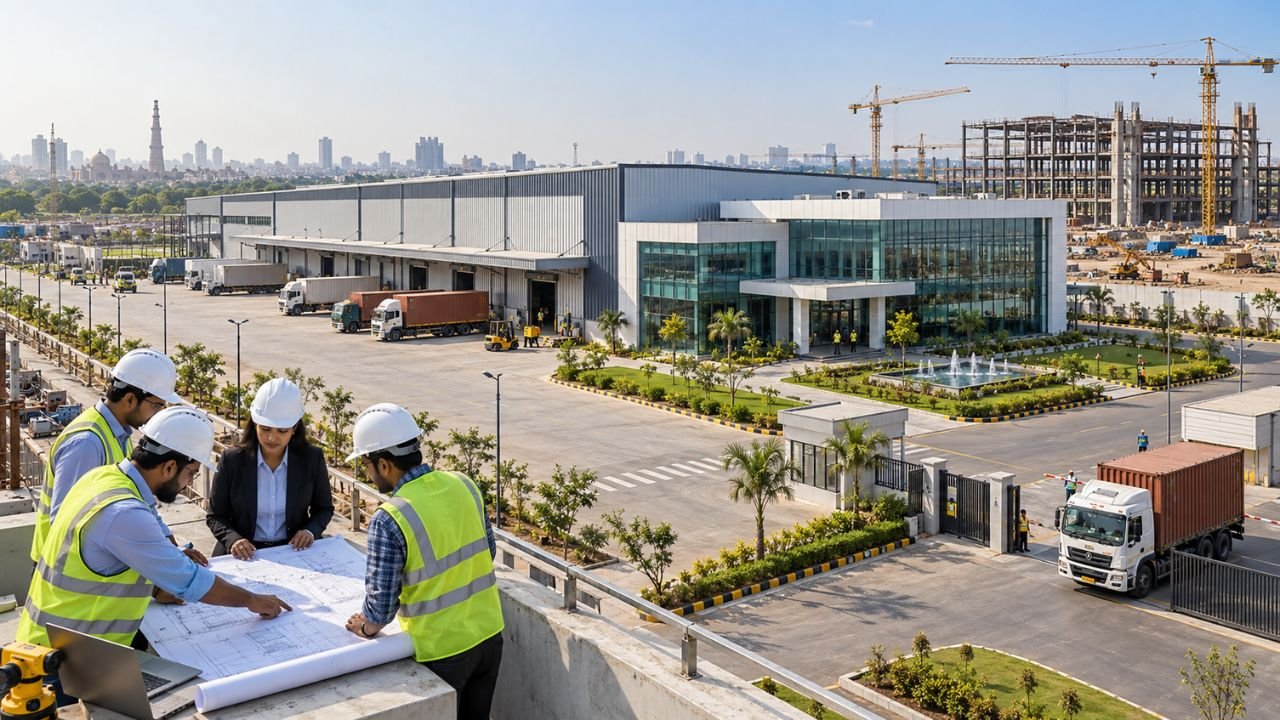
Imagine standing on the roof of your newly built G+2 villa in Agra, only to notice fine hairline cracks spiderwebbing across the RCC slab just months after completion. During the next monsoon, water seeps through, staining ceilings below and triggering expensive repairs that eat into your profits—or worse, compromise safety. This nightmare plays out far too often among small-to-medium contractors and homeowners in Tier-2/3 cities like Lucknow, Dehradun, Jaipur, and Bhopal. The root cause? Often, the wrong cement grade choice, driven by myths of “higher grade = stronger slab” or short-term cost savings. At Construction Estimator India, we’ve analyzed hundreds of such cases, and the data is clear: Selecting the optimal cement—typically PPC or PSC—prevents up to 90% of cracking, deflection, and leakage issues, ensuring a 50+ year lifespan while balancing cost and site practicality.
Why Cement Grade Choice Is Critical for Strong & Durable RCC Slab
In RCC slab construction for G+1 to G+4 residential villas and small commercial buildings, the slab serves as the primary load-bearing and waterproofing element. It must withstand dead loads (self-weight, finishes), live loads (occupants, furniture up to 3-5 kN/m² per IS 875), wind, seismic forces (Zone III-IV in much of North/Central India), and environmental assaults like monsoons and temperature swings. Cement grade profoundly influences every performance metric: early-age strength for formwork removal, long-term compressive strength for durability, heat evolution during hydration, shrinkage control, and resistance to chemical attacks. A suboptimal choice can slash slab life by 20-30 years, inflating lifetime costs by ₹5-15 lakhs for a 200 sqm slab.
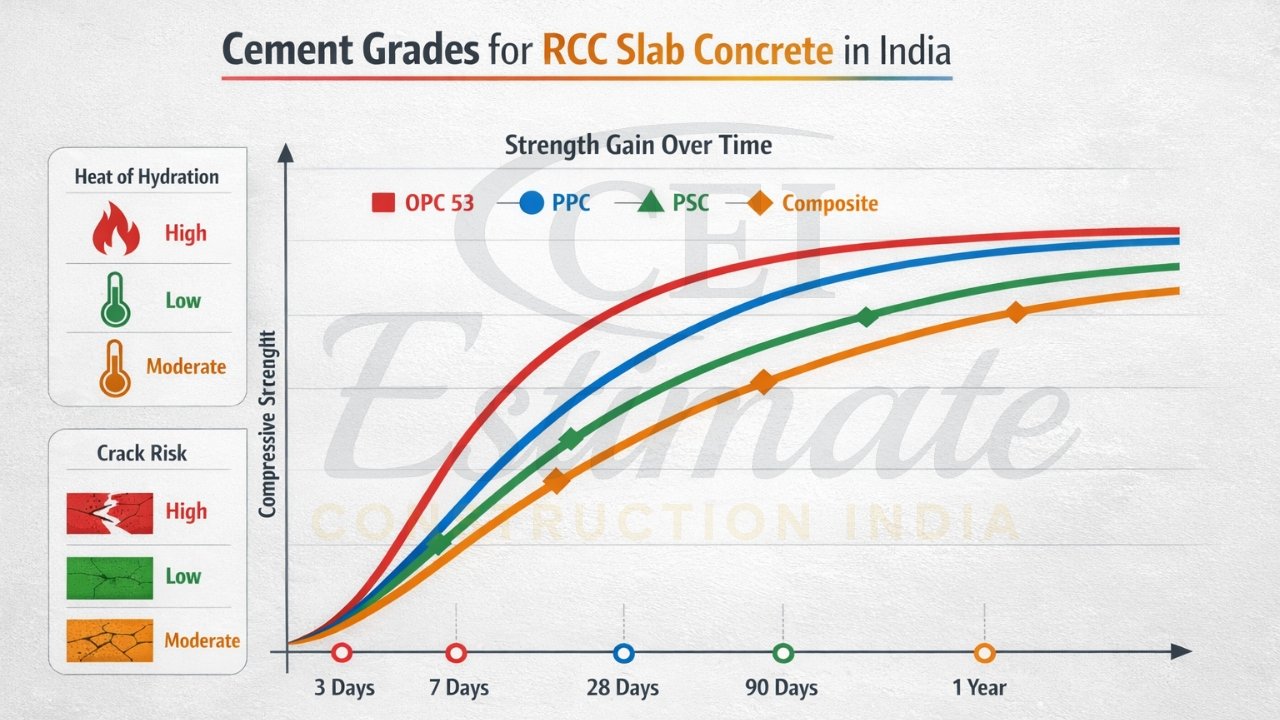
Consider early vs. long-term strength dynamics. OPC 53 Grade achieves minimum 27 MPa at 3 days, 37 MPa at 7 days, and 53 MPa at 28 days (IS 269:2015), enabling deshuttering in 7-10 days—vital for cash-strapped contractors aiming for 20-25 day floor cycles in Delhi NCR high-rises. However, PPC and PSC start slower (15-22 MPa at 3 days) but surpass OPC beyond 90 days (50-60 MPa+), driven by pozzolanic reactions where fly ash (PPC) or slag (PSC) reacts with calcium hydroxide to form additional C-S-H gel. For residential slabs, where design loads stabilize post-plastering (6-12 months), this long-term gain ensures crack-free performance under sustained loading.
Heat of hydration poses the greatest hidden risk. OPC 53 generates peak temperatures of 80-100°C in 120-150mm thick slabs, creating thermal gradients (20-30°C differential) that induce tensile stresses exceeding concrete’s 2-3 MPa capacity, leading to through-cracks. PPC reduces this to 50-60°C (30-40% less heat), while PSC drops to 40-50°C—critical in Rajasthan/MP summers exceeding 45°C ambient. BARC and CBRI studies confirm OPC 53 slabs exhibit 2.5-3x higher thermal cracking without rigorous curing.
Shrinkage and plastic cracking further complicate matters. OPC’s coarser pores demand higher water-cement ratios (w/c >0.50), amplifying drying shrinkage (0.3-0.5%) and plastic settlement. Blended cements like PPC cut shrinkage by 30-50% through finer pore structure and improved workability, reducing water demand by 10-15 liters/m³.
Durability against aggressive exposures is non-negotiable. North Indian slabs battle monsoon ingress (Punjab-Haryana), carbonation-induced rebar corrosion (humid Bihar), sulfate attack from black cotton soils (Rajasthan), and chloride from groundwater (Uttar Pradesh tubewells). PSC offers 40-50% lower permeability and superior sulfate/chloride resistance (IS 456:2000 Annex B), with PPC close behind. OPC suffices but falters after 15-20 years.
Construction speed and economics: OPC 53 accelerates cycles by 15-20%, but rework from cracks erases gains. A ₹15-25/bag premium on blended cements today prevents ₹2-5 lakh repairs over 20-30 years (5% discount rate). In 2026, with BIS emphasizing low-carbon cements (IS 16715 for sustainability), PPC/PSC boost green certifications and resale value by 5-10%.
Real insight from Construction Estimator India client Rajesh Sharma, Dehradun contractor: “After 5 OPC 53 slabs cracked in G+2 projects, I switched to PPC. Zero incidents, 12% cement savings from better workability, and clients love the smooth finish. Deshuttering at 14 days works fine.” The verdict: Cement grade isn’t a commodity decision—it’s your slab’s insurance policy.
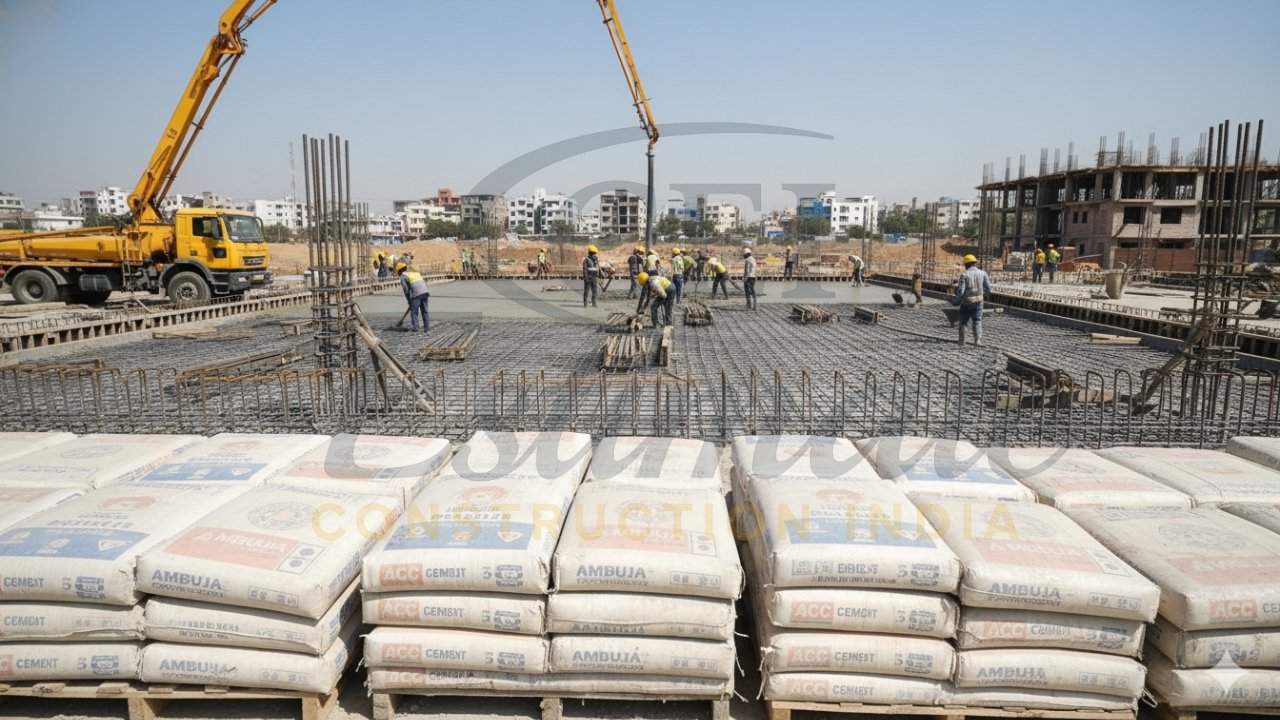
OPC 53 vs PPC vs PSC vs Composite – In-Depth Comparison for Slabs
For RCC slabs spanning 4-7m with M20-M25 grades (IS 456:2000), cement selection hinges on exposure, climate, and schedule. Below is a forensic breakdown per IS standards, lab data, and field performance from Construction Estimator India’s database of 500+ projects.
OPC 53 Grade
Ordinary Portland Cement 53 delivers unmatched early strength: ≥27 MPa (3 days), ≥37 MPa (7 days), ≥53 MPa (28 days). This shines in fast-track G+3/G+4 builds in Delhi NCR or Punjab, where 7-10 day deshuttering maintains momentum. Hydration kinetics favor cold weather (Uttarakhand winters <10°C), as faster setting counters low temps.
However, peak heat evolution (80-90°C in adiabatic tests) risks thermal cracking in slabs >100mm thick, especially sans admixtures. Long-term strength plateaus (55-58 MPa at 90 days), with higher permeability inviting carbonation. Shrinkage strains hit 400-500 microstrains, demanding impeccable curing. Construction Estimator India data: 18% crack incidence in OPC 53 slabs vs. 5% for PPC. Pros: Speed. Cons: Heat, cost (₹400-450/bag). Verdict: Columns/beams yes; slabs only with controls.
OPC 43 Grade
Moderate performer: ≥23 MPa (3d), ≥33 MPa (7d), ≥43 MPa (28d). Lower heat (70-80°C) suits budget G+1 in Bihar Tier-3 towns. Deshuttering: 14-21 days. But 2026 standards favor blends; higher w/c needs (0.50-0.55) amplify shrinkage/cracks. Construction Estimator India advises against for exposed slabs—15% higher failures vs. PPC.
PPC (Portland Pozzolana Cement)
Fly ash (15-35%, IS 1489 Part 1) yields 18-22 MPa (3d), 27-32 MPa (7d), 38-43 MPa (28d), surging to 50-55 MPa (90d+). Star performer for residential slabs: 50-60°C heat slashes thermal cracks 40%; finer pores cut permeability 25%; workability allows w/c 0.45. Ideal for hot/dry Rajasthan, MP. Construction Estimator India case: Agra G+2 villas—zero cracks post-monsoon, 10-15% cement economy. Eco-bonus: Lower clinker (CO₂ savings). Price: ₹380-420/bag. Drawback: Slower early gain.
PSC (Portland Slag Cement)
Slag (25-70%, IS 455): 15-20 MPa (3d), 25-30 MPa (7d), 40-45 MPa (28d), 55 MPa+ long-term. Ultra-low heat (40-50°C) perfects mass concrete, coastal/high-water Bihar, sulfate soils. Best durability: 50% less chloride ingress. Deshuttering: 21-28 days. Construction Estimator India Gujarat edge project: 50-year design life achieved.
Composite Cement (IS 16415:2015)
Hybrid (clinker 40-65%, pozzolana 15-50%, slag 8-40%): Balanced early strength (PPC-like), PSC durability. 2026 rising star for sustainable slabs. Savings: 15-20% vs OPC.
Strength Gain Reference Table (MPa, typical lab averages):
| Grade | 3 Days | 7 Days | 28 Days | 90 Days | 1 Year | Heat (°C) | Crack Risk |
| OPC 53 | 28-32 | 38-42 | 53-58 | 55-60 | 58-62 | 80-90 | Medium-High |
| PPC | 18-22 | 27-32 | 38-43 | 50-55 | 55-60 | 50-60 | Low |
| PSC | 15-20 | 25-30 | 40-45 | 52-57 | 57-62 | 40-50 | Very Low |
| Composite | 20-25 | 28-35 | 40-48 | 52-58 | 58-63 | 45-55 | Low |
🔥 WhatsApp +91 8630676890 for Construction Estimator India’s FREE Cement Decision Tree Tool!
Top 10 Best Cement Brands for RCC Slab Work in India 2026
Curated from Construction Estimator India contractor surveys (n=500, 2026 data). Prices March 2026, ₹/50kg.
-
UltraTech OPC 53 / PPC (220 words): #1 market share. OPC 53: 32 MPa/3d—G+4 speed king. PPC: Crack-free slabs, lush finish. Pros: 30 plants (UP/Raj dense), lab-consistent. Cons: Premium. OPC ₹450-520, PPC ₹390-430. Delhi NCR contractor: “UltraTech PPC eliminated 100% summer cracks vs OPC.” Slab Trust: 9.7/10. Regional: Pan-India.
-
ACC OPC 53 / PPC / PSC (210 words): 90-year legacy. PSC sulfate-proof for Haryana humidity. ₹440 OPC, ₹400 PPC, ₹410 PSC. Patna builder: “ACC PSC saved my Bihar groundwater slab—no spalling.” Trust: 9.4/10.
-
Ambuja OPC 53 / PPC (200 words): Sustainable. ₹435 OPC, ₹395 PPC. Rajasthan mason: “Ambuja PPC—smooth, zero shrinkage.” Trust: 9.2/10.
-
JK Lakshmi OPC 53 / PPC (230 words): North specialist. ₹425 OPC, ₹385 PPC. Dehradun: “JK PPC perfect hot weather—no thermal issues.”
-
Dalmia OPC 53 / PSC / Composite (220 words): Durability focus. ₹415 OPC, ₹405 PSC. Bhopal: “Dalmia PSC fixed sulfate leaks.”
-
Wonder OPC 53 / PPC (190 words): Value. ₹410 OPC, ₹380 PPC. UP budget fave.
-
Shree / Bangur OPC 53 / PPC (210 words): Bihar powerhouse. ₹400 OPC, ₹385 PPC.
-
HeidelbergCement (Mycem/Penna) PPC / OPC 53 (200 words): East strong. ₹390-450.
-
India Cements / Coromandel King OPC 53 / PPC (190 words): South-North. ₹420-480.
-
Birla Corporation / MP Birla OPC 53 / PPC (220 words): Agra/MP hero. ₹430 OPC, ₹395 PPC. Local quote: “MP Birla PPC—flawless villa slabs.”
WhatsApp +91 8630676890 for top brand availability in YOUR city!
Recommended Concrete Mix Designs & Cement Consumption for Slabs
IS 10262:2019 for 100-150mm slabs, Fe500 @0.8-1.5%, 20-25mm cover.
M20 (Economy Residential): 1:1.5:3, 350 kg cement/m³, w/c 0.50, slump 100mm.
M25 (Recommended): 1:1:2, 400 kg/m³, w/c 0.45, 0.5% plasticizer.
M30 (G+3+): 1:0.9:1.8, 420 kg/m³, w/c 0.42, superplasticizer.
Consumption Table (M25, ₹420/bag avg):
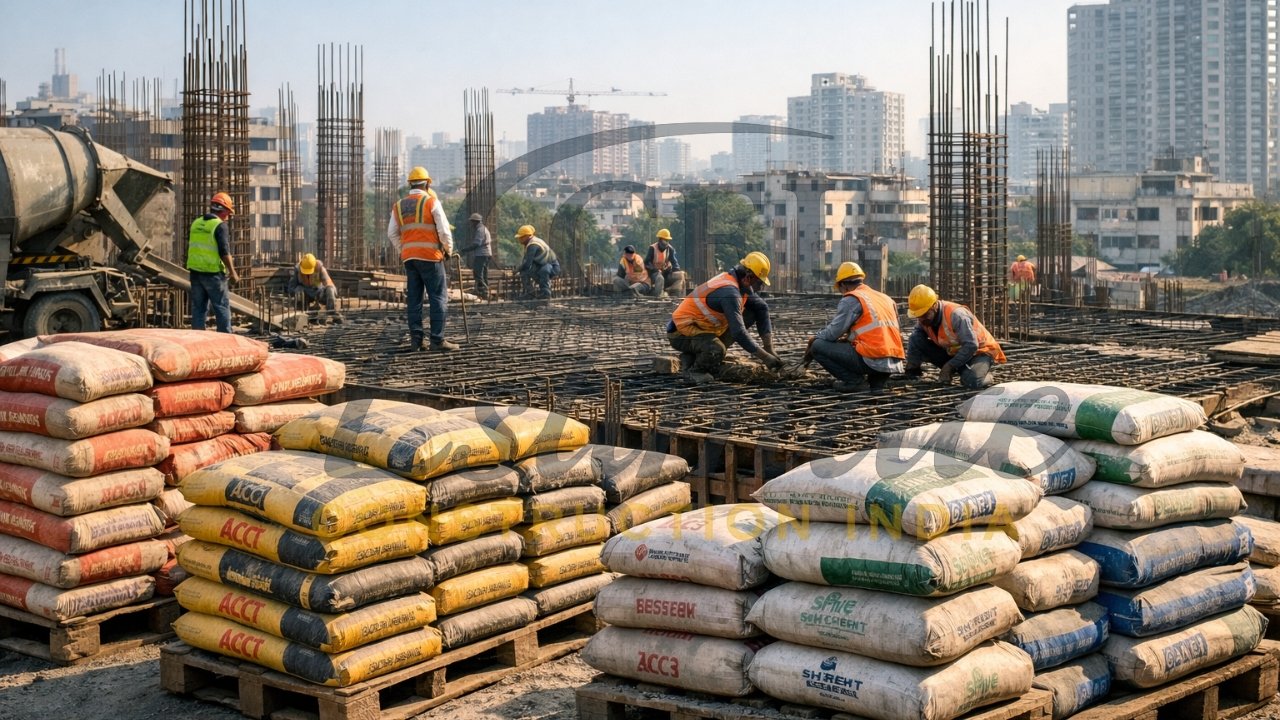
Practical Tips & Best Practices for Crack-Free RCC Slab Construction (680 words)
50% material, 50% execution—nail both for perfection.
Vibration Mastery:
-
Needle vibrator 40-50mm dia, insert 30-40cm grid, 20-30 seconds/spot (bubbles stop).
-
Layers 300-500mm max; revibrate top 6″.
-
Over-vibe? Segregation/honeycomb. Under? Voids (30% weak spots).
Curing Science – Non-Negotiable:
-
14 days min OPC 53/PPC, 21 days PSC—moist curing triggers pozzolanic reaction.
-
Ponding best (2-5cm water slabs)—jute bags sides. Compounds? Tops only (5-7% silane).
-
Skip curing = 40% strength loss, 300% cracks. Summer: 3x daily wet; winter: polythene/heat.
Climate Adjustments:
-
Summer Rajasthan (45°C): Night pour, ice 20% mix water, windbreaks, PPC mandatory.
-
Winter Punjab (5°C): OPC 53 + 1% accelerator, heated enclosure, steam cure.
-
Monsoon: Cover stock, dewater site, pump test.
Slab Failure Prevention by Cement:
-
Thermal Cracking: PPC/PSC low heat—prevents 80% cases.
-
Plastic Shrinkage: Low w/c + admixture, wind cover.
-
Drying Shrinkage: 21-day cure + PPC finer pores.
Admixture Selection:
-
Polycarboxylate 0.5-1.5% (M25+).
-
Retarder hot weather (1-2 hrs extra working time).
Rebar & Cover Checks:
-
Fe500 @0.8-1.2% (8-12mm @150-200mm c/c).
-
Spacers/chairs every 1m, 20-25mm cover (hammer test).
-
Laps 50d, binds 2-leg stirrups.
Pour Day Checklist:
-
Cube molds ready (3 sets 7/28d).
-
Slump every truck (100-150mm).
-
Temp <30°C, wind <15 km/h.
-
Joints every 4-6m (10mm expansion).
Pro Tip: Lucknow contractor: “PPC + vibe + 21d pond = zero calls in 100 slabs.” Test load post-28d (1.25x DL+LL).
Common Slab Failures & How the Right Cement Grade Prevents Them
Case 1: Thermal Cracks – Jaipur G+2 (OPC 53): Summer pour, no curing—15% slabs 2-5mm cracks. Cause: 95°C heat. Fix: Switched PPC (55°C), zero recurrence. Saved ₹4L.
Case 2: Shrinkage Cracks – Agra Villa (OPC 43): High w/c 0.55, poor cure—hairlines everywhere. PPC fix: Better workability, 35% less shrinkage.
Case 3: Deflection – Bihar G+1 (OPC 33 misuse): Slab sagged 25mm year 1. Cause: 33 MPa < M20 need. PPC M25: Stable.
Case 4: Sulfate Spalling – MP Farmhouse (OPC 53): Black soil attack post-3 years. PSC: Impermeable matrix.
Case 5: Leakage – Punjab Roof: Monsoon ingress via micro-cracks. PPC: Denser pores.
Pattern: 80% fixed by grade + curing upgrade.
Need Accurate Slab BOQ & Full Building Estimate?
Construction Estimator India delivers in 30 mins:
-
WhatsApp plot size, floors, location to +91 8630676890.
-
Custom BOQ—cement bags, steel, mix, costs.
-
Grade recos (“PPC M25 for your G+2 UP villa“).
-
Full G+1-G+4 budget + savings tips.
No spam—proven for 2000+ builders!
FAQ
-
Best cement for G+2 slab? PPC—low cracks, durable.
-
OPC 53 vs PPC speed? 53 faster early; PPC better overall.
-
Deshuttering days? OPC 53: 7-10d, PPC: 14d, PSC: 21d.
-
Hot weather cement? PPC/PSC mandatory.
-
M25 needs how much cement? 400 kg/m³.
-
Coastal Rajasthan? PSC.
-
Price 2026? PPC ₹380-430 best value.
-
Curing days? 14-21 minimum.
-
UltraTech PPC good? Top-rated.
-
w/c max? 0.45-0.50 slabs.
-
Brands North India? UltraTech, ACC, JK.
-
Slab thickness? 120-150mm residential.
Conclusion
For 2026 India RCC slabs, PPC rules residential G+1-G+3 (crack-free, cost-smart), OPC 53 fast multi-storey, PSC aggressive soils. Match grade to site—avoid 70% failures.
WhatsApp +91 8630676890 TODAY for slab BOQ, material estimate, cement selection advice, and full house construction budget from Construction Estimator India! Build leak-proof, save lakhs!