
Building a home in India is often a once-in-a-lifetime achievement, representing years of hard work, emotional investment, and financial planning. Properly knowing how to plan home construction in India can mitigate many future issues. However, the joy of moving into a brand-new house can quickly turn into anxiety when the first visible cracks appear on the walls. For many homeowners, these lines—no matter how thin—seem like a catastrophic failure of the building’s integrity. It is important to understand from the outset that minor cracks are normal in new constructions.
In the Indian context, several factors contribute to this phenomenon. Our climate is characterized by extreme temperature shifts, varying humidity levels, and diverse soil types ranging from expansive black cotton soil to rocky terrain. When a new structure is built, it undergoes a period of “settling” where the massive weight of the bricks, concrete, and steel finds its final equilibrium with the ground beneath it. Furthermore, the materials themselves—cement, sand, and water—undergo chemical and physical changes as they dry and cure. This guide aims to demystify these occurrences, helping you distinguish between harmless cosmetic issues and genuine structural threats. By the end of this article, you will be equipped with the knowledge of a structural expert to diagnose, manage, and prevent wall cracks in your Indian home.
Top 10 Reasons for Wall Cracks in New Houses in India
Understanding the “why” behind wall cracks is the first step in effective management. In India, construction practices and environmental factors play a massive role.
Temperature and Moisture Fluctuations
India experiences some of the highest thermal variations in the world. From the scorching 45°C summers in Delhi to the humid monsoons in Mumbai, building materials are constantly expanding and contracting. Concrete and masonry do not move at the same rate. When the sun beats down on an external wall, it expands. At night, it cools and contracts. This repeated movement creates internal stress in the material, eventually leading to “thermal cracks.” Moisture also plays a role; as humidity increases, certain materials swell, and as they dry out, they shrink. This cycle is a primary driver of those annoying hairline cracks that seem to appear out of nowhere during the first change of season.
Natural Building Settlement
Every new building is incredibly heavy. When this weight is first applied to the soil, the ground compresses slightly. This is known as “initial settlement.” In a perfect world, this settlement is uniform across the entire footprint of the house. However, soil is rarely perfectly consistent. Minor “differential settlement”—where one corner of the house sinks just a few millimeters more than another—is common. This slight shift puts tension on the rigid walls, causing them to crack as they adjust to the new position. Provided the movement is within engineering tolerances, these cracks are considered a normal part of the building “finding its feet” and usually stabilize within the first 12 to 18 months.
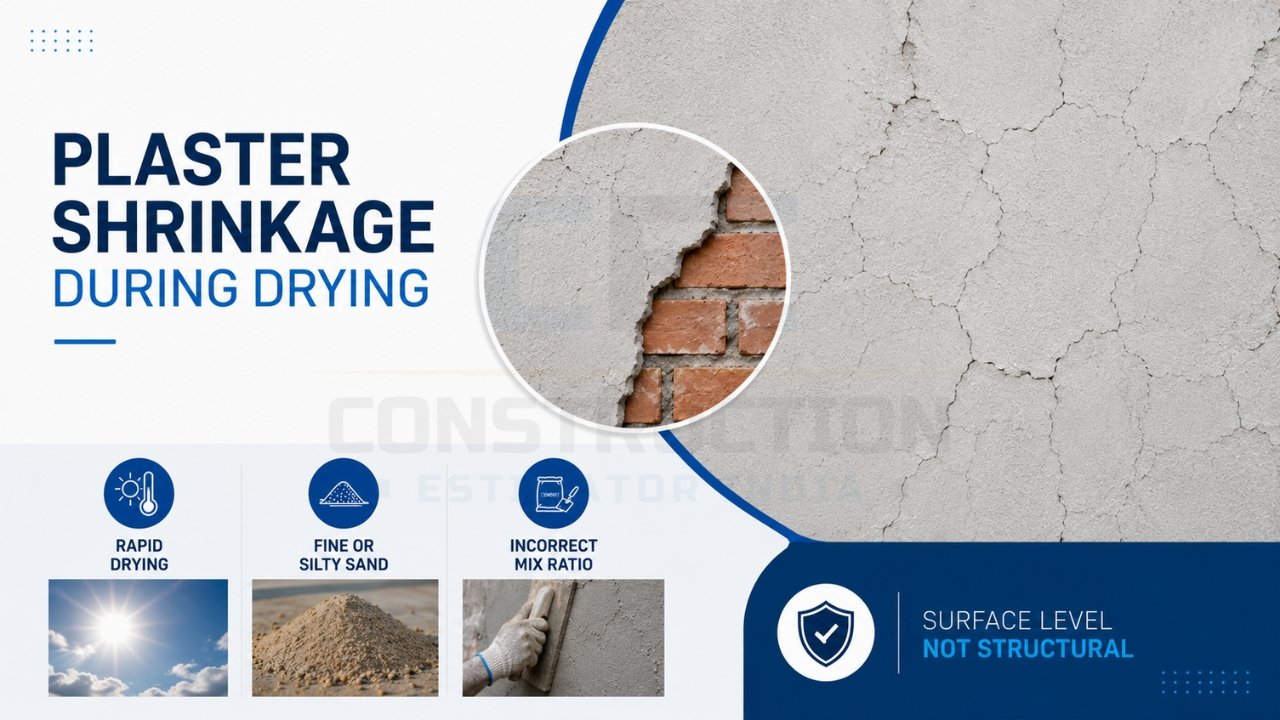
Plaster Shrinkage During Drying
Plaster is a mixture of cement, sand, and water. As the water evaporates during the drying process, the volume of the plaster slightly decreases. If the water evaporates too quickly—which is common in hot Indian climates—the plaster pulls apart from itself before it has gained enough strength to resist the tension. This results in “shrinkage cracks.” These are typically very fine, map-like patterns on the surface. If the sand used was too fine or contained too much silt, or if the cement-to-sand ratio was incorrect, the shrinkage becomes more pronounced. Understanding which grade cement is best for plastering in India is essential to minimize these surface-level issues. This is purely a surface-level issue and does not affect the bricks or the structural frame.
Poor Quality Construction Materials
The longevity of a house depends on the quality of its “ingredients.” In many Indian construction projects, cost-cutting leads to the use of sub-standard materials. For instance, using “unwashed” river sand containing high silt or organic matter can weaken the mortar. Bricks that are under-burnt (Pila bricks) are porous and weak, leading to easy cracking under load. Even the grade of cement matters; using the wrong type of cement for a specific application can lead to incompatibility issues. Furthermore, the use of adulterated steel or low-grade aggregates in the RCC (Reinforced Cement Concrete) frame can cause internal stresses that manifest as deep wall cracks.
Improper Concrete Curing
This is perhaps the most common reason for cracks in India. Proper concrete curing minimum 28 days is a non-negotiable requirement for structural strength. Curing involves keeping the concrete or plaster wet so that the chemical reaction (hydration) can complete fully. In the rush to finish projects, many contractors stop curing after 3 or 4 days. Understanding what is RCC construction helps homeowners realize why premature drying is catastrophic. When concrete dries out prematurely, it loses up to 50% of its potential strength and develops “crazing” or deep cracks because the hydration process was interrupted. Without adequate water, the cement cannot bind the aggregates properly, leading to a brittle structure prone to cracking under even minor loads.
Moisture Seepage and Dampness
India’s heavy monsoons are a test for any new building. If the waterproofing at the roof level or the Damp Proof Course (DPC) at the plinth level is faulty, water will seep into the masonry. Learning how to use white cement for waterproofing in India can provide a strong defense against these dampness-induced cracks. Bricks are like sponges; they soak up water, which causes them to expand. When the water evaporates, they shrink. This constant expansion and contraction cycle weakens the bond between the brick and the mortar, leading to cracks. Furthermore, seepage can cause the reinforcement steel inside the concrete to rust. Rusted steel expands to nearly 4 times its original volume, exerting immense outward pressure that “spalls” the concrete and creates large, dangerous cracks.
Foundation Settlement Issues
While minor settlement is normal, major foundation issues are serious. This occurs when the soil bearing capacity was not properly tested or when the foundation design was inadequate for the soil type (e.g., using shallow foundations on black cotton soil). Exploring the different foundation types for house construction in India is crucial to prevent these major structural shifts. In India, many independent houses are built without a formal soil report. If the soil beneath one part of the house softens due to a leaking underground pipe or poor drainage, that section of the foundation may sink significantly. This results in large, diagonal cracks that often start from the bottom of the house and move upwards.
Lintel Placement Problems
Lintels are the horizontal beams placed across door and window openings to support the weight of the wall above. If a lintel is too short (lacks sufficient “bearing” on the side walls) or if it isn’t strong enough, the weight of the masonry above will cause it to deflect. This downward pressure creates diagonal cracks starting from the top corners of the door or window frames. In many Indian “low-cost” constructions, contractors use thin pre-cast lintels that are not integrated with the rest of the structure, making them a frequent site for crack formation within the first year.
Slab and Wall Junction Movement
In a typical Indian RCC frame structure, the slabs and beams are the primary load-bearers, while the brick walls are just “infills.” Because concrete (the slab) and brickwork (the wall) are made of different materials, they expand and contract at different rates. Understanding the difference between RCC and brick construction in India sheds light on why these two materials move independently. The junction where the top of a brick wall meets the bottom of a concrete beam is a frequent spot for horizontal cracks. These are often caused by the slight deflection of the slab under its own weight or the weight of the furniture and people above. Without a proper “v-groove” or chicken mesh reinforcement at these joints, a crack is almost inevitable.
Vibrations from Nearby Construction
In rapidly developing Indian cities, it is common to have heavy construction, piling, or road work happening right next to a new home. The vibrations from heavy machinery, “earth compactors,” or pile-driving can travel through the soil and into your home’s foundation. While a well-built house can withstand minor vibrations, the constant shaking can accelerate the settling process or cause rigid plaster to snap. These cracks are usually non-structural but can be numerous and distressing for a homeowner who has just finished painting their walls.
Types of Wall Cracks in New Indian Houses
Not all cracks are created equal. Identifying the pattern and width of a crack is the best way to understand its origin.
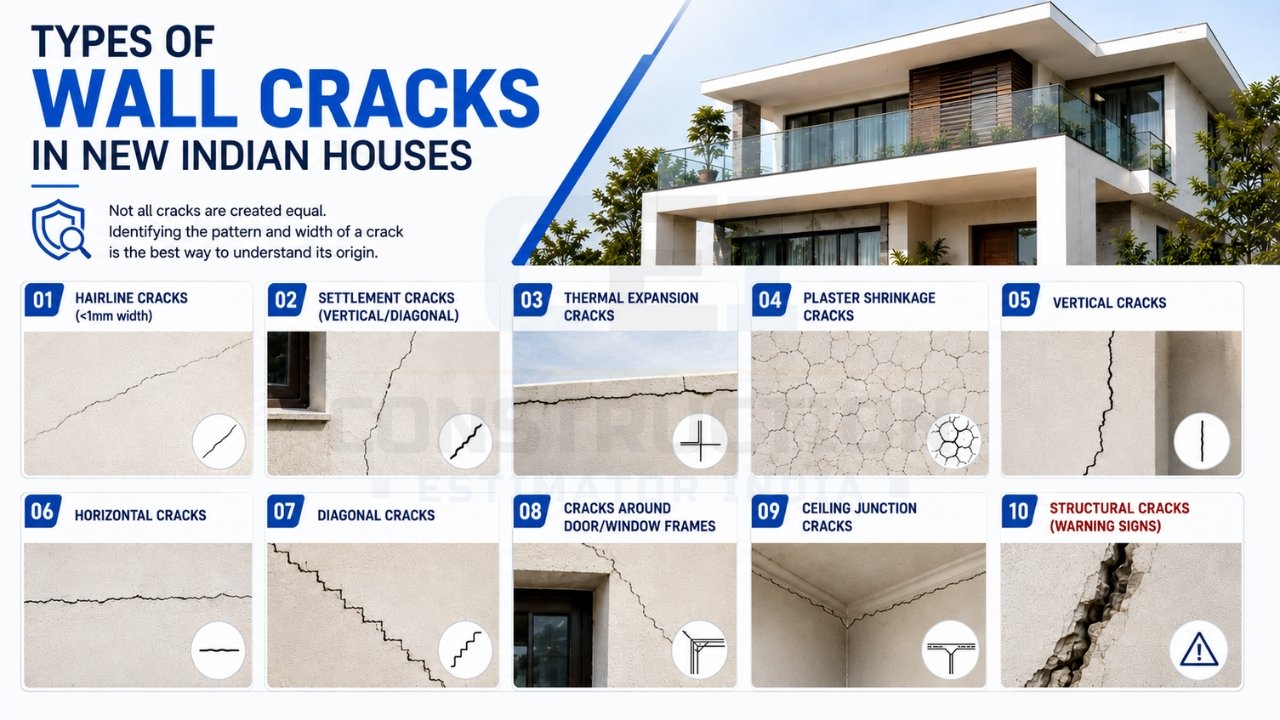
Hairline Cracks (<1mm width)
These are the most common type of cracks found in new Indian homes. Hairline cracks (<1mm) are harmless and are almost exclusively cosmetic. They usually look like a single, thin strand of hair running across the plaster. They are caused by the initial drying of the plaster or very minor thermal movements. In most cases, these cracks only exist in the paint or the top layer of the putty/plaster. They do not indicate any structural failure and can be easily covered during the first repainting cycle.
Settlement Cracks (Vertical/Diagonal)
As discussed, these occur when the house settles into the soil. They are typically vertical or slightly diagonal and often appear near the corners of the building or where a new wing has been added to an old structure. If they are thin (under 2mm) and stop growing after the first year, they are considered “stabilized settlement cracks” and are not a cause for alarm. However, if they continue to widen, it suggests an ongoing foundation issue.
Thermal Expansion Cracks
These cracks are dynamic—they might open up slightly during the hot afternoon and close during the cool night. They are usually found on top-floor walls that are directly exposed to the sun or at the junction of different materials. In India, these are very common in “Parapet walls” on the roof. They often appear as straight horizontal or vertical lines where the masonry meets a concrete column or beam.
Plaster Shrinkage Cracks
These are easily identified by their “map-like” or “spider web” appearance. They are rarely straight and usually cover a large area of a single wall. They happen when the plaster dries too fast. While they look ugly, they are entirely superficial. You can test this by tapping the area; if it sounds “hollow,” the plaster has detached from the wall (de-bonding). If it sounds solid, it’s just a surface shrinkage crack.
Vertical Cracks
Vertical cracks often appear where two different walls meet or where a brick wall meets a concrete column. If a vertical crack is uniform in width from top to bottom, it’s usually a sign of thermal movement or a lack of proper bonding between two different construction phases. If the crack is wider at the top than the bottom, it might indicate that the ends of the wall are settling more than the center.
Horizontal Cracks
Horizontal cracks are generally more concerning than vertical ones. If they appear in the middle of a wall, they might be caused by “lateral pressure”—such as soil pushing against a basement wall or heavy wind loads. However, in new Indian homes, they are most common at the slab-wall junction. A horizontal crack at the very top of a wall, just below the ceiling, is usually due to the slab’s “thermal curling” or deflection.
Diagonal Cracks
Diagonal cracks are the “signature” of differential settlement. They often look like steps in a brick wall, following the mortar joints (hence called “stepped cracks”). If you see a diagonal crack that is wider at one end than the other, it indicates that one side of the structure is moving relative to the other. Small diagonal cracks over doors are usually lintel-related, but large ones running across the middle of a wall require professional inspection.
Cracks Around Door/Window Frames
These are almost universal in new constructions. They usually radiate from the corners of the frames at a 45-degree angle. They occur because the wall is “weakened” by the opening of the door or window, and stresses concentrate at these corners. Furthermore, if the wooden frames were not properly seasoned, they may shrink or swell, putting pressure on the surrounding plaster and causing it to crack.
Ceiling Junction Cracks
These occur at the line where the wall meets the ceiling. In most Indian homes, the ceiling is a concrete slab and the wall is brick. Because these materials have different “elastic moduli” (they bend and stretch differently), they often pull apart at the joint. These are almost always non-structural and are a result of the slab’s natural deflection under load.
Structural Cracks (Warning Signs)
Structural cracks are those that affect the stability of the building. These are not limited to the plaster but go deep into the bricks and concrete. Cracks wider than 5mm indicate serious problems. Other signs include cracks that can be seen on both the inside and outside of the same wall, cracks in RCC columns or beams, and cracks that are accompanied by the jamming of doors or the sloping of floors.
Structural vs Non-Structural Cracks: How to Identify
The most important question for any homeowner is: “Will my house fall down?” Distinguishing between structural and non-structural cracks is key to peace of mind.
| Feature | Non-Structural Cracks | Structural Cracks |
|---|---|---|
| Width | Generally < 2mm (Hairline) | Often > 5mm |
| Pattern | Map-like, spider webs, or thin straight lines | Diagonal “stair-step”, large horizontal, or vertical |
| Location | Mostly in plaster, surface level | Deep into bricks, columns, beams, or foundation |
| Growth | Appear early, then stabilize/stop | Often continue to widen over months/years |
| Cause | Shrinkage, thermal, minor settlement | Foundation failure, overloading, poor design |
Non-structural cracks are like wrinkles on skin—they are signs of aging and environment but don’t affect the “skeleton.” Structural cracks, however, are like broken bones. If a crack is wider than 5mm, or if you can stick a coin into it, it is no longer just “cosmetic.” Another indicator is location; cracks in the middle of a long wall or at the ceiling-wall junction are usually non-structural. Cracks in the RCC columns or beams (the “bones” of the house) are always structural and require immediate attention.
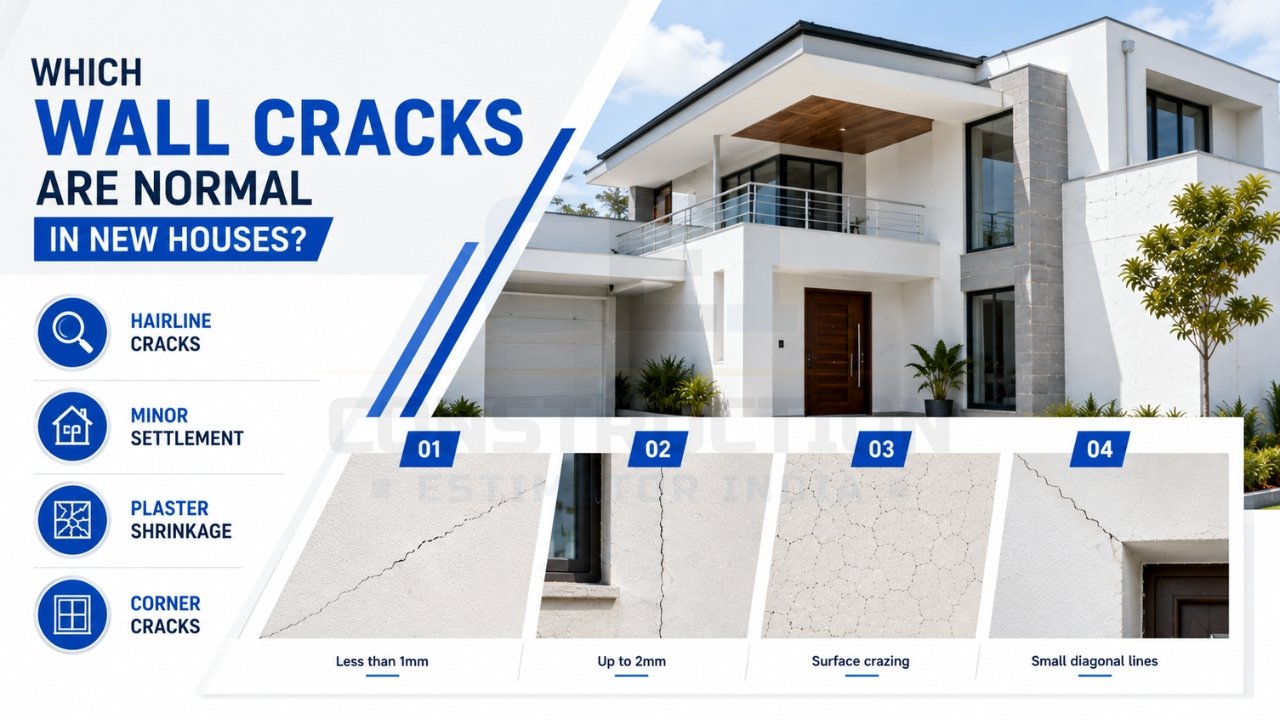
Which Wall Cracks Are Normal in New Houses?
It is vital to reiterate that some cracking is inevitable. No matter how much you spend on a house, physics cannot be ignored. The following are considered normal:
- Hairline cracks: Any crack less than 1mm wide is generally considered part of the building’s natural seasoning.
- Minor settlement: Vertical cracks that appear in the first year and do not exceed 2mm are usually just the house settling into its “nest.”
- Plaster shrinkage: Crazing or map-cracking on the surface is a result of the cement’s chemical nature and is expected in hot climates.
- Corner cracks: Small diagonal lines at the corners of doors and windows are common as the structure adjusts to the “voids” in the wall.
If your house is less than two years old, these cracks are likely just part of the “curing” process. You should monitor them, but they do not mean the construction was poor.
Which Wall Cracks Indicate Serious Problems?
While you shouldn’t panic, you shouldn’t be complacent either. Warning signs of serious trouble include:
- Width: Anything over 5mm is a red flag.
- Continuous Growth: If you mark a crack with a pencil and notice it has grown longer or wider after a month, the movement is active.
- Horizontal Cracks in Load-Bearing Walls: This can indicate that the wall is failing under the weight or is being pushed from the side.
- Diagonal Cracks at Foundation Level: Large cracks near the ground that move upward diagonally suggest the soil is shifting.
- Cracks Through the Entire Wall: If you can see light through the crack from the other side, the integrity of the masonry is compromised.
- Associated Signs: If your doors start sticking, windows won’t open, or you notice the floor feels “unlevel,” these are signs that the entire frame of the house is distorting.
Wall Crack Repair Solutions for Indian Homes
Once you have identified that a crack is stable and non-structural, you can proceed with repairs. Do not repair settlement cracks until the building is at least 18-24 months old, or the crack will simply reappear.
Hairline Crack Repair
For very fine cracks, the repair is simple.
- Scrape away the loose paint and putty using a putty blade.
- Apply a thin layer of “crack filler” or high-quality wall putty.
- Once dry, sand it smooth and apply a coat of primer and paint.
- For better results, use a flexible “acrylic crack filler” that can accommodate minor future movements.
Plaster Crack Repair
If the cracks are slightly wider (1mm to 3mm) and restricted to the plaster:
- Widen the crack into a ‘V’ shape using a chisel to allow the filler to go deep.
- Clean out all dust and debris.
- Apply a “Non-shrinkage crack filler” or a mixture of white cement and water-resistant polymer.
- For larger areas, use a “Fiberglass mesh” (Jali) over the crack before applying the final layer of putty to provide extra tensile strength.
Settlement and Thermal Crack Repair
These require more flexibility:
- Open the crack and clean it.
- Use a “Polyurethane (PU) sealant” or an “Epoxy-based filler.” These materials remain slightly flexible even after drying, allowing the wall to “breathe” during thermal shifts without cracking the repair.
- If the crack is at a junction, consider installing a “V-groove” which makes the inevitable crack look like a design element.
Structural Crack Repair (Professional)
Never attempt to fix structural cracks yourself. A structural engineer may recommend:
- Pressure Grouting: Injecting high-strength epoxy or cement slurry into the crack under pressure.
- Stitching: Inserting “U” shaped steel staples across the crack to hold the two sides together.
- Underpinning: Strengthening the foundation by pouring more concrete beneath it.
Prevention: How to Avoid Wall Cracks in New Construction
Prevention is always cheaper and easier than repair. If you are still in the construction phase, follow these expert tips:
- Quality Materials: Use Grade 43 or 53 OPC/PPC cement from reputable brands like UltraTech. Ensure sand is “silt-free” (less than 5% silt).
- Curing is King: Ensure proper concrete curing minimum 28 days. For brickwork and plaster, a minimum of 7-10 days of continuous wetting is essential.
- Chicken Mesh (Wire Mesh): Always place 6-inch wide chicken mesh at the junctions where RCC (columns/beams) meets brickwork before plastering. This prevents “separation cracks.”
- Sand Seasoning: Use “well-graded” sand. Very fine sand is the leading cause of plaster shrinkage in India.
- Expansion Joints: If your house is very long (over 30 meters), ensure there are professional expansion joints to allow for thermal movement.
- Soil Testing: Spend the ₹15,000–₹25,000 required for a professional soil test before designing the foundation.
When to Consult a Structural Engineer
You should seek professional help and ensure safety regulations aligned with the Bureau of Indian Standards (BIS) codes if:
- You see cracks in RCC columns, beams, or the foundation.
- Any crack is wider than 5mm.
- Cracks appear suddenly after a heavy rain or a minor tremor.
- Multiple diagonal cracks appear on the same wall.
- The house “creaks” or “pops” loudly at night (more than typical thermal clicking).
- Doors and windows are significantly jammed.
Cost of Wall Crack Repair in India
The cost depends heavily on the severity and the city you live in. Analyzing these aspects alongside the overall plaster cost per square foot with material in India helps in better budget planning.

| Type of Crack | Typical Repair Method | Estimated Cost (INR) |
|---|---|---|
| Hairline | Putty & Paint | ₹500 – ₹2,000 per room |
| Plaster/Shrinkage | V-groove, Mesh & Filler | ₹2,000 – ₹7,000 per wall |
| Settlement (Minor) | Epoxy injection/PU Sealant | ₹5,000 – ₹15,000 |
| Structural | Grouting/Stitching/Underpinning | ₹25,000 – ₹1,00,000+ |
Note: These costs are estimates for labor and materials. Professional consulting fees for an engineer may range from ₹5,000 to ₹15,000 per visit.
Frequently Asked Questions (FAQs)
Q1: Is it normal to have wall cracks in a new house?
Yes, it is completely normal. Most new houses in India undergo a “settling” period where the weight of the structure compresses the soil. Additionally, cement-based materials shrink as they dry. Minor cracks are normal in new constructions and are usually just cosmetic.
Q2: When do wall cracks appear in new houses?
They usually start appearing within the first 6 to 12 months. This is when the building experiences its first full cycle of seasons (Summer, Monsoon, Winter), causing maximum thermal expansion and contraction.
Q3: Are hairline cracks in a new house dangerous?
No. Hairline cracks (<1mm) are harmless. They do not affect the structural safety of your home and are typically limited to the top layer of paint or plaster.
Q4: How long does it take for settlement cracks to stop?
In most cases, settlement stabilizes within 18 to 24 months. It is generally advised to wait at least two years before doing a “final” high-end paint job so that all minor movements have finished.
Q5: Can temperature cause wall cracks in India?
Absolutely. India’s extreme heat causes significant expansion in concrete and bricks. Since different materials expand at different rates, they pull apart at junctions, creating “thermal cracks.”
Q6: Should I repaint after fixing wall cracks?
Yes, because most crack fillers have a different texture and color than your original paint. For the best finish, you will need to apply a primer and at least two coats of paint over the repaired area.
Q7: What is the best filler for wall cracks in India?
For hairline cracks, a standard acrylic wall putty works well. For wider, moving cracks, a “Polyurethane (PU) Sealant” is better because it remains flexible. Brands like Dr. Fixit, Asian Paints (SmartCare), and Fosroc offer specialized crack-filling products.
Q8: How to prevent wall cracks in new construction?
The most important factors are using quality materials, installing chicken mesh at junctions, and ensuring proper concrete curing minimum 28 days.
Q9: When should I worry about wall cracks?
You should worry if the cracks are wider than 5mm, if they are diagonal and growing, or if you notice structural members like columns or beams are cracking.
Q10: How much does wall crack repair cost in India?
Minor cosmetic repairs cost between ₹500 and ₹5,000. Serious structural repairs involving epoxy injection or stitching can cost anywhere from ₹20,000 to over ₹1 lakh depending on the extent of the damage.
Q11: Can wall cracks be completely prevented?
It is nearly impossible to prevent 100% of hairline cracks because of the nature of cement and temperature. However, structural cracks can and should be prevented through good engineering and construction practices.
Q12: Do wall cracks affect property value?
Minor hairline cracks do not affect value as buyers expect them in Indian homes. However, large, visible structural cracks can significantly reduce property value and make it difficult to get a home loan or insurance.
Conclusion: Don’t Panic About Minor Wall Cracks in Your New House
Discovering cracks in your dream home can be heartbreaking, but it is rarely a reason for catastrophe. As we have explored, the combination of India’s harsh climate, the chemical properties of cement, and the natural physics of soil settlement makes minor cracking an almost universal part of the construction process. Remember that minor cracks are normal in new constructions and in the vast majority of cases, they are purely a cosmetic nuisance rather than a structural threat.
Your primary role as a homeowner is to monitor. Keep an eye on the width and length of the cracks. If they stay thin (hairline to 2mm) and stabilize after the first year, simply fill them, repaint, and enjoy your home. However, if you see the warning signs—widths exceeding 5mm, rapid growth, or cracks in columns—do not hesitate to call a structural engineer. By understanding the science behind the walls, you can protect your investment and maintain your peace of mind for decades to come.